






 We do what's right for you...


What Is the Epicondyle? Basic Definition and Structure
Dr. Rajeev K Sharma
“It is just a bony bump.” That advice leads people to ignore why the epicondyle matters. I use a stricter view. The epicondyle is a deliberate design feature that concentrates force, houses vital attachments, and shapes movement. Understand it properly and clinical puzzles around the elbow and knee start to resolve. Small structure. Large consequences.
Types and Locations of Epicondyles in the Human Body
1. Medial Epicondyle of the Humerus
I start at the inner elbow. The medial epicondyle of the humerus sits on the distal medial aspect, projecting from the bone like a compact buttress. It is easily palpable in most adults. A shallow groove behind it carries the ulnar nerve, which is why a strike there produces the familiar tingling along the ring and little fingers. That minor detail shapes examination technique and brace design.
This epicondyle serves as the common origin for the forearm flexor-pronator group. Key contributors include flexor carpi radialis, flexor carpi ulnaris, palmaris longus, flexor digitorum superficialis, and pronator teres. The ulnar collateral ligament also anchors nearby, helping the elbow resist valgus stress. In practice, repeated wrist flexion or forearm pronation loads this anchor point. Over time, microtears can accumulate. Pain follows along the inner elbow.
Two quick clinical cues help. Point tenderness over the medial epicondyle that worsens with resisted wrist flexion is suggestive. Pain on passive wrist extension with the elbow extended adds weight to the diagnosis. Not definitive, but very helpful.
2. Lateral Epicondyle of the Humerus
On the outer elbow, the lateral epicondyle of the humerus is smaller yet functionally critical. As NCBI notes, it provides the origin for several wrist extensors and attaches the radial collateral ligament. Extensor carpi radialis brevis is often the main pain generator in tennis elbow. The site also contributes to elbow stability during gripping and rotation tasks. That is why a screwdriver can irritate it faster than a dumbbell.
Compared with the medial epicondyle, the lateral counterpart is less prominent on palpation in some individuals. Still, it is not hidden. Resisted wrist extension with the elbow extended frequently reproduces lateral symptoms. That simple test tells a useful story in clinic.
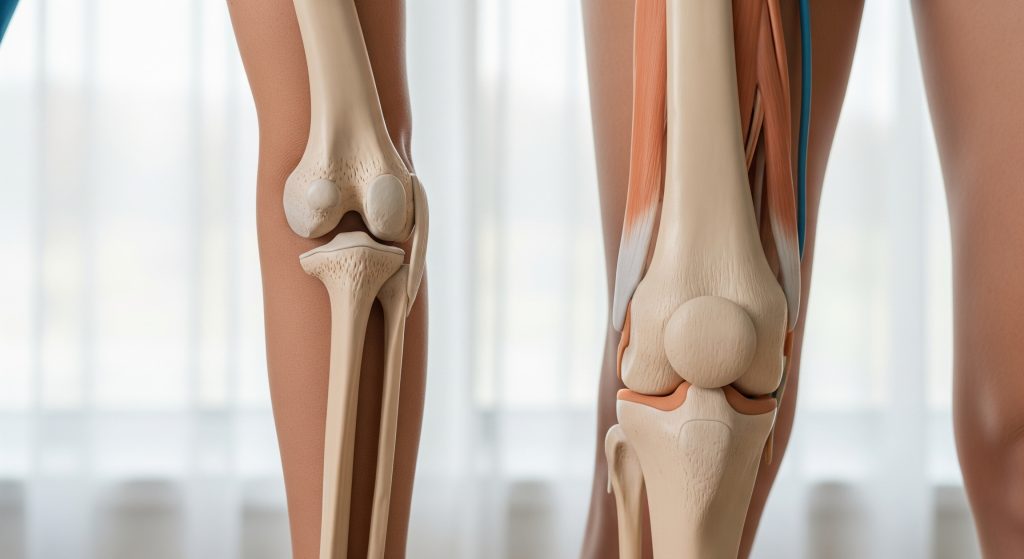
3. Medial Epicondyle of the Femur
Shift to the knee. The medial epicondyle of the femur lies just superior to the medial condyle. I think of it as a structural ledge that carries the adductor tubercle. The adductor magnus tendon inserts there, and that insertion helps partition soft tissue planes between thigh flexors and extensors. Functionally, this prominence supports medial knee stability, especially under valgus and rotational loads.
In examination, it is a landmark for medial knee ligament assessment and for guiding ultrasound or surgical approaches. It also aids orientation when evaluating patellofemoral tracking issues. Precise palpation improves accuracy for both diagnosis and injection planning.
4. Lateral Epicondyle of the Femur
On the lateral side of the distal femur, the lateral epicondyle offers a firm anchor for the fibular collateral ligament. As NCBI describes, this ligament is essential for resisting varus stress at the knee. The epicondyle also contributes to coordination during gait and running. It does not move the knee by itself, but it organises where forces start and stop.
The surrounding anatomy includes the lateral condyle articulating with the tibia. During stance and pivoting, rotational control depends on the integrity of attachments near this epicondyle. Subtle tenderness here, together with instability signs, can signal lateral collateral involvement.
Key Anatomical Features of Epicondyles
An epicondyle is a bony prominence adjacent to a condyle. In both the humerus and femur, these prominences act as attachment sites for tendons and ligaments. As StatPearls summarises, the medial epicondyle of the humerus is particularly significant for the common flexor origin and the ulnar collateral ligament. The lateral structures offer a counterpoint through extensor and collateral attachments. Together they create balanced tension and leverage at elbow and knee.
-
Shape: compact protrusions that increase the surface area for soft tissue attachment.
-
Position: immediately proximal to articular condyles, protecting joint margins.
-
Function: provide leverage, resist stress, and guide force transfer across the joint.
Epicondyle in one line: a small projection that makes big attachment physics possible.
Muscle Attachment Points
Attachment is the epicondyle’s signature role. At the elbow, the medial epicondyle hosts the common flexor tendon. The lateral epicondyle hosts the common extensor origin. At the knee, the medial femoral epicondyle carries the adductor tubercle, while the lateral femoral epicondyle anchors lateral stabilisers including the fibular collateral ligament. This arrangement distributes torque and shear around the joint rather than through it.
-
Medial humeral epicondyle: flexor carpi radialis, flexor carpi ulnaris, palmaris longus, pronator teres, and flexor digitorum superficialis.
-
Lateral humeral epicondyle: extensor carpi radialis brevis, extensor digitorum, extensor carpi ulnaris, and extensor digiti minimi.
-
Medial femoral epicondyle: adductor magnus insertion via the adductor tubercle, aiding medial stability.
-
Lateral femoral epicondyle: fibular collateral ligament attachment, supporting varus and rotational control.
Sports medicine teams often refer to the CFO and CEO. That is, the common flexor origin and the common extensor origin. The nicknames keep anatomy front of mind during rehab planning. Simple, but effective.
Common Conditions Affecting the Epicondyle
Tennis Elbow (Lateral Epicondylitis)
This condition arises from overload at the lateral epicondyle. Microtears and degenerative changes appear around the extensor carpi radialis brevis origin. Symptoms cluster around lateral elbow pain during gripping, lifting with a pronated forearm, and resisted wrist extension. Grip dynamometry often shows reduced strength on the affected side.
-
Typical signs: point tenderness over the lateral epicondyle and pain with resisted wrist extension.
-
Aggravators: repetitive gripping, repeated screwdriving, and sudden load spikes.
-
Management: relative rest, eccentric loading, isometrics for analgesia, and progressive return to function.
I prioritise activity modification and load progression before invasive options. Bracing can reduce tensile load at the epicondyle during tasks. It buys time for tendon healing.
Golfer’s Elbow (Medial Epicondylitis)
Despite the name, it affects many who do not play golf. The pain sits over the medial epicondyle and links to wrist flexion or forearm pronation. Resisted wrist flexion, especially with elbow extension, tends to reproduce the pain. Passive wrist extension can also stretch the irritated tissue and trigger symptoms.
-
Typical signs: local tenderness, pain with gripping in flexion, and sometimes ulnar nerve irritability.
-
Aggravators: repetitive wrist flexion, pronation against resistance, and sudden changes in training volume.
-
Management: eccentric and heavy slow resistance programmes, ergonomics, and graded exposure to provocative tasks.
Technique errors often matter. A small change in grip width or keyboard height can lower strain at the epicondyle to a meaningful degree.
Epicondylar Fractures
Fractures can involve the medial or lateral epicondyle, more frequently at the elbow. Mechanisms include avulsion with sudden muscle pull, valgus stress injuries, or direct impact. Pain is localised, and swelling may be modest or pronounced depending on displacement. Neurovascular assessment is mandatory given the nearby ulnar and radial structures.
-
Red flags: ulnar nerve symptoms, visible deformity, or painful instability under valgus or varus stress.
-
Imaging: standard radiographs in orthogonal views, with CT reserved for complex patterns.
-
Management: immobilisation for nondisplaced injuries and surgical fixation for unstable avulsions or entrapment.
Rehabilitation focuses on controlled range, early isometrics, and staged load to the epicondyle attachments. I emphasise tendon-friendly progressions and careful monitoring for stiffness. The aim is strength without fibrosis.
Symptoms of Epicondyle Problems
-
Local tenderness directly over the epicondyle, sometimes with a small area of swelling.
-
Pain on resisted movement: wrist extension or flexion at the elbow, adduction or rotational control at the knee.
-
Functional loss: reduced grip strength, difficulty lifting a kettle, or reduced push-off in running.
-
Neural features when involved: tingling along the ulnar distribution or local sensitivity behind the medial epicondyle.
-
Provocation with stretch: passive wrist flexion or extension may irritate the tendon origin.
Pattern recognition matters. Pain just distal to the epicondyle often indicates tendon, not joint, involvement. That nuance changes the plan.
Risk Factors and Causes
-
Repetitive load without adequate recovery or conditioning.
-
Sudden spikes in volume, intensity, or novel tasks.
-
Equipment and ergonomics that increase moment arms at the epicondyle.
-
Technique deficits that bias wrist or knee mechanics toward the attachment.
-
Systemic contributors to tendon health to an extent, including metabolic factors.
-
Age-related tendon changes that reduce tolerance to tensile stress.
Two examples illustrate the point. A developer switches to a higher-resistance mouse and grips harder all day. A weekend tennis player adds a stiffer string and a heavier racquet. Both increase load at the epicondyle with no adaptation time. Symptoms follow.
Functional Role of Epicondyles in Movement
Muscle Origin Points
Origins define lines of pull. The medial epicondyle drives flexion and pronation through the common flexor group. The lateral epicondyle powers extension and supination control via the extensor group. At the knee, the medial epicondyle supports adductor mechanics, while the lateral epicondyle supports lateral ligament stability. The result is controlled motion with efficient force transfer across the joint.
-
Clear origins simplify neuromuscular recruitment.
-
Compact footprints allow dense tendon collagen to anchor securely.
-
Strategic placement buffers articular cartilage from peak tensile stress.
Earlier, I emphasised that the epicondyle is a design feature. Here is why. The attachment geometry creates predictable leverage for everyday tasks and sport.
Leverage in Joint Movement
Leverage depends on moment arms. The epicondyle positions tendons slightly away from the joint axis to increase torque with modest muscle effort. That small distance change improves mechanical efficiency. It also focuses stress at the bony anchor.
-
At the elbow: efficient wrist torque during gripping and typing.
-
At the knee: stable tracking through stance and cutting manoeuvres.
But the same leverage that delivers power also concentrates strain. Overload the epicondyle and the tissue protests. Predictable trade-off.
Protection of Nearby Structures
The epicondyle acts as a shallow guard for adjacent neurovascular structures. The medial humeral epicondyle shelters the ulnar nerve in its groove. The surrounding soft tissue arrangement disperses friction and local pressure when the elbow flexes. At the knee, the femoral epicondyles provide attachment for ligaments that protect the joint from varus and valgus collapse.
This geometry is not cosmetic. It is basically a protective ridge plus an anchor, all in one compact unit.
Development Through Life Stages
Epicondylar regions undergo ossification and maturation through childhood and adolescence. Growth plates nearby can be susceptible to traction stress during rapid growth. That partly explains overuse problems in throwing sports. In adults, age and cumulative load shift tissue quality. Tendons grow less tolerant to sudden spikes, making the epicondyle more vulnerable during unaccustomed tasks.
Clinically, I adjust loading plans across life stages. Young athletes respond well to technique coaching and rest. Middle-aged workers need progressive strengthening and ergonomic changes. Different routes, same goal.
Understanding Your Epicondyles
Patients often ask what to do with a sensitive epicondyle. I give a short, structured answer. Identify the aggravator, reduce it, then load back up with intent. That sequence builds tolerance over time.
-
Map the provocation. Is it gripping, typing, racquet use, or kneeling tasks for knee symptoms.
-
Change one lever at a time. Grip size, string tension, keyboard height, or workload parameters.
-
Introduce isometrics for analgesia. Then progress to eccentric and heavy slow resistance.
-
Restore capacity beyond daily demand. Overshoot slightly to create a buffer.
-
Return to skill under supervision. Tidy technique trims future load at the epicondyle.
Warning signs deserve attention. Night pain that persists, true weakness rather than pain-limited effort, or a clear traumatic event all warrant medical review. Better to check early than to chase chronic irritation for months. Precision first.
Frequently Asked Questions
Can you feel your epicondyle through the skin?
Yes, in most adults the humeral epicondyles are palpable as firm prominences on either side of the elbow. The medial epicondyle is usually more prominent and sits closer to the skin. The lateral epicondyle can be slightly subtler but is still accessible with careful palpation. At the knee, the femoral epicondyles are less obvious, though landmarking is still feasible with practice.
What’s the difference between epicondyle and condyle?
|
Term |
Definition |
|---|---|
|
Condyle |
An articular surface that forms part of a joint. It bears load and allows movement. |
|
Epicondyle |
A bony projection adjacent to a condyle. It provides attachment for tendons and ligaments. |
Think of the condyle as the joint surface and the epicondyle as the attachment shelf next to it. The distinction matters for both imaging reports and surgical approaches.
Why does my medial epicondyle hurt when I bend my elbow?
Elbow flexion increases tension and compression around the medial epicondyle and the ulnar nerve groove. If the common flexor origin is irritated, bending can stretch or compress the tissue. Repeated gripping or pronation tasks often sensitise the area. A brief deload plus targeted strengthening usually reduces symptoms. Nerve-related tingling into the ring and little fingers suggests ulnar involvement and warrants assessment.
How long does epicondylitis take to heal?
Recovery varies. Many cases improve within several weeks under a structured programme, though more persistent cases can extend into months. Tendons adapt slowly. Progressive loading, consistent technique, and removing aggravators shorten timelines. Set expectations early and measure grip strength or pain thresholds to track progress. Quick fixes are uncommon. Steady work usually wins.
Are epicondyle injuries common in children?
They occur, especially around growth spurts and in throwing or racquet sports. Traction on developing attachment sites can cause pain or, less commonly, avulsion injuries. Prompt load management and skill coaching help considerably. Persistent pain or a clear traumatic incident should be assessed to exclude physeal or avulsion problems. Early correction prevents longer-term setbacks.

