






 We do what's right for you...


Meniscus Surgery in India: Causes, Process, and Recovery Time
Dr. Rajeev K Sharma
Conventional advice says a torn meniscus always needs quick surgery. That blanket rule does not hold in every case. The right choice depends on tear type, age, activity goals, and the realistic recovery window. In this explainer, I set out how I evaluate meniscus surgery options in India, what to expect in hospital, and how to structure rehabilitation. It is basically a practical map so you can make a sound decision, not a guess.
Types and Techniques of Meniscus Surgery Available in India
India offers the full spectrum of modern knee arthroscopy procedures for complex and simple tears. In practice, I prioritise preserving tissue whenever feasible. Meniscal tissue protects cartilage and spreads load. Remove less if you can and repair more when biology allows. That principle shapes the options below.
1. Arthroscopic Meniscus Repair
When the tear pattern, vascular zone, and tissue quality are favourable, I recommend arthroscopic repair. Success rates are high when technique and rehab align. As PMC reports, fibrin clot augmentation showed a healing success above 96%, with mean Lysholm scores improving from 67.63 to 92.0 at three years in Indian patients. Those are strong patient-reported outcomes (PROMs). They also reflect careful selection and disciplined aftercare.
-
Best suited for vertical longitudinal tears in the red-red or red-white zones.
-
Often combined with biologic augmentation to improve healing potential.
-
Protective rehabilitation is essential to avoid stressing the repair early.
Devices and suture methods vary. I choose inside-out, outside-in, or an all-inside device based on tear site and surgeon access. The aim is stable fixation without over-tightening. A simple example helps. A young footballer with a bucket-handle medial tear usually benefits from repair and a staged return to pivoting sport. That is preferable to early removal of tissue and later arthritis risk.
2. Partial Meniscectomy
Partial meniscectomy removes only the unstable fragment and shapes a stable rim. I consider it when the tear is complex, degenerative, or avascular and cannot be repaired reliably. Recovery is typically faster than repair because there is no biological healing requirement. But there is a trade off. Less meniscus means higher joint contact stress over time. I discuss that candidly with patients who run or do heavy labour.
-
Indicated for flap, radial root extension, or frayed degenerative tears.
-
Goal is stable edges and smooth contour to reduce mechanical catching.
-
Rehab progresses by symptoms and swelling control rather than protection of a repair.
3. Total Meniscectomy
Complete removal is rarely indicated now. It is a last resort for non-salvageable tissue with persistent locking or pain. The long term risk of cartilage wear increases after full meniscal loss. I reserve it for exceptional scenarios where all other strategies are unsafe or have failed. Even then, I document the downstream implications with clarity.
4. Meniscus Transplant
Meniscal allograft transplantation is a joint preserving option for symptomatic meniscal deficiency in select patients. Candidacy depends on alignment, cartilage status, and ligament stability. It is not a quick fix. It is a structural solution that demands precise sizing and meticulous rehabilitation. When done well, it can reduce pain and protect the tibiofemoral cartilage to some extent.
Inside-Out vs Outside-In Repair Techniques
Inside-out suits posterior horn and midbody tears with robust fixation and reliable suture placement. Outside-in is efficient for anterior horn tears where needle control is better from outside the joint. Technique choice follows the tear, not the other way round. As PMC notes, inside-out, outside-in, and all-inside methods each have a role depending on location and pattern. I often combine approaches in complex tears.
-
Inside-out: strong fixation for posterior horn tears but requires a small posteromedial or posterolateral incision.
-
Outside-in: good for anterior horn repairs with precise needle trajectory.
-
Hybrid: use more than one method when the tear spans zones.
All-Inside Repair Method
All-inside systems reduce operative time and avoid accessory incisions. They are useful for bucket-handle and midbody tears. Device choice matters less than execution: stable reduction, anatomic suture placement, and careful tensioning. I still tailor the approach to the tear configuration. The technique is only as good as the indications and the rehab that follows.
|
Option |
When I consider it |
|---|---|
|
Arthroscopic repair |
Peripheral vascular tears, younger or active patients, good tissue quality |
|
Partial meniscectomy |
Irreparable complex or degenerative tears causing mechanical symptoms |
|
Total meniscectomy |
Rare salvage for non-repairable, locked tears with no viable rim |
|
Meniscus transplant |
Symptomatic meniscal deficiency with preserved alignment and cartilage |
Causes and Risk Factors Leading to Meniscus Tears
The meniscus fails for two broad reasons. Sudden overload or gradual degeneration. The exact mechanism guides both treatment and expectations. A traumatic vertical tear in a young athlete behaves differently to a degenerative horizontal cleavage in a 50 year old. Management should reflect that difference.
Sports-Related Injuries and Contact Activities
Pivots, cuts, and tackles generate shear stress across the meniscus. Football, basketball, and combat sports are frequent culprits. Add a planted foot and rapid rotation, and the posterior horn is at risk. I also see tears combined with ACL injuries. The two together complicate stability and healing timelines.
Age-Related Degeneration
With age, meniscal tissue loses water and elasticity. Small repeated loads can then propagate a tear without a single dramatic event. Patients often recall a minor squat or staircase twist, then persistent soreness. Degenerative tears respond well to conservative care at first, but persistent locking or catching tips the balance towards knee arthroscopy.
Sudden Twisting or Pivoting Movements
A quick pivot with a planted foot is a classic mechanism. The joint compresses while rotating and the meniscus is pinched. Symptoms depend on where the tear sits and whether a fragment displaces. A displaced flap can cause sharp catching or painful clicks with flexion.
Heavy Lifting and Squatting Positions
Work exposures matter. As BMC Musculoskeletal Disorders reports, kneeling and squatting more than double risk with an effect size of 2.01, and lifting loads above 10 kg adds further risk. That aligns with what I see in trades and agriculture. The fix is not only treatment. It is hazard control and task redesign where possible.
-
Use neutral spine and hip drive when lifting loads from the floor.
-
Avoid deep flexion holds during repetitive work if alternatives exist.
-
Rotate tasks to limit prolonged kneeling or narrow stance squats.
Recognising Meniscus Tear Symptoms Early
Early recognition prevents weeks of compensation and swelling. Typical meniscus tear symptoms include joint line pain, swelling that builds over hours, and painful clicking. Locking or a block to extension suggests a displaced fragment. A careful exam plus MRI confirms the pattern if needed. I prefer to escalate imaging when symptoms persist beyond simple rest and activity adjustment.
-
Sudden pain at the joint line after a twist is a red flag.
-
Recurrent swelling after activity suggests intra articular irritation.
-
Giving way episodes can reflect pain inhibition or concurrent ligament laxity.
Surgical Process and Hospital Experience
The hospital journey is predictable when organised well. Clear preoperative steps, a standardised operative plan, and a structured discharge reduce stress. Here is how I frame the process from first tests to the first two weeks after surgery.
Pre-Surgical Diagnostic Tests Required
I start with weight bearing knee X rays to assess alignment and joint space. MRI defines tear type, rim quality, and associated injuries. Baseline blood work, ECG when indicated, and anaesthesia review complete the checklist. This is not bureaucracy. It is risk management to avoid surprises on the day.
Day of Surgery Preparation Steps
Preparation reduces complications. Declare medicines, especially anticoagulants and anti inflammatories. Report any infection or fever so we can delay if needed. Arrange a responsible adult for the trip home. Fasting rules are strict for safety. As Cleveland Clinic outlines, solids are usually stopped for about 6 hours and clear liquids for around 3 hours before anaesthesia. These timings may be adjusted by your anaesthetist.
-
Confirm consent and operative side before entering theatre.
-
Bring imaging and previous operative notes if available.
-
Wear loose clothing to accommodate a post op brace if one is planned.
Anaesthesia Options and Operating Procedure
Meniscus surgery is typically done under spinal anaesthesia or general anaesthesia, with local infiltration for analgesia. I perform knee arthroscopy through two or three small portals. The joint is systematically inspected. Then I either repair or trim based on preoperative planning and intraoperative findings. I photograph key steps for patient education later.
Stable fixation plus a disciplined rehabilitation protocol is the simplest predictor of a good outcome.
Post-Operative Care in Hospital
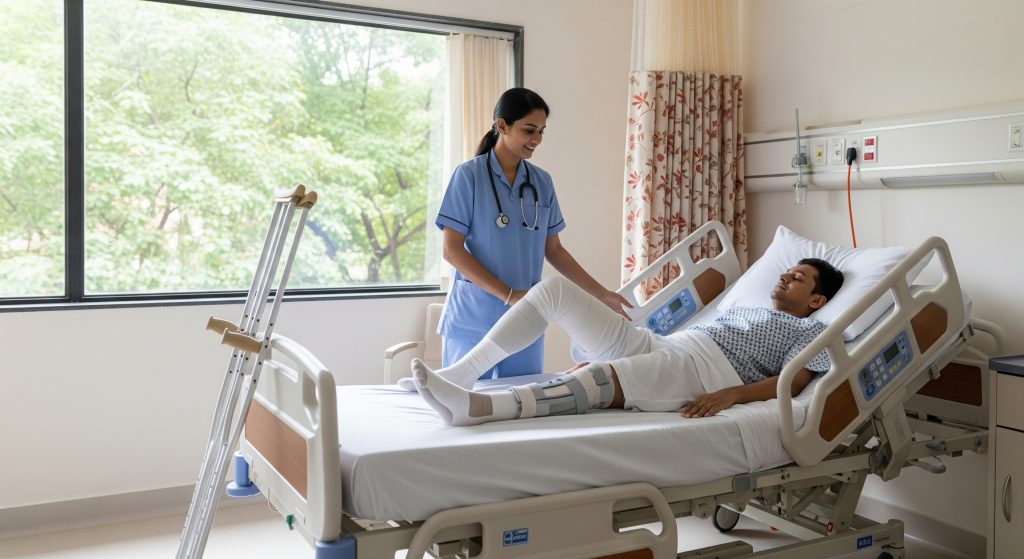
In recovery, the nursing team monitors pain, limb perfusion, and nausea. Cryotherapy and elevation start immediately. I prescribe early ankle pumps and quadriceps activation to reduce clot risk. If we have repaired the meniscus, I protect flexion and load. After a partial meniscectomy, I progress weight bearing as tolerated, within pain limits.
Discharge Process and Initial Recovery Instructions
Safe discharge is a team effort. As StatPearls notes, structured discharge planning improves continuity of care, reduces readmission, and safeguards recovery. I use a simple checklist for day one to day seven tasks.
-
Keep dressings dry and intact for 48 hours. No soaking until wounds seal.
-
Ice the knee for 15 to 20 minutes, 5 to 6 times daily, and elevate above heart level.
-
Use crutches as advised. Repair cases usually need protection for several weeks.
-
Begin supervised physiotherapy within the first week to restore extension and limit swelling.
-
Take prescribed analgesics and avoid smoking, which slows healing.
I provide a written plan with exercises, brace settings, and follow up dates. Clarity now avoids confusion later. Simple, predictable steps win the day.
Recovery Timeline and Rehabilitation Programme
Rehabilitation is the other half of meniscus surgery. Time frames vary with procedure. Repairs heal biologically and need protection. Partial resections move faster because there is no repair to protect. I align the plan to tissue healing and symptoms, not a calendar alone.
First 2 Weeks: Immediate Post-Surgery Care
The first fortnight is about pain control, swelling reduction, and regaining full extension. Gentle range of motion within safe limits begins early. Quadriceps engagement starts on day one with isometrics. This is the base for later strength. If there was a repair, I avoid deep flexion that loads the posterior horn during this period.
-
Exercises: quad sets, ankle pumps, heel slides within limits, patella mobilisations.
-
Protection: brace as prescribed, crutches, and careful transfers.
-
Milestones: near full extension by end of week two, swelling trending down.
Weeks 3-6: Early Mobilisation Phase
Now I progress range, gait, and neuromuscular control. Deep squats remain off limits after repair. For partial meniscectomy, progression is faster, but swelling and pain still guide pace. I refine gait with cues for stance stability and knee control. Balance drills begin once swelling settles.
-
Exercises: straight leg raises, mini squats to a safe depth, step ups, and supported balance work.
-
Goals: symmetrical extension, improving flexion, and normalising walking pattern.
-
Cues: no valgus collapse, controlled descent on steps, even weight through both legs.
Months 2-3: Strength Building Stage
By this stage, the focus shifts to strength, proprioception, and controlled load. I use closed chain work first, then add open chain ranges that do not stress the repair. Stationary cycling and low impact conditioning help cardiovascular base without joint irritation. If symptoms flare, I pull back a week and rebuild. Progress is rarely linear. That is normal.
-
Exercises: leg press within range, bridges, hamstring curls in a safe arc, and lateral band walks.
-
Neuromuscular: single leg balance with reach, controlled lunges within pain free depth.
-
Benchmarks: minimal swelling after sessions, improving single leg control, and step height progression.
Essential Meniscus Tear Exercises for Recovery
High value exercises are simple and consistent. I prioritise a small set and execute them well. Fancy programmes fail without adherence. These are my mainstays for most patients, adjusted by tolerance.
-
Quadriceps sets: hold for 5 to 10 seconds, repeat 10 times, several sets daily.
-
Straight leg raises: maintain full knee lock, avoid hip hiking.
-
Mini squats to a chair: stop before pain or compensations start.
-
Heel raises: build calf strength to support gait mechanics.
-
Step ups: start low, focus on slow control and knee alignment.
If searching online, use the term meniscus tear exercises, but filter advice through your physiotherapist. Precision matters here.
Return to Sports and Normal Activities
Return is criteria based. That is the safest path. For repair, running usually begins after adequate single leg control and impact tolerance. Cutting and pivoting come last. For partial meniscectomy, return to desk work can be quick, often within two weeks. Heavy manual work or sport needs better strength and movement quality first.
|
Activity |
Typical clearance criteria |
|---|---|
|
Driving |
Off pain meds, safe brake reaction, adequate right leg control |
|
Office work |
Independent mobility, swelling controlled, comfortable sitting plan |
|
Jogging |
Symmetric single leg squat quality and minimal post run swelling |
|
Cutting sport |
Hop test symmetry, no apprehension, coach led change of direction drills |
One caution. A knee that looks calm for three days can still react to an early sprint session. Build gradually and monitor how it responds 24 hours later. Simple rule. Earn the next step.
Managing Complications and Warning Signs
Most patients progress without issues. A few do not. I ask patients to escalate if they notice fever, increasing calf pain, excessive redness, or a hot swollen knee that does not settle. Recurrent catching may signal a loose fragment or a failed repair stitch. Early review allows early correction.
-
Red flags: fever, night sweats, severe calf pain, or sudden loss of motion.
-
Common bumps: delayed swelling after overactivity, quad inhibition, or gait asymmetry.
-
Response: dial down load, increase recovery tactics, and seek review if signs persist.
Maybe that is the point. The best results come from quick action on small problems before they grow.
Making the Right Decision for Your Meniscus Surgery in India
Decision quality improves with a structured approach. I use four filters. Indication, tissue biology, patient goals, and system capability. Indication asks whether surgery is necessary now. Biology asks whether the tear can heal if repaired. Goals define acceptable timelines and activity targets. System capability means surgeon skill, rehab access, and realistic support at home.
-
If repairable and goals include long term joint health, choose repair and accept a longer rehab.
-
If irreparable and mechanical symptoms persist, a limited partial meniscectomy is reasonable.
-
If meniscal deficiency drives pain in a young knee, consider transplant after alignment and ligament checks.
-
When mixed signals exist, a short period of structured conservative care can clarify the path.
I also share two practical checks. First, can the patient commit to six to twelve weeks of physiotherapy without major gaps. Second, can daily tasks be adapted for a few weeks with crutches and a brace. If the answer to both is no, the plan needs revisiting. And yet, with the right preparation and a realistic timetable, meniscus surgery often restores function and confidence.
Frequently Asked Questions
What is the typical cost range for meniscus surgery across different Indian cities?
Costs vary by city, hospital tier, and procedure type. Arthroscopic repair generally costs more than a partial meniscectomy because it uses implants and takes longer. Major metros tend to price higher than tier 2 cities. Insurers usually reimburse per procedure code, not per device. Request an itemised estimate that includes surgeon fee, hospital stay, implant cost, and physiotherapy.
How long does knee arthroscopy for meniscus repair take?
Most procedures take 45 to 90 minutes, depending on tear complexity and whether other procedures are combined. Add time for anaesthesia, positioning, and recovery room transfer. Theatre slot bookings typically account for these steps.
Can all meniscus tears be repaired through surgery?
No. Repairability depends on tear pattern, location, tissue quality, and blood supply. Peripheral vertical tears in the red zone heal better than central degenerative tears. In some cases, a limited partial meniscectomy provides more reliable symptom relief.
Which hospitals in India specialise in advanced meniscus surgery?
High volume centres with established sports medicine units are a good starting point. Look for surgeons who publish outcomes and use protocol driven rehabilitation. Ask about case volumes for repairs, not just meniscectomies. Volume and structured rehab usually correlate with outcomes, though there are exceptions.
Is physiotherapy always necessary after meniscus surgery?
Yes. Physiotherapy is not optional after meniscus surgery. It restores extension, strength, balance, and movement quality. Without it, stiffness and poor gait patterns linger. A brief home programme is rarely sufficient for athletes or manual workers.
What insurance coverage options are available for meniscus surgery in India?
Most comprehensive policies cover medically indicated procedures after waiting periods. Preauthorisation is standard. Ensure the hospital and surgeon are in network, confirm room rent limits, and verify implant coverage caps. Keep all imaging and operative notes for claims processing.
How soon can I walk after meniscus repair surgery?
With a repair, protected weight bearing begins early but with crutches and a brace. The exact plan depends on tear stability and fixation. After a partial meniscectomy, many patients weight bear as tolerated within days. The safer rule is simple. Walk well, not just early.
What are the success rates of meniscus surgery in Indian hospitals?
Success is defined by pain relief, function, and return to activity. Repairs show high success in suitable tears with disciplined rehabilitation. Partial meniscectomy relief is usually quick but carries long term load implications. Outcome quality depends on case selection, surgical execution, and adherence to rehab. Roughly speaking, those three factors matter more than hospital décor.
Final note: If unsure whether to proceed with meniscus surgery, request a structured second opinion. Bring MRI images, not just the report, and a clear list of activity goals. Decisions improve when the data and the destination are both visible.

