






 We do what's right for you...


What Is the Defibrillator Procedure and How It Works in Emergencies
Dr. (Prof.) Tarun Kumar
Most advice about resuscitation focuses on confidence rather than precision. That is a mistake. In a real arrest, clarity wins. In this explainer, I set out the defibrillator procedure in a structured way, so a competent adult can act swiftly and safely. I also outline device types, when shocks save lives, and the practical safety limits. The aim is simple. A reliable mental model you can recall under pressure.
Step-by-Step Defibrillator Procedure in Emergency Situations
A disciplined approach matters. I treat the defibrillator procedure as a short sequence that repeats until help arrives. These are the core defibrillator procedure steps that I teach and use in audits.
1. Initial Assessment and Scene Safety
I first scan for hazards and establish control. Electricity, moving traffic, or water can quickly turn a rescue into a second emergency. I put on gloves if available, identify the patient, and ask bystanders to clear space. This prepares the defibrillator procedure to proceed without delay.
- Check for live power sources, fluids, and sharp objects.
- Ask for privacy and adequate lighting if possible.
- Designate one person to fetch the AED and one to call for help.
Small detail, big effect. Order reduces risk.
2. Checking Responsiveness and Breathing
I tap the shoulder and speak loudly to test responsiveness. If there is no response, I open the airway and look, listen, and feel for normal breathing. Gasping counts as abnormal breathing and demands immediate action. As Mayo Clinic explains, an unresponsive person who is breathing should be placed on their side to protect the airway. The goal is straightforward. Decide within seconds whether to start CPR and the defibrillator procedure.
3. Calling Emergency Services
I direct a bystander to call emergency services now and to return to confirm the call. I ask them to report the exact location, the suspected cardiac arrest, and that CPR is starting. Survival drops by about 7 to 10 percent for each minute without defibrillation, as American Heart Association notes, so fast activation is non negotiable. While the call is ongoing, I start compressions or prepare the AED.
4. Positioning the Patient Correctly
I lay the patient supine on a firm, flat surface. I expose the chest and quickly dry sweat or moisture with a cloth. If jewellery or clothing obstructs pad placement, I remove or shift it. For implanted devices, I keep pads at least 8 cm away from the device, as ANZCOR advises. Good positioning prevents delays and improves pad contact. It is basically the foundation for the defibrillation process.
5. Turning On the Defibrillator
I power on the AED immediately. Most units use a single button or lid open to start. The device provides clear voice prompts and visual cues. I listen and follow. This is the most approachable path for anyone learning how to use a defibrillator. No improvisation, just the device script. If the unit requests pads, I place them now and continue.
6. Attaching Electrode Pads Properly
I apply pads firmly on bare skin. Standard adult placement is anterior lateral. One pad sits below the right clavicle. The other pad sits on the left chest, below the nipple line along the mid axillary area. I avoid placing pads over obvious devices or heavy hair. If needed, I shave a small area for adhesion. For special cases, I switch to anterior posterior placement. I do not waste time. Proper pad placement keeps the defibrillator procedure effective and safe.
- Press pads to ensure full contact and no trapped air.
- Do not place pads over medication patches.
- For pacemakers or ICDs, offset pads to avoid direct overlap.
7. Analysing Heart Rhythm
I ensure no one is touching the patient. I announce, Clear. Then I allow the AED to analyse. I do not interrupt analysis with movement or speech. If a shock is advised, I prepare to deliver it. If no shock is advised, I resume compressions promptly. The defibrillator procedure depends on this disciplined pause and restart cadence.
8. Delivering the Shock
I recheck that the area is clear. I look and point to confirm no contact. Then I press the shock button when prompted. Early shocks matter most. Earlier, we noted that survival falls sharply with each minute without defibrillation. That number drives urgency. After the shock, I resume compressions without delay. The defibrillation process is not a single moment. It is shocks and CPR, aligned.
9. Performing CPR Between Shocks
I perform high quality compressions at a steady rhythm and adequate depth. I minimise pauses. I rotate compressors every two minutes if a team is present. If trained, I add rescue breaths with a proper seal. If alone, I prioritise compressions and follow AED prompts. This is where teams win. Coordination, cadence, and calm speech.
- Hands centred on the sternum, arms straight, shoulders above hands.
- Allow full chest recoil between compressions.
- Switch roles quickly at rhythm checks.
Good CPR is the bridge. Shocks restore rhythm. Compressions sustain the brain.
10. Continuing Until Help Arrives
I continue the defibrillator procedure in cycles. Analyse, shock if advised, and resume CPR. I do not stop unless the patient shows clear signs of life, trained responders take over, or I become unable to continue. If the patient regains breathing, I place them in the recovery position and monitor airway and pulse. Simple rule. Persistence saves lives.
Types of Defibrillators and Their Applications
The right device depends on setting, training, and clinical context. I view devices across four practical categories, with a paediatric note.
Automated External Defibrillators (AEDs)
AEDs guide lay responders with voice prompts and automatic rhythm analysis. They are the default public device for cardiac arrest. If someone asks how to use a defibrillator in an office or gym, this is the unit they mean. AEDs simplify the defibrillator procedure without sacrificing clinical effect in shockable rhythms.
- Ideal for airports, schools, offices, and transport hubs.
- Minimal training required to follow prompts safely.
- Pad sets vary for adults and children.
Manual External Defibrillators
Manual defibrillators require clinical skills. A clinician selects energy settings, interprets ECG rhythms, and chooses synchronised or unsynchronised shocks. These devices sit in ambulances, theatres, and emergency departments. The defibrillator procedure here includes rhythm recognition and energy titration. Precision matters, but so does speed.
Implantable Cardioverter Defibrillators (ICDs)
ICDs monitor rhythm continuously and deliver internal shocks when certain thresholds are met. They protect high risk patients from recurrent ventricular arrhythmias. The external defibrillator procedure still applies if an ICD shock fails to restore circulation. Pads must be offset from the device to maintain current flow and reduce damage risk.
Wearable Cardioverter Defibrillators
Wearable devices provide a temporary bridge for patients awaiting a decision on an ICD or with transient risk. They detect shockable rhythms and deliver therapy through external electrodes. Adherence and education are crucial. A wearable unit does not replace emergency response or the standard defibrillator procedure when collapse occurs.
Paediatric vs Adult Defibrillators
Paediatric pads reduce energy and adjust placement for smaller chests. Some AEDs include a child mode. If paediatric pads are unavailable, many systems allow adult pads with specific positioning to avoid contact. Always follow device labelling. The principles of the defibrillator procedure remain, with scaled energy and careful pad placement.
When Defibrillation Becomes Life-Saving
Defibrillation is not a cure all. It works for specific rhythms and within a time window. Knowing the indications prevents harmful delays and false hopes.
Recognising Cardiac Arrest Signs
Typical signs include sudden collapse, unresponsiveness, and absent or abnormal breathing. A brief seizure like movement may occur at onset. I confirm unresponsiveness, call for help, and start CPR. I then move into the defibrillator procedure as soon as an AED arrives.
Ventricular Fibrillation Episodes
Ventricular fibrillation produces chaotic electrical activity with no effective output. It is the classic shockable rhythm in a sudden collapse. The defibrillator procedure aims to depolarise the myocardium so the sinoatrial node can resume control. Fast recognition and pad placement matter here.
Pulseless Ventricular Tachycardia
Pulseless VT is organised but non perfusing. It is also shockable. I treat it with the same urgency and structure. Pads on, clear the patient, deliver shock when advised, and resume compressions. The defibrillation process repeats until a perfusing rhythm returns.
Time-Critical Nature of Defibrillation
Every minute counts. Early shocks correlate with markedly better outcomes, roughly speaking across registries. That is why the defibrillator procedure is designed for speed, clarity, and repeatable actions. The earlier citation on minute by minute decline sets the tempo. It should stay in mind while working.
Contraindications and Precautions
There are few absolute contraindications during arrest. Key precautions relate to safety and effectiveness. I avoid shock delivery if the patient is in water or on a conductive surface that cannot be insulated. I dry a wet chest before pads. I remove medication patches and avoid metal contact under pads. I never touch the patient during a shock. For implanted devices, I offset pad placement. Balanced judgement first, then the defibrillator procedure.
Conclusion
A reliable response to cardiac arrest rests on three things. Rapid recognition, immediate CPR, and a calm, structured defibrillator procedure. The device does not replace judgement. It magnifies it. Learn the script, practise the pad positions, and keep the cadence of analyse, shock, and compress in mind. That is how lives are saved in ordinary places by ordinary people, and by clinicians who have rehearsed it a hundred times.
Quick Reference: Core Actions
|
Action |
Purpose |
|
Scene safety |
Protect rescuer and patient for an uninterrupted defibrillator procedure. |
|
Call for help |
Mobilise advanced care while CPR starts. |
|
Pads on, analyse |
Identify shockable rhythm quickly and accurately. |
|
Shock if advised |
Terminate VF or pulseless VT to allow organised rhythm. |
|
Immediate CPR |
Maintain cerebral perfusion between analyses and shocks. |
Pros and Cons of AED Use in Public Settings
Pros
- Guided prompts simplify the defibrillator procedure for lay responders.
- Rapid shocks improve outcomes when minutes matter.
- Built in safeguards prevent inappropriate shocks.
Cons
- Limited benefit for non shockable rhythms.
- Requires device availability and basic familiarisation.
- Pad placement errors can reduce efficacy.
Practical Tips I Rely On
- Say what you are doing out loud. It keeps the team aligned and the defibrillator procedure smooth.
- Point to the pads before you place them. Muscle memory builds faster that way.
- Keep a small towel and razor with each AED. Adhesion problems waste precious seconds.
- Switch compressors every rhythm check. Fatigue lowers compression quality quickly.
- Use a metronome when possible. Steady cadence beats guesswork.
Short Example Scenario
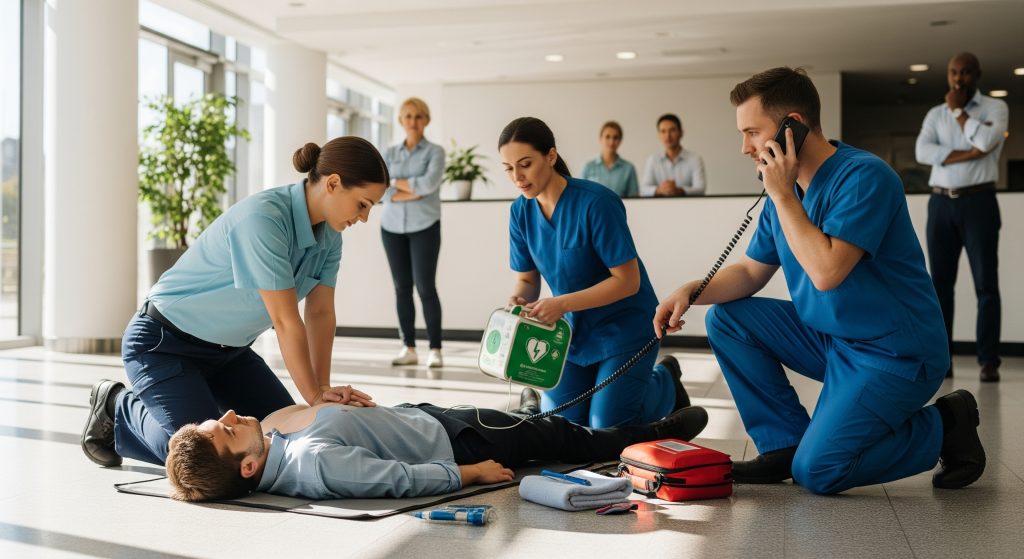
Office lobby. A colleague collapses near reception. I verify no response and abnormal breathing. I send one person for the AED and another to call. I start compressions. The AED arrives in under two minutes. I expose the chest, dry sweat, place pads, clear, and deliver a shock when advised. Compressions resume immediately. Paramedics arrive and take over after several cycles. This is the defibrillator procedure as it should look under pressure.
Can anyone use a defibrillator without medical training?
Yes. Modern AEDs are designed for public use with clear voice prompts and safeguards. If collapse and absent normal breathing are present, open the unit and follow instructions. This is the safest route to a correct defibrillator procedure for non clinicians. The device will not advise a shock if the rhythm is non shockable.
How quickly should defibrillation be performed after cardiac arrest?
As early as possible. Each minute of delay reduces the chance of survival, as previously noted from the AHA report. This is why I emphasise immediate calling, rapid pad placement, and disciplined cycles. Speed and sequence define an effective defibrillator procedure.
What is the survival rate when using a defibrillator?
Outcomes vary by setting, response time, and rhythm. Public access AED use markedly improves survival in shockable arrests, though results depend on minutes to first shock. The practical takeaway is consistent. Earlier shocks and uninterrupted compressions produce better odds.
Can a defibrillator restart a stopped heart?
Not in true asystole. Defibrillation terminates disorganised electrical activity like ventricular fibrillation or pulseless VT. It enables the natural pacemaker to regain control. If the heart has no electrical activity, the focus is high quality CPR, airway support, and reversible causes. The defibrillator procedure still plays a role in ongoing analysis.
Is it safe to use a defibrillator on a wet surface?
Yes, with precautions. Move the patient away from standing water if possible. Dry the chest where pads attach. Ensure no one touches the patient during analysis or shock. The aim is to prevent current spread and maintain effective energy delivery. Safety first, then the defibrillation process.
What happens if you use a defibrillator on someone who doesn’t need it?
An AED will analyse the rhythm and withhold shock if it is not indicated. If the person is breathing normally, place them in the recovery position and monitor. If in doubt, start the assessment and follow the prompts. The defibrillator procedure is designed to prevent harmful shocks and support correct actions.

