






 We do what's right for you...


What Is a Serum PSA Test? Know the Procedure, Cost, and Accuracy
Dr. Juhee Chandra
Common advice treats a single blood marker as a verdict on prostate health. That is a mistake. I use the serum psa test as a helpful signal, not a final answer. The value lies in the context, the trend, and the follow-up plan. Here is a clear, formal guide that lays out the test, the psa test procedure, the way to interpret results, and what to expect on cost and accuracy.
Understanding the Serum PSA Test and Its Components
What Is the Prostate-Specific Antigen Test
The serum psa test, also known as the prostate-specific antigen test, measures the concentration of a protein made by prostate cells. Both healthy and malignant cells release PSA into the blood. A higher reading can reflect cancer. It can also reflect benign prostatic enlargement or inflammation. As PMC notes, a historical threshold of 4.0 ng/mL prompted concern, though practice has shifted toward more nuanced interpretation.
In clinical work, I treat a single PSA value as a clue. It guides whether to repeat the test, add imaging, or discuss biopsy. The serum psa test supports screening and monitoring, but specificity is limited when used alone. This is why context matters.
Different Types of PSA Tests Available
Several versions of the serum psa test exist, each adding context for decision making. I focus on a core set:
- Total PSA estimates the combined free and protein-bound PSA in blood.
- Free PSA measures only the unbound fraction and helps refine risk assessment when total PSA is modestly raised.
- Percent-free PSA expresses free PSA divided by total PSA. Useful when numbers sit in the grey zone.
- PSA velocity tracks the rate of change across time points. A sharp rise can be more concerning than a flat high value.
- PSA density adjusts PSA for prostate volume. This is helpful when the gland is significantly enlarged.
The right choice depends on history, examination, and previous results. One test is rarely enough. Pattern over time is usually more informative than a stand-alone value.
Total PSA vs Free PSA Testing
Total PSA covers all PSA forms in circulation. Free PSA isolates the unbound fraction. The percentage of free PSA can improve specificity in men with total PSA in the borderline range. In practice, I look closely at the free-to-total ratio when total PSA sits between 4 and 10 ng/mL. This narrows unnecessary biopsies and reduces missed disease. The serum psa test becomes more decisive when these measures are combined with clinical findings.
Consider a typical scenario. A patient’s total PSA reads 5.6 ng/mL and the free PSA is relatively high. With a benign examination and stable prior results, I would often repeat testing before invasive steps. Conversely, a low free PSA percentage in the same situation tilts toward further evaluation. Judgment matters here.
When Doctors Recommend PSA Testing
I recommend the serum psa test when personal risk and potential benefit align. Age, family history, ancestry, prior biopsy results, and urinary symptoms all influence timing. As Johns Hopkins Medicine notes, men aged 55 to 69 are the main group that benefits from screening, with earlier discussions for higher risk groups.
Screening also depends on life expectancy and comorbidity. For many men over 70, routine testing may offer limited value. That is because treatment risks can outweigh benefits for indolent disease. Shared decision making remains essential. I explain the trade-offs, and then align on a plan.
List of Common Symptoms That May Lead to PSA Testing
- Urinary frequency, urgency, or weak stream.
- Nocturia with a progressive pattern over months.
- Blood in urine or semen.
- Pelvic discomfort or bone pain when advanced disease is suspected.
- Unexplained weight loss with persistent urinary symptoms.
Symptoms alone do not confirm cancer. They prompt assessment. The serum psa test is part of that assessment, not its replacement.
Complete Guide to the PSA Test Procedure
Pre-Test Preparation Guidelines
The serum psa test is straightforward, but preparation improves reliability. I advise the following:
- Avoid ejaculation for 48 hours before testing. It can transiently raise PSA.
- Delay testing for several weeks after urinary infection or prostatitis treatment.
- Inform the clinician about 5-alpha reductase inhibitors. These drugs lower PSA levels.
- Schedule the draw before a planned digital rectal examination or wait a few days after one.
- If cycling vigorously, ease off for 24 to 48 hours before the draw.
Fasting is not usually required. I still suggest a light meal to avoid vasovagal symptoms during the draw.
Step-by-Step Blood Collection Process
- Registration and consent. I confirm identity and the ordered test codes.
- Pre-draw check. Recent infections, procedures, and medications are reviewed.
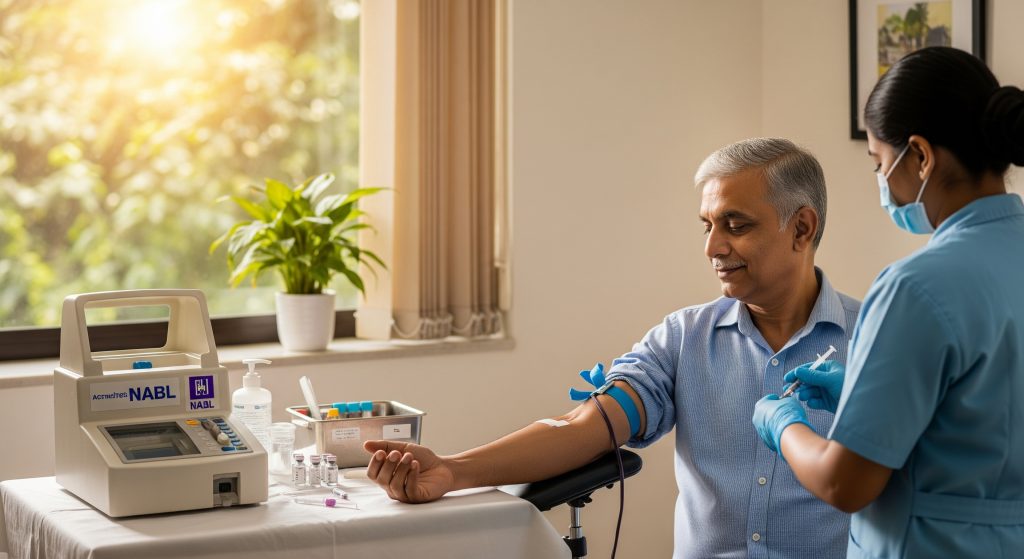
- Venepuncture. A trained phlebotomist draws venous blood, usually from the antecubital vein.
- Sample handling. Tubes are labelled, stored, and transported under lab protocols.
- Assay. The lab runs the serum psa test on validated immunoassay platforms with internal controls.
- Verification. Results undergo quality checks before being released to the clinician.
This is routine pathology workflow. It is basically a standard venous sampling with immunoassay analysis.
Home Sample Collection Services in India
Home collection is widely available in metro and tier 2 cities. I find it useful for older adults and for repeat monitoring. Most providers offer time windows and SMS tracking. Turnaround is similar to in-centre draws. If refrigeration or rapid processing is required, the technician manages it on site. Choose a NABL-accredited lab where possible.
How Long Results Take
Most centres release the serum psa test report within one working day. Some deliver same-day if the sample arrives early. Add-ons such as free PSA can add processing time. For velocity assessments, I schedule results review after the second draw is ready. This avoids partial interpretation.
Understanding Your PSA Test Report
Reports show total PSA, and sometimes free PSA and percent-free PSA. Age, history, and prior values shape interpretation. As MD Anderson Cancer Center notes, levels above 4.5 ng/mL in men in their 60s are considered abnormal, and screening every two to three years is common guidance.
I look first at the number. Then I look at trend, symptoms, examination, and free PSA percentage. I might also consider PSA density if imaging reports include prostate volume. If results remain borderline, I repeat the serum psa test after an interval. Small fluctuations are common.
PSA Test Accuracy and Reliability
Understanding False Positive Results
False positives are common when using a single cut-off. Benign prostatic hyperplasia and prostatitis can elevate PSA. Recent ejaculation, cycling, or instrumentation can also raise levels. The result looks abnormal, yet no cancer exists. In such cases, I repeat the serum psa test after removing the confounders.
False Negative Results and Their Implications
False negatives occur when cancer exists but PSA remains low. Some tumours produce little PSA. Early cancers can also sit below any threshold. This is why the examination, risk profile, and occasionally MRI matter. A normal serum psa test does not eliminate risk in a high-risk clinical picture.
Factors That Affect PSA Test Accuracy
- Prostate size and inflammation alter baseline values.
- 5-alpha reductase inhibitors lower PSA by roughly half over time.
- Assay variability between labs introduces minor shifts.
- Intercurrent urinary infection skews readings upward.
- Recent procedures such as catheterisation can elevate results.
These factors are manageable. The key is to test under stable conditions and use the same lab when feasible.
Limitations of PSA Testing
The serum psa test is sensitive but not specific. It detects many signals, including benign ones. It can lead to over-investigation if used without discrimination. It can also miss aggressive disease that sheds little PSA. The conclusion is not to avoid testing. It is to combine the serum psa test with clinical judgment and, when appropriate, imaging and biopsy.
Additional Tests for Improved Accuracy
- Free PSA percentage when total PSA lies in the grey zone.
- Multiparametric MRI to localise suspicious lesions prior to biopsy.
- PSA density using MRI or ultrasound-derived prostate volume.
- Repeat serum psa test to confirm a new elevation and establish velocity.
- Biomarker panels where appropriate and available.
Used together, these tools improve precision. Not perfect. Better.
Making Informed Decisions About PSA Testing
The best approach is structured and calm. I start with risk assessment, then the serum psa test under stable conditions, then a plan for next steps. Here is a practical framework:
- Clarify risk. Family history, ancestry, prior pathology, and current symptoms.
- Order the serum psa test plus free PSA if prior results suggest ambiguity.
- Interpret results alongside examination, history, and any prior values.
- Decide on repeat testing, imaging, or referral. Avoid reflex actions from a single number.
- Document the decision and schedule follow-up to review the trend.
This measured sequence prevents both overreaction and delay. It respects uncertainty without ignoring it.
Two closing notes. First, use the same laboratory where possible to minimise inter-assay variation. Second, agree a testing cadence in advance. As far as current data suggests, stability over time is reassuring even when the first result raised concern.
What is the normal PSA level for a 50-year-old man
There is no single universal cut-off. I interpret the serum psa test using age, risk factors, and prior values. Age-specific ranges exist, but trends often matter more than one reading. If a value rises rapidly across two draws, I investigate further. This is safer than relying on a fixed threshold alone.
Can I eat before a PSA blood test
Yes. Fasting is not necessary for the psa blood test. I do recommend avoiding heavy exercise and ejaculation for 48 hours before the draw. If a digital rectal examination is planned, arrange the blood draw before it or wait a few days after.
How often should I get a PSA test done
Frequency depends on risk and prior results. For average-risk men, a periodic serum psa test aligned with age and shared decision making is reasonable. If results are borderline or rising, I shorten the interval to confirm the trend. Screening intervals tighten or relax based on the overall picture.
Does an elevated PSA always mean cancer
No. Many benign conditions elevate PSA. Infection, prostate enlargement, and recent ejaculation can all increase the number. I confirm with a repeat serum psa test under stable conditions. If concern remains, I consider free PSA, imaging, or biopsy.
What activities should I avoid before PSA testing
- Ejaculation for 48 hours before the test.
- Strenuous cycling or similar perineal pressure.
- Testing immediately after urinary instrumentation or infection.
These steps reduce transient elevations. They make the serum psa test more reliable.
Is PSA testing covered under health insurance in India
Many policies reimburse when medically indicated. Preventive packages sometimes include the serum psa test for eligible age groups. Check your policy terms and request a written order. Documentation supports straightforward claims.
Quick reference
|
Term |
Meaning |
|
Total PSA |
Combined free and bound PSA measured in blood. |
|
Free PSA |
Unbound PSA used to refine cancer risk in borderline cases. |
|
Percent-free PSA |
Free PSA divided by total PSA, expressed as a percentage. |
|
PSA velocity |
Rate of change of PSA over time. |
|
PSA density |
PSA value adjusted for prostate volume from imaging. |
Final note: I use the serum psa test as part of a structured pathway. That means history and examination and trend and, when needed, imaging. It leads to clearer decisions and fewer regrets.
serum psa test, psa blood test, prostate-specific antigen test, normal psa levels by age, psa test procedure

