






 We do what's right for you...


What Are the Main Chalazion Causes and How to Treat Them
Dr. Krishna Vaitheeswaran
Conventional wisdom suggests that small eye lumps will simply disappear on their own, requiring nothing more than patience. For decades, the standard advice has been to wait it out. But that guidance misses something crucial. it’s basically ignoring the underlying reasons why these bumps form in the first place. Without addressing those root chalazion causes, that painless lump on the eyelid can become a recurring frustration that keeps coming back, sometimes bigger than before.
A chalazion develops when an oil-producing gland in the eyelid becomes blocked, leading to a slow-growing bump that can affect vision and cause significant discomfort. Understanding what triggers this blockage changes everything about how effectively it can be managed. The difference between someone who experiences a single chalazion and someone who battles them repeatedly often comes down to identifying and addressing the actual cause.
Primary Chalazion Causes and Risk Factors
The meibomian glands (those tiny oil factories lining the eyelids) play a starring role in eye health. When they malfunction, problems follow. Here are the seven major factors that lead to chalazion formation.
1. Blocked Meibomian Gland
This is the direct mechanical cause of virtually every chalazion. The meibomian glands produce an oily substance called meibum that forms the outer layer of the tear film, preventing tears from evaporating too quickly. When these glands become clogged, the oil backs up and forms a lump.
Think of it like a kitchen drain. When oils and debris build up, water cannot flow properly. The meibomian glands work the same way. Meibomian gland dysfunction (MGD) occurs when these oil-secreting glands fail to produce enough or quality oil, according to Cleveland Clinic. The glands fill up, the oil cannot exit, and inflammation follows.
What drives me crazy is how often this gets dismissed as simply “bad luck.” It isn’t. MGD frequently stems from a combination of factors including poor oil quality, bacterial proliferation, and chronic inflammation. The pathogenesis involves bacteria breaking down the oils, creating a cascade of problems that leads to gland blockage and ocular surface instability.
2. Poor Eyelid Hygiene
Here’s something rarely discussed. most people have never been taught proper eyelid hygiene. The eyelids accumulate oils, dead skin cells, makeup residue, and environmental debris throughout the day. Without regular cleansing, this buildup clogs the gland openings.
The fix sounds simple. Clean the eyelids daily. Yet fewer than 15% of people actually do this regularly. The result? Chronic irritation, bacterial overgrowth, and blocked glands that eventually form chalazia.
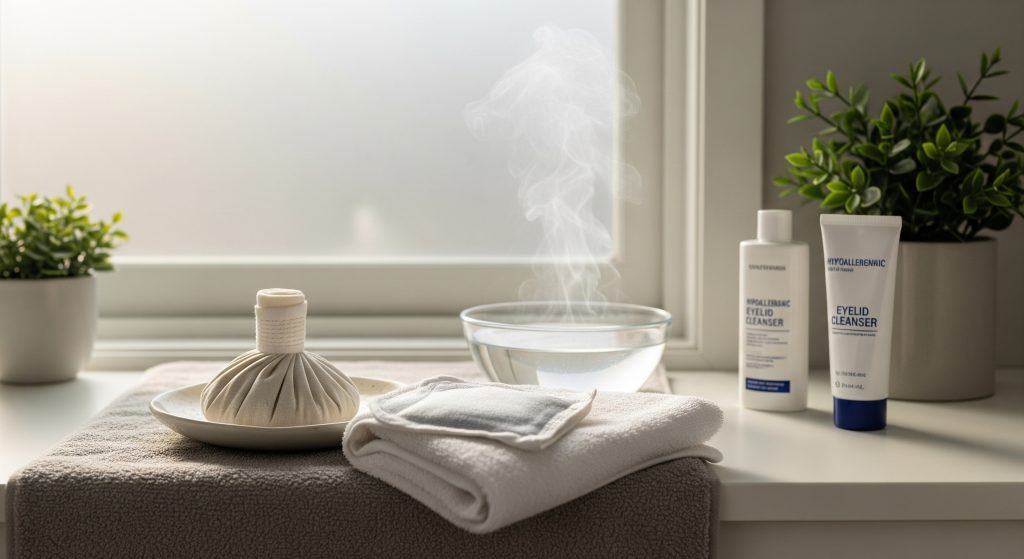
Proper eyelid hygiene involves:
-
Warm compresses to soften oils
-
Gentle lid scrubs with appropriate cleansers
-
Complete removal of eye makeup before bed
-
Regular replacement of eye makeup products
3. Chronic Blepharitis
Blepharitis describes the inflammatory condition characterised by swelling and irritation of the eyelids, often caused by blocked oil glands, as Mayo Clinic explains. It’s basically the precursor condition that sets the stage for chalazion formation.
The relationship works both ways. Blepharitis causes gland dysfunction, and gland dysfunction worsens blepharitis. Breaking this cycle requires consistent, long-term management. Good eyelid care isn’t a one-time fix but an ongoing commitment.
Signs of blepharitis include:
-
Red, swollen eyelid margins
-
Crusty or flaky debris at the base of the lashes
-
Burning or stinging sensation
-
Excessive tearing
-
Light sensitivity
Don’t even bother with expensive treatments until you’ve perfected the basics of daily eyelid hygiene. That alone resolves mild to moderate blepharitis in the majority of cases.
4. Seborrheic Dermatitis
This skin condition creates flaky, scaly patches and often affects the scalp, face, and yes, the eyelids. Seborrheic dermatitis directly contributes to eyelid inflammation, making it a significant risk factor for chalazion development.
The connection runs deeper than surface-level irritation. International Journal of Medical Research & Health Sciences identifies seborrheic dermatitis as a key risk factor linked to meibomian gland dysfunction. Individuals with this condition produce excess sebum that alters the composition of meibum, making it thicker and more likely to block the glands.
Managing seborrheic dermatitis requires treating the underlying skin condition while simultaneously addressing eyelid health. Antifungal shampoos, topical treatments, and consistent skincare routines help control symptoms.
5. Rosacea and Skin Conditions
Rosacea affects approximately 5% of the global population, and ocular rosacea (affecting the eyes) occurs in roughly half of those cases. The inflammatory nature of rosacea extends to the eyelids, causing chronic irritation and meibomian gland dysfunction.
Patients with rosacea often notice:
-
Recurrent styes and chalazia
-
Persistent eye redness
-
Gritty or burning sensations
-
Visible blood vessels on the eyelid margins
Other skin conditions that increase chalazion risk include eczema, psoriasis, and acne. The common thread? Chronic inflammation that disrupts normal gland function.
6. Previous Chalazion History
Having one chalazion significantly increases the likelihood of developing another. It’s not that the eye becomes “weakened” but rather that the underlying conditions causing the first chalazion likely persist.
Consider this carefully. If someone develops a chalazion without addressing the root cause, they’re essentially waiting for the next one to form. The recurrence rate without preventive measures runs between 25% and 50%. That’s a coin flip at best.
Breaking the cycle requires:
-
Identifying specific risk factors present in the individual
-
Implementing targeted prevention strategies
-
Maintaining consistent eyelid hygiene indefinitely
-
Regular monitoring for early signs of recurrence
7. Age-Related Risk Factors
Meibomian gland function naturally declines with age. The glands produce less oil, and the oil they do produce becomes thicker and more likely to cause blockages. Hormonal changes, particularly during menopause, accelerate this decline.
Age-related factors include:
-
Decreased tear production
-
Slower lid turnover and healing
-
Medication side effects (many common medications reduce tear production)
-
Reduced blinking rate (especially with increased screen time)
But here’s something important. Age doesn’t guarantee chalazion development. Proper prevention strategies work regardless of age.
Chalazion Treatment Options
The single most frustrating part of chalazion treatment is the waiting game many practitioners recommend. “Give it six weeks” sounds reasonable until you’re living with a visible lump on your eyelid affecting your confidence and potentially your vision. Fortunately, multiple treatment approaches exist, ranging from simple home care to surgical intervention.
Home Remedies and Warm Compresses
Warm compresses remain the first-line treatment, and honestly, the only one that really matters for most cases. Done correctly, they work remarkably well. Done incorrectly? They’re virtually useless.
The proper technique involves:
-
Heating a clean flannel with warm water (not hot enough to burn)
-
Testing the temperature on the inside of your wrist
-
Applying to the closed eyelid for 10-15 minutes
-
Reheating every 2-3 minutes to maintain adequate warmth
-
Following with gentle eyelid massage
-
Repeating 4-6 times daily initially
The mistake most people make? Using lukewarm water and applying it for only a few minutes once daily. That accomplishes nothing. The heat needs to be consistently warm enough to melt the solidified oils blocking the gland, and this takes time and repetition.
Antibiotic Eye Drops and Ointments
Antibiotics don’t treat the chalazion directly since it’s not an infection. However, they address secondary bacterial involvement and treat associated blepharitis that may be contributing to the problem.
Commonly prescribed antibiotics include:
|
Medication Type |
Purpose |
Duration |
|---|---|---|
|
Chloramphenicol drops |
Broad-spectrum coverage |
1-2 weeks |
|
Fusidic acid ointment |
Targeted staphylococcal coverage |
1-2 weeks |
|
Oral doxycycline |
Anti-inflammatory and antibacterial |
6-12 weeks |
|
Azithromycin drops |
Reduces inflammation |
Variable |
Oral antibiotics like doxycycline work differently than topical ones. At low doses, they have anti-inflammatory properties that help normalise meibomian gland secretions. This makes them particularly useful for recurrent chalazia associated with rosacea or chronic blepharitis.
Steroid Injections
When warm compresses fail and the chalazion persists beyond six to eight weeks, intralesional steroid injections offer a middle ground between conservative management and surgery. A small amount of triamcinolone is injected directly into the lesion, reducing inflammation and often shrinking the lump significantly.
Success rates hover around 80%, though some chalazia require a second injection. The procedure takes minutes and involves minimal discomfort with local anaesthetic. Risks include temporary skin depigmentation (more noticeable in darker skin tones) and rarely, fat atrophy at the injection site.
Sounds straightforward, right? It mostly is, but patient selection matters. Steroid injections work best for non-infected, moderately sized chalazia that have been present for at least four weeks.
Surgical Drainage Procedures
Surgery becomes necessary when other treatments fail or when the chalazion is particularly large or causing visual problems. The procedure, called incision and curettage (I&C), involves making a small cut on the inner surface of the eyelid and draining the contents.
The good news: it’s quick, effective, and performed under local anaesthetic. The not-so-good news: it’s still minor surgery with associated recovery time, potential for recurrence, and rare complications including scarring or eyelid notching.
Surgical drainage typically takes 15-20 minutes. Recovery involves wearing an eye patch for several hours, using antibiotic ointment for a week, and avoiding eye makeup for about ten days.
Prevention Through Daily Care
Prevention beats treatment every time. The daily care routine that prevents chalazia takes about five minutes but requires consistency.
“Ongoing maintenance of good eyelid care is crucial as blepharitis is generally chronic and can require long-term management.”
An effective prevention routine includes:
-
Morning: Brief warm compress followed by gentle lid cleansing
-
Evening: Complete makeup removal, warm compress, lid massage
-
Weekly: Deep cleansing with diluted baby shampoo or specific lid scrub products
-
Monthly: Assess for early signs of recurrence
Diet also plays a role. Omega-3 fatty acids from oily fish, flaxseed, or supplements improve meibum quality. Staying hydrated helps maintain tear film stability. Reducing processed foods and sugar decreases systemic inflammation.
Chalazion vs Stye: Key Differences
The chalazion vs stye confusion affects virtually everyone who develops an eyelid lump. They look similar initially, but their causes, symptoms, and treatment approaches differ significantly. Knowing which is which prevents unnecessary worry and ensures appropriate care.
Location and Appearance
Location reveals the underlying cause. A stye (hordeolum) develops at the base of an eyelash or in a small oil gland at the lid margin. it’s basically an infected hair follicle or gland. A chalazion forms deeper within the eyelid, arising from a blocked meibomian gland in the tarsal plate.
|
Characteristic |
Stye |
Chalazion |
|---|---|---|
|
Location |
Lid margin, near lashes |
Within eyelid tissue |
|
Appearance |
Red, pointed, pus-filled |
Smooth, rounded bump |
|
Colour |
Red and inflamed |
Skin-coloured or grey |
|
Size |
Usually small (pea-sized) |
Can grow larger |
A stye often has a visible “head” like a spot, while a chalazion appears as a smooth, firm lump that moves with the eyelid tissue.
Pain Level Comparison
Here’s where the difference becomes obvious. Styes hurt. A lot. The infected gland swells rapidly, causing significant tenderness, throbbing pain, and sensitivity to touch. Even blinking can be uncomfortable.
Chalazia, conversely, are typically painless once they establish themselves. During initial formation, some discomfort may occur, but the mature chalazion usually causes pressure sensations rather than actual pain. As noted by Dr. Agarwal’s Eye Hospital, chalazia can be painful during initial stages but generally become painless lumps as they develop.
The pain distinction helps with identification:
-
Painful + red + developing quickly = likely stye
-
Painless + firm + developing slowly = likely chalazion
Duration and Healing Time
Styes typically resolve within one to two weeks, often rupturing and draining spontaneously. The infection clears, swelling reduces, and the eyelid returns to normal relatively quickly.
Chalazia persist much longer. Without treatment, they may take two to six months to resolve completely. Some never fully disappear without intervention. The slow-growing nature means the lump may be present for weeks before the person seeks help.
This difference in timeline affects treatment urgency. A stye warrants immediate attention if it doesn’t begin improving within a few days. A chalazion permits a more measured approach, though early treatment generally produces better outcomes.
Treatment Approach Variations
Styes, being infections, may require antibiotic treatment if they don’t resolve spontaneously. Warm compresses help draw the infection to a head. Occasionally, a healthcare provider may need to lance a particularly stubborn stye.
Chalazion treatment focuses on clearing the blockage rather than fighting infection. While the warm compress technique is similar, the goal differs. it’s about melting solidified oils rather than encouraging drainage of pus.
|
Treatment |
Stye |
Chalazion |
|---|---|---|
|
Warm compresses |
Yes (to draw out infection) |
Yes (to melt oils) |
|
Topical antibiotics |
Often needed |
Rarely needed |
|
Steroid injection |
No |
Sometimes beneficial |
|
Surgical drainage |
Rarely |
More commonly needed |
A stye can occasionally transform into a chalazion if the initial infection resolves but the gland remains blocked. This is why proper treatment of styes matters beyond simply waiting for them to heal.
Recognising Chalazion Symptoms
Early recognition of chalazion symptoms allows for prompt treatment and better outcomes. The progression follows a predictable pattern, and knowing what to expect helps distinguish a chalazion from other eyelid conditions.
Early Warning Signs
The first indication is usually a subtle heaviness or awareness of the eyelid. It’s that feeling of something not quite right before any visible swelling appears. Mild tenderness may develop over a day or two.
Early symptoms include:
-
Vague sense of eyelid fullness
-
Slight tenderness when pressing on the lid
-
Minimal redness (unlike the dramatic redness of a stye)
-
Possible increased tearing
At this stage, aggressive warm compress therapy can sometimes prevent the chalazion from fully forming. The window is brief, typically just a few days.
Progressive Symptom Development
Over the following one to two weeks, the lump becomes more apparent. The bump grows gradually, eventually becoming visible as a distinct swelling. The eyelid may appear slightly droopy due to the added weight.
As the chalazion matures:
-
The lump becomes firm and well-defined
-
Tenderness typically decreases or disappears
-
The overlying skin appears normal in colour
-
The bump can be felt through the eyelid when pressing gently
I remember watching one develop on my own eyelid over about ten days. Day one: vague heaviness. Day three: definite lump forming. Day seven: clearly visible bump about the size of a small pea. By day ten, it had stabilised in size, painless but very much present.
When to Seek Medical Attention
Not all chalazia require professional intervention, but certain situations warrant prompt evaluation. According to Cleveland Clinic, medical attention becomes necessary if the chalazion persists or affects vision.
Seek help if:
-
The lump doesn’t improve after four weeks of warm compresses
-
Vision becomes affected (the bump presses on the eyeball)
-
Signs of infection develop (increased pain, spreading redness, fever)
-
The entire eyelid becomes swollen
-
Chalazia recur frequently
-
A new chalazion develops in someone over 60 (rarely, it can indicate other conditions)
The visual impact deserves particular attention. A large chalazion can press against the cornea, causing astigmatism and blurred vision. This pressure-induced vision change typically resolves once the chalazion is treated.
Complications to Watch For
Most chalazia resolve without lasting problems, but complications can occur. Awareness allows for early intervention.
Potential complications include:
|
Complication |
Signs |
Action Required |
|---|---|---|
|
Secondary infection |
Increased pain, warmth, spreading redness |
Antibiotics needed |
|
Vision impact |
Blurry vision, light distortion |
May need urgent drainage |
|
Chronic cyst formation |
Hard, non-resolving lump |
Surgical removal |
|
Eyelid deformity |
Lid notching, scarring |
Reconstructive surgery rarely |
The blurred vision complication deserves specific attention. A chalazion pressing against the cornea can cause astigmatism, distorting images and making reading difficult. This mechanical pressure on the eye is reversible with treatment but shouldn’t be ignored.
Managing Chalazion Effectively
Living with a chalazion or preventing recurrences requires a systematic approach that addresses both immediate symptoms and underlying causes. The most effective management combines proper treatment technique with lifestyle modifications and ongoing monitoring.
The week after implementing a consistent lid hygiene routine, the change becomes noticeable. Eyelids feel cleaner, less irritated, and the grittiness that often accompanies meibomian gland dysfunction diminishes. That’s when prevention starts working.
Key management principles:
-
Consistency over intensity: Daily gentle care beats occasional aggressive treatment
-
Warmth is crucial: Invest in a proper eye mask designed to retain heat
-
Massage matters: Gentle downward strokes after warming help express blocked glands
-
Address underlying conditions: Treat blepharitis, rosacea, or seborrheic dermatitis
-
Know when to escalate: Persistent chalazia need professional evaluation
The psychological impact of a visible eyelid lump shouldn’t be underestimated. Many people feel self-conscious about their appearance and frustrated by slow resolution. Accepting that healing takes weeks rather than days helps manage expectations and reduces treatment abandonment.
For recurrent sufferers, consider:
-
Consultation with an ophthalmologist for comprehensive evaluation
-
Investigation for systemic conditions (diabetes, immune disorders)
-
Long-term low-dose oral antibiotics if appropriate
-
Intense pulsed light (IPL) therapy for chronic MGD
-
Lipiflow or similar thermal pulsation treatments
The goal isn’t just treating the current chalazion. it’s creating conditions where future ones can’t easily form. This shift in mindset, from reactive treatment to proactive prevention, makes the real difference in long-term outcomes.
Frequently Asked Questions
Can a chalazion go away on its own?
Yes, many chalazia resolve spontaneously over two to six months. However, treatment with warm compresses accelerates healing and reduces the chance of complications. Approximately 25-50% of untreated chalazia eventually require intervention due to size, persistence, or cosmetic concerns. Early treatment produces better results than waiting.
How long does chalazion treatment typically take?
With consistent warm compress therapy, improvement typically begins within one to two weeks. Complete resolution takes four to eight weeks in most cases. Steroid injections work faster, often reducing the lump within one to three weeks. Surgical drainage provides immediate relief, though full healing takes about two weeks. Treatment duration depends on the chalazion’s size and how long it’s been present.
Is chalazion contagious?
No, chalazia are not contagious. Unlike styes which can involve bacterial infection, a chalazion results from blocked oil glands rather than infectious agents. You cannot “catch” a chalazion from someone else, and you cannot spread it to others. However, the underlying conditions predisposing to chalazia (like blepharitis) may be associated with bacterial colonisation that isn’t directly transmissible in casual contact.
Can children get chalazion?
Yes, children can develop chalazia, though they’re less common than in adults. Children with blepharitis, eczema, or other skin conditions face higher risk. Treatment follows similar principles as in adults, with warm compresses as first-line therapy. Children may require sedation for surgical drainage procedures, making conservative management particularly important. Most paediatric chalazia respond well to proper warm compress technique.
What happens if a chalazion is left untreated?
An untreated chalazion may resolve spontaneously over months, persist indefinitely, or occasionally become infected (forming a stye). Large chalazia can press against the cornea causing temporary vision changes. Very rarely, a persistent lump in an older adult that doesn’t respond to treatment requires biopsy to exclude sebaceous carcinoma, a rare eyelid malignancy. While most untreated chalazia aren’t dangerous, treatment offers faster resolution and reduces complications.
Can makeup cause chalazion?
Makeup itself doesn’t directly cause chalazia, but poor makeup habits increase risk significantly. Old or contaminated products harbour bacteria contributing to blepharitis. Incomplete makeup removal leaves residue that blocks gland openings. Certain makeup types, particularly waterproof formulations, require oil-based removers that may leave residue. Sharing eye makeup spreads bacteria between people. Best practice includes replacing eye products every three to six months, removing makeup completely before bed, and cleaning applicators regularly.

