






 We do what's right for you...


Vocal Cord Polyps Symptoms Explained: When to See an ENT Specialist
Dr. Poonam Singla
Disclaimer: The content shared here is for informational purposes only. Always consult a specialist doctor before attempting any treatment, procedure, or taking any medication independently.
Conventional wisdom says voice problems are just a cold that needs to run its course. Maybe a few lozenges and some tea. But here’s the reality that catches most people off guard: when hoarseness lingers for more than two weeks, it’s the vocal cords sending a distress signal that warm drinks won’t fix. That scratchy, unreliable voice might actually be pointing to vocal cord polyps – benign growths that can quietly derail careers, strain relationships, and make everyday communication feel like an uphill battle.
I’ve seen this story play out countless times. Someone brushes off voice changes for months, assuming it’s allergies or stress, only to discover that early intervention could have saved them from surgery altogether. Understanding vocal cord polyps symptoms isn’t about catastrophising every throat tickle. It’s about knowing which warning signs genuinely warrant attention – and which ones can wait.
Common Vocal Cord Polyps Symptoms and Warning Signs
The tricky thing about vocal cord polyps is that they don’t announce themselves dramatically. There’s no sudden moment of “something’s wrong.” Instead, the symptoms creep in gradually, like a slow leak that only becomes obvious when the damage is done. Let me walk through what to actually look for.
1. Persistent Hoarseness and Voice Changes
This is the big one. If I had to pick the single most reliable indicator, it’s hoarseness that simply won’t budge. Not the raspy voice after a concert or a particularly shouty football match – that’s normal and clears within days. I’m talking about a voice that sounds rough, strained, or lower in pitch for weeks on end.
What makes polyp-related hoarseness distinct? It tends to be consistent rather than fluctuating wildly throughout the day. The voice might sound passable in the morning but degrade significantly by afternoon, especially for anyone who uses their voice professionally. Teachers, salespeople, call centre workers – these folks often notice it first because their livelihood depends on vocal clarity.
The sound quality shifts too. Voices become gravelly or acquire a “thick” quality, as if speaking through cotton wool. Some describe it as feeling like their voice has aged decades overnight.
2. Breathiness and Vocal Fatigue
Here’s something that surprises most people: polyps don’t just affect how the voice sounds – they affect how much effort it takes to produce sound at all. The vocal cords need to close completely to create clean phonation (that’s the fancy term for voice production). When a polyp sits on one cord, that closure becomes incomplete. Air escapes during speech.
The result? A breathy quality that makes every sentence feel exhausting. Think of it like trying to fill a balloon with a small hole in it. More air goes in, but the balloon never quite inflates properly.
Vocal fatigue sets in quickly under these conditions. By mid-afternoon, speaking might feel genuinely difficult – not painful exactly, but depleted. Like the voice has run a marathon when it’s only done a light jog.
3. Voice Breaks and Pitch Problems
This symptom can feel genuinely embarrassing. Mid-sentence, the voice simply… cracks. Pitches unexpectedly into a squeak or drops into a rasp without warning. It’s unpredictable, which makes public speaking or important conversations nerve-wracking.
Pitch range narrows considerably with polyps. Singers notice this acutely – notes that once came easily suddenly feel strained or unattainable. Even non-singers find themselves unable to modulate their voice normally. The subtle rises and falls that make speech expressive become difficult to control.
Why does this happen? Polyps add mass to the vocal cord, disrupting the delicate vibrations that produce different pitches. It’s like trying to play a guitar with a blob of putty stuck on one string. The mechanics simply don’t work properly anymore.
4. Throat Discomfort and Sensation of Lump
Not everyone with polyps experiences pain – in fact, true pain is relatively uncommon. What’s more typical is an uncomfortable awareness of the throat. A persistent urge to clear it. A sensation that something is lodged there, even when swallowing shows nothing’s wrong.
This “globus sensation” (there’s our insider terminology) drives people mad with constant throat-clearing, which ironically makes things worse. Each aggressive clear slams the vocal cords together, potentially irritating the polyp further. It’s a frustrating cycle.
Some people report a scratchy or tickly feeling localised to one spot. Others feel mild tightness or tension in the neck muscles as they unconsciously strain to compensate for the polyp’s interference with normal voice production.
5. Difficulty Projecting Voice
Remember the balloon analogy? This is where it really comes into play. Projection – the ability to speak loudly without shouting – requires efficient vocal cord closure. With a polyp in the way, that efficiency tanks.
People find themselves straining to be heard in restaurants, struggling in group conversations, or getting feedback that they’re mumbling when they feel like they’re speaking normally. The effort required to raise volume becomes disproportionate to the result achieved.
For professionals who rely on their voice, this becomes career-limiting remarkably fast. A teacher who can’t project across a classroom. A performer who can’t fill a room without a microphone. The impact extends far beyond simple inconvenience.
Key Differences Between Polyps and Nodules Symptoms
This is where things get genuinely confusing, and I’ll admit it – even experienced clinicians sometimes need diagnostic imaging to tell them apart. But there ARE differences worth understanding.
|
Feature |
Polyps |
Nodules |
|---|---|---|
|
Typical Location |
Usually one cord only |
Both cords (bilateral) |
|
Appearance |
Blister-like, fluid-filled |
Callous-like, firmer |
|
Onset |
Often sudden after vocal injury |
Gradual from chronic overuse |
|
Voice Quality |
More breathy, diplophonia possible |
Hoarse, rough but consistent |
|
Response to Rest |
May not improve significantly |
Often improves with rest |
The vocal cord nodules symptoms tend to develop more gradually in people with long histories of voice abuse – singers, teachers, cheerleaders. Polyps can appear suddenly after a single traumatic event like screaming at a concert or a particularly forceful coughing fit. Nodules often respond well to voice therapy alone. Polyps? Less predictably so.
Vocal Cord Polyp Treatment Options Available
Here’s what frustrates me about most articles on this topic: they treat surgery as inevitable. It isn’t. Not always. The treatment pathway depends enormously on the polyp’s size, composition, and how recently it developed. Let’s be clear about what’s actually on the table.
Voice Rest and Therapy Approaches
The foundation of any vocal cord polyp treatment starts here. Complete voice rest – meaning genuine silence, not just “talking less” – gives inflamed tissue a chance to settle. For fresh polyps that haven’t fully organised, this window can be critical.
But voice rest alone rarely solves the problem. Why? Because the behaviours that created the polyp in the first place haven’t changed. Without addressing those patterns, recurrence is virtually guaranteed.
Voice therapy with a speech-language pathologist (SLP) becomes essential. They identify which habits – hard glottal attacks, speaking too loudly, poor breath support – contributed to the polyp’s development. Then they systematically retrain those patterns.
Medications for Symptom Management
Medications don’t shrink polyps. Full stop. Anyone suggesting otherwise is misinformed or selling something. What medications CAN do is address contributing factors that make symptoms worse:
-
Proton pump inhibitors – if acid reflux (LPR) is irritating the larynx
-
Antihistamines – for allergies causing postnasal drip and throat-clearing
-
Steroids – sometimes prescribed short-term to reduce surrounding inflammation
-
Hydration aids – mucolytics to thin secretions
These are symptom management tools, not cures. They create better conditions for the vocal cords to function and potentially for small polyps to resolve with therapy.
Speech Therapy Techniques
Don’t dismiss speech therapy as a soft option. For the right cases, it’s the difference between surgery and recovery without a scalpel. The techniques involved are surprisingly specific:
-
Resonant voice therapy – creating forward-focused vibration with minimal cord impact
-
Vocal function exercises – systematic strengthening and coordination drills
-
Laryngeal massage – releasing muscle tension that forces compensatory strain
-
Semi-occluded vocal tract exercises – using straws, lip trills, or humming to reduce impact stress
The goal isn’t just symptom reduction. It’s building a sustainable voice production pattern that won’t recreate the problem down the line.
Lifestyle Modifications for Recovery
This bit sounds boring. It’s also non-negotiable. Lifestyle factors create the environment where polyps either resolve or persist:
-
Hydration – vocal cords need moisture to vibrate efficiently. Most people chronically underhydrate.
-
Caffeine and alcohol reduction – both dehydrate laryngeal tissues
-
Smoking cessation – obvious but worth stating. Smoke is directly toxic to vocal cord tissue.
-
Reflux management – elevating bed head, avoiding late meals, reducing acidic foods
-
Vocal pacing – scheduling rest periods throughout high-demand voice days
Sounds simple, right? But actually implementing these changes consistently proves surprisingly difficult for most people.
Treatment Timeline and Expected Outcomes
Conservative treatment isn’t a quick fix. Most structured voice therapy programmes run eight to twelve weeks, with gradual improvements becoming noticeable around the four to six week mark. Patience matters enormously here.
Response varies considerably based on polyp characteristics:
-
Recent, small, oedematous polyps – best candidates for conservative management
-
Older, organised, fibrotic polyps – less likely to respond without surgery
-
Haemorrhagic polyps – variable response depending on cause
Honestly, the only polyps that really respond well to therapy alone are the fresh ones. Once they’ve been present for months or developed significant structure, surgery becomes increasingly likely.
When to Consult an ENT Specialist for Voice Problems
Timing matters more than most people realise. Waiting too long doesn’t just prolong suffering – it can reduce treatment options and outcomes.
Immediate Red Flag Symptoms
Some symptoms warrant urgent attention. Not next month. Not when the diary frees up. Soon:
-
Complete voice loss lasting more than a few days
-
Coughing blood or blood-streaked phlegm
-
Difficulty breathing or noisy breathing at rest
-
Pain with swallowing that persists beyond a cold
-
Neck lumps alongside voice changes
-
Unexplained weight loss with hoarseness
These combinations require ruling out more serious pathology. Better to investigate and find a simple polyp than delay and miss something nastier.
Progressive Symptom Timeline
For symptoms that aren’t emergency-level but aren’t resolving, here’s a practical timeline:
Two weeks of persistent hoarseness – worth a GP visit to rule out simple causes. If voice changes followed a clear incident (screaming, illness), slightly longer might be reasonable.
Four to six weeks – if no improvement despite resting the voice and addressing obvious irritants, referral to an ENT specialist is appropriate.
Beyond six weeks – specialist assessment becomes urgent. Any hoarseness persisting this long needs laryngoscopy to visualise what’s actually happening on the vocal cords.
Diagnostic Tests and Examinations
The ENT specialist will likely perform several evaluations:
-
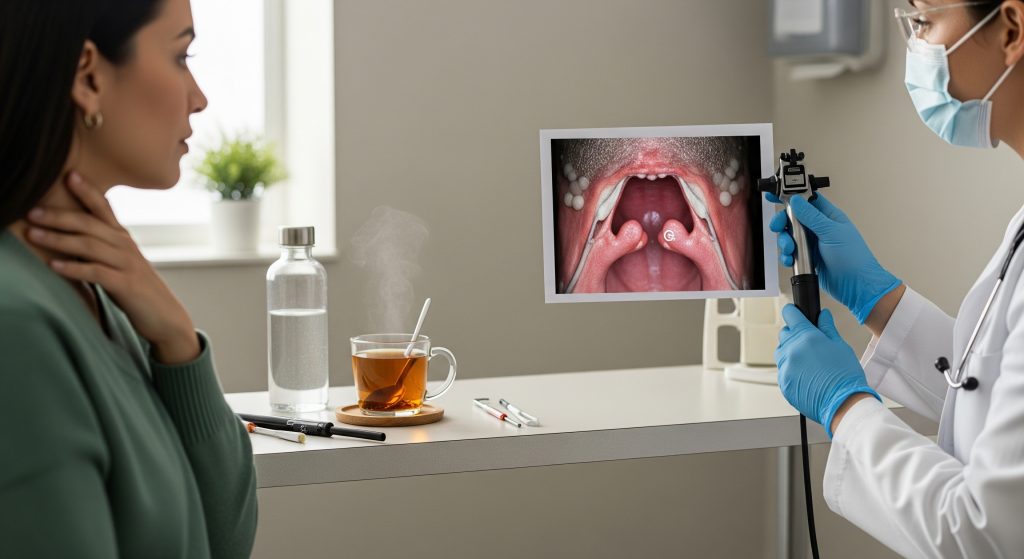
Flexible nasendoscopy – a thin camera passed through the nose to visualise the larynx. Uncomfortable but quick.
-
Videostroboscopy – uses strobe lighting to view vocal cord vibration in slow motion. This is the gold standard for assessing polyps.
-
Acoustic analysis – computer measurement of voice parameters
-
Perceptual assessment – trained clinical judgement of voice quality
The stroboscopy is genuinely fascinating to watch (even if you’re the patient). Seeing your own vocal cords in action makes the problem suddenly very real and concrete.
Questions to Ask Your ENT Doctor
Don’t leave the consultation with unanswered questions. Here’s what to ask:
-
Is this definitely a polyp, or could it be something else?
-
How long has this likely been present?
-
Is conservative management realistic for this case?
-
What specific behaviours should I change?
-
If surgery becomes necessary, what are the risks?
-
What’s the likelihood of recurrence?
-
Should I see a speech pathologist regardless of treatment path?
Finding Qualified ENT Specialists
Not all ENT doctors specialise in voice. For polyp assessment and treatment, seek a laryngologist – a subspecialist focused specifically on the voice box. They work closely with speech pathologists and understand the nuances of voice rehabilitation.
Ask about their experience with phonomicrosurgery (delicate vocal cord surgery) and whether they have access to stroboscopy equipment. These aren’t unreasonable questions – they’re practical ones that affect outcomes.
Vocal Cord Polyp Surgery: Process and Recovery
When conservative measures fail, vocal cord polyp surgery offers a way forward. It’s not as dramatic as it sounds, but it does require understanding and commitment to the recovery process.
Pre-Surgery Evaluation Requirements
Before scheduling surgery, several assessments happen:
-
Comprehensive voice evaluation – baseline measurements for comparison post-surgery
-
General health assessment – standard pre-operative checks
-
Discussion of realistic expectations – surgery removes the polyp, not the underlying habits
-
Speech therapy consultation – often recommended before AND after surgery
Some surgeons request voice therapy before operating. This seems counterintuitive – why delay? But establishing good vocal habits pre-operatively improves post-surgical outcomes and reduces recurrence risk.
Microlaryngoscopy Surgical Procedure
Phonomicrosurgery – specifically microlaryngoscopy with excision – is the standard approach. Here’s what actually happens:
The procedure occurs under general anaesthetic. A laryngoscope (metal tube) is placed through the mouth to expose the vocal cords. Operating microscopes and very fine instruments allow precise removal of polyp tissue while preserving healthy vocal cord structure.
The whole thing typically takes under an hour. Most patients go home the same day. There’s no external incision – everything happens through the mouth.
The skill lies in removing exactly enough tissue and exactly the right tissue. Too aggressive, and vocal quality suffers. Too conservative, and the polyp returns.
Post-Operative Voice Rest Guidelines
This is where discipline matters enormously. Immediately following surgery, complete voice rest is required. We’re talking absolute silence – typically for seven to fourteen days, depending on the surgeon’s protocol.
And this is hard. Genuinely hard. No talking, no whispering (whispering is actually worse – it creates more tension), no clearing the throat. Communication happens via writing, texting, or pre-prepared cards explaining the situation.
The surgical site needs time to heal without the mechanical stress of vocal cord vibration. Violating voice rest can create scarring that permanently affects voice quality. It’s that important.
Recovery Timeline and Milestones
The recovery process follows a fairly predictable pattern:
|
Timeframe |
What to Expect |
|---|---|
|
Days 1-7 |
Complete voice rest. Mild throat discomfort. Possibly some swallowing difficulty. |
|
Weeks 1-2 |
Gradual voice reintroduction under SLP guidance. Voice sounds rough initially. |
|
Weeks 3-6 |
Progressive voice use increase. Voice quality improving but variable. |
|
Weeks 6-12 |
Tissue maturation continuing. Voice becoming more stable. |
|
Months 3-6 |
Final voice quality emerging. Full activities typically resume. |
The voice doesn’t sound perfect immediately. In fact, it often sounds worse before it sounds better. The surgical site goes through healing phases that temporarily affect vibration patterns. Patience is essential.
Long-term Voice Care After Surgery
Surgery addresses the immediate problem. Long-term success depends on what happens next.
Speech therapy post-surgery isn’t optional – it’s essential. The patterns that created the original polyp need systematic retraining. Without this, recurrence rates climb significantly.
Ongoing voice hygiene becomes a permanent consideration:
-
Adequate hydration – every day, not just when symptomatic
-
Reflux management – ongoing vigilance
-
Voice pacing – building rest into heavy voice-use days
-
Warm-up exercises – especially for professional voice users
-
Regular check-ups – periodic laryngoscopy to catch any changes early
Think of it like maintaining dental health. You don’t stop brushing after a filling is completed.
Managing Vocal Cord Polyps Successfully
The single most frustrating part of vocal cord polyps is how preventable most cases are. Voice abuse and misuse – yelling at kids, talking over noise, pushing through laryngitis, clearing the throat constantly – these everyday behaviours accumulate into real pathology.
Success with polyps comes down to three things: recognising symptoms early, seeking appropriate specialist care, and committing to voice habit changes whether or not surgery happens. The voice is resilient, but it’s not indestructible.
For anyone experiencing persistent vocal cord polyps symptoms, the message is simple: don’t wait. Early intervention expands treatment options and improves outcomes. What feels like a minor nuisance today can become a significant functional limitation if ignored for months.
The voice is too important for everyday communication, relationships, and often careers to dismiss warning signs as “probably nothing.” Getting checked out costs time and perhaps some mild discomfort during nasendoscopy. Not getting checked out can cost far more.
Frequently Asked Questions
Can vocal cord polyps heal without surgery?
Some polyps – particularly small, recent, oedematous ones – can resolve with conservative management including voice rest, speech therapy, and lifestyle modifications. However, larger, older, or fibrotic polyps typically require surgical removal. The key factor is timing: seeking treatment early maximises the chances of avoiding surgery.
How long does voice recovery take after polyp removal?
Initial voice rest lasts one to two weeks. Gradual voice use returns over the following weeks with speech therapy guidance. Most people see significant voice improvement within three months, though final voice quality continues developing for up to six months. Full activities typically resume around the three-month mark.
What causes vocal cord polyps to develop?
Polyps usually result from vocal trauma – either a single acute injury (screaming, forceful coughing) or cumulative voice misuse over time. Contributing factors include chronic throat clearing, speaking over background noise, untreated reflux, smoking, dehydration, and excessive voice demands without proper technique or rest periods.
Are vocal polyps different from throat cancer symptoms?
Yes, vocal polyps are benign growths – not cancer. However, the symptoms (persistent hoarseness, voice changes) can overlap with early laryngeal cancer symptoms. This is precisely why persistent hoarseness beyond two weeks warrants medical evaluation. Visual inspection of the vocal cords through laryngoscopy can differentiate between benign and concerning lesions.
Can children develop vocal cord polyps?
Children can develop vocal cord lesions, though nodules are far more common than true polyps in paediatric populations. Children who frequently yell, scream, or make loud vocalisations during play are at higher risk. Treatment typically focuses on behavioural modification and voice therapy, with surgery rarely needed in children.
What foods should I avoid with vocal cord polyps?
Foods that worsen reflux should be limited: spicy dishes, citrus, tomatoes, chocolate, caffeine, and alcohol. Large meals close to bedtime are problematic. Dairy doesn’t directly affect polyps but may increase mucus sensation for some individuals, leading to more throat-clearing (which does affect polyps). Hydrating foods and adequate water intake support vocal cord health.

