






 We do what's right for you...


Understanding the TKR Procedure: What Patients Should Expect
Dr. Rajeev K Sharma
Introduction
Hearing that you need a knee replacement can feel overwhelming. Knowing what happens before, during, and after surgery can ease anxiety. At Moolchand, one of the best hospital in Delhi, our superb physicians guide patients step by step, supported by cutting-edge technology and compassionate care.
The TKR Procedure is a common surgical treatment for people with severe knee damage. TKR means Total Knee Replacement. It is considered when pain, stiffness, and limited movement affect daily activities. The goal of total knee replacement surgery is to reduce pain and improve knee function.
A knee replacement does not mean replacing the entire knee with a single artificial joint. During the procedure, damaged surfaces of the knee are removed. They are then replaced with specially designed artificial components.
For patients considering Knee Replacement Surgery in Delhi, understanding the complete treatment journey can help them make informed decisions. The process usually includes medical evaluation, preparation, surgery, hospital recovery, physiotherapy, and follow-up care.
Pre-Surgery Preparation
Preparation is an important part of tkr surgery. Your doctor evaluates your overall health and examines the condition of your knee before recommending surgery.
Evaluation
Your evaluation may include physical examination, X-rays, blood tests, and other investigations. These tests help the surgical team understand the condition of your knee and identify any health concerns that may affect surgery.
Cardiac clearance may also be required for some patients. This can involve consultation with a cardiologist, including support from the best cardiologist near me, when appropriate.
Your medical history, current medicines, allergies, previous surgeries, and other relevant health information are also reviewed.
Lifestyle Preparation
Your doctor may recommend exercises before surgery. These exercises can help strengthen the muscles around the knee and prepare your body for postoperative rehabilitation.
Maintaining a healthy weight, following prescribed exercises, and stopping certain medicines when advised can also support surgical preparation.
Patients should follow their surgeon’s instructions carefully. Good preparation can help make the recovery process smoother.
Patient Counseling
Patient counseling is another important part of preparation. Your doctor explains the knee replacement procedure, expected recovery, possible risks, and rehabilitation requirements.
Clear communication helps patients understand realistic expectations. At Moolchand, patient care is guided by integrity, transparency, and a focus on individual needs.
The TKR Procedure Step by Step
A total knee replacement surgery generally follows several important steps. The exact approach can vary depending on the patient’s condition, surgeon’s recommendation, and technology used.
1. Anesthesia
Before the knee replacement operation, anesthesia is administered. Spinal or general anesthesia may be used depending on the patient’s medical condition and surgical plan.
The anesthesia team monitors the patient’s vital signs throughout the operation. This helps ensure patient safety and comfort during surgery.
2. Incision
The surgeon makes an incision to access the knee joint. The size and position of the incision can vary depending on the surgical approach.
Through this access, the surgeon reaches the damaged portions of the knee.
3. Resurfacing the Joint
The damaged bone and cartilage are carefully removed from the affected surfaces of the knee.
The surgeon prepares the bone surfaces to receive the artificial components. Proper preparation is important for achieving appropriate implant positioning and knee function.
4. Implant Placement
Artificial components made from medical-grade materials are positioned to replace the damaged joint surfaces.
The implant typically includes components designed to replace the damaged portions of the thigh bone and shin bone. A specialized component may also be used for the kneecap, depending on the patient’s condition.
Correct implant positioning is an important part of tka surgery.
5. Closure
After checking the movement and stability of the knee, the surgical wound is closed.
The knee is then bandaged, and the patient is moved to the recovery area for monitoring.
Advanced Techniques at Moolchand
Modern approaches to total knee replacement surgery focus on accurate implant positioning, appropriate surgical planning, pain management, and early rehabilitation.
Minimally Invasive Approaches
Where clinically appropriate, minimally invasive approaches may help reduce tissue disruption. The suitability of an approach depends on the patient’s anatomy, condition, and surgeon’s assessment.
Computer-Guided Precision
Computer-assisted technology can help surgeons plan and perform surgery with greater precision. It can assist with assessing alignment and positioning during the procedure.
Accurate alignment is important because it can influence knee movement, stability, and implant performance.
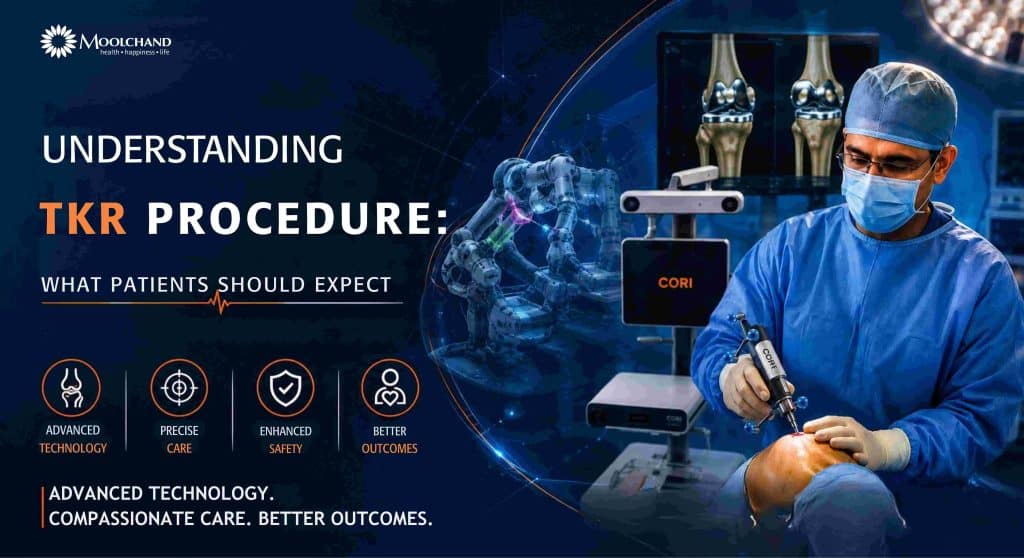
Robotic Knee Replacement
For selected patients, robotic knee replacement may be considered. Robotic technology can assist surgeons with surgical planning and bone preparation.
The technology does not replace the surgeon. Instead, it works as a supporting tool that helps the surgical team perform the planned procedure with precision.
The choice between conventional, computer-assisted, or robotic techniques depends on individual patient requirements.
Recovery in Hospital
Recovery begins soon after surgery. Modern knee replacement programs often encourage early movement when medically appropriate.
Early Mobilization
Patients may begin walking with support within 24–48 hours after surgery, depending on their medical condition and the surgeon’s recommendations.
Early mobilization can support recovery and help patients gradually regain confidence in using the operated leg.
Pain Management
Pain management is an important part of recovery. Doctors may use medicines and other strategies to keep postoperative discomfort under control.
Patients should communicate openly with the medical team about their pain. This allows treatment to be adjusted according to individual needs.
Physiotherapy
Physiotherapy plays a major role following tkr surgery.
A physiotherapist may guide patients through exercises designed to improve:
- Knee movement
- Muscle strength
- Balance
- Walking ability
- Independence in daily activities
The rehabilitation program is gradually adjusted as recovery progresses.
Hospital Discharge
The length of hospital stay varies from patient to patient. Factors such as age, general health, mobility, pain control, and recovery progress can influence discharge timing.
Discharge may typically occur within 4–6 days at private hospitals in Delhi like Moolchand, depending on individual recovery.
Recovery After Knee Replacement
Recovery does not end after leaving the hospital. Patients usually continue physiotherapy and home exercises according to their rehabilitation plan.
Walking ability generally improves gradually. Patients may initially need a walker or other support. As strength and balance improve, support can usually be reduced under professional guidance.
Patients should attend scheduled follow-up appointments. These visits allow the surgeon to assess healing, knee movement, and overall progress.
It is important not to rush recovery. Every patient progresses at a different pace.
Knee Replacement Surgery Cost
The knee replacement surgery cost can vary considerably. It depends on several factors, including the type of implant, surgical technique, hospital stay, investigations, surgeon’s fees, medicines, physiotherapy, and other medical requirements.
Patients should discuss the expected treatment expenses with the hospital before surgery. A clear estimate can help families understand the financial aspects of treatment.
The cost should not be considered separately from the quality of care. Surgical expertise, implant quality, infection-control practices, rehabilitation support, and hospital facilities are also important considerations when choosing a treatment centre.
Choosing the Right Hospital and Surgeon
Choosing the right medical team is an important decision when planning Knee Replacement Surgery in Delhi.
Patients may consider factors such as:
- Experience of the surgical team
- Hospital accreditation and clinical standards
- Availability of advanced technology
- Physiotherapy and rehabilitation support
- Emergency and critical-care facilities
- Infection-control practices
- Patient safety protocols
- Transparent communication
- Overall patient experience
People searching for the best orthopaedic hospital delhi should evaluate the complete care pathway rather than focusing on a single factor.
Similarly, selecting one of the experienced total knee replacement surgeons can help ensure that the treatment plan is based on the patient’s individual condition.
Patients looking for the best orthopedic doctor in delhi should consider the doctor’s experience, treatment approach, communication, and suitability for their specific knee condition.
Who May Need Total Knee Replacement?
A knee replacement may be recommended when severe knee damage causes persistent pain and affects everyday activities.
Common reasons may include advanced osteoarthritis, rheumatoid arthritis, previous knee injuries, or significant joint damage.
Doctors usually consider non-surgical treatments first when appropriate. These may include medicines, physiotherapy, lifestyle changes, injections, and activity modification.
When these treatments no longer provide adequate relief and knee damage is severe, surgery may become an option.
The decision should always be made after a detailed evaluation by an orthopaedic specialist.
TKA Surgery vs TKR Surgery
The terms tka surgery and tkr surgery are often used to describe the same type of operation.
TKA stands for Total Knee Arthroplasty, while TKR stands for Total Knee Replacement.
Both terms generally refer to surgery in which damaged knee joint surfaces are replaced with artificial components.
Your orthopaedic surgeon can explain which procedure is appropriate based on your symptoms, X-rays, physical examination, and overall health.
Conclusion
Understanding the TKR Procedure can help patients feel more confident and prepared for treatment. From pre-surgery evaluation to the knee replacement operation, hospital recovery, physiotherapy, and follow-up, every stage contributes to the overall treatment journey.
total knee replacement surgery aims to reduce severe knee pain and improve mobility when other treatment options are no longer effective.
For patients considering Knee Replacement Surgery in Delhi, choosing an experienced surgical team and a well-equipped hospital is an important step.
At Moolchand, patients rely on superb physicians, affordable prices, cutting-edge technology, compassionate care, and integrity throughout their treatment journey. As a best hospital in Delhi, Moolchand focuses on providing comprehensive orthopaedic care with patient safety and individualized treatment at the centre of the experience.
10 FAQs About TKR Procedure
1. What is a TKR Procedure?
TKR Procedure, or Total Knee Replacement, is a surgery that replaces damaged knee joint surfaces with artificial components. It can help reduce severe knee pain and improve mobility.
2. When is total knee replacement surgery recommended?
Total knee replacement surgery may be recommended when severe knee damage causes persistent pain, stiffness, and difficulty performing daily activities, especially when other treatments no longer provide sufficient relief.
3. How long does TKR surgery take?
The duration of TKR surgery can vary depending on the patient’s condition and surgical approach. Your orthopaedic surgeon can provide a more specific estimate after evaluation.
4. Is knee replacement surgery painful?
Pain can occur after surgery, but doctors use pain-management strategies to keep discomfort under control. Physiotherapy and gradual movement are important parts of recovery.
5. What is the recovery time after a knee replacement?
Recovery varies from person to person. Patients usually begin walking with support soon after surgery and continue physiotherapy after discharge. Full recovery can take several weeks to months.
6. What is the difference between TKA surgery and TKR surgery?
TKA means Total Knee Arthroplasty, while TKR means Total Knee Replacement. Both terms generally refer to surgery to replace damaged knee joint surfaces with artificial components.
7. How much does knee replacement surgery cost?
The knee replacement surgery cost varies depending on factors such as the implant, surgical technique, hospital stay, investigations, medicines, and rehabilitation. Patients should discuss the expected cost with their hospital before surgery.
8. Is robotic knee replacement better than conventional surgery?
Robotic knee replacement can assist surgeons with surgical planning, alignment, and bone preparation. Whether it is suitable depends on the patient’s condition and the surgeon’s assessment.
9. How long will I stay in the hospital after TKR surgery?
Hospital stay varies according to individual recovery. Many patients may be discharged within a few days when pain is controlled and they can move safely with appropriate support.
10. How do I choose the right hospital for Knee Replacement Surgery in Delhi?
Consider the experience of the orthopaedic team, hospital facilities, surgical technology, rehabilitation services, patient-safety protocols, and overall quality of care when choosing a hospital for Knee Replacement Surgery in Delhi.

