






 We do what's right for you...


Understanding Median Nerve Compression and Hand Numbness
Dr. Arunav Sharma
Rest is often prescribed for tingling hands. Helpful, yes, but incomplete. If the Median Nerve is irritated, the cause is usually mechanical compression. Not fatigue. You need to know where and why the pressure occurs, how symptoms evolve, and which interventions reliably change the course. This guide clarifies the common patterns of median nerve compression, shows you how to recognise early warnings, and explains conservative and surgical options. It aims for practical action. Not platitudes.
Primary Conditions Causing Median Nerve Compression
1. Carpal Tunnel Syndrome
Carpal tunnel syndrome is the best known cause of median nerve compression at the wrist. You typically notice hand numbness in the thumb, index, and middle fingers. Symptoms may worsen with repetitive gripping or prolonged keyboard use. Swelling in the tunnel reduces space for the Median Nerve and its blood supply. That is why brief shaking of the hand can bring temporary relief.
-
Common triggers: forceful gripping, vibration exposure, and fluid retention states.
-
Typical signs: night tingling, reduced pinch strength, and clumsiness with buttons or coins.
-
Provocation tests can reproduce symptoms, but they are not definitive alone.
Left unchecked, carpal tunnel syndrome can progress from intermittent tingling to persistent numbness. Early action prevents chronic weakness.
2. Pronator Teres Syndrome
Pronator teres syndrome compresses the Median Nerve in the forearm, usually between the two heads of the pronator teres muscle. You often feel aching in the proximal forearm with paresthesia in the same digits as carpal tunnel. Symptoms can worsen with forearm pronation or resisted elbow flexion. Grip may feel normal at rest yet fade during sustained tasks.
A quick screen helps: if night symptoms are minor and forearm tenderness is prominent, think pronator-related compression. Conservative care focuses on load reduction and targeted soft tissue work. Surgical release is rare but considered if conservative measures fail.
3. Anterior Interosseous Nerve Syndrome
The anterior interosseous nerve is a motor branch of the Median Nerve. When compressed, pain is often minimal. Weakness is the hallmark. You may struggle to make an OK sign because thumb and index finger flexion is impaired. Fine motor tasks become awkward despite preserved sensation.
Causes include fibrous bands, anomalous muscles, or traction after heavy lifting. Diagnosis is clinical and may be supported by nerve conduction studies. Many cases improve with rest and physiotherapy, though persistent motor deficits sometimes require surgical decompression.
Risk Factors for Median Nerve Compression
-
Repetitive wrist or forearm tasks, especially with force or vibration.
-
Prolonged wrist flexion or extension during sleep or device use.
-
Metabolic conditions: diabetes, thyroid dysfunction, and obesity.
-
Fluid shifts in pregnancy or renal disease that raise tunnel pressure.
-
Previous fractures or scars altering local anatomy.
These factors act cumulatively. The Median Nerve tolerates load until it does not. Thresholds vary by person and by day.
Anatomical Variations Affecting the Median Nerve
Several variations can influence risk. A persistent median artery may crowd the carpal tunnel. Accessory muscle slips can narrow forearm pathways. A bifid Median Nerve in the tunnel changes symptom distribution and may complicate injections. These variants are not rare. They only matter when space is tight and load is high.
|
Variation |
Potential Impact |
|---|---|
|
Bifid Median Nerve |
Alters tunnel geometry and may blunt response to standard injections. |
|
Persistent Median Artery |
Increases volume in the tunnel and pulsatile contact with the nerve. |
|
Accessory Pronator Slip |
Creates extra compression in forearm rotation tasks. |
Recognising Symptoms and Warning Signs of Median Nerve Issues
Early Hand Numbness Patterns
Early signs are subtle. Intermittent tingling in the thumb, index, and middle fingers after typing or driving. Shaking the hand helps for a moment. These patterns point toward the Median Nerve rather than ulnar or radial involvement. If hand numbness appears after sleep or phone scrolling, consider wrist posture as a key driver.
-
Short tasks cause fleeting pins and needles.
-
Cold rooms and tight cuffs make symptoms more noticeable.
-
Symptoms recede with gentle movement or brief rest.
Progressive Symptoms in Fingers and Thumb
With ongoing compression, symptoms last longer and occur more often. The thumb may feel clumsy when opening jars. Fine pinch weakens. You start dropping small objects. The Median Nerve supplies critical thumb muscles, so sustained compression degrades dexterity. At this stage, self-management is still effective if consistent.
Loss of discrimination between coins in the pocket is a practical red flag.
Wrist Pain and Weakness Indicators
Pain is not always the lead symptom in median nerve compression. When present, it sits at the volar wrist or proximal forearm. Weakness shows during sustained pinch or when holding a book. Repeated flexion reduces grip endurance. If wrist pain coexists with burning tingling, treat compression as the primary issue rather than simple tendon overload.
-
Grip fades by 20 to 30 seconds in provocative positions.
-
Isometric holds reveal fatigue faster than dynamic tasks.
Night-time Symptoms and Sleep Disruption
Night symptoms are classic in carpal tunnel syndrome. Wrist flexion during sleep elevates tunnel pressure and irritates the Median Nerve. You may wake with numb fingers, needing to shake or hang the hand off the bed. A neutral wrist splint can markedly reduce episodes. Consistent use for 2 to 4 weeks usually clarifies benefit.
Sleep disruption compounds daytime sensitivity. Manage posture at night and reduce peak loads by day. Small changes compound.
Distinguishing Median Nerve Compression from Other Conditions
|
Primary sensory area |
Median digits vs ulnar ring-little or dorsal radial zones |
|
Motor pattern |
Thumb opposition and pinch weakness for Median Nerve |
|
Neck referral |
Cervical radiculopathy often spans multiple dermatomes and varies with neck motion |
|
Provocation |
Wrist flexion or forearm rotation increases median symptoms |
Cubital tunnel, De Quervain tenosynovitis, or cervical causes can mimic parts of the picture. Pattern recognition narrows the field quickly.
Treatment Approaches for Median Nerve Compression
Conservative Management Options
Start with load management, education, and graded exercise. The aim is to improve nerve mobility and reduce local pressure. You adjust tasks but do not stop using the hand. The Median Nerve responds to progressive, symptom-informed loading. Use clear baselines and a simple log to track change.
-
Reduce peak compression tasks for 10 to 14 days.
-
Introduce nerve glides and light isometrics daily.
-
Optimise posture and workspace to avoid end-range wrist positions.
Improvement within 3 to 6 weeks is common, though timelines vary.
Splinting and Bracing Techniques
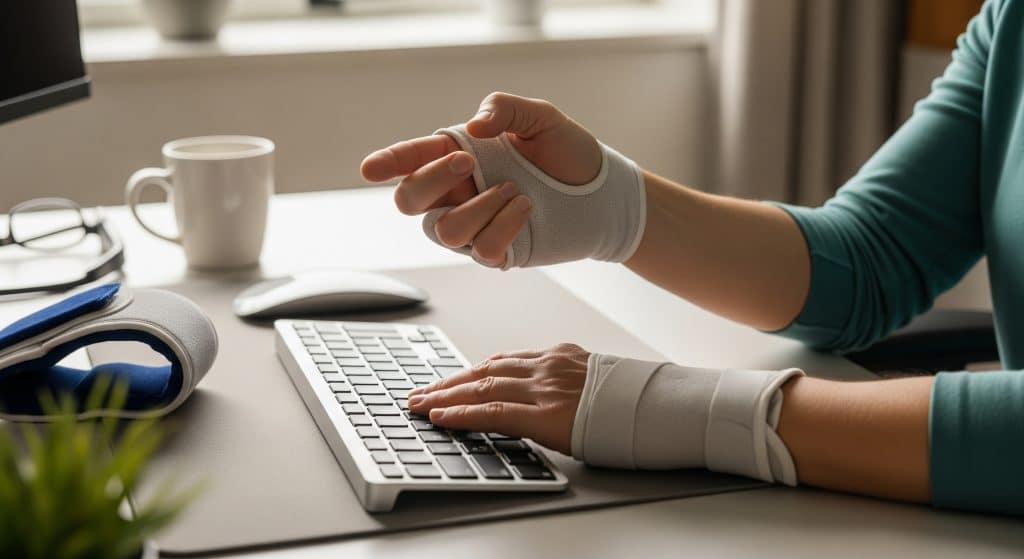
Neutral wrist splints lower tunnel pressure and protect the Median Nerve during sleep and repetitive work. Fit matters more than brand. A well-contoured volar splint that prevents flexion is typically sufficient. Daytime splinting is useful for high-load tasks, not continuously. Too much immobilisation can stiffen tendons.
-
Night use: every night for 2 to 4 weeks, then reassess.
-
Task use: during cycling, driving, or heavy typing blocks.
-
Avoid tight straps that increase edema.
Physical Therapy Exercises for Nerve Gliding
Nerve glides aim to improve the relative motion of the Median Nerve within surrounding tunnels. Perform within a comfortable range. Symptoms should settle within 30 seconds after the set. If they linger, reduce the intensity. Combine glides with mid-range tendon glides to balance tissue mobility.
-
Start in a neutral wrist and elbow position with the shoulder relaxed.
-
Extend fingers and wrist gently while supinating the forearm.
-
Add gradual elbow extension, keeping pain below 3 out of 10.
-
Return to the start position and breathe steadily.
Complete 2 sets of 8 to 10 repetitions once or twice daily. Consistency beats intensity.
Corticosteroid Injections and Medications
For carpal tunnel syndrome, a well-placed corticosteroid injection can ease symptoms for months. It reduces tenosynovial swelling, creating space for the Median Nerve. Response is better in mild to moderate cases. Oral anti-inflammatories may help in short courses, though benefits are modest. Always combine medication with load management and exercise for durable change.
Repeated injections have diminishing returns. If symptoms recur quickly, escalate to a surgical consult rather than cycling injections.
Surgical Interventions and Recovery
When symptoms persist despite structured conservative care, surgical decompression is effective. Carpal tunnel release increases tunnel volume and relieves Median Nerve pressure. Pronator and AIN entrapments can also be released when clearly identified. Technique selection varies by surgeon and anatomy.
-
Expected timeline: symptom relief often within days, strength recovery in weeks.
-
Rehabilitation: early finger motion, progressive grip training, scar care.
-
Return to work: office roles in 1 to 2 weeks, manual roles in 3 to 6 weeks.
Outcomes are strong when preoperative numbness is not longstanding. Chronic denervation recovers less fully, though function still improves.
Alternative Therapies and Their Effectiveness
Acupuncture, laser, and ultrasound appear to provide short-term relief in some cases, at least from available trials. Benefits are typically modest and adjunctive. Splints, graded exercise, and ergonomic change remain the mainstays. Manual therapy focused on the forearm flexors can reduce perceived tightness. It complements, not replaces, nerve-specific work.
In brief, use alternatives to amplify a sound plan, not to avoid one.
Prevention and Long-term Management Strategies
Ergonomic Workplace Modifications
Your desk should fit you, not the other way around. Keep the wrists in neutral and the elbows near 90 degrees. Position the keyboard low and flat. A split keyboard can reduce ulnar deviation. Use a light-touch mouse with minimal grip force. This protects the Median Nerve during long sessions of typing and pointing.
-
Reduce keystroke force and use shortcuts to limit repetition.
-
Take microbreaks every 30 to 45 minutes.
-
Rest forearms on the desk, not the wrist crease.
Daily Stretching Exercises for the Median Nerve
Two short routines are sufficient. Morning mobility to prime the system. Evening recovery to downshift sensitivity. Keep the intensity low, the volume steady. The Median Nerve prefers calm rhythm.
-
Morning: gentle tendon glides, then light wrist extension holds for 15 seconds.
-
Evening: median nerve slider in mid-range followed by forearm flexor stretches.
Track response. If tingling increases and lingers, reduce range or frequency. Adaptation beats bravado.
Activity Modifications to Reduce Compression
-
Alternate tasks to avoid long blocks of one movement pattern.
-
Use padded gloves for cycling and light tools for DIY work.
-
Keep the wrist straight during lifting and carrying.
-
Rotate grips in the gym and avoid end-range holds.
These adjustments look minor. Over a week, they lower cumulative pressure on the Median Nerve. That is what matters.
Lifestyle Changes to Support Nerve Health
Glycaemic control, thyroid health, and weight management influence nerve resilience. Hydration supports tissue gliding. Sleep regularity reduces pain amplification. Smoking cessation improves microvascular flow. Each factor adds a small edge. Together, they protect the Median Nerve from avoidable stress.
From a training view, plan recovery weeks. Your hands are not exempt from periodisation.
Taking Control of Median Nerve Health
Clarity drives action. Identify whether symptoms fit carpal tunnel syndrome, pronator teres involvement, or an anterior interosseous pattern. Match the plan to the problem. Start with load changes, splinting, and nerve glides. Escalate with injections or surgery when progress plateaus. Keep the long view. Protect the Median Nerve and function follows.
Frequently Asked Questions
How long does median nerve compression take to heal?
Recovery depends on severity, duration, and your adherence to treatment. Mild cases often improve within 3 to 6 weeks using splints, load management, and nerve glides. Moderate cases may require 8 to 12 weeks. After surgery, many regain comfort quickly, though strength rebuilds over several weeks. Timelines vary, as far as current data suggests.
Can median nerve damage be reversed without surgery?
Yes, in many cases. If compression is mild to moderate and not longstanding, conservative care can reverse symptoms. Splinting, exercise, and ergonomic changes reduce pressure on the Median Nerve and restore function. When numbness is constant or weakness progresses, a surgical opinion is appropriate. Do not delay if dexterity is worsening.
What sleeping positions worsen median nerve compression?
Positions that hold the wrist in flexion tend to aggravate symptoms, especially in carpal tunnel syndrome. Side sleeping with the hand under the head is a common culprit. A neutral wrist splint prevents this. Keeping the elbow softly bent and the shoulder relaxed also helps. Small pillows can stop the hand from folding in during sleep.
Is hand numbness always caused by median nerve issues?
No. Hand numbness can arise from ulnar nerve compression, cervical radiculopathy, or even vascular causes. Distribution offers clues. The thumb, index, and middle fingers suggest the Median Nerve. The ring and little fingers suggest ulnar involvement. If symptoms shift with neck movement, screening the cervical spine is prudent.
When should I seek medical attention for wrist pain and numbness?
Seek care if symptoms persist beyond 2 to 3 weeks despite rest and ergonomic changes. Immediate review is warranted if weakness appears, you drop objects frequently, or night pain disrupts sleep. Diabetes, pregnancy, or previous fractures justify earlier assessment. Early diagnosis prevents chronic Median Nerve irritation.
Can pregnancy cause temporary median nerve compression?
Yes. Fluid shifts and hormonal changes increase pressure in the carpal tunnel during pregnancy. Night tingling and wrist pain are common. Most cases improve postpartum as fluid levels normalise. Splinting at night, activity pacing, and gentle gliding exercises are safe options. Surgery is rarely needed during pregnancy unless symptoms are severe.

