






 We do what's right for you...


Transformational Impact of a Neurosurgeon on Spine Health
Dr. Arunav Sharma
Conventional wisdom says spine surgery always means long recoveries and heavy scars. That view no longer holds. With the right Neurosurgeon, you can access precise, targeted treatments that shorten hospital stays, preserve motion, and reduce pain. It is basically a quiet revolution powered by imaging, robotics, and data. The impact is not theoretical. You feel it when walking further, sleeping better, and returning to work without fear.
Life-Changing Neurosurgical Procedures for Spine Health
1. Minimally Invasive Endoscopic Spine Surgery
Endoscopic techniques aim to treat the problem while sparing healthy tissue. As Percutaneous Endoscopic Posterior Decompression for reports, percutaneous management for thoracic myelopathy can deliver durable neurological gains over 60 to 72 months with minimal blood loss. That balance of safety and efficacy matters when frailty or comorbidities raise the stakes.
Quicker recovery is not hype. As Patient Recovery Following Uniportal Endoscopic Vs Open notes, uniportal endoscopic patients regained mobility faster, with wearable sensors confirming improved gait and activity. The pattern is consistent across age groups. As Minimally Invasive Endoscopic Spine Surgery as a Viable describes, even a nonagenarian achieved marked pain relief. That example is extreme, yet informative.
Endoscopic spine surgery is expanding in scope. As Development of an Endoscopic Spine Surgery Program explains, uniportal and biportal approaches reduce morbidity and length of stay, though they demand investment and steep learning. The right Neurosurgeon will be open about that curve and the benefits to you.
-
Typical benefits: smaller incisions, less muscle disruption, faster mobilisation.
-
Common uses: disc herniation, spinal stenosis, selected deformity or tumour decompressions.
-
What this means: less collateral damage and more targeted relief.
2. Robotic-Assisted Spine Surgery with AI Navigation
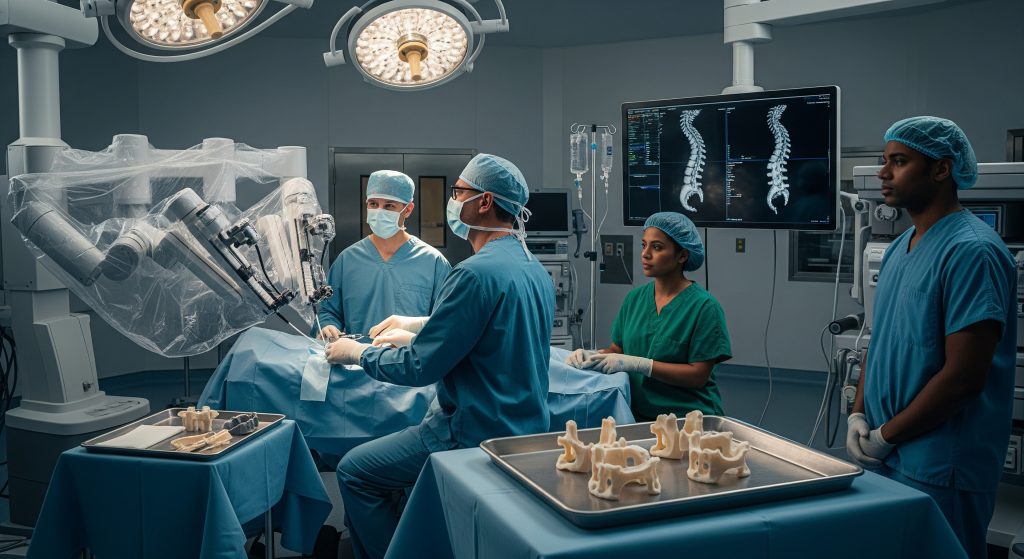
Robotics and AI refine precision where millimetres matter. As Scoping review of robotics technology in spinal surgery indicates, robotic assistance improves accuracy and reduces complications, integrating with augmented reality and navigation. As Artificial Intelligence and Robotics in Spine Surgery adds, AI enhances preoperative planning and reduces fatigue during demanding cases.
Not every setting employs robots. As Why navigation and robotics are not the standard for all spine surgery highlights, adoption varies by surgical volume and national income. Economics remain a practical constraint. As The hidden cost of robotic spine surgery notes, delays and adverse events can erode efficiency claims, though evidence is evolving. There are counterpoints. As Cost-effectiveness of robotic-assisted spinal surgery suggests, cost-effectiveness improves when limiting levels or reducing revisions. Context is the lever.
-
Where it helps most: complex deformity, revision instrumentation, or anatomically challenging pedicles.
-
What to ask: accuracy metrics, revision rates, and team training in the chosen platform.
A skilled Neurosurgeon will use robotics when the precision gain outweighs the overhead. Not as a badge, but as a tool.
3. Custom 3D-Printed Spinal Implants
Personalised implants solve a simple problem. Standard sizes are not always a match. As Implications of 3-Dimensional Printed Spinal Implants on explains, 3D printing enables patient-specific geometry, lighter constructs, and better fit for complex reconstructions. As 3D printing in spine surgery – PMC notes, the shift moved from models to surgical guides to true implants, improving precision, though long-term data are still maturing.
Clinical signals are encouraging. As Clinical Outcomes of 3D-Printed Titanium Patient-Specific reports, patient-specific titanium implants can reduce operative time and complications while enhancing satisfaction. Milestones keep arriving. As World’s First Custom Anterior Cervical Spine Surgery documented, a fully personalised cervical implant was successfully used in a complex case.
Barriers remain. Costs and heterogeneous evidence limit widespread use. A prudent Neurosurgeon will weigh benefit, durability, and value for your condition. Carefully and openly.
4. Anterior and Lateral Lumbar Interbody Fusion
Fusion is sometimes the most reliable way to stabilise painful motion segments. As Lumbar interbody fusion: techniques, indications and comparison of interbody fusion options outlines, options include PLIF, TLIF, MI-TLIF, OLIF, LLIF, and ALIF. Indications include discogenic pain, spondylolisthesis, and claudication, with each approach offering trade-offs in access, risk, and correction.
Lateral approaches have grown for good reasons. As The evolving role of lateral lumbar interbody fusion in lumbar fusion describes, LLIF can preserve posterior elements, enable indirect decompression, and reduce complications. Anterior access remains valuable. As Anterior lumbar interbody fusion: patient selection and workup notes, ALIF offers large graft placement and disc space restoration, though vascular risks demand careful preoperative imaging.
In practice, your Neurosurgeon will tailor the approach to anatomy, goals, and risk profile. Less ideology. More fit for purpose.
5. Percutaneous Vertebroplasty and Kyphoplasty
Osteoporotic fractures are painful and disabling. As Percutaneous Vertebroplasty and Kyphoplasty – NCBI – NIH explains, vertebroplasty and kyphoplasty inject cement to stabilise the vertebral body, with kyphoplasty using a balloon to restore height. As Vertebroplasty and Kyphoplasty Can Restore Normal Spine Mechanics – PMC indicates, both improve mechanics and relieve pain, though vertebroplasty may carry higher leakage risk.
Which is better depends. As Vertebroplasty and kyphoplasty: a comparative review of efficacy – PMC and Cureus note, outcomes vary and no single method dominates across all patients. Your selection should reflect fracture pattern, bone quality, and symptom duration.
-
Best candidates: persistent pain after conservative care, acute or subacute compression fractures.
-
Key decisions: height restoration goals vs cement leakage risk.
6. Artificial Disc Replacement Surgery
Motion preservation is the promise. As What You Should Know About the Latest in Artificial Disc Technology explains, modern discs mimic natural biomechanics and may reduce adjacent segment degeneration compared with fusion. Bone health is pivotal. As Optimizing bone health before complex spinal surgery notes, preoperative optimisation of bone density and nutrition shapes outcomes and integration.
Your Neurosurgeon will confirm candidacy, including alignment, facet integrity, and bone quality. Not everyone benefits from a disc. Selection wins here.
7. Spinal Cord Stimulation for Chronic Pain
When surgery is not the answer, neuromodulation can be. Spinal cord stimulation modulates pain signalling using implanted leads and a generator. A trial often precedes the implant to confirm benefit. A Neurosurgeon or a spine surgeon may offer this when conservative care and targeted decompression have failed. Expectations must be precise. Relief is significant for many, though not universal.
Essential Skills and Training Requirements for Neurosurgeons
Medical School and Residency Pathway
The training pipeline is long and structured. As Training Requirements states, residency typically spans 84 months, with core clinical rotations and a 12 month chief year, plus basic neuroscience and surgical critical care. Research capacity matters. As Roadmap for Successful Research Training in Neurosurgery argues, protected time and mentorship help trainees move into independent research roles. That mix of operating and inquiry defines modern neurological surgery.
A capable Neurosurgeon brings both technical and scientific literacy to your case. It shows in the plan and in the results.
Fellowship Specialisation in Spine Surgery
Fellowship deepens judgement and technique. As Experience of a fellowship in spinal surgery – PubMed Central notes, a one year spine fellowship significantly improves confidence in elective and emergent cases, especially deformity. Global gaps persist. As Review of global neurosurgery education – PubMed Central highlights, disparities in fellowship access limit specialised care in some regions.
Resources exist to guide applicants. As NASS Fellowship Directory lists, more than 100 programmes operate across North America, with a match process to align training needs. Programme examples illustrate breadth. As Spine Fellowship | UCSF Department of Orthopaedic Surgery details, curricula emphasise minimally invasive techniques, complex reconstructions, and research participation.
A fellowship trained Neurosurgeon in spine care will likely show stronger outcomes in complex pathologies. Not always. Often.
Mastery of Advanced Imaging Technologies
Imaging mastery underpins precision. As Roadmap for Successful Research Training in Neurosurgery outlines, training programmes now centre CT, MRI, and advanced guidance techniques for clinical and research excellence. Clinical practice relies on them. As How advancing technology is transforming modern neurosurgery notes, neuronavigation maps complex anatomy for safer, less invasive approaches.
AI is entering routine imaging workflows. As Research Shows AI’s Potential in Spine Care reports, models have reached up to 97% accuracy reading spinal MRIs and can prioritise CT interpretation to cut delays. As Artificial Intelligence in Spinal Imaging and Patient Care and Artificial Intelligence and Imaging in Neurosurgical Practice add, AI supports personalised planning and intraoperative decisions.
For you, this means better targeting and fewer surprises. That is the quiet dividend of good imaging.
Robotic Surgery Certification and Training
Robotics require structured training, not just enthusiasm. As Spine Image Guidance and Robotics: Exposure, Education, Training, and the Learning Curve explains, adoption is limited by learning demands and the lack of standardised curricula. Use is growing. As Global adoption of robotic technology into neurosurgical practice and research reports, 48.5% of neurosurgeons in one survey used robotics clinically, especially in Europe and North America.
Hands-on programmes help bridge the gap. As Robotic Surgery Training Programs | Ohio State College of Medicine outlines, options include live case observations and skills development. As AAGL/Intuitive Senior Fellows Advanced Robotics Procedure Skills Course shows, platform specific courses build confidence in systems like the da Vinci Xi.
Ask your Neurosurgeon about case volumes and platform credentials. Volume and vigilance matter.
Continuous Professional Development Requirements
Technical skill alone is insufficient. As Non-technical skills for neurosurgeons: An international survey highlights, attention to detail, humility, and self awareness shape teamwork and outcomes. Regulatory frameworks support ongoing growth. As European training requirements in neurological surgery notes, annual reviews and multifaceted assessments are standard.
Structured lifelong learning is expected. As Continuing Certification explains, the ABNS programme requires regular assessments and quality improvement participation, with flexibility for multiple certifications. Broader healthcare also recognises the need. As MEETING ON POST-GRADUATE AND CONTINUING EDUCATION OF PHYSICIANS IN THE EASTERN MEDITERRANEAN REGION argues, continuing education must align with system needs to remain effective.
The best Neurosurgeon keeps learning. Quietly and consistently.
Critical Differences Between Neurosurgeons and Neurologists
1. Surgical vs Non-Surgical Treatment Approaches
Think of scope first. Neurologists diagnose and treat with medicines, rehabilitation, and injections. Neurosurgeons operate when structural compression or instability demands mechanical correction. As OrthoIndy explains, non surgical care usually comes first, with a seamless shift to surgery if deficits or deformity persist. Evidence supports careful escalation. As PubMed shows, many chronic low back pain treatments outperform placebo only marginally. For unstable fractures, surgical options can outperform bracing. As PubMed reports, surgery improved pain and function for thoracolumbar burst fractures in the right patients.
In short, one treats physiology, the other fixes anatomy. Both matter.
2. Educational Pathways and Training Duration
Pathways diverge after medical school. Neurology typically involves a shorter residency plus optional subspecialty fellowships. As Training of Neurologists in South East Asian Countries notes, programmes vary but emphasise core competencies and targeted fellowships. Neurosurgical training is longer. As Training Requirements confirms, residency spans about seven years, followed by possible fellowships in spine or skull base. As How to become a Neurosurgeon? – A step-by-step guide summarises, the full journey is lengthy and specialised.
Depth of operative training defines the Neurosurgeon’s role in your care.
3. Diagnostic Tools and Treatment Methods
Both use MRI and CT, but with different aims. As Brain Magnetic Resonance Imaging: Perception and Expectations of Neurologists, Neurosurgeons and Psychiatrists notes, neurosurgeons rely on MRI mainly for surgical planning and follow up, while neurologists focus on diagnosis. Robotics and navigation now complement surgery. As Neurosurgery 4.0: A Scoping Review of Current Trends and Challenges in Specialized Smart Hospitals and Artificial intelligence and machine learning in spine care: Advancing precision diagnosis, treatment, and rehabilitation note, AI assisted navigation improves implant placement and reduces complications.
The toolkit differs, because the job differs.
4. Patient Conditions Commonly Treated
You would see a neurologist for migraines, epilepsy, neuropathies, multiple sclerosis, or movement disorders. You would see a Neurosurgeon for disc herniations, spinal stenosis, spondylolisthesis, tumours, tethered cord, Chiari malformation, and trauma. Overlap exists in pain and peripheral nerve issues. Shared clinics handle that grey zone well.
5. Collaborative Care Models
Best outcomes come from coordinated teams. As Current Status of Neurosurgical and Neurointensive Care reports, neurointensivist involvement improves care quality in most surveyed hospitals. Collaboration extends across borders. As Collaborative Initiatives in Neurosurgery Research shows, partnerships between high and lower income regions elevate research and patient outcomes.
For spine care, multidisciplinary clinics reduce delays and boost satisfaction. As The Effect of a Multidisciplinary Spine Clinic demonstrates, coordinated pathways accelerate diagnosis and treatment. Practical impact. Shorter time to the right intervention.
Patient Outcomes and Recovery Expectations
Immediate Post-Operative Recovery Timeline
Recovery unfolds in phases with predictable tasks. As Immediate postoperative recovery: measurement and care notes, there is immediate recovery, intermediate dependency, then long term return to normal. In the first week, three priorities dominate. As Recovery Timeline: What to Expect After Spine Surgery outlines, focus on pain control, wound care, and early mobilisation to limit complications.
-
Day 0 to 2: monitoring, fluids, first assisted walks, pulmonary hygiene.
-
Days 3 to 7: mobility progression, bowel recovery, safe discharge planning.
-
Week 2 to 6: gradual activity build, physiotherapy, return to light duties.
Small wins add up. Steps count. Literally and figuratively.
Long-Term Success Rates by Procedure Type
Motion preserving options can hold up well. As Lumbar Disc Replacement: Successes & Adoption Obstacles notes, disc replacement shows favourable long term outcomes, though adoption is tempered by complexity and reimbursement. For fusion, return to work is a practical metric. As Return to work within 2 years of lumbar fusion reports, roughly 76% resume work within two years, with job demands shaping timelines.
Your baseline health and job duties will influence your trajectory. Strong rehab matters.
Factors Affecting Recovery Speed
Expectations are not soft factors. They act like multipliers. As Canadian Medical Association Journal (CMAJ) shows, patients anticipating a quicker return often recover faster, with up to 30% improvements in return to work. The relationship holds across studies. As Canadian Medical Association Journal (CMAJ) notes, perceived recovery influences benefit duration.
Care pathways drive outcomes too. As Global Spine Journal reports, Enhanced Recovery After Surgery pathways reduce complications and shorten stays, with education and early mobilisation as core elements. Nursing insights echo this. As Journal of Neuroscience Nursing highlights, pain control, education, and discharge planning shape real world recovery.
-
Positive expectations and clear goals.
-
Adherence to ERAS protocols.
-
Comorbidity control: diabetes, obesity, osteoporosis.
Get these right and recovery accelerates. Often by more than you expect.
Quality of Life Improvements
Quality of life is the north star, not a bonus. As Influence of fulfilment patient expectations in outcomes shows, meeting expectations correlates with better clinical and functional results at one year. Robotic assistance can support that arc. As Patient satisfaction and quality of life outcomes following robotic-assisted surgery notes, patients often report high satisfaction in pain and psychological domains.
Endoscopic techniques show similar promise. As Clinically significant improvement in health-related quality of life indicates, endoscopic surgery can deliver clinically meaningful gains. Practical effects are visible. As How Spine Surgery Can Improve Your Quality of Life describes, reduced pain and better mobility enable activity and lift mood. Rehabilitation compounds gains. As The Importance Of Post-Surgical Rehabilitation For Spine Surgery Patients emphasises, structured rehab restores strength and protects your investment.
Set clear expectations with your Neurosurgeon and the care team. Then build toward them.
Managing Complications and Risk Factors
Risk is part of surgery. Managing it is part of care. As Assessment of postoperative complications and their risk factors in general surgery shows, complications correlate with comorbidities, higher BMI, and longer procedures. Specific risks matter too. As Risk factors of perioperative complications and management with enhanced recovery notes, diabetes and obesity raise risks, reinforcing the case for ERAS and meticulous planning.
Systems and teams reduce harm. As Improving Patient Outcomes Through Effective Hospital Administration reports, structured protocols and collaboration improve safety. Patients also need clear information. As Patients’ expectations and experiences of provided surgery highlights, informed patients experience less anxiety and better satisfaction. Some procedures carry higher readmission risk. As Spine surgery and readmission: Risk factors in lumbar corpectomy patients shows, malignancy and age increase risk after corpectomy, demanding robust preoperative assessment.
ERAS is a consistent mitigator. As Optimising postoperative spine outcomes: an umbrella review of enhanced recovery summarises, ERAS cuts complications and length of stay. It also saves costs. The signal is strong and actionable.
The Future of Neurosurgical Spine Care
The near term future looks precise, personalised, and data informed. Expect AI to scale triage and planning, from MRI segmentation to risk prediction. Expect smarter implants that integrate sensors for load and fusion monitoring. And expect better ergonomics for teams using robotics and navigation so fatigue recedes and consistency improves.
Two forces will shape access. Cost and training. Robotics and custom implants require investment and volume to realise value. Training pipelines must keep pace with technology and safety. Your best position is with a Neurosurgeon who is transparent about indications, outcomes, and when to prefer restraint over novelty.
One more shift is underway. Multidisciplinary, outcome based clinics are replacing siloed care. It feels different. Fewer appointments and clearer plans and faster relief.
Frequently Asked Questions
When should I see a neurosurgeon instead of an orthopaedic spine surgeon?
Choose the specialist with the most experience in your specific condition. Complex deformity, intradural tumours, or tethered cord often suit a Neurosurgeon. For many degenerative issues, a spine surgeon from either background can be appropriate. Review case volumes, complications, and approach options. Evidence and experience trump labels.
What percentage of spine conditions require surgical intervention?
Roughly speaking, only a minority proceed to surgery after conservative care. Many back and neck problems improve with time, physiotherapy, and targeted injections. Red flags such as progressive weakness, severe deformity, or intractable pain after structured care shift the calculus toward surgery.
How long does recovery typically take after minimally invasive spine surgery?
Ambulation often begins the same day or next day. Desk work can resume in 1 to 3 weeks for simple decompressions. Full activity builds over 6 to 12 weeks, depending on procedure and conditioning. Enhanced Recovery After Surgery protocols can shorten timelines to some extent.
Can neurosurgeons treat both brain and spine conditions?
Yes. Neurosurgeons complete comprehensive training in brain, spine, and peripheral nerve. Many later specialise in spine or cranial practice. If your case is complex, ask about subspecialty fellowship training and recent case mix.
What are the success rates for robotic-assisted spine procedures?
Success relates to accurate implant placement and complication reduction. Studies show improved precision with robotics and navigation, particularly in challenging anatomy. Real world results depend on surgeon experience, case selection, and institutional workflow. Ask for unit level accuracy and revision metrics.
Is spine surgery covered by most insurance plans?
Most medically necessary spine procedures are covered when indications are met and documentation is complete. Prior authorisation is common. Coverage for novel technologies, such as some motion preserving devices or custom implants, may vary by plan and region.
What non-surgical treatments do neurosurgeons recommend first?
Core options include physiotherapy, targeted exercise, analgesics, and image guided injections. Lifestyle modifications address weight, bone health, and smoking. Many Neurosurgeons collaborate with pain specialists and rehabilitation medicine to structure a time bound trial before considering neurosurgery procedures.

