






 We do what's right for you...


One Eye Smaller Than the Other? Causes Explained Simply
Dr. Krishna Vaitheeswaran
Common advice says facial symmetry rules appearance. That is incomplete. Perfect symmetry is rare, and mild asymmetry is normal. I wrote this to explain why one eye smaller than the other shows up in the mirror, what actually helps, and when medical care is warranted. The focus is clear outcomes. No scare tactics. Just sound options, from skincare and habits to procedures.
Common Causes of Asymmetrical Eyes
Genetic Factors and Natural Development
I start with the simplest reason. Facial bones and soft tissues develop at slightly different rates. That small variance can make one eye smaller than the other by altering eyelid position or brow height. In practice, the orbit shape, fat pad volume, and levator muscle tone set the final look. Most differences are minor. They read as character rather than a flaw. When clients ask how to fix uneven eyes without surgery, I often advise assessing natural dominance first. Sometimes a subtle brow-grooming or lash strategy is enough.
Age-Related Changes and Skin Elasticity
Age changes the periocular area faster than most regions. Loss of collagen and elastin reduces recoil, so the upper lid can sit lower and look heavier. Thin skin settles into fine lines and folds. Repeated expression etches crow’s feet and lowers the tail of the brow. These shifts together can make one eye smaller than the other, especially if one side sleeps downward. External factors accelerate this process, including sun exposure and smoking. I counsel a baseline routine of sunscreen, retinoids, and gentle peptides to slow the slope. Prevention is not flashy. It is effective.
Medical Conditions That Cause Uneven Eyes
A handful of conditions can create a clear asymmetry. Ptosis lowers the upper lid when the levator muscle weakens or its tendon stretches. Thyroid eye disease may push one eye forward and change lid position. Horner syndrome can create a mild ptosis with a smaller pupil on the same side. Keratoconus alters corneal shape and can change how light hits the eye, which shifts perceived size. Amblyopia can make one eye appear less engaged. Anisocoria, or unequal pupils, changes the way the iris reads on camera. Any of these can make one eye smaller than the other in photos and in person. The common thread is muscle, nerve, or tissue change. The right path starts with diagnosis, not guesswork.
Environmental and Lifestyle Factors
The daily pattern matters more than most expect. Habitual side sleeping can create fluid pooling and soft tissue stretching on one side. High salt intake raises morning puffiness, which can invert perceived size once swelling settles. Chronic allergies inflame the lids and make rubbing more likely. Rubbing stretches the skin and can worsen droop. Poor screen ergonomics tilt the head and recruit one brow more than the other. Over a year, that pattern shows up. If a client describes one eye smaller than the other only in the morning, I first review sleep, salt, and allergies. Small changes often yield visible gains.
Natural Methods to Improve Eye Symmetry
Effective Facial Exercises for Eye Symmetry
Exercises cannot change bone. They can improve neuromuscular control and eyebrow balance. I use them conservatively and with a clear target. If the left brow overcompensates, I teach controlled slow holds on the weaker side. The goal is better symmetry in resting tone, not bulk. Three concise options:
-
Levator awareness: Gently look down. Place a fingertip under the brow bone. Look up without lifting the brow. Hold for 5 seconds. Repeat 8 times.
-
Frontalis control: Keep brows neutral. Close the eyes. Open to a half gaze without lifting the brows. Hold 5 seconds. Repeat 10 times.
-
Orbicularis reset: Close eyes softly, not tightly. Count to 10. Release. Repeat 6 times to reduce gripping.
These drills help when one eye smaller than the other is driven by muscle habit. They do not fix true ptosis. That distinction is crucial.
Eye Lift and Brow Smoothing Techniques
Temporary lift is possible with taping, massage, and precise grooming. I use three practical tools:
-
Micro taping at night for side sleepers to discourage face compression. One week often shows a small difference.
-
Brow shaping to lighten the heavier side and slightly extend the higher one. The aim is visual balance.
-
Gua sha with light pressure along the supraorbital ridge to reduce tension. No aggressive scraping near the eye.
In photos, I suggest adjusting the camera height and chin angle. Simple framing can neutralise one eye smaller than the other without filters.
Cold Compress and Hydration Methods
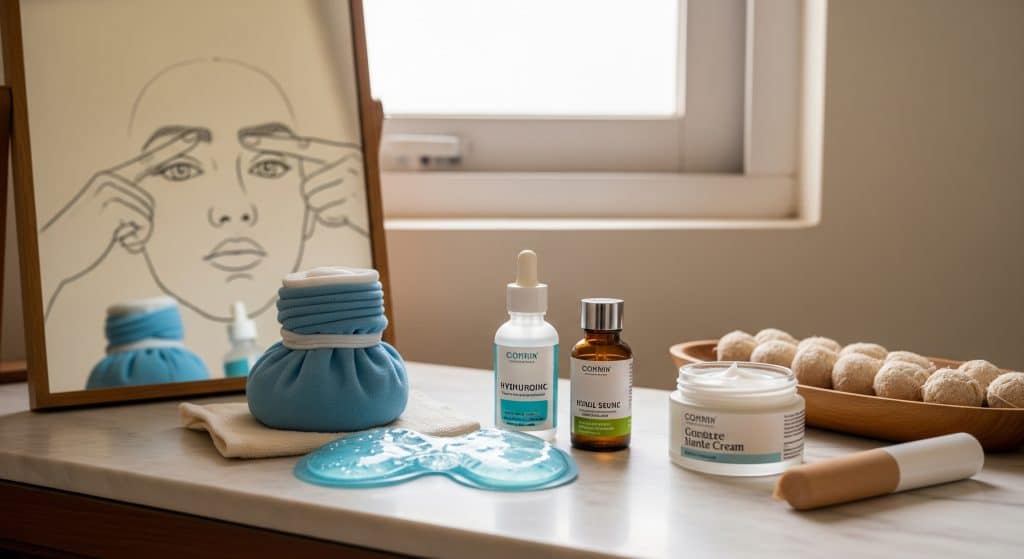
Cold reduces vasodilation and puffiness. I recommend chilled spoons or gel masks for 3 to 5 minutes. Follow with a hydrating serum containing glycerin or hyaluronic acid. Finish with a light peptide cream. This sequence deflates swelling and then seals water. It often reduces the look of one eye smaller than the other, particularly after sleep or flights. For an illustrative routine:
-
Rinse with cool water. Pat dry.
-
Cold compress for 4 minutes.
-
Apply hyaluronic serum. Wait 60 seconds.
-
Peptide cream. Then sunscreen if daylight.
Sleep Position and Posture Corrections
Two simple corrections pay off quickly. First, elevate the head by a few centimetres and avoid pressing one cheek into the pillow. Second, align screens so the gaze is level. Hunched posture encourages one brow to overwork. If one eye smaller than the other appears worse late afternoon, posture is a common driver. An adjustable chair and a monitor riser cost little and help consistently.
Essential Oils and Eye Creams
I am cautious with essential oils near eyes. Many irritate and can cause dermatitis. If used, they must be highly diluted and patch tested. For daily care, I prefer fragrance free eye creams with retinoid derivatives, peptides, and antioxidants. Those can improve texture and resilience. They cannot correct true ptosis. Still, better skin support reduces how strongly one eye smaller than the other registers on the face.
Medical Treatments for Droopy Eyelids
<cite index=”1-4,2-7″>Ptosis Surgery Cost in India ₹15,000-₹55,000</cite>
Surgical repair addresses levator weakness or loose aponeurosis. The standard approach is levator advancement or Müller muscle resection, chosen by testing and lid measurements. Outcomes are generally durable. Revision rates vary by technique and tissue quality. In my consultations, I discuss the drivers of expense rather than headline ranges. Factors include surgeon expertise, hospital type, anaesthesia approach, and whether both lids need correction. When one eye smaller than the other is due to acquired aponeurotic ptosis, surgery is the definitive fix. Proper evaluation ensures the lid margin, crease height, and contour remain natural.
|
Factor |
Influence on outcome |
|---|---|
|
Levator function |
Determines technique and expected lift symmetry. |
|
Corneal health |
Guides postoperative lubrication and risk planning. |
|
Bell’s phenomenon |
Assessed to protect the cornea during closure. |
|
Skin redundancy |
May require skin pinch or blepharoplasty add on. |
Clients often ask about ptosis surgery cost. I recommend evaluating total value, not just fees. Surgeon volume, complication handling, and anaesthesia safety outweigh small price differences.
Non-Surgical Options: Botox and Fillers
Botulinum toxin can relax a depressor muscle and create a subtle chemical brow lift. Correct placement is critical. Over-relaxation can worsen asymmetry. Hyaluronic fillers can support the brow tail or tear trough, lifting shadows that make one eye smaller than the other. I use micro aliquots to avoid heaviness. Results are temporary and adjustable, which suits conservative plans or trial runs before surgery.
Prescription Eye Drops and Medications
Oxymetazoline 0.1 percent drops can elevate the upper lid by stimulating Müller muscle. The effect is modest and temporary. It can help when one eye smaller than the other stems from mild acquired ptosis. Not suitable for everyone. Dryness, rebound redness, and contraindications apply. Antihistamines and mast cell stabilisers reduce allergy driven swelling. That can restore balance if asymmetry is fluid related rather than structural.
Laser Therapy and Advanced Procedures
Fractional lasers and radiofrequency tighten thin eyelid skin by stimulating collagen remodelling. Plasma fibroblasting offers a non surgical tightening option, though downtime is real. These methods do not fix levator dysfunction. They improve skin envelope and crease definition. When one eye smaller than the other is mainly a skin laxity issue, these technologies can help. Selection depends on skin type, downtime tolerance, and prior treatments.
<cite index=”11-27,12-17″>Top Eye Creams for Droopy Eyelids 2025</cite>
I view eye creams as support tools. They enhance texture and reduce puffiness so asymmetry draws less attention. They are not substitutes for surgical correction of true ptosis. The formulas below are popular in clinics and retail. I summarise how I use them within a routine, not as miracle cures.
<cite index=”11-29,11-30″>Dermalogica Eye Cream: 37% Reduction in Sagging</cite>
This type of product usually combines peptides and firming polymers. I position it for clients who notice mid day creasing and makeup settling. Layer over a hydrating serum and under sunscreen. If one eye smaller than the other is accentuated by fine crinkles, firmer texture improves the read.
<cite index=”12-33,12-34″>Garnier Ultra-Lift with Pro-Retinol Formula</cite>
Pro retinol derivatives are tolerable for many users. They support renewal with less irritation than stronger retinoids. I recommend a three nights per week cadence at first. Use a pea sized amount for both eyes. Over months, improved smoothness reduces shadowing that makes one eye smaller than the other seem more pronounced.
<cite index=”13-1,13-25″>Colorescience Total Eye with SYN-EYE Technology</cite>
Tinted eye care products provide instant brightening and UVA protection. This one sits well under concealer. For video calls, clients often report a quick visual lift. The iron oxide pigments also block visible light, which supports pigment prone skin. That is useful when uneven pigment magnifies the impression of one eye smaller than the other.
<cite index=”16-14,16-15″>Murad Retinal Resculpt Eye Treatment</cite>
Retinal is a step closer to retinoic acid and can deliver visible smoothing faster than retinol. I use it in resilient skin that tolerates actives. Start slowly. Pair with a bland moisturiser to buffer. Over time, better elasticity helps the heavier lid look less heavy.
<cite index=”17-10,17-11,17-13″>ROC Dual Eye Cream: Results in 1 Week</cite>
Early visible effect claims often reflect hydration and film formers. That is valid, though temporary. For events or photos, this is a pragmatic choice. As with any topical, discontinue if stinging or redness occurs. Eye health comes first.
Taking Action for More Symmetrical Eyes
Decisions are easier with a simple framework. I use a three stage approach to address one eye smaller than the other without overreach.
-
Clarify the driver. Is it muscle tone, puffiness, skin laxity, or true ptosis. Sometimes mixed.
-
Sequence interventions. Start with sleep, salt, cold, and posture. Add topicals. Then consider procedures.
-
Measure response. Take front lit photos at the same time each day for two weeks.
If the concern is how to fix uneven eyes before an event, I suggest a short sprint. Hydration, cold compress, precise brow shaping, and a tinted sunscreen around the eyes. If the concern is chronic and functional, I advise medical evaluation. A specialist can confirm levator function and corneal safety. One plan avoids regrets. Another point is expectation management. Mild asymmetry is a normal feature. The goal is harmony, not identical halves.
Frequently Asked Questions
Can facial exercises permanently fix uneven eyes?
Exercises can improve muscle control and relax overactive areas. They cannot change bone or correct true ptosis. When one eye smaller than the other results from habit and mild tone differences, improvements can hold with maintenance. If asymmetry stems from levator dysfunction, only surgery offers a lasting anatomical change. A hybrid approach is common. Train the muscles and adjust posture. Then reassess after 8 weeks.
How long before eye creams show visible results?
Hydration and film formers show within minutes. Pigment brightening or retinoid smoothing takes several weeks. For structural lift, topicals have limits. If the aim is to reduce the appearance of one eye smaller than the other, plan on two horizons. Immediate improvement from hydration and tint. Gradual improvement from retinoids and peptides. I set checkpoints at 2, 6, and 12 weeks.
Is ptosis surgery covered by insurance in India?
Coverage depends on whether the condition is classified as functional or cosmetic. If vision is obstructed, insurers may consider reimbursement. Policies vary widely by provider. Documentation of visual field impairment strengthens the case. When discussing ptosis surgery cost, I encourage confirming pre authorisation and inclusions, such as theatre fees and follow up care.
Which eye makeup techniques help conceal asymmetry?
Shape the brows to balance the frame first. Use a slightly deeper crease shadow on the larger appearing eye to create parity. Tightline the upper lash on the smaller appearing eye to lift the margin. Avoid heavy liner on the lower lid. That can pull the eye downward. This combination reduces how strongly one eye smaller than the other reads on camera.
When should I seek medical attention for uneven eyes?
Seek care urgently if asymmetry appears suddenly, is linked to pain, double vision, headache, or pupil change. A new droopy lid after trauma or infection also warrants examination. For gradual changes, book a routine evaluation. If function is normal and the concern is cosmetic, a planned approach is appropriate. Sudden change is the red flag.
Are eye lift creams safe for sensitive skin?
Many are. Choose fragrance free formulas and introduce them slowly. Patch test first. If redness, stinging, or swelling occurs, stop use and reassess. Sensitive skin often prefers ceramides, panthenol, and low strength retinoids. Even with good formulas, creams cannot correct true ptosis. They help the skin look smoother, which reduces the impact of one eye smaller than the other.
Can children have ptosis correction surgery?
Yes, when the droop threatens visual development or function. Timing depends on severity and levator function. In congenital cases with poor levator action, a frontalis sling may be advised. The priority is preventing amblyopia. For mild cases without risk to vision, monitoring is reasonable. In either case, an experienced oculoplastic surgeon should lead care.
Pros and Cons of Common Approaches
Pros
-
Non invasive steps are safe, low cost, and reversible.
-
Topicals improve texture and reduce puffiness quickly.
-
Injectables offer adjustable changes and short downtime.
-
Surgery provides definitive correction of true ptosis.
Cons
-
Exercises cannot fix structural ptosis.
-
Topicals require consistency and deliver limited lift.
-
Injectables can misbalance brows if placed poorly.
-
Surgery involves risks, cost, and recovery time.
Quick Reference: What Helps Which Scenario
|
Morning puffiness |
Cold compress, salt control, allergy management. |
|
Mild muscle asymmetry |
Targeted exercises and posture corrections. |
|
Skin laxity without ptosis |
Retinoids, peptides, RF or fractional laser. |
|
True ptosis |
Surgical correction after assessment. |
|
Event ready quick fix |
Tint, tightlining, brow shaping, film forming cream. |
Putting It All Together
Here is a pragmatic path for anyone concerned about one eye smaller than the other. Start with the lowest friction wins. Adjust sleep position, add a brief cold routine, and tidy posture. Layer a hydrating serum and a peptide eye cream. Trial a tinted sunscreen that plays nicely near the eyes. Reassess in two weeks with consistent photos. If asymmetry still bothers you daily, explore injectables or energy devices to improve brow and skin support. If the lid margin itself is low, consult an oculoplastic surgeon for definitive correction. That is the fork in the road. Choose the branch that addresses the actual cause, not the symptom.
Key Takeaways
-
Mild asymmetry is normal. Perfection is neither realistic nor necessary.
-
Define the driver first. Muscle, skin, swelling, or true ptosis.
-
Stack simple habits before procedures. Measure the effect.
-
Use skincare to support, not to promise lift it cannot deliver.
-
For true ptosis, surgery is the solution that aligns anatomy and function.
Maybe that is the point. Good outcomes come from clear diagnosis and modest, well sequenced steps.
Targeted Phrases Integrated for Clarity
Readers often search for treatment for droopy eyelid and how to fix uneven eyes, then meet a wall of jargon. I aim for clarity. If one eye smaller than the other is driven by ptosis, consider specialist assessment. If swelling exaggerates the difference, hydration, cold, and allergy control offer quick wins. When creams are requested, I shortlist options routinely described as the best eye creams for droopy eyelids by clients and peers, while noting their limits. And yes, it is reasonable to compare ptosis surgery cost across centres, but match fees with experience and outcomes.
Realistic Expectations: A Brief Example
A client presented with one eye smaller than the other after long hours at a laptop. The left brow was subtly higher, the right upper lid heavier by one to two millimetres. We changed monitor height, began light levator drills, and used a peptide cream under a mineral sunscreen. Two weeks later, photos showed gentler brow elevation and less puff. Not perfect. Better. That is often the right target.

