






 We do what's right for you...


Hand Tremor Treatment Explained: Causes, Options & Relief
Dr. Arunav Sharma
Most advice on tremors starts with a single drug and a wait-and-see plan. That rarely matches the complexity of the condition. I approach hand tremor treatment as a layered process that blends diagnosis, targeted therapy, and real-world adjustments that actually hold up in daily tasks. In the following sections, I explain current options, how to think about hand tremor causes, and where evidence is moving next. The aim is simple. Build a plan that brings steadier hands and keeps quality of life intact.
Best Hand Tremor Treatment Options Currently Available
Effective hand tremor treatment is usually stepwise. I start with medication, consider device-based options, and add occupational strategies early. Evidence supports this staged approach, though not without exceptions. Below is how I structure decisions in practice.
1. Medication Treatments for Hand Tremors
Pharmacotherapy remains a first-line pillar of hand tremor treatment. I balance efficacy against side effects and daily function. Dose titration is slow and deliberate, with realistic endpoints agreed beforehand.
|
Medication |
Typical role and notes |
|---|---|
|
Propranolol |
Beta blocker for action tremor. Helpful for situational tremor. Watch for bradycardia, asthma, fatigue. |
|
Primidone |
Anticonvulsant used when beta blockers underperform. Start low to limit sedation and nausea. |
|
Topiramate |
Adjunct for persistent tremor. Cognitive slowing and paraesthesia can appear at higher doses. |
|
Gabapentin |
Modest benefit in some patients. Useful where anxiety or neuropathic pain coexist. |
|
Clonazepam |
Intermittent use for task-triggered tremor. Dependence risk argues for restraint. |
|
Botulinum toxin |
Targeted injections for focal hand tremor. May weaken fingers or wrist if dosing is not precise. |
-
Set a measurable goal before titration, for example writing a legible sentence or drinking without spillage.
-
Layer behavioural supports while titrating. Do not wait for a perfect dose.
-
Reassess every 6 to 8 weeks. If there is no functional gain, pivot.
In short, medication is necessary for many, but it is rarely sufficient. That is why I plan the next moves in parallel.
2. Focused Ultrasound (HIFU) Therapy
High-intensity focused ultrasound offers a nonincisional option within a modern hand tremor treatment plan. It targets a thalamic node under MRI guidance. Relief can be rapid, and the workflow is outpatient in many centres.
As YaleMedicine notes, tremor reduction can reach **92%** in selected patients, with treatment lasting about **1 hour 15 minutes**, and FDA approvals arriving in **2016** for unilateral therapy and expanded in **2023** for bilateral use. Those milestones matter because they shape candidacy and consent.
Pros
-
No incision and no implanted hardware.
-
Immediate on-table assessment of tremor change.
-
Useful when medication fails or is poorly tolerated.
Cons
-
Creates a permanent lesion. Not adjustable after the fact.
-
Potential for imbalance or speech change, usually dose related.
-
Skull density and anatomy can limit eligibility.
Who fits best? Patients with action-predominant tremor, clear functional goals, and limited benefit from drugs. I discuss staged bilateral plans where appropriate. Caution where gait instability already exists.
3. Deep Brain Stimulation (DBS)
DBS remains the most adjustable surgical option within hand tremor treatment. Electrodes are placed in a motor circuit and linked to a pulse generator in the chest. Programming then fine tunes amplitude, frequency, and contacts.
-
Reversible and programmable, which supports long-term control as needs change.
-
Suitable for bilateral symptoms when candidacy is confirmed.
-
Modern systems offer directional leads and rechargeable batteries, reducing replacements.
Risks include infection, lead migration, and stimulation side effects. A careful trial of settings usually resolves the latter. I advise a centre with a strong programming service. That is often where outcomes are won.
4. Wearable Neuromodulation Devices
Wrist-worn stimulation devices provide nonpharmacological, on-demand relief for some. They deliver patterned stimulation to peripheral nerves that influence tremor circuitry. The practical value is timing. Patients can use a session before writing or meetings.
-
No anaesthesia and minimal downtime.
-
Effect sizes vary, and responders can be a subset.
-
Best placed alongside other elements of hand tremor treatment, not as a sole therapy.
I set a four-week trial with a diary of tasks. If there is no measurable task improvement, I de-escalate. Simple and fair.
Understanding Hand Tremor Causes and Diagnosis
Accurate diagnosis guides the entire plan. Hand tremor causes range from benign, hereditary patterns to endocrine or medication effects. I confirm type, exclude reversible drivers, and document task impact. That sequence prevents missteps later.
Essential Tremor vs Other Tremor Types
Essential tremor is the most common action tremor. It often affects the hands and can involve the head or voice. It progresses slowly and interferes with writing, eating, and fine work. Parkinsonian tremor is typically rest predominant, often unilateral at onset, and accompanied by slowness or rigidity. Other types exist and matter for triage.
|
Tremor type |
Key clinical cues |
|---|---|
|
Essential tremor |
Action or posture driven, bilateral tendency, family history common, alcohol response sometimes present. |
|
Parkinsonian tremor |
Resting tremor, asymmetry at onset, associated bradykinesia and rigidity. |
|
Dystonic tremor |
Irregular amplitude, abnormal postures, null point where tremor quiets. |
|
Cerebellar tremor |
Intention-driven with overshoot, ataxia, wide-based gait, often lesion or demyelination related. |
|
Neuropathic or metabolic |
Sensory loss, peripheral signs, thyroid or hepatic clues on history and labs. |
|
Drug or toxin induced |
Temporal link to new agents or withdrawal. Improves with dose change or cessation. |
|
Functional tremor |
Variability with distraction, entrainment, and internal inconsistency. |
Correct classification prevents the wrong hand tremor treatment. It also frames prognosis and expectations.
Common Triggers That Worsen Hand Tremors
-
Caffeine and other stimulants.
-
Anxiety, acute stress, and sleep deprivation.
-
Alcohol withdrawal or rebound after heavy use.
-
Low blood glucose and dehydration.
-
Temperature extremes and strenuous exertion.
-
Medications such as bronchodilators, lithium, valproate, some SSRIs, and corticosteroids.
-
Fatigue from unstructured tasks that force sustained posture.
I address triggers early. Small changes sometimes outperform a dose increase. Quiet wins add up.
When to Seek Medical Evaluation
-
Sudden onset tremor or step change in severity.
-
Rest tremor with stiffness, slowness, or gait change.
-
New neurological deficits, for example weakness or visual symptoms.
-
Systemic signs such as weight loss, heat intolerance, or palpitations.
-
Recent medication introduction or dose change.
-
Impact on work safety or ability to perform essential tasks.
-
Family history of early or severe tremor syndromes.
Escalate sooner rather than later. The right assessment opens more precise hand tremor treatment options.
Hand Tremor Exercises and Natural Management
Therapy and routines improve function even without large tremor reduction. I use structured hand tremor exercises to stabilise joints and refine task control. Gains are often practical rather than cosmetic. That is still a success.
List of Effective Hand Strengthening Exercises
I prioritise proximal stability first. Shoulders and forearms set the foundation for precise fingers. Here is a focused series I prescribe.
|
Exercise |
Purpose and cue |
|---|---|
|
Wrist curls and extensions |
Builds forearm support. Use a light dumbbell, slow tempo, **2** sets of **12**. |
|
Pronation-supination |
Rotational control with a hammer grip. **2** sets of **10** each way. |
|
Isometric grip holds |
Anti-tremor bracing. Squeeze a soft ball for **20** seconds, repeat **5** times. |
|
Finger opposition ladder |
Thumb to each finger tip, then speed up without sacrificing accuracy. |
|
Pinch and release |
Use clothes pegs to train graded force. Aim for **15** smooth reps. |
|
Weighted utensil practice |
Eat soup with a weighted spoon. Measure spills to track improvement. |
|
Scapular set and hold |
Posture control for fine tasks. Hold for **30** seconds, repeat **3** times. |
-
Train **5** days per week. Keep sessions under **20** minutes to avoid fatigue.
-
Pair exercises with a breathing drill to dampen physiologic tremor.
-
Record one functional metric weekly, for example buttoning time.
This routine complements any hand tremor treatment. It improves control, even if tremor amplitude barely shifts.
Stress Reduction Techniques for Tremor Control
Stress amplifies tremor in many patients. I use simple, reproducible drills that fit into real schedules.
-
Box breathing: inhale **4** seconds, hold **4**, exhale **4**, hold **4**. Repeat for **2** minutes.
-
Progressive muscle relaxation: tense and release forearm and hand groups in sequence.
-
Mindfulness micro-break: one minute of focused attention on breath or a tactile anchor.
-
Biofeedback where available. Even a heart rate trace can guide pacing.
-
Sleep hygiene: consistent lights out, reduced evening screen use, and a cool, dark room.
Alcohol can dampen tremor briefly. I advise caution. Rebound and dependence risks often outweigh the short relief.
Adaptive Devices and Lifestyle Modifications
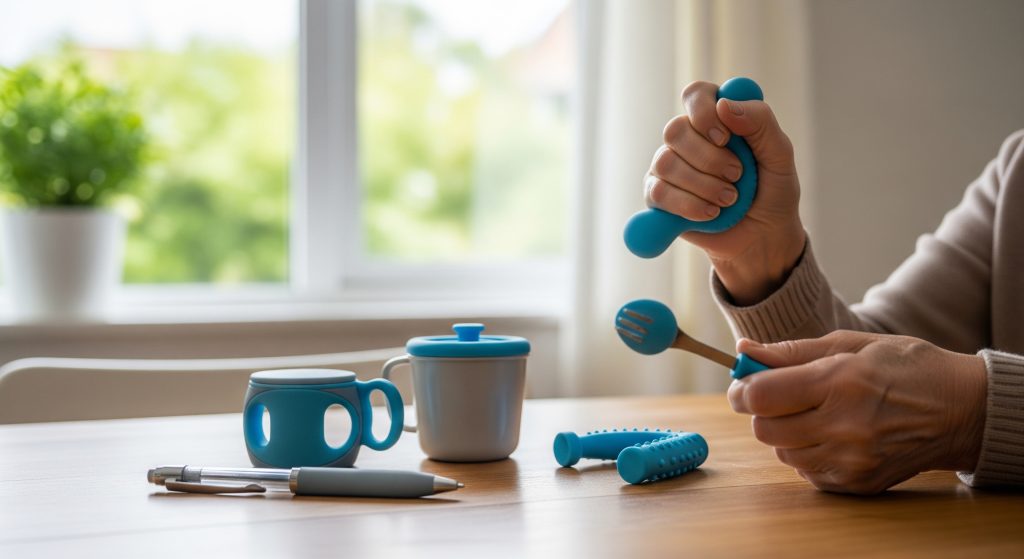
Adaptive tools translate into fewer spills and less frustration. That is value, regardless of the measured tremor score.
-
Weighted pens, broad grips, and pen sleeves for smoother signatures.
-
Cups with lids, non-slip placemats, and plate guards for dining.
-
Voice-to-text, text expansion, and keyboard shortcuts for desk work.
-
Button hooks, zip pulls, and magnetic fasteners for dressing.
-
Smartphone tweaks: larger targets, haptic cues, and stylus use.
-
Occupational therapy review to align tools with tasks and goals.
Another point is practice. Ten minutes of timed, purposeful tasks beats an hour of unfocused effort.
Latest Advances in Essential Tremor Treatment
Innovation is steady, not explosive. Still, the practical toolkit for essential tremor treatment is growing. I focus on advances that change daily life, not only lab metrics.
Breakthrough FDA-Approved Therapies
Expanded bilateral pathways for MR-guided focused ultrasound now shape referrals. Earlier, I noted the 2016 unilateral and 2023 bilateral approvals. Those dates reflect improved selection and structured counselling. DBS platforms have also matured with directional leads and longer-life batteries. The net effect is flexibility. And better matching of therapy to symptom pattern.
Emerging Medications Under Development
Pipeline work targets tremor circuits rather than broad sedation. Agents modulating GABA signalling and T-type calcium channels are under study. Some repurposed compounds show task-level gains in small cohorts. As far as current data suggests, larger trials are needed before routine use. I track tolerability closely in any early adoption.
Bilateral Treatment Options and Guidelines
Bilateral needs require nuance. With DBS, staged implantation remains standard for many. It allows adjustment and safety checks. With HIFU, staged contralateral treatment is now possible in selected patients. Careful screening for balance and speech effects is essential.
-
Write down bilateral goals. Eating, typing, and carrying hot drinks are common priorities.
-
Sequence matters. Treat the most disabling side first. Reassess function after three months.
-
A multidisciplinary board review reduces risk. Surgeon, neurologist, and therapist input align the plan.
Guidelines continue to evolve, but the principle stands. Balance relief with safety and long-term adaptability.
Taking Control of Hand Tremor Treatment
Hand tremor treatment works best when structured. I use a simple framework that patients can adopt immediately.
-
Define one or two concrete tasks to improve. Keep them observable and measurable.
-
Optimise sleep, hydration, and stimulant intake for two weeks. Record any change.
-
Trial first-line medication with preset criteria for success and tolerability.
-
Add hand tremor exercises and at least two adaptive tools in the same fortnight.
-
If targets are unmet, evaluate device options. Consider wearable stimulation, HIFU, or DBS based on candidacy.
-
Revisit goals quarterly. Step down what does not help. Double down on what does.
This is not about perfection. It is about a steadier signature, safer meals, and confident work. That is meaningful progress. And it is achievable with a disciplined hand tremor treatment plan.
Frequently Asked Questions
What is the most effective medication for hand tremors?
There is no single best drug for every patient. Propranolol and primidone are common first choices within hand tremor treatment. I decide based on comorbidities, side effect profiles, and the specific tasks a patient values. A short, structured trial usually clarifies the winner.
Can hand tremors be completely cured?
Most tremors can be controlled to a useful degree, but complete cure is uncommon. The realistic goal is functional improvement with a tailored hand tremor treatment. Combining medication, targeted procedures, and adaptive strategies yields the most reliable gains.
How long does focused ultrasound treatment last?
Durability is measured in years for many recipients, though individual results vary. Early benefits are often immediate, as I noted under HIFU. Follow-up within a comprehensive hand tremor treatment plan maintains gains and manages any side effects.
What exercises help reduce hand tremors immediately?
Nothing removes tremor instantly, but certain drills steady performance. Brief isometric grips, box breathing, and a supported writing posture can reduce spillover. Integrating these hand tremor exercises before key tasks delivers practical advantages.
Are there any new treatments for essential tremor in 2025?
Yes, meaningful refinements continue. Bilateral pathways for HIFU are now established in selected cases, and DBS hardware keeps improving. Wearable neuromodulation also offers task-timed benefits. I integrate these advances into essential tremor treatment when candidacy and goals align.
When should I consider surgery for hand tremors?
Consider a procedural route when medications fail to deliver agreed functional targets or cause limiting side effects. A formal assessment then compares HIFU, DBS, and wearables within your hand tremor treatment. The choice depends on symptom pattern, risk tolerance, and required adjustability.

