






 We do what's right for you...


What You Should Know About Throat Cancer Treatment in India, and How I do it?
Dr. Akriti Rastogi
Diagnosis of Throat Cancer Treatment can be worrisome and scary. Throat Cancer is a complex cancer and needs precise treatment startaegy. Like many diseases, many guidelines for treatment of throat cancer have been formulated in the western world, and fail to heed attention on the unique scenarios present in India. Traditional and Standard advice often frames throat cancer treatment as modalities which compromise the functioning of the larynx (our voice box). This treatment approach rarely fits real patients. I instead prefer to approach it as a precise sequence of choices that focus on protection of function and at the same time on controlling the disease aggressively. It is basically a balancing act between tumour control, organ preservation, side effect risk, and resources available. The sections below set out how I prefer to structure those choices in India, from first scans to long term recovery.
Primary Treatment Options for Throat Cancer in India
1. Surgical Interventions Including TORS and Conventional Surgery
Because I am a Surgical Oncologist, let me start with Surgical Options. I start with surgery when the disease is resectable and functional outcomes are acceptable. Conventional open approaches remain vital for bulky or unfavourable tumours. Yet early to selected intermediate cases benefit from transoral approaches that avoid large incisions decreasing patient morbidity.
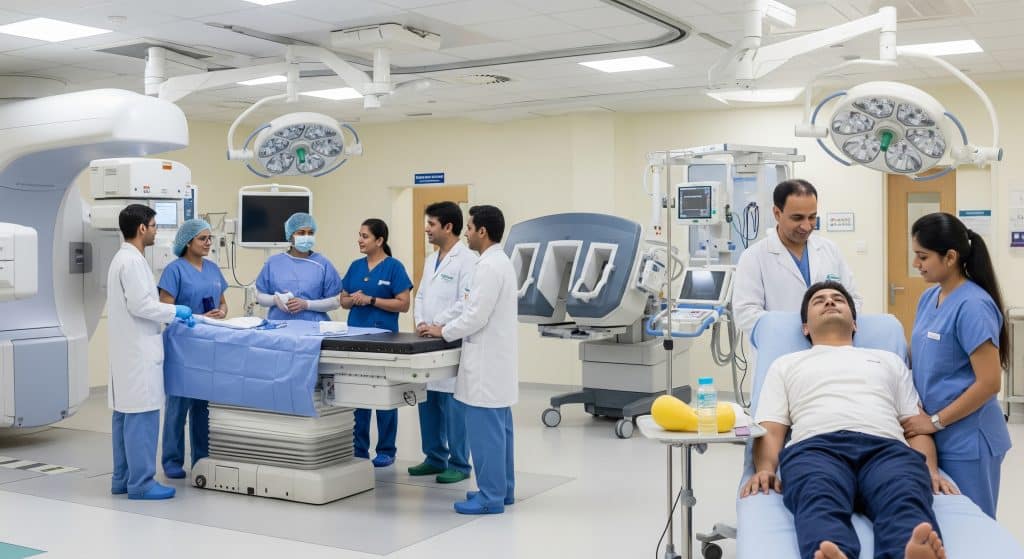
Transoral robotic surgery delivers visibility and dexterity in tight spaces of the oropharynx and supraglottis. The console magnifies, steadies, and enables fine dissection, which reduces collateral trauma. Many patients recover swallowing faster, spend fewer days in hospital, and resume diets sooner. In practice, that can mean less need for feeding tubes and fewer tracheostomies.
There is also a strategic benefit. When clear margins are achieved with TORS, adjuvant therapy can sometimes be de-escalated. That reduces the cumulative toxicity and costs across the full pathway. I still plan adjuvant radiotherapy or chemotherapy where pathology dictates risk, but the baseline burden may be lower.
-
Conventional surgery: best for large, infiltrative, or cartilage invasive disease.
-
TORS: best for well selected oropharyngeal, supraglottic, and tongue base lesions where access is otherwise difficult.
-
Neck management: selective or modified neck dissection is planned based on nodal risk.
We should understand one caveat. Not every tumour suits TORS. Very poor mouth opening, unfavourable exposure, or need for complex reconstruction usually point to open techniques instead of transoral approach. Patients’s Safety is always the priority.
2. Radiation Therapy with IMRT and IGRT Techniques
When surgery risks unacceptable functional loss, radiation becomes the primary modality. I advise intensity modulated radiation therapy to sculpt dose around critical structures. That helps spare salivary glands, swallowing muscles, and spinal cord while still covering the tumour and at risk nodes.
Image guidance adds precision. With daily imaging and soft tissue matching, I can reduce planning margins and keep dose off healthy tissue. For elderly or medically complex patients, this precision supports organ preservation with manageable toxicity.
-
IMRT: conformal dose shaping to protect organs at risk.
-
IGRT: daily verification to correct setup drift and anatomical change.
-
Adaptive strategies: mid course replans if weight loss or tumour shrinkage alters geometry.
The end goal is straightforward. Maximise tumour control and keep saliva, taste, and swallow as intact as possible. Function preserved is quality of life retained.
3. Chemotherapy Protocols for Different Stages
Systemic therapy can prime, intensify, or salvage. I use it in three main settings. First, induction chemotherapy where shrinkage may convert an inoperable situation to operable, or enable organ preservation. Second, concurrent chemoradiation as standard for many locally advanced cases. Third, palliative regimens for recurrent or metastatic disease.
Concurrent cisplatin with radiation remains the backbone. Weekly or tri weekly schedules are selected by renal function, performance status, and hearing profile. Where cisplatin is unsuitable, I consider carboplatin based schedules or targeted additions. I refer to this as chemotherapy for throat cancer in three roles, not one. It is a toolset, not a single drug choice.
-
Induction: taxane plus platinum combinations in selected cases.
-
Concurrent: cisplatin based protocols with careful hydration and audiology checks.
-
Palliative: platinum, taxane, and immunotherapy combinations by biomarker status.
Supportive care drives outcomes here. Anti emetics, nutrition, and renal protection reduce unplanned breaks and dose reductions.
4. Combination Therapy Approaches
Combination therapy is often decisive for control and function. Surgery plus risk adapted adjuvant radiotherapy achieves strong local control when pathology shows adverse features. Chemoradiation achieves organ preservation in many laryngeal and oropharyngeal cases. The art lies in sequencing and de escalation where safe, without compromising oncological outcomes.
I aim for the fewest modalities that still deliver adequate control. Additions are justified by evidence of risk, not habit. That restraint limits long term swallowing, dental, and thyroid complications. A measured pathway beats maximalist treatment in most early to intermediate cases.
Advanced Treatment Technologies and Innovations
Transoral Robotic Surgery (TORS) Advantages and Availability
Transoral robotic surgery confers three advantages. Visual access, precision, and conservation of healthy tissue. Put simply, I can reach behind the tongue base and the soft palate with steadier robotic hands and better angles. That matters when the goal is to remove tumour while leaving speech and swallow mechanics largely intact.
Availability has improved in major centres, with trained head and neck teams and integrated anaesthesia protocols. Patient selection is critical. I assess mouth opening, dental status, tumour geometry, and comorbidities. If exposure is doubtful, I do not compromise safety for gadgetry.
In practice, the benefits compound. Shorter theatre time, fewer tracheostomies, and earlier oral intake. Better readiness for adjuvant therapy too, as recovery typically proceeds faster. And yet, costs and access still limit universal adoption. But costs are gradually decreasing and overall cost-benefit ratio is better for robotic surgeries in the long term. Still, at least for the time being, for some, a well executed open surgery remains the right call.
Proton Therapy Centres and Treatment Protocols
Proton therapy shapes dose differently. The energy peaks at depth and then stops, which can reduce exit dose to critical structures behind the target. For skull base or re irradiation cases, that physical property can be advantageous.
Protocols mirror photon workflows, with immobilisation, target delineation, and risk adapted nodal coverage. Suitability hinges on anatomy, prior treatments, and logistics. I consider proton planning for selected nasopharyngeal or skull base adjacent disease where dose constraints are tight.
Access remains limited, and travel burdens are real. I weigh those factors against the marginal dosimetric gains on a case by case basis. The best plan is the one a patient can complete without interruptions.
Immunotherapy Options Including PD-1/PD-L1 Inhibitors
Checkpoint inhibitors have changed late stage management. Pembrolizumab and nivolumab enable the immune system to recognise and attack cancer cells by blocking PD 1 or PD L1 signalling. For platinum refractory disease or high biomarker expression, they are now routine considerations.
Responses can be durable, though not universal. I counsel patients on timing, biomarker testing, and potential immune related adverse events. Colitis, dermatitis, and endocrinopathies demand vigilance and swift management protocols.
In first line metastatic settings, combinations with chemotherapy improve control for many. In curative settings, trials continue to refine neoadjuvant and adjuvant roles. My approach is pragmatic and biomarker driven.
Targeted Therapy with Cetuximab
Cetuximab targets the EGFR pathway, which many head and neck cancers exploit. It pairs with radiation where cisplatin is unsuitable, and with chemotherapy in recurrent or metastatic settings. Infusion reactions and skin toxicity require proactive management, but most patients tolerate therapy with standard protocols.
Evidence supports its additive effect with traditional chemotherapy in advanced disease. As Journal of Clinical Oncology reported, response rates increased from 20% to 36% when cetuximab was added to platinum chemotherapy. That improvement informs regimen selection where the clinical picture fits.
The broader trend is clear. Targeted agents and antibodies are not magic bullets. They are components that raise the ceiling for well selected patients.
Treatment Planning and Cost Considerations
Staging and Diagnostic Procedures
Thorough staging prevents downstream missteps. I begin with comprehensive endoscopy to map mucosal disease and assess mobility. Tissue diagnosis confirms histology and defines risk features. Cross sectional imaging characterises primary size, cartilage invasion, and nodal involvement.
PET CT helps uncover occult primaries and distant spread, particularly when nodal disease is the first sign. I use it to refine radiation volumes and to avoid futile surgery in disseminated disease. Functional studies like videofluoroscopy may baseline swallowing before therapy starts.
-
Endoscopy with biopsy to confirm diagnosis.
-
CT or MRI of head and neck for local and regional mapping.
-
PET CT when nodal disease or advanced stage is suspected.
-
Baseline dental and nutrition assessments before radiation.
Good staging shortens treatment, reduces surprises, and guides coherent sequencing. It is the one investment that always pays back.
Treatment Costs Across Major Cities
Costs vary by city, hospital type, and treatment plan. Surgery, radiation, systemic therapy, and stays all add to the total. Patients and families need realistic estimates to plan time off work, caregiving, and insurance approvals.
|
City |
Illustrative cost note |
|
New Delhi |
Private tertiary centres commonly quote mid range packages for surgery and radiation. |
|
Mumbai |
Pricing is comparable, with variation by facility and length of stay. |
To anchor expectations, As India Cancer Surgery Site notes, indicative totals in New Delhi average about ₹3,50,000, with Mumbai around ₹3,25,000. Actual amounts vary by stage, modality mix, and complications. In addition to the stadard modalities, I advise budgeting for supportive items like dental care, nutrition, and speech therapy as well.
Insurance Coverage and Financial Assistance
Insurance pre authorisation, cashless networks, and co pay limits influence timing. I recommend clarifying policy sublimits on chemotherapy, radiation fractions, consumables, and ICU before admission. For those without comprehensive cover, philanthropic funds and state schemes can bridge gaps.
As Indian Cancer Society highlights, the Cancer Cure Fund prioritises families under an annual income threshold and can sanction up to ₹5,00,000 for treatment, and ₹8,00,000 for select procedures. The programme has supported thousands of patients, which shows the scale of need and the value of early application.
-
Confirm room rent caps and implant or consumable exclusions.
-
Ask for a provisional estimate covering the full cycle.
-
Seek social work support to identify grants and NGO options.
-
Plan travel and caregiver costs if treatment requires relocation.
Financial clarity reduces dropouts and treatment breaks. It also frees families to focus on recovery rather than paperwork.
Hospital Selection Criteria and Quality Indicators
Facility choice affects outcomes. I prioritise multidisciplinary tumour boards, access to advanced radiotherapy planning, critical care capacity, and integrated rehabilitation. Volume matters to an extent, but process reliability matters more.
-
Head and neck MDT with surgery, radiation, medical oncology, pathology, and radiology.
-
IMRT or better capability with image guidance and physics QA processes.
-
Speech and swallowing therapy available during and after treatment.
-
Nutrition, dental oncology, and psychosocial support embedded in pathways.
-
Transparent infection control and perioperative protocols.
A hospital that publishes protocols and outcomes is preferable. Openness tends to correlate with quality in healthcare delivery.
Post-Treatment Care and Recovery
Managing Side Effects of Radiation and Chemotherapy
Treatment works because it is potent. That power carries predictable effects. Fatigue, mucositis, xerostomia, taste change, and weight loss are common during chemoradiation. Nausea, neuropathy, and hearing changes can follow systemic therapy. The key is anticipation and early intervention.
-
Oral care: bland rinses, topical analgesics, and antifungals as needed.
-
Nausea control: guideline based antiemetics and hydration plans.
-
Nutrition: high protein soft diets, supplements, and temporary feeding tubes if required.
-
Pain: multimodal regimens with careful constipation prevention.
Psychological load is real. Distress screening, counselling, and peer groups reduce isolation and improve adherence. I schedule supportive touchpoints the same way I schedule radiation fractions. Consistency helps.
Speech and Swallowing Rehabilitation
Swallowing drives independence. Early referral to speech and language therapy pays dividends. Baseline assessment, exercise programmes, and dietary adjustments protect function during therapy and accelerate recovery after.
I use instrumental assessments when needed. Fibreoptic evaluations and videofluoroscopy reveal aspiration patterns and guide safe progression of texture. Exercises focus on tongue base strength, hyolaryngeal elevation, and coordination.
-
Therapy during treatment to maintain range of motion.
-
Post treatment progression from liquids to soft solids under supervision.
-
Voice therapy for hoarseness and pitch control post laryngeal therapy.
The goal is safe, enjoyable eating and intelligible speech. In other words, everyday dignity.
Follow-up Protocols and Monitoring
Follow up finds recurrences early and manages late effects. I front load visits in the first two years, then taper. Imaging is used judiciously based on stage, symptoms, and physical findings.
|
Time after treatment |
Key actions |
|
0 to 3 months |
Clinical exam, wound and swallowing review, baseline post treatment imaging as indicated. |
|
3 to 24 months |
Visits every 2 to 4 months, thyroid and dental checks, nutrition monitoring. |
|
2 to 5 years |
Visits every 4 to 6 months, late effects screening, smoking and alcohol cessation support. |
|
Beyond 5 years |
Annual review, survivorship plan updates, secondary cancer surveillance. |
I document a survivorship plan that lists expected late effects, warning signs, and contact pathways. Clarity reduces anxiety and avoids delays if symptoms arise.
Quality of Life Considerations
Quality of life is not an afterthought. It is a core outcome. Dry mouth, dental decay, neck stiffness, and hypothyroidism can erode gains if unmanaged. I address these systematically.
-
Saliva and dental care: custom trays, fluoride, regular dental reviews, and saliva substitutes.
-
Neck and shoulder mobility: physiotherapy with scar and fibrosis management.
-
Endocrine health: thyroid function testing and replacement when indicated.
-
Work and social reintegration: graded return plans and employer communication.
Nutrition and exercise act like medicine here. Modest, consistent routines improve fatigue, mood, and long term resilience. Small habits compound.
Making Informed Decisions About Throat Cancer Treatment
Informed decisions start with priorities. Voice, swallow, work continuity, and travel constraints guide modality choices. Once those are clear, I match them to evidence and logistics.
-
Clarify goals: organ preservation vs maximal clearance, and acceptable trade offs.
-
Confirm stage: use complete diagnostics to avoid false starts.
-
Select modality: surgery, radiation, chemotherapy for throat cancer, or combinations.
-
Plan support: nutrition, speech therapy, dental, and psychosocial care.
-
Confirm finances: insurance, grants, and out of pocket estimates.
-
Commit to schedule: minimise breaks and unplanned dose reductions.
One more perspective. The best pathway is not the flashiest technology. It is the plan that a patient can complete safely and that preserves function while controlling disease. That is the north star for every decision in throat cancer treatment.
Frequently Asked Questions
What is the success rate of throat cancer treatment in India?
Outcomes vary by stage, site, and biology. Early stage disease treated with surgery or radiation achieves high control and survival. Locally advanced cases do well with chemoradiation or surgery plus adjuvant therapy, though toxicity risks rise. HPV positive oropharyngeal cancers generally have better prognoses. Success is best measured through disease control and functional preservation together.
How long does a typical course of throat cancer treatment take?
Timelines differ by modality. Surgery with recovery and adjuvant therapy spans 8 to 12 weeks in many cases. Definitive chemoradiation usually runs 6 to 7 weeks of radiation with concurrent therapy and 4 to 6 weeks of recovery before reassessment. Rehabilitation often continues for several months. I plan schedules that allow minimal interruptions and structured follow up.
Which hospitals offer transoral robotic surgery for throat cancer?
Major tertiary centres in large Indian cities provide transoral robotic surgery within head and neck programmes. Availability depends on surgeon expertise, anaesthesia protocols, and perioperative support teams. When choosing a facility, prioritise experience with TORS and access to comprehensive rehabilitation. A centre with integrated speech and nutrition services is advantageous.
What are the eligibility criteria for immunotherapy in throat cancer?
Eligibility depends on disease setting and biomarkers. For recurrent or metastatic disease, PD L1 expression, prior platinum exposure, and performance status guide decisions. In curative settings, immunotherapy remains within trials or selected indications. I confirm autoimmune histories and organ function given the risk of immune related adverse events. Shared decision making is essential here.
Can throat cancer be treated without surgery?
Yes, many cases are treated definitively with radiation or chemoradiation. This is common for laryngeal and oropharyngeal cancers where organ preservation is a priority. Suitability depends on stage, airway safety, and expected functional outcomes. For small glottic lesions, radiation alone often achieves excellent voice preservation. The converse is also true. For some tumours, surgery is the most reliable path to control.
What is the difference between proton therapy and conventional radiation?
Conventional radiation with photons deposits dose along the entry and exit paths. Proton therapy deposits most energy at a specific depth, which can reduce exit dose. That property can improve dose distributions near critical structures. Clinical advantages depend on anatomy, motion, and planning quality. Availability, cost, and travel also influence the choice. Precision is helpful, but completion of a well planned course matters more.
Clinically effective treatment is a sequence, not a single choice. Plan it as a whole and protect function at every step.
Practical checkpoint list
-
Confirm diagnosis and complete staging before starting.
-
Discuss surgery, radiation, and chemotherapy for throat cancer with risks and benefits.
-
Ask about transoral robotic surgery if early oropharyngeal disease is present.
-
Secure finances and schedule rehabilitation early.
-
Adhere to follow up and report symptoms promptly.

