






 We do what's right for you...


What Is a Defibrillator Machine and How Does It Work?
Dr. Hriday Kumar Chopra
Common advice says shocks restart hearts. The reality is more precise. A Defibrillator Machine does not simply switch the heart back on. It interrupts lethal chaos so normal rhythm can reassert itself. That distinction matters when seconds slip away and decisions count.
Types of Defibrillator Machines
1. Automated External Defibrillator (AED)
The automated external defibrillator is built for speed, clarity, and public access. As The automated external defibrillator – PMC explains, modern units guide you with step-by-step prompts and analyse rhythms before advising a shock. This design lets you act quickly without advanced training.
Usability still matters. As Automated external defibrillator use by untrained bystanders notes, pad placement can be inconsistent for untrained users, and better interfaces improve speed. Most volunteers in that trial could deliver a shock within roughly **3.5** minutes. That is fast enough to change outcomes in many cases.
Reliability is high. In out-of-hospital cardiac arrest research, AED rhythm detection reached **90.0%** sensitivity and **100%** specificity, as Machine and Operator Performance Analysis of AED Utilization reports. Operator compliance still matters though. Training and adherence to prompts reduce avoidable delays.
Intelligence is improving too. As Role of artificial intelligence in defibrillators: a narrative review suggests, AI is being integrated to refine rhythm classification and predict shock success. Device model differences exist, but speed remains the lever. As Differences in Automated External Defibrillator Types records, survival did not differ markedly between models, yet faster defibrillation helped.
-
Key use case: public spaces and workplaces.
-
Strengths: clear prompts, safety interlocks, broad access.
-
Limitations: pad-placement errors by novices can slow care.
2. Implantable Cardioverter-Defibrillator (ICD)
An implantable cardioverter-defibrillator continuously monitors rhythm and treats life-threatening arrhythmias from inside the body. As Automatic Internal Cardiac Defibrillator – StatPearls – NCBI – NIH explains, these devices provide immediate therapy for ventricular tachycardia and fibrillation, including anti-tachycardia pacing or shock.
There are variations. As Defibrillators: Selecting the Right Device notes, transvenous ICDs are proven lifesavers after near-fatal events, while subcutaneous ICDs reduce lead-related complications but lack pacing. Programming strategy matters because inappropriate shocks can be reduced significantly, as Safety and Efficacy of an Implantable Cardioverter reports.
Newer concepts like extravascular systems aim to blend safety and capability. As Contemporary issues in implantable cardioverter highlights, the EV-ICD shows promise in lowering complications while maintaining effective therapy. In practice, device choice depends on anatomy, pacing needs, and infection risk. Fit the device to the patient, not the other way round.
-
Best for: patients at sustained risk of malignant ventricular arrhythmias.
-
Consider: need for pacing, venous access, and long-term follow-up.
3. Manual External Defibrillators
Manual defibrillators allow clinicians to select energy, interpret rhythms, and time shocks. As Defibrillation – StatPearls – NCBI Bookshelf – NIH outlines, they are used for ventricular fibrillation or pulseless ventricular tachycardia and require training to operate effectively under pressure.
Compared with an AED device, manual control offers flexibility but demands expertise. As Different methods of providing AEDs explains, AEDs simplify decisions for laypersons, while manual units put interpretation in clinical hands. Studies suggest clinicians can recognise and respond faster using manual mode, yet the skill requirement is high, as Associations of manual defibrillator compared to observes.
-
Strengths: fine control of energy and synchronisation.
-
Requirement: advanced training and regular practice.
4. Wearable Cardioverter Defibrillators
Wearable cardioverter defibrillators protect patients during transient high-risk periods. As Defibrillators: Selecting the Right Device notes, they are useful when an implant is not yet appropriate. Post-myocardial infarction and heart failure recovery are classic windows.
Design is shifting fast. Early human data for the Jewel patch system showed high success with reduced false alarms, as First human safety and effectiveness study reports. Broader reviews affirm their role in sudden cardiac death prevention while balancing comfort and adherence, as Defibrillation – StatPearls – NCBI Bookshelf – NIH would contend in the context of early access, and as Current Device Therapies for Sudden Cardiac Death details specifically for WCDs.
False alarms and comfort influence compliance. As A wearable cardioverter defibrillator with a low false alarm shows, improved algorithms lower nuisance alerts. Real-world data also support effective monitoring and therapy, as Real-world data from Kestra indicates.
-
Use case: temporary protection while awaiting recovery or decision.
-
Watch for: adherence, skin tolerance, and alarm fatigue.
How a Defibrillator Machine Works
Heart Rhythm Analysis
Before any shock, the Defibrillator Machine analyses the heart rhythm via chest electrodes. In AEDs, embedded algorithms classify rhythms as shockable or not. As Automated external defibrillator: Rhythm analysis shows in paediatric data, sensitivity and specificity are high, which underpins safety and confidence in public settings.
The principle is simple. Identify chaos that a shock could reset. Avoid shocking rhythms that require oxygen, compressions, or drugs instead. Accuracy preserves myocardium and time.
Electrical Shock Delivery
When a shock is advised, the device delivers a brief, controlled current to depolarise a critical mass of cardiac cells. As How Do Defibrillators Work – NHLBI – NIH explains, this interruption gives the sinoatrial node a chance to resume control.
Speed matters for survival. Design features support untrained users, yet pad preparation can slow delivery, as Automated external defibrillator use by untrained bystanders found. The clinical goal is unchanged across settings. Deliver energy quickly and safely so perfusing rhythm returns.
Synchronisation with Heartbeat
Defibrillation is unsynchronised for cardiac arrest rhythms. Cardioversion is different. In unstable tachyarrhythmias with a pulse, you time the discharge to avoid vulnerable phases of the cycle. As Synchronized Electrical Cardioversion – StatPearls – NCBI – NIH clarifies, shocks are synchronised to the R or S wave to prevent inducing ventricular fibrillation.
Clinical protocols stress this timing. As Cardioversion notes, synchronisation reduces complications. As the 2025 ESC-EHRA atlas on heart rhythm disorders | EP highlights, matching the safe phase of the cycle improves effectiveness.
Energy Levels and Settings
Energy selection is not trivial. As Defibrillation – StatPearls – NCBI Bookshelf – NIH summarises, choose energy according to rhythm, device type, and patient factors. Biphasic waveforms allow effective shocks at lower energies than older monophasic systems.
Mechanistically, the shock must stun a sufficient mass of myocardium. As Mechanisms of Defibrillation explains, effectiveness depends on field gradients and tissue properties. Evidence supports both fixed and escalating strategies in out-of-hospital cardiac arrest, with some long-term benefits for escalation, as Escalating vs Fixed Energy Defibrillation reports.
Prehospital teams often start at **200 J** or higher using biphasic devices. As Energy levels in manual defibrillation after prior AED shock indicates, settings may need adjustment after prior shocks to optimise success. Aim for effective defibrillation without excessive myocardial injury. That balance is the craft.
Safety Features and Mechanisms
Modern devices contain interlocks that prevent shocks when no shockable rhythm is detected. Regular testing is essential. As A Study on Performance and Safety Tests of Defibrillator Equipment warns, low battery conditions can degrade performance, and routine checks reduce risk.
On the implantable side, technology continues to reduce complications. As Implantable Defibrillator – StatPearls – NCBI Bookshelf – NIH notes, subcutaneous systems remove transvenous lead risks, and features like anti-tachycardia pacing can terminate some arrhythmias painlessly. Safety is never a single feature. It is system design, maintenance, and training.
When Defibrillators Are Used
Ventricular Fibrillation Treatment
Ventricular fibrillation is electrical chaos with no effective cardiac output. Defibrillation is the definitive treatment. As Defibrillation for Ventricular Fibrillation: A Shocking Update outlines, timely shocks markedly improve survival.
Biphasic shocks are preferred at lower energies, with high efficacy, as Biphasic external defibrillation for adults in ventricular shows. AEDs detect VF accurately in adolescents too, as Accurate recognition and effective treatment reports.
Timing is unforgiving. Survival falls by roughly **10%** each minute without defibrillation, as Defibrillation – StatPearls – NCBI Bookshelf – NIH summarises. Earlier shocks also improve VF termination, as Association Between Delay to First Shock indicates. Move the clock, change the outcome.
Ventricular Tachycardia Response
Sustained ventricular tachycardia can destabilise quickly. Management depends on stability and morphology. Anti-tachycardia pacing is often effective for monomorphic VT. The difference between induced and spontaneous VT matters, as Relation of induced to spontaneous VT records.
Recurrence risk requires tailored planning after implantation. As Predictors of ventricular tachycardia recurrence suggests, persistent inducibility predicts recurrence. Higher energies increase termination likelihood within safety bounds, as Probability of Successful Defibrillation reports. Clinically, you escalate with intent, not guesswork.
Cardiac Arrest Situations
During cardiac arrest, the Defibrillator Machine is one link in a chain. CPR maintains minimal perfusion while the device analyses and shocks if appropriate. As StatPearls emphasises, rapid access to an AED device changes survival trajectories.
Expanding access helps. AEDs in non-critical hospital wards improved responses, as PubMed reported. Home defibrillation has been explored to shorten time to therapy, as PubMed also discussed. Integration with high-quality CPR lifts outcomes, as PubMed Central notes.
Preventive ICD Applications
Primary prevention is nuanced. Traditional criteria rely heavily on ejection fraction thresholds. As Preventive ICD therapy explains, contemporary therapy has improved, and some thresholds may overselect. Risk stratification must sharpen to target those most likely to benefit.
Some populations need special consideration. In end-stage renal disease, shocks can be less effective due to electrolyte shifts, as Do ICDs Prevent Sudden Cardiac Death in ESRD notes. Device therapy should be individualised, not automatic.
Success Rates and Timing
Outcome rests on timing and technique. Shocks timed to favourable phases can improve conversion and reduce energy needs. As Shock Timing Lowers Transvenous Defibrillation Energy shows, optimal timing reduces myocardial stress and improves success.
Manual mode can shorten pre-shock pauses in prehospital care, improving return of spontaneous circulation, as The effect of prehospital defibrillation mode reports. Delays are costly. Each minute can reduce ROSC odds markedly, with one analysis estimating a **19%** drop per minute, as The impact of time to defibrillation indicates. Early action saves muscle and lives.
For context, rapid shocks within **100 ms** of the QRS peak in rapid VT reached **93%** conversion in one study, as Timing of defibrillation shocks records. The broader message stands. Minimise pauses, escalate appropriately, and maintain CPR quality. As Mayo Clinic reminds readers, CPR sustains flow, but only defibrillation restores a shockable rhythm to order.
Using an AED Device
1. Initial Assessment Steps
Act fast and stay structured. As AED Steps | How to Use an AED Correctly advises, check responsiveness, call for help, and start chest compressions. Apply the AED as soon as it arrives while compressions continue.
-
Verify unresponsiveness and abnormal breathing.
-
Call emergency services or send someone to call.
-
Begin chest compressions at a rate of **100-120** per minute.
-
Power on the Defibrillator Machine and follow prompts.
Keep compressions high quality. As The AED in Resuscitation shows, combining an AED with immediate CPR improves survival.
2. Pad Placement Positions
Correct pad placement determines current flow through the heart. The standard anterior-lateral position places one pad below the right collarbone and the other on the left chest, below the pectoral muscle. As Automated external defibrillators: How to use an AED explains, avoid breast tissue and ensure firm adhesion on bare skin.
Accuracy varies across diagrams and can mislead untrained users, as Accuracy of instructional diagrams found. If anterior-lateral is difficult, anterior-posterior placement is a valid alternative, as Defibrillator Pad Placement advises.
-
Avoid placing pads directly on the female breast to reduce impedance, as Transthoracic defibrillation notes.
-
For adults of any gender, placement principles are consistent, as AED Pad Placement – Avive confirms.
-
Recent data show no major difference between common configurations for efficacy, as Efficacy of defibrillator pads placement reports.
Its basically this. Pads on bare skin, placed to drive current through the ventricles. Secure the gel. Press firmly.
3. Analysing Heart Rhythm
Stop touching the patient when analysis starts to avoid artefact. The device will declare shock advised or no shock. In-hospital data show only a small fraction of arrests are shockable, as Automated external defibrillator use for in-hospital observed. Minimise interruptions because pauses worsen outcomes.
Continuous analysis during compressions is advancing. As Rhythm Analysis During Cardiopulmonary Resuscitation reviews, improved filters and algorithms aim to keep compressions going with fewer stops. The aim is simple. More flow and faster decisions.
4. Delivering the Shock
When prompted, declare “stand clear” and ensure no contact. Press the shock button if required. Resume compressions immediately. As AED Steps details, most devices walk you through each action with voice prompts.
Do not add delays after professionals arrive. As Delaying a shock after takeover from the AED shows, postponing defibrillation lowers survival. As The AED in Resuscitation summarises, minimise interruptions before and after shock. Flow is life.
5. Post-Shock Care
After a shock, immediately restart compressions for two minutes, then reanalyse. As Minimizing pre- and post-shock pauses highlights, reducing pauses improves odds of return of spontaneous circulation. Follow device prompts closely for subsequent cycles.
If the patient regains signs of life, maintain airway and monitor breathing until help takes over. As What You Should Do After Providing an AED Shock notes, follow the on-device instructions. The Defibrillator Machine continues to guide your next steps.
Training and Certification Requirements
Formal training improves speed and confidence under stress. As A Comparison of First-Responder AED Application Rates shows, certified curricula lift AED application rates and performance.
Skills decay over time. As Contemporary levels of CPR training in Denmark found, many responders do not retain proficiency without refreshers. Workplace programmes need risk assessment and maintenance plans, as Presence and use of AEDs in occupational setting suggests.
-
Certification options include blended and in-person courses, as Get Official CPR/AED Certification outlines.
-
High-quality CPR and early AED use are the core skills, as Enhancing CPR training explains.
-
Accessible training increases preparedness, as CPR, First Aid, AED Certification confirms.
Add a drill to your site safety plan. And a maintenance log. Batteries and pads fail quietly.
Understanding Defibrillator Machines
Across formats, the Defibrillator Machine serves one purpose. Terminate malignant rhythms so intrinsic pacemakers can resume control. The devices differ in access, control, and permanence, yet share essential logic. Analyse. Advise. Shock if needed. Then reassess.
To bring this together, consider a simple comparison.
|
Device |
Primary use |
Operator |
Key strength |
Key caution |
|---|---|---|---|---|
|
Automated external defibrillator |
Public response to cardiac arrest |
Layperson or professional |
Clear prompts and safety interlocks |
Pad-placement accuracy varies |
|
Manual external defibrillator |
Clinical resuscitation and cardioversion |
Trained clinician |
Full control of energy and timing |
Requires advanced training |
|
Implantable cardioverter-defibrillator |
Continuous protection from VT or VF |
Device acts automatically |
Immediate therapy for recurrences |
Lead complications or inappropriate shocks |
|
Wearable cardioverter defibrillator |
Temporary protection during high-risk periods |
Patient wears device |
Non-invasive monitoring and therapy |
Adherence and comfort can limit use |
Two quick technical notes for context. First, biphasic waveforms spread energy more efficiently across the myocardium than older monophasic shocks. Second, ATP is a painless pacing sequence used by ICDs to interrupt VT without shocks. These matter when you evaluate outcomes and patient experience.
In practice, your priority is simple. Get to the Defibrillator Machine fast in a suspected cardiac arrest. Use the automated external defibrillator confidently. Place pads correctly. Follow prompts. Resume compressions immediately after shocks. Small details decide lives.
Frequently Asked Questions
Can anyone use an AED device without training?
Yes. AEDs are designed for untrained users with clear prompts, safety checks, and automatic rhythm analysis. Training improves speed and accuracy though. It also reduces common errors like poor pad placement. A short course raises confidence during stressful events.
What’s the difference between cardioversion and defibrillation?
Cardioversion is a synchronised shock for unstable tachyarrhythmias with a pulse. The device times discharge to the QRS to avoid inducing VF. Defibrillation is unsynchronised and used during cardiac arrest for VF or pulseless VT. Two techniques, distinct timing.
How long do implantable cardioverter-defibrillators last?
Battery life typically spans 5 to 10 years, depending on shocks delivered, pacing use, and device model. Follow-up checks forecast elective replacement timing well in advance. Lead longevity and programming choices also influence the replacement interval.
Do defibrillators restart stopped hearts?
Defibrillators do not jump-start a flat line. They treat shockable rhythms by halting chaotic activity so normal pacing can resume. Asystole and pulseless electrical activity require CPR, ventilation, and drugs. The shock is not the answer for every rhythm.
Where are automated external defibrillators commonly found?
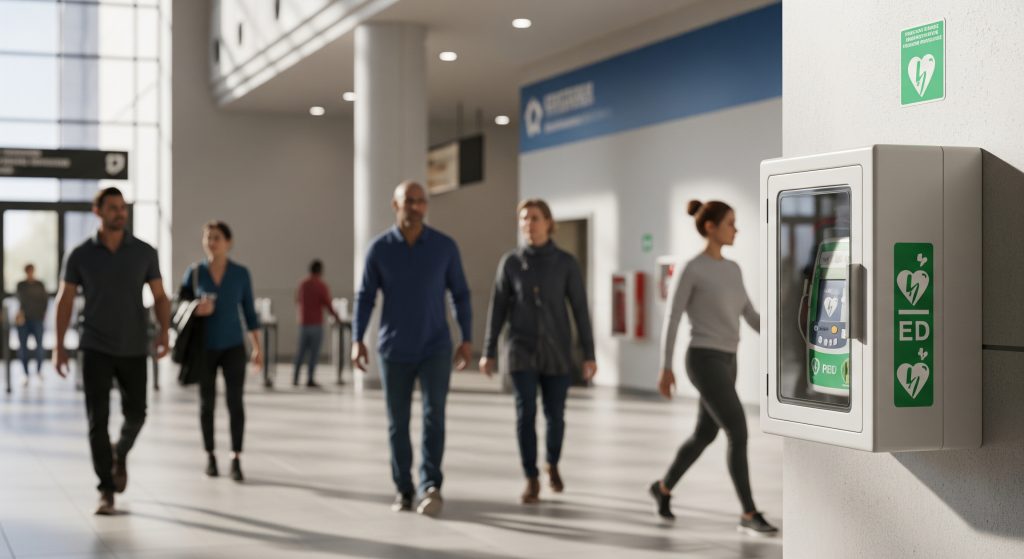
You will find AEDs in airports, gyms, stadiums, shopping centres, schools, and large workplaces. Many buildings place them near entrances or lifts for rapid access. Local regulations and corporate safety policies guide placement density and signage.
Can defibrillators harm someone who doesn’t need them?
AEDs analyse rhythm and only advise shocks for shockable patterns. The safety logic prevents inappropriate discharge in normal rhythms. Touching the patient during a shock can cause a minor jolt to a bystander, which is why the clear command matters. Stand clear.

