






 We do what's right for you...


What Are Shoulder Mobility Exercises and Why You Need Them
Dr. Ali Haider Khan
Stretching harder is not the answer. Most stiff shoulders are not tight only because of short muscles but because the joint, the scapula, and the nervous system are not moving in sync. I focus on shoulder mobility exercises because they train motion under control. Not just length. The result is smoother movement, less irritation, and strength that actually shows up in daily life.
Essential Shoulder Mobility Exercises for Better Range of Motion
1. Shoulder Rolls and Circles
I open most sessions with shoulder rolls. The movement is simple and reliable, and it primes the scapula to glide. As Gym Mikolo notes, a practical starting point is about 30 seconds in each direction.
-
Setup: Stand tall with feet hip width. Keep the neck relaxed and arms by the sides.
-
Action: Make controlled circles with the shoulders. Up, back, down, forward.
-
Dosage: Two sets clockwise and two sets counterclockwise. Breathe steadily.
Coaching cues: I keep my ribs quiet and avoid shrugging to the ears. Slow circles let the joint fluids warm. Fast reps do not help here. It is basically a primer for the rest of my shoulder mobility exercises.
2. Cross-Body Shoulder Stretch
This stretch targets the rear shoulder capsule and posterior deltoid. It helps when reaching across the body or fastening a seat belt. I bring one arm across the chest and support the elbow with the other forearm. Then I draw the arm gently toward the body until a mild stretch arrives.
-
Hold for 20 to 30 seconds. Repeat two to three times per side.
-
Keep the shoulder blade down and back. No pinching in the front of the shoulder.
If the stretch bites at the front, I lower the elbow slightly and reduce the pull. Relief, not strain.
3. Wall Slides and Angels
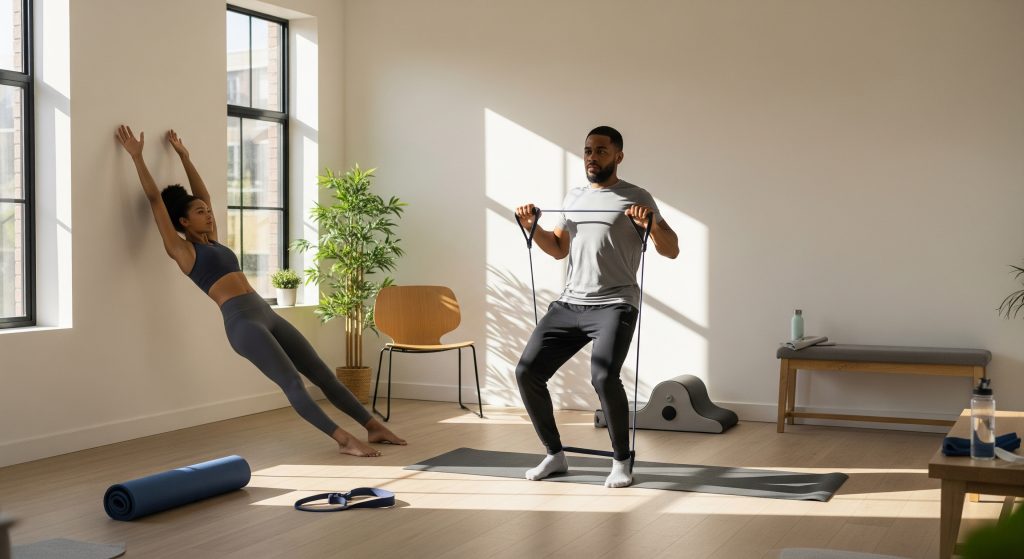
Wall slides teach scapular control and humeral movement together. This is vital for overhead tasks. As Hinge Health explains, pressing the forearms into the wall while sliding up and down builds posture, mobility, and control for those who sit long hours.
-
Setup: Stand with back, head, and hips against a wall. Forearms on the wall, elbows bent to 90 degrees.
-
Slide: Reach the forearms up without letting the ribs flare. Keep contact light but present.
-
Return: Lower with control to the start. No shrugging through the ears.
Progression: I add a brief pause near the top to own the position. If the wrists peel away, I reduce the range and rebuild control. This drill anchors many of my shoulder mobility exercises because it integrates scapular upward rotation with rib positioning.
4. Doorway Chest Stretch
Tight pectorals pull the shoulders forward. That compresses space for tendons at the front of the joint. I place forearms on the door frame at shoulder height and step forward until I feel a broad chest stretch. I keep the chin tucked slightly and the lower ribs quiet.
-
Hold for 20 to 40 seconds. Repeat two times.
-
Vary elbow height to target different fibre angles.
This stretch pairs well with wall slides. Open the chest, then train the new range under control.
5. Pendulum Swings
Pendulums are gentle and surprisingly effective early in rehab or on sore days. As Mayo Clinic outlines, the arm hangs freely while the body sways to generate small circles or arcs. The shoulder stays passive and relaxed.
-
Lean on a table with one hand. Let the other arm hang.
-
Shift the body to produce small forward, side, and circular motions.
-
Spend 1 to 2 minutes exploring comfortable ranges.
I keep the movement small and pain free. On stiff mornings, this calms things before heavier shoulder mobility exercises.
6. Band Pull-Aparts
Band pull-aparts strengthen the mid back and posterior shoulder. That counters desk posture and improves scapular positioning. I hold a light band at chest height with straight elbows. Then I pull the band wide by sliding the shoulder blades back and slightly down.
-
Reps: 10 to 15 relaxed reps. Two or three sets.
-
Tempo: Smooth in both directions. No jerking or compensations.
-
Focus: Keep the neck relaxed and ribs down for clean mechanics.
I often alternate sets of pull-aparts with wall slides. The pairing builds capacity and control together.
7. Cat-Cow Shoulder Movement
Cat-cow is not only for the spine. When I round and arch, the scapulae track along the rib cage. This movement lubricates the shoulder blade contacts. On all fours, I press the floor away as I round through the upper back. Then I gently extend through the thoracic spine and let the shoulder blades fall toward each other.
-
Eight to ten slow cycles. Breathe with the motion.
-
Keep the neck long and eyes softly down to avoid compressing the upper neck.
For tighter upper backs, this drill often unlocks room for overhead movement. It is quiet work. It matters.
8. Thread the Needle Stretch
This rotation stretch targets the posterior shoulder and thoracic spine. From all fours, I reach one arm under the body with palm up and slide the shoulder toward the floor. I keep the hips square to limit lumbar twist.
-
Hold for 20 to 30 seconds. Breathe into the upper back.
-
Repeat two to three times per side with calm tempo.
I use this before overhead pressing or swimming drills. It softens stiffness without fatiguing the shoulder.
Benefits of Regular Shoulder Flexibility Exercises
Improved Posture and Alignment
Balanced shoulder motion supports a neutral rib cage and a longer neck line. I see faster postural change when I pair shoulder flexibility exercises with mid back strength. The shoulders sit more naturally, which reduces compensations during lifting or typing.
Reduced Risk of Injury
Better control through range distributes load more evenly across tissues. That reduces hotspots in the tendon or bursa. Strong scapular mechanics also reduce the urge to shrug, which often irritates the top of the shoulder. Prevention is not flashy. It is consistent practice.
Enhanced Athletic Performance
Clean overhead mechanics help swimmers, throwers, and lifters. Power transfers through the trunk into the arm without leakage. In practice, a simple change like cleaner scapular upward rotation can add confidence to the catch in the pool or the lockout in a press.
Pain Relief and Prevention
Gentle mobility within tolerance tends to settle guarded muscles. It also restores joint nutrition via movement. On achy days, I keep the range small and the breath slow. Relief usually follows. And yet, I progress to strength work once symptoms ease to sustain the gains.
Better Daily Movement Quality
Reaching a high shelf, fastening a bra strap, or loading luggage feels different with better control. I aim for smoothness first, then range. The result is less clunky movement and fewer end range pinches. Sustainable comfort beats short term stretch highs.
Shoulder Mobility Drills for Specific Groups
Shoulder Mobility Exercises for Seniors
I prioritise safety, balance, and confidence. Chairs, benches, or a countertop offer stable support. I use shoulder mobility exercises for seniors that favour gentle arcs and breathing.
-
Supported pendulum swings with a firm table for balance.
-
Seated shoulder rolls with a slow cadence.
-
Wall slides with a reduced range and soft towel under the forearms.
Guidelines: two to four days per week, short sessions, and pain free ranges. Small improvements compound. Falls risk and fatigue guide progressions.
Shoulder Mobility Exercises for Swimmers
Swimmers need end range control and thoracic rotation. I build sessions around scapular upward rotation and long axis internal-external rotation control.
-
Wall slides into overhead holds, then controlled lowers.
-
Band pull-aparts paired with prone Y and T raises.
-
Thread the needle, then single arm overhead reach with rib control.
These shoulder mobility exercises for swimmers carry into the catch and the recovery phase. I cue timing, not just strength, because water rewards rhythm and precision.
Exercises for Desk Workers
Desk work pushes the head forward and rounds the upper back. I counter that pattern with frequent micro sessions. Two minutes every hour often beats one long block.
-
Shoulder rolls and band pull-aparts standing beside the desk.
-
Doorway chest stretch after a long call.
-
Cat-cow to restore thoracic extension before overhead tasks.
These shoulder mobility drills improve comfort and productivity. Better posture frees up attention for actual work.
Modifications for Beginners
I reduce range, add external support, and slow the tempo. If a drill pinches, I change the angle or swap the exercise.
-
Wall slides with elbows slightly lower than shoulders.
-
Cross body stretch supported by a towel to reduce leverage.
-
Pendulums in very small arcs with a timer for consistency.
Beginners benefit from clear exit rules. Pain sharper than a 3 out of 10 means stop and regress. Simple and safe.
Advanced Shoulder Mobility Techniques
When basics are clean, I layer load and complexity. I also use tempo to build control at end range.
-
Overhead carry holds with light kettlebells and rib control.
-
Prone swimmer patterns on the floor for scapular sequencing.
-
End range isometrics for external rotation using a band.
These are not fancy for the sake of novelty. They convert new mobility into usable strength. That is the point.
Creating Your Shoulder Mobility Routine
Warm-Up Techniques
I start with global motion, then move to targeted drills. This sequence reduces guarding and builds confidence in the joint.
-
Global: Cat-cow, shoulder rolls, and gentle thoracic rotations.
-
Targeted: Wall slides and cross body stretch.
-
Integrate: Band pull-aparts or light overhead carries.
Breathing matters here. I use nasal breaths and longer exhales to lower tone. Shoulders respond well to calm signals.
Frequency and Duration Guidelines
Consistency beats intensity for joint health. I prefer shorter sessions repeated across the week. Volume depends on goals and training load.
|
Goal |
Guideline |
|---|---|
|
General maintenance |
10 to 15 minutes, 3 to 4 days per week |
|
Pain management |
5 to 10 minutes daily, gentle range only |
|
Athletic performance |
15 to 20 minutes, 4 days per week plus sport specific drills |
|
Posture support |
Micro breaks of 2 minutes every hour during work |
For busy schedules, I stack mobility between strength sets. It keeps the total session efficient and focused.
Common Mistakes to Avoid
-
Chasing extreme range without control. End ranges need strength.
-
Letting the ribs flare during overhead drills. It is a false range.
-
Moving too fast. Joints need time to organise smooth motion.
-
Skipping the mid back. Thoracic stiffness steals shoulder range.
-
Pushing through sharp pain. Discomfort is fine. Pinch pain is not.
One more error deserves mention. Doing everything once, then forgetting for a month. Progress prefers rhythm over heroics.
Tracking Progress Effectively
I test what I train. Simple measures provide honest feedback and motivation.
-
Reach test: Note how many fingertips above the spine could be touched.
-
Wall slide photo: Two angles each month to compare rib control and range.
-
Pain scale: Record start and end of the week using the same activity.
-
Performance marker: Overhead press comfort or swim stroke tempo.
Earlier, I emphasised control and rhythm. These metrics confirm that those habits are working. Evidence keeps the routine honest.
Conclusion
Healthy shoulders depend on practiced movement, not heroic stretching. I build programmes around shoulder mobility exercises that pair range with control. The essentials are uncomplicated: move often, breathe well, and strengthen the positions you earn. That approach improves posture, protects the joint, and transfers to sport and daily life. Start with a short sequence, stay consistent, and let the results accumulate.
Frequently Asked Questions
How often should I perform shoulder mobility exercises?
I recommend brief practice on most days. Three to four focused sessions per week work well for many people. Short daily check ins also help, especially for desk workers. Small and frequent beats sporadic and intense for joint health.
Can shoulder mobility exercises help with frozen shoulder?
They can help to an extent, especially during the stiff and thawing phases. Gentle pendulum swings and pain free range drills are appropriate early. Progression depends on symptom irritability and medical guidance. If inflammation spikes, I reduce volume and hold ranges.
What’s the difference between shoulder mobility and shoulder flexibility?
Flexibility is passive range. Mobility is range plus control. I use shoulder flexibility exercises to open options, then mobility drills to own them. Control under breath and load is what protects the joint in real tasks.
Are shoulder mobility exercises safe during pregnancy?
In most cases, yes with modifications. I avoid long end range holds and position changes that cause dizziness. I favour gentle range work, breathing, and light band drills. When unsure, I clear the plan with a clinician.
How long does it take to improve shoulder mobility?
Roughly speaking, noticeable change appears within four to six weeks with regular practice. Timelines vary with training age, pain levels, and stress. Consistency and quality of movement set the pace more than any single technique.
Should I do shoulder mobility exercises before or after workouts?
Before lifting or swimming, I use low dose drills to prime range and control. After sessions, I add gentle range and breathing to reduce tone. On rest days, I use a short sequence to maintain rhythm. It is a simple, durable structure.

