






 We do what's right for you...


What Are Kyphosis Exercises and How Can They Improve Posture?
Dr. Ali Haider Khan


Stretching alone will not fix a rounded upper back. Strength alone will not either. The most reliable change comes from targeted, repeatable kyphosis exercises that open the chest, strengthen the upper back, and retrain the ribcage to sit better over the pelvis. I will show how to perform the key movements correctly, how to programme them, and how to avoid the common pitfalls. The goal is straightforward. Build a routine that improves posture without inflaming painful areas or wasting time.
Top Kyphosis Exercises for Better Posture
1. Doorway Chest Stretches
Doorway stretches open tight pectoral tissue and reduce the pull into rounded shoulders. I use them at the start of most sessions addressing thoracic rounding.
-
Stand in a doorway. Place forearms on the frame at shoulder height.
-
Step one foot forward. Keep ribs down and neck long.
-
Lean the body through the doorway until a firm stretch is felt across the chest.
-
Hold for 30 to 45 seconds. Breathe slowly.
-
Sets and frequency: 2 to 3 sets, five to seven days per week.
-
Regression: One arm at a time if the stretch is intense.
-
Coaching cue: Keep the chin tucked slightly. Avoid flaring the ribs.
Why it matters. Tight chest muscles tilt the shoulders forward. This stretch creates room for the upper back to extend.
2. Wall Angels
Wall angels train shoulder upward rotation and scapular control while encouraging thoracic extension. They also reveal mobility limits quickly.
-
Stand with back, head, and hips touching the wall. Feet 10 cm forward.
-
Press the lower ribs toward the wall. Keep a gentle chin tuck.
-
Place arms in a goalpost position. Back of hands and forearms near the wall.
-
Slide arms up without losing rib or head contact. Then return to start.
-
Reps and sets: 8 to 12 slow reps, 2 to 3 sets.
-
Regression: Do the move lying on the floor if the wall is too demanding.
-
Common mistake: Overarching the lower back to fake shoulder range.
Expect a burning sensation between the shoulder blades. That is the target area waking up.
3. Cat-Cow Stretches
Cat-Cow links breath and spinal movement. It is an effective primer before heavier kyphosis exercises and improves segmental control.
-
Begin on all fours. Wrists under shoulders. Knees under hips.
-
Inhale and drop the chest slightly while lifting the tailbone. Eyes look forward.
-
Exhale and round the spine gently. Draw the ribs up and tuck the tailbone.
-
Flow for 6 to 10 cycles with controlled breathing.
-
Coaching cue: Move the thoracic area, not only the neck or lower back.
-
Progression: Pause two seconds at each end of the range to build control.
-
Use case: A reliable warm up before strength focused kyphosis exercises.
This sequence helps reduce stiffness from sitting and prepares the upper back for more demanding work.
4. Thoracic Extension Exercise
Thoracic extension drills target the mid back segments that are often stubborn. I prefer controlled reps over forcing range.
-
Sit tall on a firm chair with a backrest ending at mid back level.
-
Place hands behind the head. Keep elbows slightly forward.
-
Extend gently over the chair edge for one breath. Then return to neutral.
-
Move up or down one vertebra level and repeat.
-
Reps and sets: 6 to 10 extensions across 3 to 4 positions, 2 sets.
-
Alternative: Perform on a foam roller for added range.
-
Safety: Do not crank the neck. The movement is through the ribcage.
As J Phys Ther Sci notes, thoracic extension programmes have shown pre and post reductions in kyphosis angle, supporting their role in postural change.
5. Prone Y-T-W Raises
Prone Y-T-W work builds endurance in the lower trapezius, middle trapezius, and posterior deltoid. These are the posture stabilisers people neglect.
-
Lie face down on a bench or mat. Set forehead on a small towel.
-
Y: Raise arms overhead in a Y shape with thumbs up. Lower with control.
-
T: Raise arms to the side in a T shape. Squeeze shoulder blades lightly.
-
W: Bend elbows and pull them down to form a W. Hold one second.
-
Reps and sets: 8 to 12 each shape, 2 to 3 rounds.
-
Load: Start bodyweight only. Add 0.5 to 1 kg micro plates if solid.
-
Coaching cue: Keep the chin tucked. Avoid shrugging.
This sequence teaches the scapulae to move and centre. It also pairs well with band rows.
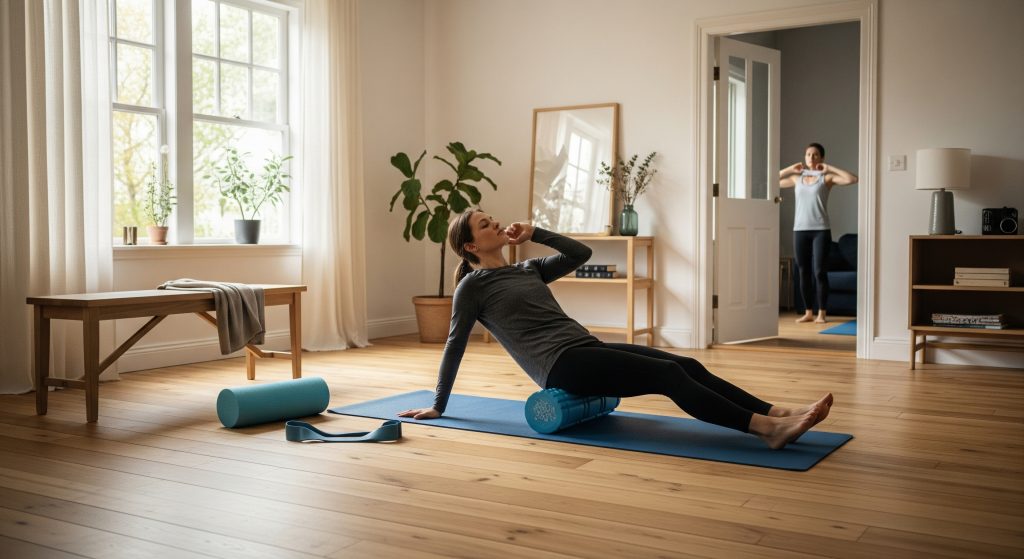
6. Foam Roller Extensions
Foam roller extensions mobilise the thoracic spine with passive support. They suit desk workers and beginners alike.
-
Lie on a mat with a roller across the mid back. Knees bent. Feet planted.
-
Support the head with hands. Keep the pelvis level.
-
Gently extend over the roller as you exhale. Return on the inhale.
-
Shift the roller one segment and repeat.
-
Reps: 8 to 12 controlled arcs across 3 to 5 segments.
-
Tip: Limit the arch to the area above the lowest ribs.
-
When to use: As a primer before strength focused kyphosis exercises.
Expect a mild stretch across the ribs. Never force end range. Precision beats amplitude here.
7. Child’s Pose Variations
Child’s pose eases spinal tension while allowing targeted arm positions to open the lats and armpit fascia. It is restorative and practical.
-
Kneel and sit back on the heels. Reach arms forward on the floor.
-
Hold for 30 to 45 seconds with long exhales.
-
Variation: Walk hands to the right for a left side stretch. Then switch.
-
Variation: Place elbows on a block to bias lat length.
-
Use case: Cool down after upper back work or mid day desk breaks.
-
Coaching cue: Keep shoulders relaxed. Let the breath do the work.
Recovery matters. Mobility gains are kept when the nervous system stays calm.
8. Bird Dog Exercise
Bird Dog connects trunk control with shoulder and hip stability. It protects gains from other kyphosis exercises by steadying the spine.
-
Start on all fours. Brace lightly as if zipping up the abdomen.
-
Extend the right leg and left arm. Keep hips level and neck neutral.
-
Hold two to three breaths. Return and switch sides.
-
Reps and sets: 6 to 8 holds each side, 2 sets.
-
Progression: Draw slow boxes with the outstretched hand.
-
Common mistake: Arching the lower back to lift the leg higher.
Quality beats height. The point is quiet control with minimal wiggle.
9. Rowing Exercises
Row variations strengthen the retractor muscles that counter rounded shoulders. They form the strength base for posture change.
-
Band row: Attach a band at chest height. Row with elbows at 30 to 45 degrees.
-
Dumbbell chest supported row: Lie face down on an incline bench. Pull in a smooth arc.
-
Seated cable row: Neutral grip. Keep ribs down and finish with a light squeeze.
Programming options:
-
Hypertrophy focus: 3 sets of 10 to 12 reps with a 2 second eccentric.
-
Endurance focus: 2 sets of 15 to 20 reps with shorter rests.
-
Posture pairing: Combine rows with chest opening between sets.
Rows teach the shoulder blades to glide. Not just to pinch. That distinction matters.
10. Scapular Wall Slides
Wall slides blend mobility and control. They reinforce scapular upward rotation and posterior tilt that upright posture requires.
-
Stand with back and head touching the wall. Tuck the pelvis slightly.
-
Press forearms into the wall. Hands in a V shape above the elbows.
-
Slide up while keeping gentle pressure against the wall. Then slide down.
-
Reps and sets: 10 to 15 reps, 2 to 3 sets.
-
Progression: Add a light loop band around forearms to cue external rotation.
-
Coaching cue: Keep the neck long. Think chin in and crown tall.
Correct technique matters. Contact points, rib control, and slow tempo make the drill count.
How Kyphosis Exercises Improve Posture and Spinal Alignment
Strengthening Weak Upper Back Muscles
Kyphotic posture often reflects undertrained scapular retractors and depressors. I emphasise rowing patterns, prone Y-T-W, and wall angels to restore balance.
-
Effect on alignment: Stronger mid back muscles hold the shoulder blades closer to the ribcage.
-
Breathing effect: Better ribcage stacking improves quiet nasal breathing in daily life.
-
Pain modulation: Endurance in these muscles can reduce perceived upper back fatigue.
This is not about crushing heavy weights. It is about repeatable quality reps that the body can sustain daily.
Stretching Tight Chest Muscles
Tight pectoral tissue tips the shoulders forward and drags the head with it. Doorway stretches and soft tissue work create the space needed for strength to hold.
-
Choose two chest opening drills in each session.
-
Hold stretches for at least 30 seconds to allow a noticeable release.
-
Follow the stretch with a pulling drill to lock the range in.
Stretch then strengthen. The order is simple and effective.
Correcting Forward Head Position
Forward head posture increases cervical extensor load and compresses joints at the base of the skull. I integrate chin tucks, thoracic extension, and workspace tweaks.
-
Chin tuck sets the head over the ribcage without force.
-
Thoracic mobility reduces the need for the neck to cheat extension.
-
Ergonomic checks lower the daily trigger for poor alignment.
As BMC Musculoskeletal Disorders notes, therapeutic exercise programmes can improve forward head posture and reduce associated symptoms over structured cycles.
Correcting the head is not vanity. It reduces headaches and eases shoulder tension for many people. Often quickly.
Improving Core Stability
Posture is a whole body event. A quiet, well timed core allows the ribcage to stack over the pelvis and frees the thoracic spine to extend.
-
Favourites: Bird Dog, dead bug, and side plank holds.
-
Dosage: 2 to 3 sets of 20 to 40 seconds each exercise.
-
Key cue: Breathe behind the brace. Do not hold your breath.
When the trunk is steady, the shoulder blades can move cleanly. That is when kyphosis exercises really stick.
Enhancing Spinal Mobility
Mobility is the permission slip for better alignment. Cat-Cow and segmental extensions unlock the thoracic area gradually.
-
Focus on the ribcage, not the lower back.
-
Use slow exhales to nudge extra range without strain.
-
Pair mobility with light strength work to retain gains.
Small daily mobility deposits compound. The spine rewards consistency more than intensity.
Creating an Effective Kyphosis Exercise Programme
Age-Specific Exercise Modifications
Age changes tissue tolerance, recovery time, and baseline mobility. I adjust loading, positions, and tempo accordingly.
|
Group |
Practical modification |
|---|---|
|
Children and teens |
Keep sessions playful and brief. Teach movement patterns, not heavy loading. |
|
Adults 20 to 50 |
Prioritise strength endurance. Mix 2 pulling moves with 1 chest opener. |
|
Older adults |
Use more supported positions. Shorter sets. Daily low dose mobility. |
|
Office bound |
Micro sessions during the day. Two 5 minute blocks beat a missed workout. |
The goal remains the same. Restore extension, build upper back endurance, and make posture changes feel natural.
Frequency and Duration Guidelines
Successful programmes favour rhythm over effort. I use clear weekly targets that are realistic and sustainable.
-
Daily micro work: 5 to 10 minutes of mobility and one activation drill.
-
Main sessions: 3 days per week of 25 to 35 minutes focused on upper back strength.
-
Stretch exposure: Accumulate at least 5 minutes of chest opening per day.
-
Reassessment: Recheck posture photos every 4 weeks to track change.
Kyphosis exercises benefit from consistency. Small daily wins add up faster than occasional hard efforts.
Progressive Exercise Difficulty
Progression should feel almost boring. That is a good sign. It means the joints are adapting without complaint.
-
Range first: Increase movement quality and control before adding load.
-
Volume next: Add reps and sets once technique stays solid under light fatigue.
-
Load last: Introduce small weights or stronger bands while keeping tempo honest.
-
Example ladder: Wall angels to wall slides with bands to overhead lifts.
-
Example ladder: Band rows to cable rows to chest supported dumbbell rows.
Keep two clean reps in reserve on most sets. Posture training responds well to submaximal work.
Common Mistakes to Avoid
-
Chasing range with the lower back. The extension must live in the thoracic spine.
-
Skipping strength. Stretches without rowing work rarely hold.
-
Overusing high loads. Endurance and control matter more early on.
-
Ignoring breath. Breath holds create neck tension and fake stability.
-
Inconsistent practice. Three short bouts beat a heroic weekend session.
Another point is simple. If pain increases sharply, regress the drill and shorten the set. Then rebuild.
Tracking Posture Improvement
I prefer objective markers over vague impressions. The following tools keep progress honest.
-
Front and side photos every four weeks in the same lighting and stance.
-
Wall test: Back, head, and hips on the wall. Measure the natural gap behind the neck.
-
Range log: Note how many wall angel reps you can perform without rib flare.
-
Daily feel: Record neck or shoulder tension on a simple 1 to 5 scale.
Earlier numbers become anchors. When a gap reduces or a rep count rises, confidence follows. That momentum matters.
Conclusion
Kyphosis exercises work best as a coordinated plan, not as isolated moves. Open the chest, mobilise the thoracic spine, then build upper back endurance that holds better alignment without strain. Keep the core quietly stable and the breath steady. Progress range before load, and quality before volume. The result is posture that stands up by itself and stays that way through work, training, and everyday life.
Frequently Asked Questions
How long does it take to see results from kyphosis exercises?
Expect small changes in two to four weeks with consistent practice. Visible posture shifts often appear across eight to twelve weeks. Strength and comfort usually improve first, then shape follows. I encourage photo checks every four weeks to confirm progress.
Can kyphosis exercises completely reverse poor posture?
They can significantly improve posture for most people, though results vary by age, severity, and adherence. Structural changes in older adults may not fully reverse. Yet function, comfort, and appearance can still improve markedly. The programme’s consistency is the real driver.
Are kyphosis exercises safe for children and elderly people?
Yes, with appropriate modifications. Children need short, skill focused sessions. Older adults benefit from supported positions and lower loads. If pain persists or there is a known spinal condition, I suggest clearance from a clinician before starting.
Should I feel pain whilst doing kyphosis exercises?
No sharp pain should occur. A mild muscular burn or stretch is acceptable and expected. If pain exceeds mild discomfort, stop the set, reduce the range, or switch to a gentler version. The correct dose builds capacity without provoking symptoms.
Can I do kyphosis exercises at home without equipment?
Yes. Wall angels, Cat-Cow, Bird Dog, doorway stretches, and prone Y-T-W can all be done with no equipment. A foam roller or light resistance band is useful but not essential. Home based routines work well when performed regularly.
How often should I perform exercises to improve posture?
Short daily mobility blocks plus three weekly strength sessions deliver reliable results. Think 5 to 10 minutes of mobility each day with two to three movements. Then 25 to 35 minute strength sessions on non consecutive days. This pattern fits most schedules and sustains momentum.
kyphosis exercises, exercises to improve posture

