






 We do what's right for you...


Understanding Hip Mobility Exercises: Benefits for All Age Groups
Dr. Ali Haider Khan
Static stretching before strength work. That old rule lingers, yet the hips respond better to a deliberate blend of mobility, stability, and strength. In this guide, I set out exactly how to use hip mobility exercises across ages and abilities. The aim is simple. Move more freely, reduce compensations, and keep training without the repeat niggles that keep returning.
Essential Hip Mobility Exercises for Daily Practice
1. Hip Circles and Rotations
When people ask where to start, I usually start here. Controlled hip circles and rotations build awareness as much as range. I use slow standing circles, then move into controlled articular rotations. The sequence wakes up joint capsules and the deep rotators. It is basically a daily diagnostic and a tune up in one.
-
Set-up: Stand tall, brace lightly, and draw a slow circle with one knee without shifting the torso.
-
Tempo: Two to three rounds clockwise and the same anticlockwise, keeping the circle smooth.
-
Progression: Perform from a quadruped position to reduce balance demands, then advance to standing.
External and internal rotation deserve targeted time. I include both because balanced rotation reduces unwanted stress on knees and lumbar spine. Keep the pelvis still and let the ball of the hip do the work. Small, precise, consistent.
Here is why I rate these hip mobility exercises so highly. They improve neuromuscular control, not only length. Better control means cleaner squats, steadier lunges, and a lower risk of compensation when fatigue creeps in.
2. 90-90 Hip Stretch
The 90-90 position targets external rotation in the front leg and internal rotation in the rear. I coach three phases: passive hold, active lift, and end range breathing. Each adds a layer of control. Each respects the joint’s limits.
-
Passive: Sit with both knees at right angles. Hinge forward from the hips and hold for 30 to 60 seconds.
-
Active: From the same position, attempt to lift the front ankle a few centimetres. Hold 5 seconds. Repeat 5 times.
-
End range: Breathe slowly into the stretch. On each exhale, add a micro hinge without rounding the back.
Short on time? I suggest one minute per side daily. It fits between meetings and still pays off. These hip mobility exercises integrate well before strength work, particularly squats and deadlifts. The result is noticeable, even in cautious lifters.
3. Pigeon Pose Variations
Pigeon is useful, but alignment matters. I prefer to teach Lying Figure 4 first, then Upright Pigeon, then forward fold only if the hip accepts the position without knee discomfort. A block or cushion under the front hip can maintain neutral pressure.
-
Entry: From hands and knees, bring one knee forward and angle the shin. Slide the rear leg back, toes pointed.
-
Alignment: Square the pelvis towards the front knee. Keep the rear leg long and in line with the body.
-
Options: Stay tall to bias the hip flexor of the rear leg. Fold gently to bias the outer hip of the front leg.
Common faults include twisting the pelvis and collapsing into the lower back. I cue a gentle lift through the chest and even weight across the hips. If the front knee feels vulnerable, return to Figure 4. No exercise is worth an irritated joint.
Used judiciously, these hip mobility exercises open space in the hips without chasing extreme ranges. That restraint helps. Especially for runners and lifters who need repeatable positions rather than party tricks.
4. Hip Flexor Lunges
I rely on split stance work to lengthen and strengthen at the same time. The half kneeling hip flexor lunge is efficient and clear. Glute engagement of the rear leg is non negotiable. Without it, the front of the hip never truly releases.
-
Set-up: Half kneel with the rear knee under the hip. Tuck the pelvis. Squeeze the rear glute.
-
Shift: Gently glide the hips forward while maintaining the pelvic tuck. Hold for 20 to 30 seconds.
-
Add reach: Raise the arm on the rear leg side and side bend away slightly to bias the psoas.
I often follow this with a few controlled reverse lunges to layer strength on newly gained range. That blend turns simple flexibility into usable mobility. In practice, these hip mobility exercises reduce tugging at the front of the hip during squats.
5. Butterfly Stretch Progressions
The butterfly position focuses on the adductors and pelvic floor region. I coach a progressive trio: supported hold, active presses, and gentle pulses. This sequence respects tissue tolerance and builds capacity across sessions.
-
Supported hold: Sit tall, soles together, heels a comfortable distance from the pelvis. Hold 45 to 60 seconds.
-
Active press: Press knees into hands for 5 seconds, then relax and allow a small increase. Repeat 3 to 5 times.
-
Pulses: Small controlled pulses at end range for 15 to 20 seconds without bouncing.
For many, the limiting factor is not just muscle length. It is also low tolerance to stretch sensation. Calm breathing and steady holds improve that tolerance. Over weeks, these hip mobility exercises unlock deeper but safer ranges.
6. Standing Hip Abductions
Hip abduction is a missing link in many programmes. Standing abductions train the gluteus medius for pelvic control during single leg tasks. I prefer a wall assisted stance so the pelvis does not hike or rotate.
-
Execution: Stand tall, brace, and move the working leg outward 20 to 30 degrees. Pause at the top.
-
Dosage: Two sets of 10 to 15 controlled reps. Add a mini band above the knees for progression.
-
Focus: Keep the toes pointing forward to avoid turning this into hip flexion.
These hip mobility exercises improve lateral stability. They support cleaner running mechanics and reduce knee valgus under load. Small muscles. Big outcome.
7. Clamshell Exercise
Clamshells are simple and widely prescribed. They work when form is strict. The goal is targeted abductor activation without rolling the pelvis backwards. I set the knees at roughly 45 degrees and keep heels together.
-
Form: Lie on your side, spine neutral, hips stacked. Lift the top knee a short distance. Pause.
-
Tempo: Two seconds up, one second hold, two seconds down. Aim for control.
-
Progression: Add a light band. Then move to side plank clamshells for combined trunk and hip demand.
Integrate these hip mobility exercises alongside modest strength work and the hip complex stabilises notably. Runners with recurring ITB symptoms often feel steadier within weeks. Not magic. Just specific stimulus and patience.
8. Hip Bridges with Variations
The bridge family trains hip extension and trunk control. I start with a basic glute bridge, then add marching, feet elevated options, or single leg bridges. Each variation exposes weak links. That is useful feedback for training focus.
-
Base: Heels close to the hips, ribs down, then drive through the heels. Squeeze the glutes at the top.
-
March: Hold the top position and alternately lift one foot a few centimetres. Keep the pelvis level.
-
Single leg: Extend one leg and bridge with the other. Reduce height if hamstrings dominate.
In many cases, these hip mobility exercises restore extension that sitting erodes. The side effect is welcome. Better posture in standing and less anterior hip pinching during deep flexion tasks.
Age-Specific Hip Mobility Programmes
Playful Movement Patterns for Young Children
For children, structure matters less than variety. I build games around animal walks, gentle frog sits, and squat to stand flows. Sessions last ten minutes and show movements, not lectures. The aim is exploration and safe challenge.
-
Bear crawl, crab walk, and frog jumps for multiplanar hip movement.
-
Short balance tasks on one leg with a soft landing zone.
-
Mini obstacle courses with crawls under and steps over.
Think of these as early hip mobility exercises in disguise. The benefit is durable. Better coordination and joint awareness that carry forward into sport skills.
School Sport Preparation Exercises
School age athletes need consistency more than novelty. I anchor warm ups with dynamic hip drills: walking lunges, lateral shuffles, and A-skips. I add 90-90 transitions and hip circles for joint readiness.
-
Five minute circuit: Hip circles, lateral lunges, walking lunges, and 90-90 shifts.
-
Coaching cue: Smooth rhythm first, speed only when patterns are stable.
-
Weekly goal: Three sessions of basic hip mobility exercises paired with simple strength.
The combination reduces tightness from sitting and grows capacity for sprinting, cutting, and landing. It is practical and repeatable, which is the point in busy school terms.
Athletic Performance Enhancement for Teenagers
For teenagers in structured sport, I design low volume, high quality blocks. First, dynamic mobility. Second, primer strength. Third, short plyometrics. The hips then express power through a full and safe range.
-
Mobility: 90-90 active lifts, deep squat pry with breath, and hip flexor lunge reaches.
-
Strength: Split squats, bridges, and banded abductions. Two hard sets, not junk volume.
-
Plyo: Line hops and low box jumps with soft, symmetrical landings.
These progressions integrate hip mobility exercises into performance goals without draining training energy. The result is often better change of direction and cleaner acceleration mechanics.
Desk Worker Relief Routines
Long sitting compresses hip flexion all day. I prescribe two five minute movement snacks. One mid morning. One mid afternoon. The ingredients are predictable, and effective.
-
Set 1: Hip circles, standing hip abductions, and 90-90 forward hinge.
-
Set 2: Half kneeling hip flexor lunge, seated Figure 4, and bridge holds.
-
Rule: No stretch should irritate the knee or lower back. Adjust positions if needed.
Over a quarter, these hip mobility exercises often relieve background stiffness and reduce desk to gym friction. Small breaks that preserve productivity and comfort.
Maintaining Independence in Later Years
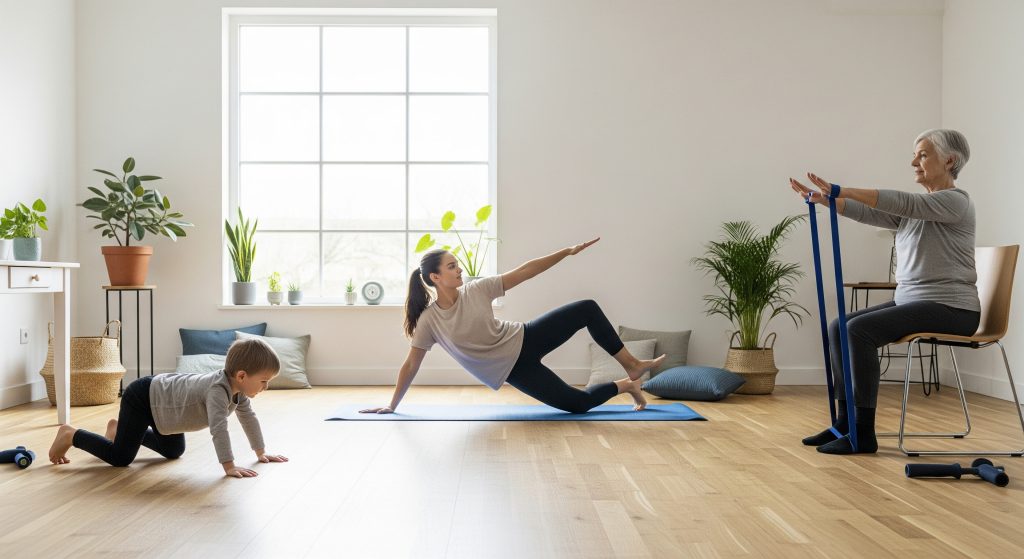
For older adults, the priority is confident gait and safe transfers. I emphasise chair stands, supported split stance holds, and step overs. The programme blends flexibility and stability without floor work if getting down is difficult.
-
Chair routine: Sit to stand for 8 to 10 reps. Then standing hip abductions at the countertop.
-
Mobility: Gentle butterfly holds and supported 90-90 transitions with cushions.
-
Balance: Heel to toe walks along a stable surface.
These hip mobility exercises preserve range to tie shoes, step into a bath, and walk uneven pavements. Independence is the real outcome. Not just looser hips.
Combining Hip Strengthening with Flexibility Training
Dynamic Warm-Up Sequences
Mobility without warmth is inefficient. I build three to five minute sequences that raise temperature and rehearsal quality. Think marching, leg swings within control, and gentle open the gate patterns.
-
Flow: Marching, hip circles, lateral lunges, and 90-90 transitions.
-
Rule: Start small, then increase amplitude as tissues accept the range.
-
Check: Joints feel smoother and movement feels lighter. If not, reduce range and repeat.
In practice, these dynamic hip mobility exercises reduce the number of warm up sets needed under the bar. That saves time and energy for the main work.
Resistance Band Hip Exercises
Bands offer cheap, portable overload for the hip complex. I rely on lateral walks, monster walks, and standing abductions with a loop band. Keep the feet parallel and the knees softly bent.
-
Lateral walk: 10 to 12 controlled steps each way. Do not let the knees cave.
-
Monster walk: Forward and backward at a 45 degree angle. Short steps. Constant band tension.
-
Standing abduction: Two sets of 12 to 15 per side with quality pauses.
This mini circuit pairs well with hip mobility exercises in the same session. Mobility opens the door. Bands keep it open by strengthening end ranges.
Bodyweight Strengthening Movements
Bodyweight work delivers a clear signal without complex equipment. I rotate split squats, step downs, and bridge variations. The sequence challenges unilateral control and exposes favouring between sides.
-
Split squat: Vertical shin bias for quad and hip control. Two sets of 8 to 10 per side.
-
Step down: Slow three second lower to a small box. Keep the knee tracking the middle toes.
-
Bridge hold: 30 to 45 seconds at the top with ribs down and glutes active.
Stack these with hip strengthening exercises if extra load is available later. The foundation remains the same. Control first, then intensity.
Progressive Flexibility Protocols
Flexibility rarely improves without progression. I periodise in simple four week blocks. Week 1 fixes positions. Week 2 adds contract relax work. Week 3 extends hold times. Week 4 emphasises end range strength.
|
Phase |
Focus |
|---|---|
|
Week 1 |
Positioning and gentle holds in 90-90, butterfly, and hip flexor lunge |
|
Week 2 |
Contract relax: 5 second press, 10 second ease, repeat |
|
Week 3 |
Longer holds, 60 to 90 seconds, calm nasal breathing |
|
Week 4 |
End range lifts and controlled returns within safe limits |
By focusing on consistent exposure, these hip mobility exercises convert flexibility gains into function. That is the bridge many plans miss.
Recovery and Cool-Down Techniques
Cooling down is not theatre. It accelerates recovery when done with intent. I use three components: gentle range, breath work, and tissue care.
-
Gentle range: Two minutes of 90-90 shifts and short hold Pigeon or Figure 4.
-
Breath: Four slow breaths in each end position. Exhale slightly longer than inhale.
-
Tissue care: Light foam rolling along glutes and adductors for 60 to 90 seconds each.
These hip mobility exercises close the loop. They lower tone and signal readiness for the next session. Recovery is not passive. It is a strategy.
Creating Your Personalised Hip Mobility Routine
Morning Mobility Sequences
Morning stiffness is normal. I keep the morning set short and achievable. Five minutes, no special kit, and a clear finish.
-
Hip circles: 2 rounds each direction per leg.
-
90-90 sit and shift: 6 slow transitions with control.
-
Bridge hold: 30 seconds, twice.
These hip mobility exercises create enough space to start the day without heaviness. No heroics. Just repeatable wins that compound over months.
Pre-Workout Hip Activation
Before strength or running, I activate abductors and hip rotators. The goal is crisp patterns, not fatigue. I use a simple tri set.
-
Banded lateral walk: 12 steps each way.
-
Standing hip abductions: 12 per side with a 1 second pause on top.
-
90-90 active lift: 5 controlled lifts each side.
These hip mobility exercises make the first work set feel like the second. Joints feel ready and positions lock in faster. That is useful in tight time windows.
Post-Exercise Hip Recovery
After training, I bias longer holds. I select two positions that reflect the session demands. Squat day? Choose butterfly and hip flexor lunge. Sprint day? Choose 90-90 and Figure 4.
-
Hold: 60 to 90 seconds per side, calm breathing.
-
Reset: A gentle bridge set of 10 reps to finish.
-
Note: Discomfort may be present, but sharp pain is a stop signal.
Integrating these hip mobility exercises post session reduces next day stiffness to a manageable level. It also protects range built over time.
Common Mistakes to Avoid
-
Chasing discomfort: More sensation is not more benefit. Seek a firm but sustainable stretch.
-
Skipping rotation: Many focus only on flexion and extension. Rotation maintains healthy joint function.
-
Poor pelvic control: Pelvic tilt and rib position matter. They decide which tissues are loaded.
-
Inconsistent dosing: Three short exposures per week beat one long, sporadic session.
-
Ignoring strength: Mobility without hip strengthening exercises creates fleeting gains.
I see these errors in busy professionals and committed athletes alike. The fixes are uncomplicated and reliable. Precision over intensity.
Tracking Progress Indicators
Progress hides in small markers. I track four indicators and ask clients to record them monthly. Objective and subjective, together.
|
Deep squat comfort |
Less pinching at the front of the hip and smoother depth |
|
Single leg balance |
Stable 20 second hold without hip drop |
|
Change of direction |
Cleaner push off and faster recovery step |
|
Daily tasks |
Ease putting on socks, stepping into a car, or climbing stairs |
Earlier improvements often show up as reduced warm up time. That matters. It means your hip mobility exercises are creating durable change, not temporary slack.
Conclusion
Hip function is not a mystery. It is a trainable blend of range, control, and strength. The exercises above cover the essentials for children, desk workers, and athletes. Apply them consistently. Pair hip mobility exercises with targeted hip strengthening exercises and a few well chosen hip flexibility exercises. The hips will move better, accept load more evenly, and support the rest of your training. Sustainable capacity is the real goal. Build that, and performance follows.
Frequently Asked Questions
How often should I perform hip mobility exercises?
For most people, three to five short sessions per week deliver steady gains. I recommend 5 to 10 minutes on non training days and 5 minutes before training. Short sessions promote adherence and reduce soreness. If stiffness is high, use daily micro sessions with reduced intensity. These hip mobility exercises respond well to frequent, gentle input.
Can hip flexibility exercises help reduce lower back pain?
They can, to an extent. Limited hip rotation or extension often shifts stress to the lumbar spine. Improving hip range and control reduces that compensation. Combine hip flexibility exercises with trunk stability drills and glute strength. The combination is more effective than stretching alone. Persistent pain warrants a clinical assessment.
What are the best hip strengthening exercises for runners?
I prioritise lateral band walks, standing hip abductions, split squats, and bridge progressions. These build pelvic control and hip extension power, both critical for running economy. Pair them with targeted hip mobility exercises like 90-90 and hip flexor lunges. The balance of mobility and strength sustains form on long runs and under fatigue.
How long does it take to see improvements in hip mobility?
Roughly speaking, two to four weeks of consistent practice produces noticeable ease in daily positions. Deeper changes in range and control usually appear by eight to twelve weeks. Dose and quality matter. Use precise positions and calm breathing. These hip mobility exercises reward patience.
Are hip mobility exercises safe during pregnancy?
Generally yes, with modifications and clinician guidance. Focus on comfortable ranges, supported positions, and breathing. Avoid deep end positions if joints feel overly loose. Prioritise standing or side lying variations and reduce intensity as needed. Any sharp pain or dizziness is a stop signal and requires review.
Which hip exercises are most suitable for arthritis sufferers?
Low load, high control movements are ideal. I use supported sit to stand, gentle 90-90 transitions with cushions, short hold butterfly, and bridge isometrics. Warm up the joint with slow hip circles first. Keep sessions short and frequent. These hip mobility exercises aim to maintain function and manage stiffness without flare ups.

