






 We do what's right for you...


Understanding Diplopia Treatment: Causes, Symptoms, and More
Dr. Krishna Vaitheeswaran
Advice to simply wait for double vision to clear on its own is often misguided. I approach diplopia treatment as a structured process that starts with cause, moves to stabilisation, and then focuses on durable recovery. This article sets out that path clearly. It explains the likely double vision causes, what to look for, which tests matter, and how I combine optical, medical, surgical, and therapy options. The goal is practical: reduce risk, restore function, and return patients to confident daily vision.
Primary Diplopia Treatment Options
Prism Glasses for Immediate Relief
When patients present with binocular double vision, I frequently begin with prisms. The reason is simple. Prisms redirect light to help the eyes register a single fused image, which can provide fast symptomatic relief while the underlying issue is evaluated. As PubMed reports, roughly 88% of patients in a study achieved complete or partial resolution with prism use, particularly in divergence insufficiency. That result aligns with clinical experience where prisms buy time and comfort.
In practice, I test with Fresnel stick-on prisms first. They are adjustable and inexpensive. If alignment stabilises, I switch to ground-in prisms for better optics. I keep the prescription conservative at the start, since over-prisming can cause distortion or asthenopia. This staged approach fits into a wider diplopia treatment plan, not a stand-alone fix.
-
Advantages: rapid relief, reversible adjustment, supports ongoing diagnostics.
-
Limitations: less effective with large, variable, or vertical deviations; can reduce clarity or contrast.
-
Best fit: stable small-to-moderate deviations and predictable gaze patterns.
Here is the real value. Early comfort improves compliance with further testing and therapy. That accelerates definitive diplopia treatment and reduces avoidable anxiety.
Contact Lens Solutions for Diplopia Management
Contact lens strategies are a useful adjunct when glasses are impractical or when corneal optics complicate the picture. For monocular diplopia linked to corneal irregularity or post-surgical changes, a carefully fitted soft or scleral lens can neutralise aberrations and restore a single image. I consider this pathway when spectacle corrections fail or when occupational demands make glasses inconvenient.
Prism contact lenses are a specialised option. They incorporate prism or use prism-ballast designs to stabilise lens orientation. I reserve these for small-angle deviations where light realignment within the lens can help. For intractable binocular symptoms that resist alignment, therapeutic occlusion with a blackout contact lens is sometimes the most humane choice. It is reversible, non-invasive, and preserves appearance while removing the conflict between images.
This is not the first line for every case. But when fitted correctly and monitored, contact lenses can integrate smoothly with broader diplopia treatment. They enhance daily function without locking the patient into a single modality.
Botulinum Toxin Injections for Muscle Control
Botulinum toxin can temporarily weaken an overacting extraocular muscle. I use it to reduce imbalance, permit fusion, or to test likely surgical outcomes. The effect typically develops over a few days and lasts several weeks to months. It is a measured tool. It provides a reversible trial when alignment is unstable or when systemic risk makes immediate surgery unwise.
Ideal scenarios include acute cranial nerve palsies with disabling diplopia, restrictive strabismus where scarring produces overpull, and cases in which I need to understand the dynamic response before choosing a permanent correction. The benefit is often practical rather than cosmetic: improved comfort, fewer head tilts, and better function at work or school.
As with any pharmacological step, I counsel patients about transient ptosis or overcorrection. Those effects usually pass as the drug weakens. The aim remains consistent. Use botulinum toxin to support the overall diplopia treatment pathway, not to replace a definitive plan.
Surgical Interventions for Persistent Cases
Surgery becomes relevant when deviation is stable, symptoms persist, and optical or pharmacological measures cannot maintain single vision. The decision is not rushed. I confirm stability over time and map the pattern across gaze positions.
In post-traumatic cases with globe malposition or restrictive strabismus, outcomes are encouraging. As PubMed Central summarises, improvement rates reached roughly 85.7% for globe malposition and 90.1% for restrictive strabismus after surgical intervention. These figures reflect careful selection and targeted techniques rather than a one-size approach.
-
Typical procedures: recession or resection of extraocular muscles, adjustable sutures, and release of restrictive tissue.
-
Candidate profile: stable deviation, consistent measurements, and failure of non-surgical diplopia treatment.
-
Postoperative plan: early alignment checks, possible suture adjustments, and structured vision therapy.
I use adjustable sutures where possible. They allow refinement once the patient is awake and viewing naturally. It is a small detail that often makes a large difference.
Common Double Vision Causes and Diagnostic Approaches
Monocular vs Binocular Diplopia Identification
The first clinical fork is binary. Does double vision persist with one eye covered? If yes, the problem is monocular. If no, and it disappears upon occluding either eye, it is binocular. This single observation defines the initial workup and strongly influences diplopia treatment.
|
Type |
Likely source |
|---|---|
|
Monocular |
Cornea, lens, or retinal optics causing ghosting or image splitting. |
|
Binocular |
Ocular misalignment from nerve palsy, muscle restriction, or decompensated strabismus. |
This distinction saves time. It directs testing, avoids unnecessary scans, and shapes the early management plan. Precision at this step prevents months of frustration.
Age-Related Double Vision Causes
Ageing introduces predictable risk patterns. Decompensated phorias can present after decades of stable control. Divergence insufficiency appears in later decades with distance diplopia. Lens changes create monocular diplopia through internal reflections or irregular astigmatism. The remedy depends on the origin. It may be prism for a small esodeviation, ocular surface care, or lens optimisation after cataract surgery.
I routinely evaluate thyroid history and vascular risk in this cohort. Small vessel ischaemic cranial nerve palsies are more common in older adults and often recover partially. That trajectory influences timing. Early relief with prisms or occlusion is reasonable while I monitor for improvement.
Neurological and Systemic Conditions
Neurological causes demand careful triage. Acute third nerve palsy with pupil involvement requires urgent imaging to rule out compressive aneurysm. Myasthenia gravis produces fluctuating diplopia and ptosis. Thyroid eye disease leads to restrictive patterns and vertical diplopia. Diabetes and hypertension increase risk for microvascular palsies that may resolve over weeks.
Systemic context informs both urgency and treatment selection. I coordinate with neurology, endocrinology, or rheumatology when autoimmune or inflammatory disease is suspected. That integrated approach reduces blind spots and accelerates effective diplopia treatment.
Essential Diagnostic Tests and Examinations
A concise test panel answers most questions without overreach. I prioritise the following sequence when symptoms are stable and non-acute.
-
Refraction and ocular surface assessment to exclude monocular contributors.
-
Cover tests at distance and near to quantify deviation and comitancy.
-
Motility charting across nine gaze positions to reveal pattern and restrictions.
-
Hess or Lancaster charts when available to visualise muscle action.
-
Pupil and eyelid examination for neurological red flags.
-
Targeted imaging if trauma, restriction, or neurological signs are present.
I keep testing purposeful. The output must change management, not merely fill a file. That is the discipline.
Recognising Double Vision Symptoms and Warning Signs
Visual Disturbances and Image Patterns
Patients describe lateral displacement, vertical splitting, or torsional offset. Night driving worsens symptoms. High contrast lights create flare and ghosting. Patterns vary with cause. Convergence insufficiency produces near blur and pulling with fatigue. Thyroid restriction causes vertical diplopia in upgaze or downgaze.
I ask for sketches. A quick drawing of perceived image positions often reveals the vector and helps calibrate diplopia treatment. It is simple and surprisingly informative.
Associated Physical Symptoms
Headache, eye strain, brow ache, and neck tilt are common. Nausea appears when images conflict during motion. Children may close one eye in bright light to suppress diplopia. Adults often report reduced reading stamina and loss of depth cues. These details guide me toward the correct mix of optical correction and therapy.
-
Compensatory head posture suggests cyclovertical issues.
-
Fluctuating ptosis hints at neuromuscular junction disease.
-
Photophobia and tearing may indicate ocular surface involvement.
Symptoms map to causes. Causes define the plan. That is the chain.
Emergency Warning Signs Requiring Immediate Care
Sudden-onset diplopia with severe headache, new neurological deficits, or pupil-involving third nerve palsy needs emergency evaluation. Acute trauma with orbital pain or crepitus requires urgent imaging. Painful eye movements and fever raise concern for infection or inflammatory disease.
When these features appear, I do not delay. I stabilise with occlusion and arrange same-day referral for imaging and multidisciplinary input. Safety first, then the rest.
Vision Therapy and Eye Exercises for Diplopia
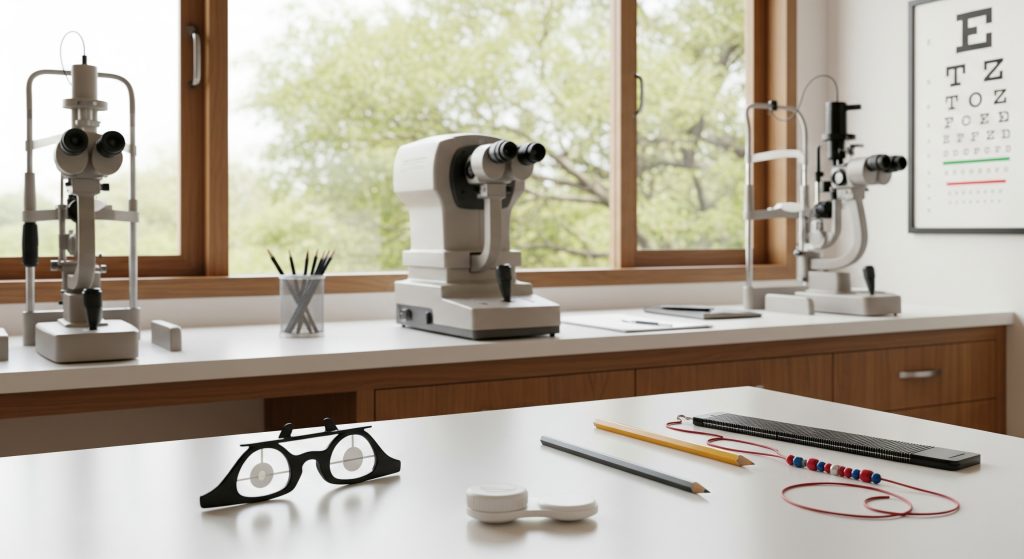
1. Pencil Push-Up Exercises for Convergence
Pencil push-ups remain a pragmatic tool for convergence insufficiency. I prescribe short, consistent sets rather than marathon sessions. The goal is controlled effort at the edge of comfort, not strain. Patients track a small letter or dot as the pencil moves inward, stopping when a single image cannot be maintained.
-
Dosage: 5 to 10 minutes, 5 days per week, reassess at 6 to 8 weeks.
-
Target: reduce near exo deviation and improve near point of convergence.
-
Integration: combine with ergonomic adjustments and intermittent breaks.
These exercises complement prisms in a layered diplopia treatment plan. Training builds endurance while optics provide relief.
2. Brock String Training for Eye Coordination
The Brock string gives immediate feedback on where fusion breaks. I use three beads to train depth and alignment. Patients learn to see the physiological cross at the in-focus bead. Suppression or unequal effort becomes obvious at once. It is simple and data-rich training for home use.
Progress markers include smoother bead transitions, fewer suppression scotomata, and improved comfort at intermediate distances. I escalate difficulty by altering bead spacing and head position. It is targeted, not generic exercise.
3. Near-Far Focus Exercises
Alternating focus between near and distant targets trains accommodation and vergence flexibility. I pair this with metronome pacing to encourage rhythm. Sessions are intentionally short and regular. The aim is to normalise switching speed and reduce lag that fuels double images during reading and screen use.
For patients with coexisting dry eye, I add blink routines and environmental changes. Small adjustments prevent setbacks and keep the schedule consistent.
4. Computer-Based Vision Therapy Programmes
Software-guided programmes can accelerate progress by quantifying performance. I select modules that train vergence ranges, saccades, and anti-suppression. Data helps. It shows gains and exposes plateaus early. I still anchor progress in functional targets such as comfortable reading for 30 minutes without diplopia.
Technology is not a shortcut. It is an instrument. I fit it into broader diplopia treatment with regular reviews and clear exit criteria.
5. Tracking and Dot Card Exercises
Dot cards train smooth pursuit and convergence in a compact format. Patients follow dot sequences from far to near, watching for doubling and drift. I incorporate head movements to reflect real-world demands. For sports or active professions, I build tracking drills that challenge dynamic fixation under mild load.
When fatigue spikes or symptoms flare, I brief patients to reduce intensity and resume the next day. Consistency beats heroics. Always.
Moving Forward with Diplopia Treatment
My approach is phased and transparent. First, confirm whether diplopia is monocular or binocular. Then, stabilise symptoms using prisms, occlusion, or contact lenses. Next, address cause while protecting daily function. Finally, consolidate gains with therapy or surgery where indicated. This structure avoids drift and reduces time to recovery.
Diplopia treatment is rarely one decision. It is a sequence of correct decisions. The plan adapts as the picture clarifies. For example, consider a professional driver with binocular diplopia after minor trauma. I might start with temporary Fresnel prisms, restrict night driving, and initiate range-of-motion work. If imaging later confirms restriction, surgery enters the discussion. Therapy and fine-tuning follow.
Here is what this means. Evidence guides choices, but lived tasks define success. I measure outcomes by reading stamina, safe mobility, and work readiness as much as by prism dioptres. Patients value function. So do I.
Frequently Asked Questions
How long does diplopia treatment typically take to show results?
Timelines vary by cause and stability. Optical relief with prisms or occlusion can help within days. Neurological palsies may improve over weeks to months, and I review at regular intervals. Vision therapy typically shows measurable gains within 6 to 8 weeks if adherence is strong. Surgical pathways require stability before scheduling and careful follow up. Roughly speaking, many patients see functional gains within the first month of structured care.
Can children develop diplopia and what are the treatment differences?
Children can develop diplopia from decompensated strabismus, trauma, or refractive changes. Suppression can occur quickly in younger brains, which protects comfort but risks amblyopia. I therefore act promptly. Treatment focuses on accurate refraction, targeted prisms, or occlusion, with early vision therapy for coordination. Surgery is considered for stable, persistent deviations. The principles mirror adult diplopia treatment, but the neuroplastic window argues for faster intervention.
Is diplopia treatment covered by health insurance in India?
Coverage differs by insurer and policy details. Consult the policy schedule and pre-authorisation rules. Many plans cover medically necessary consultations, imaging, and surgery. Optical aids and vision therapy may be partially reimbursed or excluded. I advise patients to request a written estimate and a medical necessity letter citing diagnosis, functional impact, and planned interventions.
What lifestyle modifications help manage double vision symptoms?
Moderate, practical changes help. Improve workstation ergonomics and lighting. Schedule short visual breaks and use a 20-20-20 cadence. Reduce night driving during acute phases. Apply ocular surface measures if dry eye contributes. Where double vision symptoms worsen with fatigue, I adjust task blocks and encourage hydration and sleep discipline. These steps support formal diplopia treatment and reduce flare risk.
When should I seek emergency care for sudden diplopia?
Seek urgent care if diplopia is sudden with severe headache, new neurological deficits, or a dilated, non-reactive pupil. Head trauma, painful eye movements, or fever with orbital symptoms also require rapid assessment. In those situations, I stabilise with occlusion and expedite imaging and specialist review. Safety overrides routine scheduling.
At-a-glance Decision Guide
|
Problem |
Preferred first step |
|---|---|
|
Monocular ghosting |
Refraction, ocular surface treatment, consider specialty contact lenses. |
|
Small stable deviation |
Trial prisms, then ground-in if effective. |
|
Acute painful onset with neuro signs |
Emergency imaging and multidisciplinary review. |
|
Restrictive pattern post trauma |
Imaging and surgical evaluation once stable. |
|
Convergence insufficiency |
Pencil push-ups and Brock string, consider light near prisms. |
Pros and Cons of Common Interventions
Prisms
-
Pros: quick relief, adjustable, integrates with therapy.
-
Cons: may blur or reduce contrast, limited for large deviations.
Contact lenses
-
Pros: good for corneal issues, discrete, activity friendly.
-
Cons: fit complexity, hygiene demands, narrow prism range.
Botulinum toxin
-
Pros: reversible, diagnostic and therapeutic value.
-
Cons: transient effect, risk of temporary ptosis or overcorrection.
Surgery
-
Pros: durable alignment, adjustable refinement possible.
-
Cons: operative risk, requires stable measurements and recovery time.
Final Note
Diplopia treatment is most effective when staged, measured, and anchored to functional goals. Relief first. Cause next. Durability always.
Clarifying Key Terms
I occasionally reference two pieces of clinical shorthand that matter here. NPC is the near point of convergence, the closest point where single vision holds during convergence. PFV refers to positive fusional vergence, the reserve that maintains single vision under demand. These metrics are practical. They help me quantify progress and adjust therapy.
Putting It Together
Earlier, I noted high response rates to targeted surgery in restrictive cases. That context supports a careful but confident surgical discussion when non-surgical measures plateau. It also explains why I invest in alignment stability and accurate measurements before booking theatre time. Timing matters as much as technique.
Double vision causes may overlap and evolve across weeks. Double vision symptoms may ease with rest and then surge under stress. That variability is expected, not a failure. The response is consistent follow up and a plan that adapts without losing direction.

