






 We do what's right for you...


Trauma Care Explained: Understanding Emergency Services in India
Dr. Rajesh Kumar Mishra
Common advice says to rush any injured patient to the nearest hospital. That sounds sensible. It also risks avoidable harm if the facility cannot deliver time-critical trauma care. I wrote this guide to clarify how emergency medical services, trauma centre levels, and hospital teams work together in India. The aim is simple. Help a serious injury patient reach the right care, fast, and survive with dignity.
Types of Trauma Centres and Their Capabilities
Hospitals are not identical in trauma care capability. Matching injury severity to the right level reduces delays and prevents secondary injury. Here is a concise reference I use when planning regional networks and training.
|
Level |
Typical capabilities |
|---|---|
|
Level I |
24×7 multidisciplinary services, in-house specialists, advanced imaging, blood bank, research and training |
|
Level II |
24×7 emergency surgery, critical care, most subspecialties on-call, advanced imaging |
|
Level III |
Stabilisation, emergency surgery for select cases, transfer protocols to higher levels |
|
Level IV |
Basic resuscitation, initial assessment, rapid transfer after airway and haemorrhage control |
|
Specialised Units |
Focused services such as burns, paediatrics, neuro-trauma, or ortho-trauma |
Level I Trauma Centres
Level I centres deliver comprehensive trauma care, including complex surgery and subspecialty coverage. I rely on them for polytrauma and high-velocity injuries. They maintain in-house teams across anaesthesia, neurosurgery, orthopaedics, cardiothoracic surgery, and interventional radiology. They also run ATLS training and audit outcomes. This level anchors regional trauma care and sets standards for quality improvement.
-
Immediate access to operating theatres and ICU beds.
-
Massive transfusion protocols and validated pathways.
-
Integrated rehabilitation and psychosocial support.
Level II Trauma Centres
Level II facilities manage most serious injuries with rapid surgical response and critical care. They typically call in certain subspecialties as needed. When a Level I is distant, I treat Level II as the practical destination during the golden hour. The centre stabilises and completes definitive care for many cases. Complex neuro-trauma or major burns may still require transfer.
-
24×7 emergency theatre access with core surgical teams.
-
CT imaging and standard blood products available round-the-clock.
-
Protocol-driven trauma care to reduce handoff delays.
Level III Trauma Centres
Level III centres focus on stabilisation, initial surgery when indicated, and arranged transfer. This tier is vital in peri-urban districts. I emphasise clear transfer criteria and early communication with higher centres. Good Level III performance reduces pre-transfer deterioration. It strengthens the entire trauma care pathway.
-
Skilled airway management and haemorrhage control.
-
Damage control surgery for time-critical bleeding.
-
Formal transfer agreements and shared documentation.
Level IV Emergency Facilities
Level IV facilities deliver first-line resuscitation in remote areas. The goal is safe, rapid triage and transfer. I encourage focused training for nurses and medical officers on ABCDE, spinal precautions, and safe analgesia. Where transport times are long, simple measures like splinting and haemostatic dressings save lives. This is frontline trauma care in India, often under challenging conditions.
-
Basic airway devices and oxygen therapy.
-
IV access, fluids, and analgesia within protocol limits.
-
Immediate activation of transport to higher levels.
Specialised Trauma Units
Specialised units handle burns, paediatric trauma, or neuro-trauma. I route cases to these services when specific expertise improves outcomes. An example helps. A child with isolated head injury benefits from paediatric anaesthesia and neuro-monitoring. Focused units reduce complications and length of stay. They also strengthen trauma care management for niche but high-risk cohorts.
Emergency Medical Services and Response System
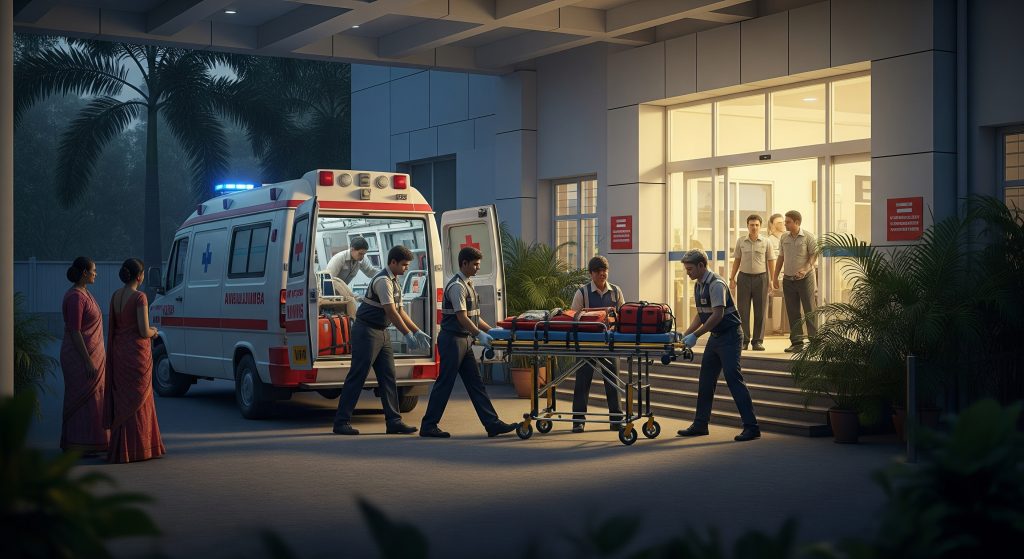
Pre-hospital systems link injury scenes to definitive care. The chain includes dispatch, first responders, transport, and hospital notification. Strong emergency medical services are the backbone of equitable access.
108 Ambulance Service Operations
The 108 network provides public ambulance access across many states. I consider it the default dial for serious injury. Dispatch prioritises life-threatening calls, assigns the closest ambulance, and guides callers. Crew skill mix varies by state contract. Coordinated handover with receiving hospitals shortens time to theatre and improves trauma care.
-
Call triage with priority codes.
-
GPS-based allocation and route optimisation.
-
Pre-arrival alerts to emergency departments.
First Responder Protocols
First responders stabilise airway, breathing, and circulation. They also control bleeding and protect the spine. I ask teams to follow ATLS principles, adapted for field limitations. Avoid unnecessary on-scene procedures that cost precious minutes. Early recognition of severe shock matters more than a perfect set of vitals.
-
Catastrophic haemorrhage control with tourniquets or hemostatic dressings.
-
Airway positioning and oxygen as needed.
-
Rapid packaging for transport to a suitable level.
Golden Hour Management
The first hour after major trauma shapes survival and disability. My rule is simple. Do essential interventions fast and move. On-scene time should be minimal for unstable patients. Choose the destination based on trauma centre levels, not proximity alone. This is the heart of effective trauma care in India, especially on crowded urban corridors.
Focus on the right care, not just fast care. Speed without direction wastes the golden hour.
Pre-Hospital Care Standards
Standards cover training, equipment, documentation, and safety. I recommend structured checklists, including airway kit readiness, spinal devices, and splints. Field triage tools like GCS and RTS guide destination choice. Record simple but critical data. Time of injury, mechanism, vital trends, interventions performed, and medications given.
-
Adopt ATLS-informed checklists and refreshers.
-
Audit call timelines and clinical outcomes quarterly.
-
Standardise handover using SBAR or IMIST-AMBO.
Communication and Dispatch Systems
Dispatch quality determines response time and scene coordination. I support caller coaching for CPR and haemorrhage control until help arrives. Pre-alerts to hospitals allow theatres to prepare. Reliable communications prevent silent delays during inter-facility transfer. The result is smoother trauma care management across the region.
Trauma Care Management Process
Once a patient arrives, structured steps reduce error. The sequence is non-negotiable, though clinical judgement always applies. I insist on visible leadership, clear roles, and documented times for each stage.
Initial Assessment and Triage
Triage sorts patients by threat to life and resource needs. I use colour codes or ESI levels to allocate staff and space. Mechanism of injury, physiological instability, and apparent injuries guide priority. Good triage prevents crowding of resuscitation bays. It keeps trauma care moving during surges.
-
Immediate, urgent, delayed, and expectant categories.
-
Senior review for borderlines within minutes.
-
Activate massive transfusion early when indicated.
Primary Survey ABCDE Protocol
ABCDE saves lives by enforcing disciplined priorities. Airway with C-spine control. Breathing and ventilation. Circulation with haemorrhage control. Disability with GCS and pupils. Exposure and environment. I push teams to verbalise each step. It reduces drift and missed injuries in fast-moving trauma care.
-
Use capnography when available for airway confirmation.
-
Control external bleeding before advanced diagnostics.
-
Prevent hypothermia with active warming.
Secondary Survey Procedures
After stabilisation, a head-to-toe evaluation identifies associated injuries. I include a full history using AMPLE. Allergies, medications, past history, last meal, and events. Imaging follows an agreed algorithm. FAST, chest X-ray, and CT as indicated. Document everything clearly. Good notes allow safe handovers across shifts and sites.
-
Systematic examination with log-roll for back assessment.
-
Targeted imaging to avoid waste and delay.
-
Early involvement of required specialties.
Resuscitation and Stabilisation
Resuscitation targets oxygen delivery and perfusion. I prefer balanced blood product ratios over excessive crystalloids. Permissive hypotension can apply in select penetrating trauma. Analgesia is treatment, not comfort alone. Stabilisation ends when physiology is acceptable and the next step is safe. That clarity prevents drift in trauma care.
-
Activate massive transfusion with predefined triggers.
-
Consider TXA within approved windows and indications.
-
Reassess ABCDE after every intervention.
Definitive Treatment Planning
Definitive care balances speed with sequencing. I use damage control orthopaedics when shock persists. For polytrauma, neurosurgery and general surgery must align theatre priorities. A written plan avoids theatre conflicts and stray delays. This is where trauma care management meets operational discipline.
-
Define time goals for source control and decompression.
-
Assign a single coordinator for inter-specialty timing.
-
Communicate plan to ICU and blood bank early.
Post-Trauma Rehabilitation Services
Recovery starts on day one, not at discharge. Early mobilisation, pulmonary hygiene, and nutrition shorten ICU stay. I add neuro-rehabilitation and psychological support as soon as feasible. Rehabilitation is integral to trauma care, not an optional extra. Families benefit from structured education and follow-up schedules.
-
Set functional goals within 72 hours.
-
Provide home exercise plans before discharge.
-
Screen for PTSD and chronic pain during follow-ups.
Accessing Trauma Care Services in India
Access depends on public infrastructure, private capacity, and insurance design. The route to the right bed is often the true challenge. I recommend simple, pre-decided actions for households and employers.
Government Trauma Facilities
Public hospitals anchor regional trauma care in India. They operate Level I or Level II centres in major cities and along highways. Cost barriers are lower, and 24×7 teams are more consistent. Crowding can be significant during peak hours. A prior understanding of referral pathways helps families act decisively.
-
Use 108 for ambulance activation and routing.
-
Carry basic identity when possible, but do not delay care.
-
Ask the emergency desk for trauma coordinator contact.
Private Hospital Networks
Private networks add capacity for imaging, ICU beds, and specialist cover. They often provide faster diagnostics and shorter queues. I advise checking which centres are equipped for comprehensive trauma care. Marketing labels can be optimistic. Verify on-call neurosurgery, orthopaedics, and blood bank availability.
-
Confirm ambulance acceptance and cashless tie-ins.
-
Keep a shortlist of two nearby centres per neighbourhood.
-
Ask about inter-facility transfer support if escalation is required.
Insurance Coverage Options
Insurance influences destination choice, but clinical need comes first. Most policies cover emergency stabilisation irrespective of network status. Pre-authorisation can follow. I counsel families to focus on life-saving trauma care, then regularise paperwork. Maintain copies of all reports and invoices from day one.
-
Know cashless hospitals on your policy, but do not delay transport.
-
Inform the insurer within the stipulated notification window.
-
Request an itemised estimate before definitive procedures, when feasible.
Emergency Contact Numbers
Keep critical contacts visible on every phone and workplace noticeboard. Numbers matter when decisions must be made in seconds. I advise a simple list and clear roles.
-
108 – public ambulance coordination.
-
Two nearest trauma-ready hospitals – emergency desks.
-
Family medical decision-maker and HR or security contact.
This small step supports faster trauma care during the most stressful hour.
Rural vs Urban Service Availability
Service density differs sharply between metros and rural districts. Urban areas have more Level I and Level II centres. Rural facilities rely on Level III or Level IV resources with longer transfers. I emphasise robust referral and reliable transport. Telemedicine helps bridge expertise gaps while the patient is en route. Equity depends on these practical links.
-
Standard transfer checklists to prevent omissions.
-
Shared imaging and reports to avoid repeats.
-
Agreed feedback loops to improve outcomes over time.
Conclusion
Trauma care succeeds when three pieces align. Timely response, the right destination, and disciplined in-hospital management. I focus on repeatable behaviours. Call 108 promptly, choose a centre by capability, and use ABCDE without deviation. Families and employers should prepare basic plans in advance. Clinicians should practise clear leadership and measure outcomes. This is how trauma care in India improves at scale. One decision, one transfer, and one protocol at a time.
Frequently Asked Questions
What is the difference between a trauma centre and a regular emergency department?
A trauma centre has dedicated teams, protocols, and resources for complex injuries. A regular emergency department treats many emergencies but may not support advanced trauma care. The distinction affects survival for major injuries. Destination choice should reflect injury severity and required capability.
How quickly should a trauma patient reach a hospital in India?
As a rule of thumb, reach a capable centre within the golden hour. Faster is better when bleeding or airway compromise exists. Choose the facility by trauma centre levels, not just distance. Early pre-alert and direct to theatre can save critical minutes.
Are trauma care services free in government hospitals?
Government hospitals usually offer subsidised or free emergency stabilisation. Charges may apply for certain consumables or advanced procedures. The focus is immediate life saving trauma care first. Financial counselling follows once the patient is stabilised.
What documents are needed for emergency trauma admission?
Bring any identity proof if available, but do not delay care. Hospitals can register the patient as unknown if needed. Insurance details help later. The priority is life saving trauma care and accurate clinical information from the scene.
Which cities in India have Level I trauma centres?
Major metros and several state capitals host Level I centres. Examples include Delhi, Mumbai, Chennai, Kolkata, Bengaluru, Hyderabad, and Ahmedabad. Regional hubs continue to expand capacity. Always verify current capability and on-call coverage before planned referrals.
Can I choose which trauma centre to go to during an emergency?
Yes, if time and clinical condition allow. However, destination choice should follow medical advice and accepted protocols. For severe injuries, I recommend the nearest suitable facility with comprehensive trauma care. Definitive treatment can proceed or transfer can be organised if required.
Keywords used: trauma care, emergency medical services, trauma care management, trauma centre levels, trauma care in India.

