






 We do what's right for you...


Poison Antidote Explained: What to Know and How It Works
Dr. Rajesh Kumar Mishra
Most advice about toxic exposures starts with a list of symptoms and a generic warning. That misses the practical truth. In an emergency, a poison antidote only helps if the mechanism matches the toxin, the dose is correct, and the timing is right. I will set out exactly how antidotes work, where they fit in modern care, and what to do before help arrives. This is a concise field guide for clinicians and non-specialists who want more than slogans.
Common Poison Antidotes and Their Specific Uses
1. Naloxone for Opioid Overdose
Naloxone reverses opioid effects by displacing opioids from mu receptors. I use it when respiratory rate falls or pupils are pinpoint after suspected opioid ingestion. Response is often rapid. But repeated dosing may be required because naloxone is shorter acting than many opioids. In mixed overdoses with sedatives or alcohol, airway support remains the priority. That is non-negotiable.
-
Typical approach: titrate small intravenous boluses to restore breathing, not full arousal.
-
Risks: acute withdrawal in dependent patients, agitation, vomiting with aspiration risk.
-
Adjuncts: oxygen, bag valve mask ventilation, capnography where available.
2. Atropine for Organophosphate Poisoning
Atropine counters muscarinic excess from organophosphates and carbamates. I focus on drying bronchial secretions and improving heart rate rather than chasing pupil size. Doses escalate quickly in severe cases. Pralidoxime may be added to reactivate acetylcholinesterase, particularly for organophosphates. Severe cases need intensive airway care and continuous monitoring. It is a marathon, not a sprint.
-
Indicators for atropinisation: clear lungs, heart rate improvement, rising blood pressure.
-
Support: ventilatory support, seizure control, decontamination with appropriate PPE.
3. N-Acetylcysteine for Paracetamol Toxicity
N-acetylcysteine replenishes glutathione stores and shields the liver from toxic metabolites. Early therapy changes outcomes. As WHO notes, both oral and intravenous routes are highly effective in preventing hepatic injury when administered promptly.
-
Window of maximal benefit: within about **8** hours from ingestion, though later treatment still helps.
-
Protocols: standard and SNAP regimens; both are effective, with differing adverse event profiles.
-
Safety: adverse effects occur but are usually manageable, including nausea and mild anaphylactoid reactions.
In practice, I confirm timing and dose as best as possible, take baseline liver function tests, and start N-acetylcysteine without delay when thresholds are met. If history is unclear, I err on the side of treatment. Delay costs hepatocytes.
4. Flumazenil for Benzodiazepine Overdose
Flumazenil antagonises benzodiazepine effects at the GABA-A receptor. Its use is selective. As Medscape reports, it is the specific antidote but carries seizure risk, particularly in chronic users or mixed overdoses with pro-convulsant agents.
-
Primary plan: supportive care, airway protection, and observation remain the default approach.
-
Candidate profile: iatrogenic oversedation during procedures or isolated accidental ingestion in a benzodiazepine-naive patient.
-
Dosing principle: small titrated boluses while maintaining readiness for seizures.
Clinical judgement matters. A poison antidote that triggers seizures is the wrong tool for many cases. I reserve flumazenil for narrow indications with clear upside.
5. Vitamin K for Warfarin Poisoning
Warfarin impairs synthesis of vitamin K dependent clotting factors. Vitamin K reverses this effect and restores coagulation. In life-threatening bleeding, intravenous vitamin K and factor replacement are indicated. As Circulation outlines, dosing and adjuncts such as prothrombin complex concentrates improve the speed and completeness of reversal.
-
Minor elevation of INR without bleeding: oral vitamin K may suffice, with careful monitoring.
-
Severe bleeding: intravenous vitamin K with four-factor PCC or fresh frozen plasma.
-
Caution: define the cause of over-anticoagulation to prevent rebound risks.
Reversal plans should be protocolised. But local stock, patient comorbidities, and bleeding site still guide final decisions.
6. Activated Charcoal as Universal Adsorbent
Activated charcoal can bind many xenobiotics in the gut and reduce systemic absorption. The window of utility is narrow. I consider it within one hour of a significant ingestion, provided the airway is protected. It does not bind alcohols, strong acids, alkalis, or metals well. It is not a panacea. It is a tool.
-
Key requirement: intact airway reflexes or a secured airway to avoid aspiration.
-
Practical point: do not use with caustics or if perforation is suspected.
-
Double-dose charcoal: rarely used, reserved for enterohepatic recirculation of select drugs.
7. Chelating Agents for Heavy Metal Poisoning
Chelators bind metal ions to enhance renal or biliary elimination. The choice depends on the metal involved and the clinical context. Dimercaprol, EDTA, DMSA, and penicillamine are common options. Baseline metal levels, renal function, and symptom severity guide therapy. Chelation has hazards, including redistribution and kidney stress. Careful dosing is essential.
-
Lead: calcium disodium EDTA or DMSA depending on severity and patient age.
-
Arsenic and mercury (inorganic): dimercaprol in severe cases.
-
Copper overload: penicillamine, with close monitoring for hypersensitivity.
How Poison Antidotes Work in the Body
Competitive Antagonism Mechanism
Several antidotes act by competing with the toxin at receptor sites. Naloxone is the classic example. It outcompetes opioids at mu receptors, reversing respiratory depression. Flumazenil competes at the benzodiazepine site on the GABA-A receptor. This is pharmacology in action. It is basically blocking the offender without activating the receptor.
-
Effect depends on relative affinity and concentration at the receptor.
-
Short-acting antidotes may require repeated dosing to maintain effect.
Chemical Neutralisation Process
Other agents work by direct chemical interaction. Cyanide antidotes convert haemoglobin to forms that bind cyanide or provide sulfur donors for detoxification. This is neutralisation rather than blockade. The chemistry is straightforward, though dosing windows are tight and errors are unforgiving.
-
Outcome hinges on reaction kinetics and toxin load.
-
Side effects arise from the antidote itself, which is a key trade-off.
Receptor Blocking Actions
Receptor blockade is related to competitive antagonism but can involve partial antagonism or inverse agonism. Some antidotes reduce receptor activity below baseline. This matters when the toxin acts as a receptor agonist with downstream amplification. Precision in dose avoids overshoot. Too little does nothing. Too much creates another problem.
Enhanced Elimination Methods
Multiple strategies increase toxin removal. Urinary alkalinisation enhances excretion of weak acids such as salicylates. Whole bowel irrigation clears sustained-release formulations. Extracorporeal removal, including haemodialysis, can be decisive for toxins with low protein binding and small volume of distribution. A poison antidote is not always a drug. Sometimes the machine is the antidote.
-
Match the elimination method to toxin properties and patient physiology.
-
Monitor acid-base status and electrolytes during alkalinisation.
Metabolic Pathway Modification
Some agents alter metabolism to safer routes. N-acetylcysteine is the exemplar, replenishing glutathione and favouring non-toxic conjugation of paracetamol metabolites. Ethanol or fomepizole inhibit alcohol dehydrogenase in methanol and ethylene glycol poisoning. This buys time for elimination. The poison antidote in these scenarios changes the pathway, not the endpoint only.
Recognising Poisoning Symptoms and Emergency Response
Early Warning Signs of Poisoning
Early recognition changes outcomes. I look for sudden nausea, vomiting, abdominal pain, confusion, pinpoint or dilated pupils, unusual odours, or unexplained hypotension. Rapid breathing or slow, laboured breaths tell a story. So do new seizures. Patterns matter. Context matters more.
-
Consider the scene: empty blister packs, chemical containers, or a suicide note.
-
Assess vitals and consciousness quickly, then secure the airway if needed.
Symptoms by Types of Poisons
Different toxins produce characteristic syndromes that guide action. Knowing common clusters helps. It is a diagnostic shortcut that still respects nuance.
|
Type |
Typical features |
|---|---|
|
Opioids |
Respiratory depression, miosis, bradycardia, reduced bowel sounds. |
|
Anticholinergics |
Dry skin, mydriasis, urinary retention, agitation, tachycardia. |
|
Cholinergics |
Salivation, lacrimation, urination, diarrhoea, emesis, bronchorrhoea, miosis. |
|
Sedative-hypnotics |
Somnolence, ataxia, slurred speech, respiratory depression in severe cases. |
|
Sympathomimetics |
Agitation, hyperthermia, tachycardia, hypertension, dilated pupils. |
|
Caustics |
Drooling, odynophagia, chest pain, possible perforation after ingestion. |
|
Heavy metals |
Abdominal pain, neuropathy, anaemia, cognitive changes over time. |
These clusters are a starting point. Mixed exposures blur the picture. That is where structured assessment helps.
First Aid for Poisoning Before Medical Help
Immediate steps must be simple and safe. I prioritise airway, breathing, and circulation. Then I remove ongoing exposure and gather history for handover. This is practical first aid for poisoning that anyone can follow with care.
-
Ensure scene safety. Do not expose yourself to fumes or caustics.
-
Check responsiveness and breathing. Start rescue breaths if trained and needed.
-
Call emergency services. Provide age, substance, amount, and time if known.
-
Remove contaminated clothing. Rinse skin or eyes with copious water if exposed.
-
Do not induce vomiting. Avoid food or drink unless advised by clinicians.
-
Bring containers, blister packs, or photos to hospital for identification.
One firm rule. Activated charcoal for poisoning should not be given at home unless a clinician instructs and airway is safe. Aspiration risks are real.
When to Administer Activated Charcoal
Timing and selection define benefit. Consider a single dose within one hour of a potentially toxic ingestion that is known to bind to charcoal. The patient must be awake and cooperative or intubated. Avoid charcoal after caustic ingestion, hydrocarbons with aspiration risk, or if ileus is suspected. I reassess after each step. Then I stop if the risk exceeds the gain.
-
Approximate dose: **1** g per kg body weight, if clinically appropriate.
-
Repeat dosing: only for specific agents with enterohepatic recirculation.
Emergency Contact Numbers in India
Emergency response is often the difference between harm and recovery. These numbers are nationally recognised, though state protocols vary.
|
All emergencies |
112 |
|
Ambulance |
108 |
|
Ambulance (legacy in some regions) |
102 |
|
Health helpline (state dependent) |
104 |
Keep local hospital numbers saved and visible at home. Many tertiary centres operate poison information services. Availability varies by city and time. Plan ahead, not during the crisis.
Prevention and Safety Measures
Safe Storage of Household Chemicals
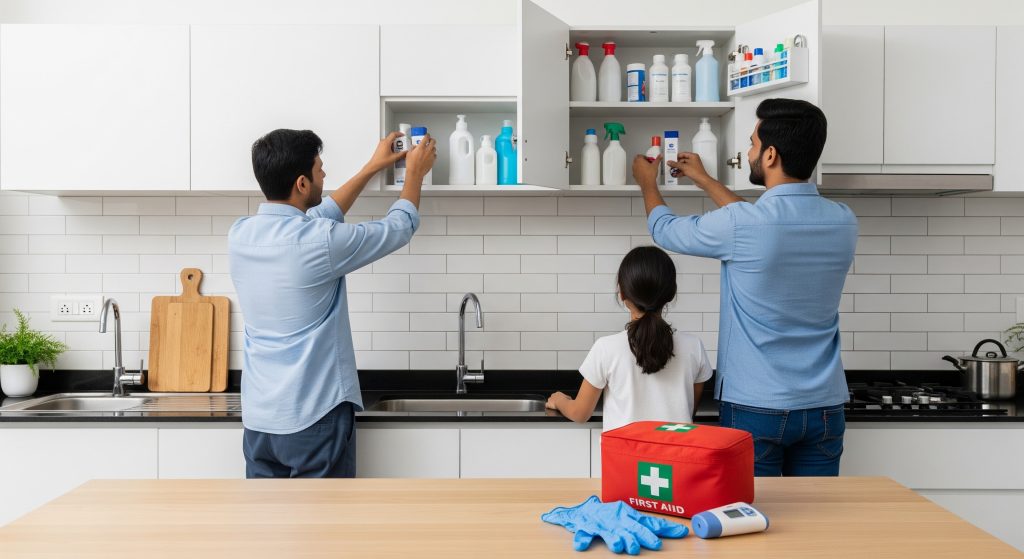
Storage beats treatment. I place chemicals in original containers with intact labels and child-resistant caps. High shelves or locked cabinets reduce accidental access. Never decant chemicals into food or drink bottles. That mistake creates tragedies. Good habits prevent exposures more effectively than any poison antidote ever could.
-
Segregate acids, alkalis, and oxidisers to limit reactions in spills.
-
Keep an updated inventory. Dispose of expired items through approved channels.
Child-Proofing Against Accidental Poisoning
Children explore by tasting and touching. Simple barriers work. I install latches, add door locks, and store medicines in tamper-resistant boxes. Teach older children not to share pills or sweets from unknown packets. Clear rules matter. So do out-of-sight locations.
-
Use blister packs when possible. They slow impulsive ingestion.
-
After use, return products to storage immediately. Not later. Immediately.
Identifying High-Risk Substances at Home
Hazards hide in plain sight. Know the obvious and the subtle. I group items by risk and plan controls accordingly. This is how to map the types of poisons that actually harm households.
-
Medicines: opioids, benzodiazepines, tricyclics, antidiabetics, iron tablets.
-
Chemicals: acids, alkalis, solvents, pesticides, antifreeze.
-
Cosmetics and personal care: nail polish remover, strong hair treatments.
-
Household and garden: rodenticides, fertilisers, certain plants and essential oils.
-
Food risks: improperly stored mushrooms or herbal remedies with unknown ingredients.
List them, label them, and control access. A short inventory reduces uncertainty during emergencies.
Creating a Home Poison Safety Kit
A basic kit turns panic into an organised response. It is not about stocking complex drugs. It is about tools and information. I keep the following items ready and visible.
-
Nitrile gloves and eye protection for safe decontamination.
-
Normal saline or clean water for irrigation.
-
A digital thermometer and a reliable pulse oximeter.
-
A torch, scissors, resealable bags for samples or labels.
-
A written sheet with emergency numbers, allergies, and regular medicines.
I do not include a do-it-yourself poison antidote. That belongs in hospitals with monitoring, labs, and escalation pathways. Preparation at home is about speed and clarity, not complex pharmacology.
Conclusion
Antidotes are precise instruments. They work when the mechanism fits, when the dose is correct, and when timing is early. I have covered core agents, from naloxone and atropine to N-acetylcysteine, flumazenil, vitamin K, and chelators. I have also outlined how they act across receptor competition, neutralisation, pathway shifts, and enhanced elimination. Recognition of poisoning symptoms and clear first steps remain the bedrock. Prevention still beats treatment by a wide margin. Think systems, not heroics. That is how a poison antidote saves lives without creating new risks.
Frequently Asked Questions
Can all poisons be treated with antidotes?
No. Only a subset have a specific poison antidote. Many cases rely on supportive care, decontamination, and enhanced elimination. The absence of a named antidote does not mean the situation is hopeless. It means physiology and time become the strategy.
How quickly must a poison antidote be administered?
Earlier is generally better. Some antidotes, such as N-acetylcysteine for paracetamol, offer maximal benefit within hours. Others, like naloxone, act immediately but may need repeats. Timing depends on the toxin, dose, and route of exposure. Aim for prompt assessment and treatment where indicated.
Is activated charcoal safe for home use?
Not routinely. Activated charcoal for poisoning carries aspiration risks without airway control. It should be given under clinical guidance and only when benefits exceed risks. Most households should focus on calling emergency services and preventing ongoing exposure.
What should never be done when someone is poisoned?
-
Do not induce vomiting.
-
Do not give food or drink to neutralise chemicals.
-
Do not delay calling for help while searching online.
-
Do not handle caustics without gloves and eye protection.
Simple, safe steps outperform improvised fixes. A misapplied home remedy can worsen injury.
Are antidotes available without prescription in India?
Most true antidotes require medical supervision and are not over-the-counter. Some supportive items, such as oral rehydration salts or topical burn treatments, are available, but they are not a substitute for a poison antidote. Hospitals maintain stocks aligned to local protocols.
Can expired medicines cause poisoning?
Yes, although the mechanism varies. Potency may fall, which can prompt unsafe dosing. Some products degrade into irritant or harmful compounds over time. Safe disposal of expired drugs is straightforward and prudent. Treat unknown tablets as a potential risk, not a convenience.
poison antidote types of poisons poisoning symptoms first aid for poisoning activated charcoal for poisoning

