






 We do what's right for you...


Plantar Fasciitis Exercises Explained: How They Help Heal Heel Pain
Dr. Neetan Sachdeva
Rest alone rarely solves stubborn heel pain. The real lever is targeted movement. Plantar Fasciitis Exercises, done correctly and consistently, reduce strain, restore tissue capacity, and help you return to normal walking. This guide shows you how these drills work, how to structure a daily routine, and how to progress safely. The goal is simple. Faster heel pain relief without guesswork.
Essential Plantar Fasciitis Exercises for Heel Pain Relief
1. Calf Stretches Against Wall
Position yourself facing a wall with one foot forward and one back. Keep the back knee straight and the heel down. As NCBI notes, proper alignment with the heel planted and toes slightly elevated improves the stretch and reduces heel strain. Lean forward until you feel a firm pull in the calf. Hold for 15 to 30 seconds and repeat 2 to 3 times per leg. This stretch offloads the plantar fascia by easing calf tightness, which is often the hidden driver of morning pain. For many, this is the first meaningful step toward heel pain relief.
-
Keep hips square to the wall.
-
Avoid bouncing. Use steady holds.
-
Swap to a bent knee position to bias the soleus.
Plant your routine around these essentials. Plantar Fasciitis Exercises work best when the basics are solid.
2. Seated Plantar Fascia Stretch
Sit tall, cross the affected leg over the other, and grasp the toes. Pull them toward the shin until a stretch is felt along the arch. As Mayo Clinic explains, plantar fascia specific stretching reduces pain and can give immediate relief after rest. Hold for 20 to 30 seconds. Repeat 3 to 5 times. You can massage the arch with the thumb between holds. Small inputs, repeated often, outperform occasional long sessions.
Several trials indicate that both stretching and strengthening reduce pain and improve gait. These Plantar Fasciitis Exercises belong in your daily plan, not just on painful days.
3. Towel Stretch Exercise
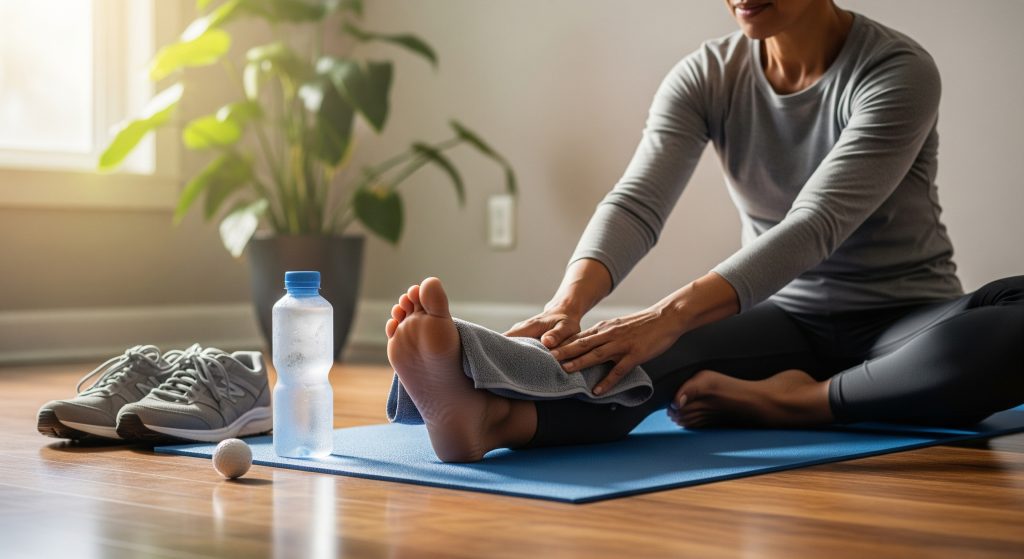
This is a reliable early win. Sit with your knee straight and loop a towel around the forefoot. Pull the towel ends toward you to dorsiflex the ankle. As PubMed reports, a plantar fascia specific stretch program improved long term outcomes, with high satisfaction and fewer activity limits. Hold 20 to 30 seconds. Complete 3 to 5 sets, especially before your first steps after sleep. The routine primes the fascia and reduces that sharp first step pain.
Consistent work beats intensity here. Regular Plantar Fasciitis Exercises act like deposits in a recovery account.
4. Frozen Bottle Roll
Place a frozen water bottle under the arch and roll from heel to ball. Use light to moderate pressure. As British Journal of General Practice notes, ice bottle massage is a common home strategy that blends cooling with gentle tissue mobilising. Aim for 10 to 20 minutes. Repeat up to three times daily during symptom flares. The cold tempers pain while the motion eases stiffness. It is simple and, to an extent, highly effective between more structured Plantar Fasciitis Exercises.
5. Toe Curls and Marble Pickups
Place a small towel on the floor. Keep the heel down and use the toes to scrunch the towel toward you. As Loyola Medicine advises, adding marble pickups improves dexterity and strengthens intrinsic foot muscles. Aim for 10 to 15 repetitions per set and 2 to 3 sets. These drills build arch support from the inside. Stronger support means less load on the fascia during walking and standing.
-
Use light resistance first. Then add a thin book under the towel for progression.
-
Keep the movement slow to avoid cramping.
These Plantar Fasciitis Exercises strengthen what your footwear often neglects.
6. Achilles Tendon Stretches
Use wall stretches, slant board holds, or controlled heel drops on a step. As Healthline notes, calf and Achilles work reduces tension that feeds heel pain and supports functional mobility. Begin with isometric holds, then progress to slow eccentric heel drops as symptoms allow. Keep the movements deliberate. Quality over range, especially early on.
Plantar Fasciitis Exercises that include Achilles conditioning address the kinetic chain. Overlooked, but decisive.
7. Golf Ball Massage Technique
Use a golf ball to perform small circular strokes under the arch. As Heel That Pain explains, this method improves local blood flow and helps relax tight tissues, offering quick symptom relief. Spend 2 to 3 minutes per foot. Keep pressure tolerable. The aim is to coax the tissue, not bruise it. Over time, you can add brief cross friction strokes for stubborn spots.
Combine this with the frozen bottle roll for a simple recovery circuit. It works, and it is easy to maintain.
How Plantar Fasciitis Exercises Heal Your Heel
Stretching Reduces Tension in Fascia
Targeted stretching reduces tensile load in the fascia during push off. As PubMed summarises, first line plantar fasciitis treatment emphasises activity changes and stretches for the gastrocnemius and plantar fascia, with most patients improving over 3 to 6 months. That timeframe holds roughly speaking. Consistency is the variable that shortens it. Stretching improves flexibility and, by extension, gait mechanics. Pain follows function, usually.
Plantar Fasciitis Exercises should prioritise calf and arch stretches daily. This is the foundation layer for heel pain relief.
Strengthening Supporting Foot Muscles
Strength builds resilience. As BJSM reports, high load strength work can stimulate collagen adaptation in the plantar fascia, potentially improving tissue capacity. Intrinsic foot muscle training also enhances arch control and reduces strain per step. Use toe curls, short foot holds, and controlled heel raises. Progress load slowly, then add single leg variations. The sequence matters.
These Plantar Fasciitis Exercises turn fragile tissue into dependable structure. Not overnight. But steadily.
Improving Blood Flow and Recovery
Movement drives circulation. As Cleveland Clinic notes, regular stretching and light strengthening increase local blood flow and support healing. Better blood flow improves oxygen delivery and waste clearance. The outcome is less soreness after standing and quicker warm up in the morning. This is basic physiology applied cleanly.
Integrate low load pumps, gentle massage, and short walking breaks. These are Plantar Fasciitis Exercises too, just less obvious.
Breaking Down Scar Tissue Formation
Chronic heel pain often involves degenerative tissue, not simple inflammation. As Journal of Manual and Manipulative Therapy discusses, cross friction massage and structured stretching reduce pain and may disrupt adhesions. Think patient, repeated inputs rather than aggressive pressure. The fascia remodels under consistent, tolerable load. Overdoing it only angers the tissue. Precision beats force.
When combined, these Plantar Fasciitis Exercises produce a useful one-two: less stiffness and better load tolerance.
Creating Your Daily Exercise Routine
Morning Stretches Before First Steps
Morning is prime time for change. As Yale Medicine notes, daily plantar fascia and Achilles stretches reduce that sharp first step pain and improve mobility. Perform a seated plantar fascia stretch before standing. Add a towel stretch with the knee straight. Finish with 1 minute of light golf ball massage. This three minute sequence reduces stiffness that accumulates overnight.
-
Keep the towel near the bed to remove friction from the habit.
-
Stand in supportive shoes straight after stretching.
Short, reliable Plantar Fasciitis Exercises beat long inconsistent ones. Every morning counts.
Midday Exercise Sessions
Use midday for strength and mobility. As Hospital for Special Surgery suggests, consistent sessions across the day improve flexibility and pain control. Do 2 sets of toe curls, 2 sets of calf stretches, then a 10 minute frozen bottle roll. Add 2 sets of slow double leg heel raises if symptoms allow. The aim is rhythmic exposure, not fatigue.
These are the Plantar Fasciitis Exercises that build lasting capacity. Small loads, repeated often.
Evening Recovery Exercises
Evening sessions unwind the day. As ChoosePT advises, nightly stretching and light massage reduce pain and improve flexibility. Consider a night splint if mornings remain severe. A splint keeps the fascia gently lengthened while you sleep. Combine with a 5 minute golf ball massage and a 30 second calf stretch hold. Sleep is a multiplier for healing when tissue is calm.
Recovery work is part of Plantar Fasciitis Exercises, not an optional extra.
Exercise Frequency and Duration Guidelines
Daily exposure is more effective than sporadic effort. As Cleveland Clinic notes, stretching before activity and at least once daily supports recovery. The following table summarises recommended volumes.
|
Exercise |
Baseline Prescription |
|---|---|
|
Seated plantar fascia stretch |
3 to 5 holds of 20 to 30 seconds, twice daily |
|
Towel stretch |
3 to 5 holds of 20 to 30 seconds, morning and evening |
|
Calf stretch at wall |
2 to 3 holds of 20 to 30 seconds per leg, twice daily |
|
Toe curls or marbles |
2 to 3 sets of 10 to 15 reps, once daily |
|
Heel raises |
2 to 3 sets of 8 to 12 reps, 3 days per week |
|
Frozen bottle roll |
10 to 20 minutes, 1 to 3 times daily during flares |
Treat these volumes as a starting point. Adjust based on pain response and functional goals.
Common Mistakes to Avoid
Several errors slow progress. As Benchmark Physical Therapy warns, unsupportive footwear and delaying care worsen symptoms and prolong recovery. Overpressuring the arch with aggressive massage can also flare pain. Adherence matters too. Many patients misapply home programmes or stop too early. Its basically the fastest way to stall progress.
-
Do not bounce stretches. Use steady holds.
-
Avoid barefoot time on hard floors during flares.
-
Do not rely on ice or orthotics alone. Build strength and mobility.
-
Respect pain ceilings. Mild discomfort is acceptable. Sharp pain is not.
Think long term capacity, not quick fixes. Plantar Fasciitis Exercises are the sustained answer.
Recovery Timeline and Exercise Progression
Week 1-2: Gentle Stretching Phase
Focus on pain control and mobility. As Medical News Today outlines, calf stretches, rolling stretches, towel curls, and bottle rolls reduce tension and improve flexibility. Perform short, frequent sessions. Prioritise morning routines and supportive shoes. If pain spikes, scale volume down rather than stopping entirely. Motion is medicine here, though not without exceptions.
-
Goal: reduce morning pain by at least 20 percent.
-
Outcome: improved first step comfort and less end of day ache.
Week 3-6: Building Strength
Layer in controlled strength work. As ACSM notes, progressive resistance training 2 to 3 days per week suits novices, with 2 to 10 percent load increases as tolerated. Begin with double leg heel raises. Progress to slow eccentrics on a step. Maintain stretching volume. This is where tissue capacity starts to change.
-
Add single leg balance holds for 30 seconds per side.
-
Introduce short foot drills to activate the intrinsic muscles.
These Plantar Fasciitis Exercises make each step cheaper for the fascia. That is the point.
Week 7-12: Advanced Exercises
Advance to single leg heel raises and step eccentrics. As Cleveland Clinic notes, using a stair to drop the heels deepens the calf and Achilles stretch for extra range. Combine with loaded carries in supportive shoes for functional strength. If you tolerate hopping drills later, use tiny volumes first. Progress demands patience and precise load control.
At this stage, heel pain relief should be clear. Keep going to consolidate gains.
Signs Your Exercises Are Working
Look for reduced morning pain, shorter warm up time, and better tolerance for standing. As Cleveland Clinic notes, improved flexibility in the calf and fascia correlates with symptom relief. You should also notice improved walking rhythm and fewer pain spikes after activity. Pain becomes dull and predictable, not sharp and surprising.
Those are green lights to continue your Plantar Fasciitis Exercises unchanged.
When to Modify Your Routine
Escalate slowly when progress stalls. As ACSM recommends, adjust frequency, volume, or load by 2 to 10 percent once you hit repetition targets. If pain increases the next morning, scale back to the previous tolerable level. Consider adding a night splint for persistent morning pain. Or swap one strengthening day for recovery work during spikes.
The aim is steady progress across your entire plantar fasciitis treatment plan. No heroics. Just consistency.
Making Plantar Fasciitis Exercises Part of Long-Term Heel Health
Prevention is a habit, not a one off fix. Keep a light version of your programme after symptoms settle. Two short stretching blocks daily, plus two strength sessions weekly, protect the gains. Rotate in golf ball massage after long standing days. Use supportive shoes for high load tasks. Track your steps and pain notes in a simple log. It keeps you honest and objective.
There will be weeks with more walking, travel, or hard floors. Plan for them. Add a morning towel stretch and an evening bottle roll during those periods. This is how Plantar Fasciitis Exercises shift from rehab to insurance. And yet, if pain creeps back, return to the week 1 to 2 plan for seven days. Reset, then build again.
One insider tip from clinicians: mind your intrinsic strength. Short foot holds, toe curls, and controlled heel raises are your long term allies. They cost little time and pay back every step you take.
Frequently Asked Questions
How long should I hold each plantar fasciitis stretch?
Hold stretches for 20 to 30 seconds, repeating 3 to 5 times. This window balances tissue relaxation and safety. For calf and Achilles holds, 15 to 30 seconds also works well. Perform longer total time by using multiple sets rather than single long holds. These parameters align with common clinical guidance for Plantar Fasciitis Exercises and heel pain relief.
Can I exercise with severe heel pain?
Yes, but modify intensity and range. Keep within a mild discomfort zone, not sharp pain. Use seated plantar fascia stretches, gentle towel stretches, and light massage. Avoid barefoot time and high impact efforts. If pain remains severe on waking, prioritise recovery inputs that day. This still counts as plantar fasciitis treatment because it supports healing.
Should plantar fasciitis exercises hurt?
You may feel a firm stretch or mild ache. Sharp, stabbing pain is a stop signal. Reduce range, decrease repetitions, or switch to isometrics. Pain that eases within a few minutes after a session is acceptable. Pain that lingers into the next morning is feedback to scale down. Effective Plantar Fasciitis Exercises respect those boundaries.
How many times daily should I do these exercises?
Use two short sessions daily for stretching and one for strengthening on alternate days. Add massage or a frozen bottle roll during flares, up to three times daily. Consistency, not marathon sessions, determines outcomes. This cadence supports plantar fasciitis treatment while limiting fatigue.
When will I see improvement in my heel pain?
Many notice change within 2 to 3 weeks, often in morning comfort. As far as current data suggests, broader improvements occur over 6 to 12 weeks with steady work. Full resolution can take 3 to 6 months, depending on load tolerance and adherence. Your personal plantar fasciitis recovery time depends on baseline strength, footwear, and daily demands.
Can I prevent plantar fasciitis recurrence with exercises?
Yes. Maintain two weekly strength sessions and daily light stretches. Keep intrinsic foot work in the plan. Use supportive shoes for high load days and rotate insoles if worn. Resume the early phase Plantar Fasciitis Exercises after any spike. Prevention is just continued capacity building, done on a smaller dose.

