






 We do what's right for you...


Night Blindness Treatment in India: Symptoms, Diagnosis and Care
Dr. Krishna Vaitheeswaran
Conventional advice often stops at new glasses or brighter lights. That rarely solves persistent difficulty seeing after dusk. I address night blindness treatment in a systematic way, from root causes to durable care. The priority is clear. Identify the cause, treat what is treatable, and protect safe mobility while the eyes recover.
Top Treatment Options for Night Blindness in India
1. Vitamin A Supplementation and Dietary Changes
When night vision drops suddenly in both eyes, I start with nutrition. Vitamin A underpins rhodopsin regeneration in the rods. Without it, dark adaptation drags and vision remains murky. For true deficiency, targeted supplementation is warranted under medical supervision.
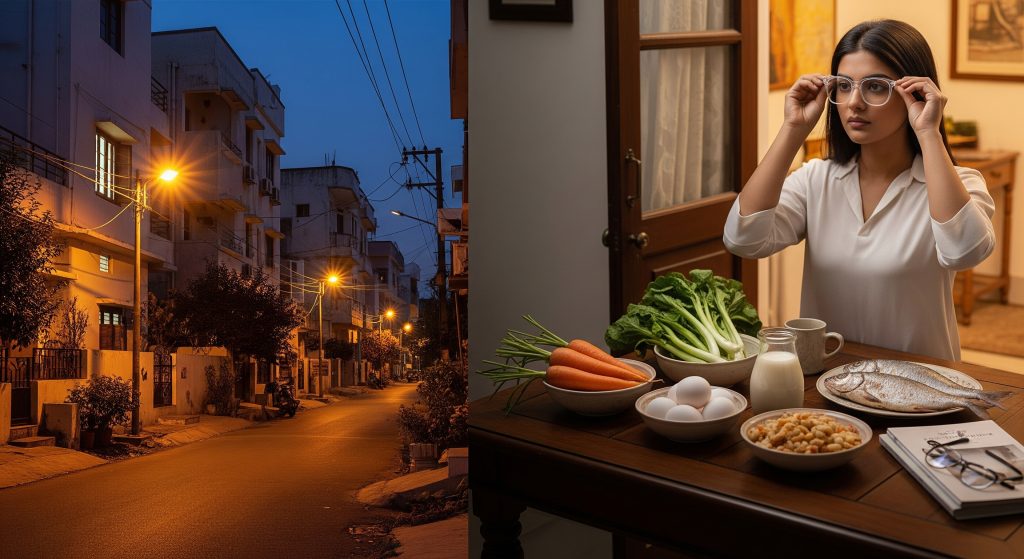
Food first still matters. I advise a steady intake of retinol and carotenoids with fat for absorption. Practical options suit an Indian kitchen: egg yolk with ghee, fish, milk, curd, carrots, pumpkin, and dark leafy greens. Liver is potent but not essential if a balanced mix is sustained. Malabsorption, liver disease, and restrictive diets complicate this picture. I screen for those before prescribing a course.
-
When deficiency is confirmed, I use a defined dose for a defined duration.
-
I add dietary counselling to prevent rebound deficiency.
-
I track night vision changes with a simple dark adaptation history.
This path is a core form of night blindness treatment when deficiency is present. It is also low risk when guided and monitored.
2. Cataract Surgery for Night Vision Restoration
Cataract scatters light and amplifies glare. Halos and starbursts around headlights are common. When cataract is the driver, surgery is the definitive night blindness treatment. The procedure removes the cloudy lens and replaces it with a clear implant.
Choice of intraocular lens is not a fashion statement. It is optics. For frequent night driving, I usually prefer monofocal or enhanced monofocal lenses. These minimise photic phenomena at night. I avoid aggressive multifocals for patients with night-critical tasks. Recovery is swift, but clarity continues to improve for weeks. Realistic expectation setting helps.
-
Indication: visual disability that affects daily function or driving.
-
Pre-op: biometry, ocular surface optimisation, and counselling.
-
Post-op: steroid-antibiotic drops with scheduled follow up.
In practice, this single intervention often restores safe mobility after dusk.
3. Glaucoma Management Through Medications and Laser Therapy
Glaucoma erodes peripheral vision and can degrade low-light performance. It is subtle. I treat the pressure, not the number alone. Target intraocular pressure depends on optic nerve risk, baseline damage, and age. Medications come first in most cases.
When drops are insufficient or poorly tolerated, I consider laser trabeculoplasty. It is outpatient. No incision. The goal is sustained pressure reduction to preserve the remaining field. Night blindness treatment is indirect here. Protecting the retina and optic nerve preserves the visual range needed after dark.
-
Start with a prostaglandin analogue if appropriate.
-
Add combination therapy if targets are unmet.
-
Offer laser in non-responders or for drop burden relief.
Glaucoma care is a marathon. Consistency wins.
4. Diabetic Retinopathy Treatment with Blood Sugar Control
Diabetes impairs retinal function and delays adaptation. Microvascular changes quietly reduce contrast sensitivity at night. I manage both the disease and its ophthalmic effects. Metabolic control is the anchor. Retinal therapy builds on it.
Treatment choices include anti-VEGF injections, focal or grid laser for macular oedema, and panretinal photocoagulation for proliferative disease. The objective is stability. Night blindness treatment in diabetes is not a single shot. It is a plan.
|
Problem |
Treatment Focus |
|---|---|
|
Macular oedema |
Anti-VEGF injections and systemic control |
|
Non-proliferative changes |
Observation with tight glycaemic, lipid, and blood pressure control |
|
Proliferative changes |
Panretinal laser, adjunct injections as needed |
Improved night vision follows reduced oedema and better contrast. It is gradual, not instant.
5. Stem Cell Therapy for Retinal Regeneration
Stem cell therapy remains investigational for most retinal dystrophies. Small trials exist and show promise in select conditions. The science is not yet routine care. I counsel patients to consider clinical trials with proper oversight. Commercial offers without peer-reviewed evidence warrant caution.
Where appropriate, participation can support future options. But it is not a current mainstay of night blindness treatment for inherited disorders. Not yet.
6. Gene Therapy for Genetic Conditions
Gene therapy has moved from theory to practice in limited cases. Certain RPE65-related dystrophies now have an approved approach in specific settings. Availability, eligibility, and cost vary by centre and region. Pre-therapy genetic confirmation is essential.
For many genotypes, therapy remains in research pipelines. I therefore combine genetic counselling with supportive care and low-vision strategies. Night blindness treatment in these patients focuses on function, safety, and realistic planning while science advances.
7. Corrective Lenses and Prescription Adjustments
Even a small refractive error magnifies night driving strain. Slight myopia or uncorrected astigmatism reduces contrast and edge detection. I review refraction under dilation when appropriate. Small changes can deliver large comfort gains.
Coatings also help. Anti-reflective layers reduce halo and glare. It is not magic. It is optics and surface physics. Prescription fine-tuning is a practical arm of night blindness treatment that patients often undervalue.
Recognising Night Blindness Symptoms Early
Difficulty Adjusting to Low Light Conditions
Delayed dark adaptation is the classic early sign. Walking from daylight into a theatre should not feel like a blackout. If that lag stretches or becomes disabling, I investigate. The cause could be nutritional, ocular surface related, or retinal.
Increased Sensitivity to Glare and Bright Lights
Glare sensitivity turns a routine night drive into a hazard. Halos around LED headlights, difficulty recognising faces under street lamps, and discomfort in malls are typical. Anti-reflective lenses and clean windscreens help, but they do not fix retinal causes. Persistent glare warrants a structured review and, if needed, night blindness treatment tailored to the underlying diagnosis.
Poor Depth Perception in Dim Environments
Depth perception weakens when contrast falls. Steps, kerbs, and uneven pavements become guesswork. I ask about misjudging a single stair in dim parking areas. That small vignette often separates casual nuisance from clinically relevant change.
Prolonged Light-to-Dark Adaptation Time
Recovery after headlight glare should be seconds, not minutes. If the retina lingers in overexposed mode, rods are struggling. I consider vitamin A status, medication effects, and early cataract. Targeted night blindness treatment depends on which factor dominates.
Reduced Peripheral Vision at Night
Peripheral vision narrows silently. People bump shoulders in crowded evening spaces or struggle to merge into fast traffic. This symptom pushes me to test the visual field. It can point toward glaucoma, retinal disease, or neuro-ophthalmic issues.
Comprehensive Diagnostic Tests and Procedures
Visual Acuity Tests for Light Sensitivity Assessment
Standard acuity in bright rooms can look fine. That does not settle the case. I run contrast sensitivity and low-luminance acuity where indicated. These refine decisions about whether night blindness treatment should begin now or after a period of observation.
Fundus Examination and Retinal Imaging
Retinal imaging maps structure. I rely on dilated fundus exam, OCT for macular clarity, and fundus autofluorescence when dystrophy is suspected. Structural normality with functional complaint redirects attention to nutrition, lens scatter, or the optic nerve. That distinction shapes the plan.
Electroretinogram (ERG) for Retinal Function Testing
ERG characterises rod and cone function. It is particularly useful when symptoms are disproportionate to imaging. I use it for suspected inherited retinal disease, toxic retinopathy, or unexplained night complaints. The result guides counselling. It also prevents false reassurance when routine tests look normal.
Visual Field Testing with Kinetic Perimetry
Visual field testing detects scotomas before patients notice them. Kinetic perimetry moves a stimulus from non-seeing to seeing regions to chart boundaries. Static tests plot fixed points. Both matter, but kinetic mapping can reveal peripheral losses that affect night navigation first.
-
Use kinetic testing to assess driving-relevant peripheral islands.
-
Repeat at intervals to track glaucoma, retinal disease, or neuro changes.
-
Integrate findings with acuity and contrast metrics for a fuller picture.
Results influence night blindness treatment priorities, especially in glaucoma or post-retinal therapy follow up.
Blood Tests for Vitamin A Deficiency
Serum retinol and related markers close the loop when diet or history suggests deficiency. I add liver function tests if risk factors exist. When results confirm low stores, I institute a supervised repletion protocol. I also set a check date. Verifying response avoids both under-treatment and excess dosing.
Genetic Testing for Inherited Disorders
Genetic panels identify causative variants for many dystrophies. I choose panels based on phenotype to preserve cost efficiency. A clear genotype enables trial eligibility and targeted counselling. It also sets appropriate expectations about prognosis and the scope of night blindness treatment over time.
Essential Care Strategies and Lifestyle Modifications
Night Vision Glasses for Safe Driving
Specialised tints promise miracles. Most do not hold up under controlled conditions. I prefer clear, high-quality lenses with anti-reflective coating. Polarised sunglasses help daytime glare but are not for night use. For some drivers, fit-over shields reduce stray reflections from the periphery.
I do recommend night vision glasses for driving when they meet two criteria. They must be optically clear and properly fitted to the current prescription. Anything else risks dimming already limited light. That defeats the purpose.
Home Safety Adjustments with Adequate Lighting
Lighting is a safety tool, not just decor. I recommend consistent colour temperature, sufficient lumens, and minimal shadow zones. Motion sensors on stairwells and bathrooms reduce falls. Matte finishes cut internal glare. Small changes, large dividends.
-
Warm to neutral white LEDs around 3000K to 4000K.
-
Strip lighting under cabinets to remove harsh contrasts.
-
Night lights near bed, corridors, and switches at reachable height.
Nutritional Guidelines for Eye Health
Diversify. Retinol and carotenoids matter, but so do lutein, zeaxanthin, vitamin C, vitamin E, zinc, and omega-3 fats. I propose a plate that looks colourful and balanced. Add nuts, seeds, pulses, seasonal greens, and fish where culturally acceptable. Hydration supports tear film quality, which supports night comfort.
This is foundational night blindness treatment when deficiency or low reserves coexist with ocular issues.
Managing Chronic Conditions Like Diabetes
Glycaemic control, blood pressure management, and lipid optimisation protect retinal health. I coordinate with physicians on targets and timing. Smoking cessation helps microvascular flow and reduces cataract progression risk. Sleep quality affects dry eye and visual comfort at night. These details matter.
Regular Eye Examinations and Monitoring
A stable three to six month review is sensible in evolving conditions. I tighten intervals when therapy begins. Baseline photos, OCT maps, and field plots create comparators. Without those, we guess. With them, we adjust night blindness treatment early and avoid surprises.
Alternative Transportation Options for Night Travel
Safety is non-negotiable. I advise pausing night driving during acute deterioration, post-surgery, or while treatments begin to work. Options include cabs, rideshare, carpools, or shifting schedules to daylight. Independence is important. So is arriving safely.
Taking Control of Night Blindness Through Early Intervention
Early intervention changes outcomes. A precise diagnosis followed by a focused night blindness treatment plan saves function and confidence. In practice, I prioritise reversible causes first. Deficiency, cataract, unstable diabetes, and small refractive errors respond well when addressed promptly.
There is another point. Vision at night is not only acuity. It is contrast, field, adaptation, and glare control working together. Support those systems and mobility improves. Delay, and compensation habits set in. Harder to unwind later.
When advanced disease limits recovery, practical aids keep life moving. Better lighting, mobility training, and driver alternatives hold the line. And yet, most readers will not need that level of support if action comes early. The window is open now.
Frequently Asked Questions
Can night blindness be completely cured in India?
Yes, when the cause is reversible. Vitamin A deficiency, early cataract, and uncorrected refractive error respond well to targeted night blindness treatment. Genetic dystrophies, advanced glaucoma, or long-standing retinal damage are managed, not cured. The aim then is safety, stability, and function.
What is the cost of night blindness treatment in major Indian cities?
Costs vary by diagnosis and centre. Nutritional management is modest. Prescription updates are routine. Cataract surgery ranges by lens choice and facility class. Glaucoma therapy adds ongoing medication or laser fees. Injections for diabetic macular oedema add episodic costs. I recommend requesting an itemised plan before committing. Transparency helps budgeting.
Are night vision glasses effective for driving at night?
Only if they are clear, anti-reflective, and matched to the current prescription. Yellow or dark tints can reduce available light and impair vision. I endorse well-fitted, high-quality optics over marketing claims. They support but do not replace night blindness treatment for underlying causes.
How long does it take to see improvement after starting treatment?
Timelines differ. Vitamin A repletion may improve dark adaptation within weeks. Post-cataract clarity improves over several weeks. Glaucoma stabilisation is ongoing and measured in months to years. Diabetic macular therapy follows disease activity. I set expectations based on the underlying driver and the chosen intervention.
Is stem cell therapy for night blindness available in India?
Stem cell therapy exists mainly in research settings for retinal disease. Access depends on trial availability and eligibility. Commercial offerings without robust evidence should be approached cautiously. For most patients today, stem cells are not a standard night blindness treatment.
Which foods are best for improving night vision naturally?
Egg yolk, dairy, fish, carrots, pumpkin, mango, and dark leafy greens support vitamin A status. Add nuts, seeds, legumes, citrus, and coloured vegetables for antioxidants and minerals. Pair carotenoid-rich foods with healthy fats for better absorption. Diet supports, and treatment corrects.
Can children develop night blindness symptoms?
Yes. Children can present with difficulty seeing in low light, bumping into objects, or fear of the dark beyond age norms. Causes include vitamin A deficiency, high refractive errors, and inherited retinal conditions. Prompt evaluation and age-appropriate night blindness treatment are important to protect development and learning.
night blindness treatment night blindness treatment night blindness treatment night blindness treatment night blindness treatment night blindness treatment night blindness treatment night blindness treatment night blindness treatment night blindness treatment night blindness treatment night blindness treatment night blindness treatment night blindness treatment night blindness treatment night blindness treatment night blindness treatment night blindness treatment night blindness treatment night blindness treatment night blindness treatment night blindness treatment night blindness treatment night blindness treatment night blindness symptoms night vision glasses for driving

