






 We do what's right for you...


How Osteoarthritis Exercises Improve Flexibility and Strength
Dr. Ali Haider Khan
Rest alone is routinely prescribed for painful joints. That approach rarely restores capacity or confidence. In practice, targeted osteoarthritis exercises build strength, restore motion, and reduce pain signals through multiple mechanisms. I will set out precise methods, clear safeguards, and pragmatic progressions. The aim is simple. Move better, hurt less, and regain daily function without guesswork.
Best Osteoarthritis Exercises for Flexibility and Strength
1. Quadriceps Strengthening Sets
Strong quadriceps reduce knee load and improve gait efficiency. I start with simple static holds, then progress to controlled lifts. These osteoarthritis exercises are joint friendly and highly scalable.
-
Set-up: Sit or lie with the knee straight. Tighten the thigh to press the knee gently downward.
-
Dosage: Hold 5 to 10 seconds. Perform 10 to 15 reps, 2 to 3 sets.
-
Progression: Add a small towel under the knee. Advance to straight leg raises when pain is stable.
-
Cues: Keep the kneecap pointing up. Avoid holding breath. Smooth on and off.
For those needing knee osteoarthritis exercises, this is often the safest starting point. It builds activation without compressive depth.
2. Hamstring Stretches
Flexible hamstrings reduce posterior knee tension and help stride length. Gentle range is the target. No bouncing. These remain staple osteoarthritis exercises for lower limb mobility.
-
Supine strap stretch: Lie on your back. Loop a strap around the foot. Lift the leg until a mild stretch is felt.
-
Dosage: Hold 20 to 30 seconds. Repeat 3 to 5 times per limb.
-
Alternative: Seated edge-of-chair stretch with a neutral spine and soft knees.
Comfort should remain within a 3 to 4 out of 10. If symptoms spike, reduce angle or time.
3. Water Aerobics Routines
Water supports body weight and reduces joint impact. This environment allows cardiovascular work and strengthening with less pain. I use pool sessions to extend volume on tough weeks.
-
Warm-up: 5 minutes of walking in waist deep water.
-
Main set: 15 to 20 minutes of gentle laps, side steps, and kickboard pushes.
-
Strength: Squats to a pool step. Wall-assisted flutter kicks for core control.
-
Cool-down: Slow walking and shoulder circles for 5 minutes.
These osteoarthritis exercises translate well to land training by maintaining rhythm and endurance.
4. Chair Yoga Poses
Chair-supported yoga blends mobility, balance, and breath control. It is basically movement with built-in safeguards. I focus on small arcs and steady breathing.
-
Mountain sit-to-stand: Feet hip width, stand tall, then return to sit with control.
-
Seated cat-cow: Alternate gentle spinal flexion and extension while seated.
-
Supported warrior hold: One hand on chair back for balance, short stance, soft knee.
Two rounds of 6 to 8 repetitions suffice for a start. These osteoarthritis exercises improve function in daily tasks.
5. Resistance Band Exercises
Bands provide variable resistance with excellent control. I prefer them for safe strengthening at home. They fit easily into a small routine.
-
Clamshell with band: Band above knees. Lie on side. Open and close the top knee.
-
Terminal knee extension: Loop the band behind the knee. Slight bend, then straighten against the band.
-
Standing row: Anchor the band, keep elbows close, pull and squeeze between the shoulder blades.
Start with 2 sets of 10 repetitions. Build to 3 sets of 12 to 15. These osteoarthritis exercises support both lower limb and trunk stability.
6. Tai Chi Movements
Tai Chi refines balance, posture, and joint motion. The slow cadence is ideal for pain control. I often teach three short sequences for beginners.
-
Commencement: Weight shift, soft knees, relaxed shoulders.
-
Parting the wild horse’s mane: Controlled step, gentle arm sweep, steady breath.
-
Golden rooster stands: Single leg balance with fingertip support as needed.
Ten minutes of practice most days improves movement confidence. These osteoarthritis exercises also sharpen proprioception.
7. Wall Push-Ups
Upper body strength aids transfers, walking aids use, and posture. Wall push-ups are accessible yet effective. I couple them with rows for balance.
-
Set-up: Hands on wall, shoulder width, body in one line.
-
Move: Lower with elbows at 45 degrees. Press back with even pressure.
-
Dosage: 2 to 3 sets of 8 to 12 repetitions.
If wrists complain, use fists or push on a sturdy bench. These osteoarthritis exercises support daily pushing tasks.
8. Ankle Pumps and Circles
Ankles drive balance and gait. Simple pumps and circles reduce stiffness and swelling. They belong in every warm-up.
-
Pumps: Point and flex the foot 20 to 30 times.
-
Circles: Draw slow circles 10 times each way.
-
Seated march: Lift one knee at a time for 30 to 60 seconds.
These are small but consequential osteoarthritis exercises. Better ankle motion improves step clearance and stability.
Physical Therapy Techniques for Osteoarthritis Management
Range-of-Motion Exercise Progressions
I begin with gentle arcs, then increase depth as pain allows. The goal is functional range, not contortion. These are targeted range-of-motion exercises for arthritis, matched to daily needs.
-
Assisted range: Use straps or the other limb to guide motion.
-
Active range: Move through pain free arcs under control.
-
End range holds: Short isometric holds at new limits for stability.
When paired with osteoarthritis exercises for strength, range gains tend to hold. Short practice sessions work best.
Isometric Strengthening Methods
Isometrics reduce pain sensitivity and improve muscle recruitment. I use them during flares or early after setbacks. They sit well within physical therapy for osteoarthritis.
-
Joint angle selection: Choose angles that reduce compression and feel secure.
-
Hold time: 5 to 30 seconds per rep, 4 to 6 reps, 1 to 2 sets.
-
Intensity: Moderate effort that is firm but not painful.
These osteoarthritis exercises can be performed daily. They offer stability without excessive motion.
Joint Protection Strategies During Exercise
Technique and load management prevent symptom spikes. I apply simple rules that keep training consistent.
-
Two day rule: If pain persists beyond 48 hours, reduce next session volume.
-
Green-yellow-red scale: Green is mild ache, yellow is watchful limit, red is stop.
-
Alignment: Knees track over second toe. Spine long. Shoulders relaxed.
Joint protection preserves adherence. That is the real advantage of any osteoarthritis exercises programme.
Manual Therapy Combined with Exercise
Hands-on techniques can reduce guarding and improve glide. I use them as a bridge back to active work. They include soft tissue release and joint mobilisations.
-
Sequence: Brief manual work, then immediate active movement to consolidate gains.
-
Duration: 5 to 10 minutes of manual therapy within a 30 to 40 minute session.
-
Focus: Areas that limit clean movement patterns.
Manual inputs without osteoarthritis exercises rarely hold. The pairing is what delivers lasting function.
How Exercise Mechanisms Reduce Osteoarthritis Symptoms
Muscle Strengthening Effects on Joint Support
Stronger muscles distribute forces more evenly across joint surfaces. This reduces peak pressure and improves tolerance. I prioritise hip and thigh strength to protect knees and hips.
-
Outcome: Better shock absorption and reduced irritation during daily tasks.
-
Method: Progressive resistance with clear form cues.
Well structured osteoarthritis exercises serve as mechanical support. Think of them as dynamic braces that you own.
Synovial Fluid Production Through Movement
Regular movement stimulates synovial fluid circulation. That improves cartilage nutrition and reduces stiffness. Small, frequent sessions outperform sporadic long ones.
-
Practical cue: Change position every 30 to 45 minutes.
-
Micro sets: 60 seconds of ankle pumps or sit-to-stands between tasks.
These micro bouts complement formal osteoarthritis exercises. Motion is both signal and medicine.
Weight-Bearing Exercise Impact on Bone Health
Safe weight bearing supports bone density and tendon resilience. It also maintains confidence under load. I add step-ups or partial squats as symptoms settle.
-
Volume: 2 to 3 sets of 6 to 10 reps to start.
-
Progression: Higher steps or light external load when stable.
Bone responds to consistent stimulus. Well planned osteoarthritis exercises offer exactly that.
Proprioception Improvement Through Balance Training
Pain blunts joint position sense. Balance drills sharpen it again. I use short holds with low threat positions first.
-
Examples: Tandem stance, single leg stand with fingertip support, foam pad work.
-
Dosage: 2 to 3 sets of 20 to 30 second holds.
Improved proprioception reduces stumbles and fear of movement. The result is steadier progress with osteoarthritis exercises.
Inflammation Reduction Through Regular Activity
Moderate activity influences systemic inflammation markers, at least to an extent. It also improves sleep and mood. That triad changes pain perception.
-
Cadence: Most days of the week, short sessions are acceptable.
-
Load: Moderate intensity that leaves room for recovery.
Consistent osteoarthritis exercises create a favourable cycle. Movement begets movement.
Creating Your Personalised Exercise Programme
Weekly Exercise Schedule Guidelines
I build programmes around frequency, not hero sessions. Small, regular inputs beat long gaps. The table below sets a sensible baseline.
|
Component |
Baseline guideline |
|---|---|
|
Strength |
2 to 3 days per week, 6 to 12 reps, 2 to 3 sets, 5 to 6 exercises |
|
Mobility |
Most days, 10 to 15 minutes, gentle range-of-motion exercises for arthritis |
|
Aerobic |
3 days, 20 to 30 minutes, low impact options |
|
Balance |
3 to 5 short bouts per week, 5 minutes each |
|
Recovery |
Daily brief walks, breath work, and light stretches |
This structure complements all osteoarthritis exercises in this guide. It also scales up or down easily.
Warm-Up and Cool-Down Protocols
A precise warm-up prepares joints and the nervous system. I use a simple sequence that applies across sessions.
-
Circulation: 3 minutes of easy marching or bike.
-
Joint prep: Ankle pumps, knee bends, hip circles, shoulder rolls.
-
Rehearsal: One light set of the first exercise.
Cooling down is equally deliberate. Slow walking, long exhalations, and two stretches restore baseline. Osteoarthritis exercises feel smoother when warm-up quality is high.
Pain Management During Exercise
Aim for tolerable discomfort, not silence. I ask clients to use a simple rule. Pain during work may rise slightly but must settle within 24 hours.
-
Green zone: 0 to 3 out of 10. Continue.
-
Yellow zone: 4 to 5 out of 10. Modify range or load.
-
Red zone: Above 5. Stop and reassess.
This approach keeps osteoarthritis exercises safe and sustainable. It also builds trust in movement.
Tracking Progress and Adjusting Intensity
Progress is not guesswork. I track four items weekly. Range, reps, perceived effort, and day after effect. It is basically a scoreboard.
-
Range: Can I reach further with similar comfort.
-
Reps: Two extra controlled reps indicate readiness to load.
-
Effort: Rate of perceived exertion staying moderate while volume increases.
-
After effect: Soreness resolves within a day.
When three items trend positive, I increase load by roughly 5 to 10 percent. That keeps osteoarthritis exercises progressive yet steady.
Equipment and Home Setup Requirements
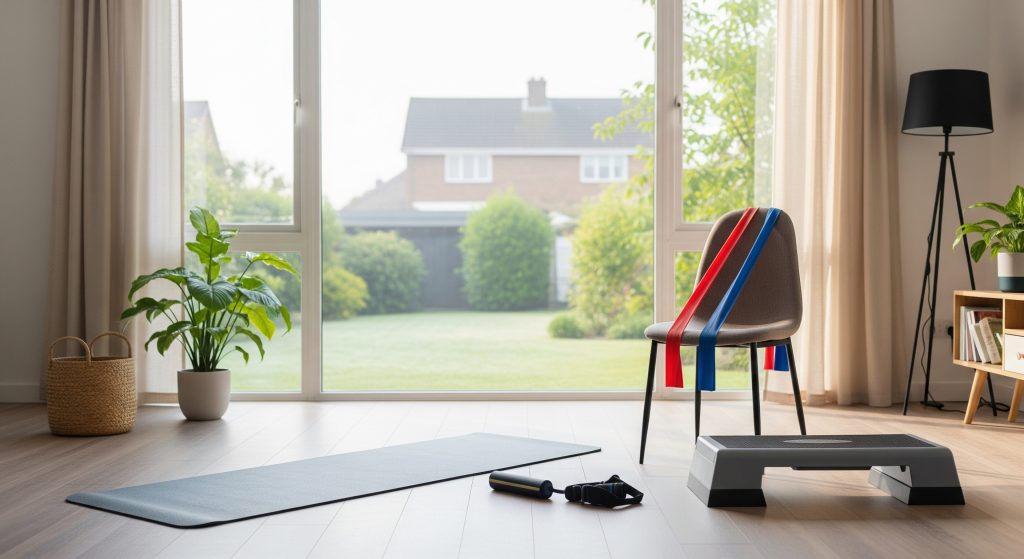
Home programmes need little kit. Smart choices reduce barriers. Here is a minimal list that covers the essentials.
-
Two resistance bands, one light and one medium.
-
A sturdy chair and a wall surface.
-
A yoga strap or towel for assisted range work.
-
An exercise mat and a small step or low box.
Clear a safe space with good lighting and firm footing. A consistent setup supports consistent osteoarthritis exercises. Safety first. Always.
Maximising Long-Term Benefits of Osteoarthritis Exercise
Consistency outperforms intensity, almost every time. I encourage simple habits that protect momentum. Schedule sessions, pair them with existing routines, and record completion. Missed day. Do half tomorrow.
-
Cycle focus: Alternate strength emphasis weeks with mobility emphasis weeks.
-
Deload weeks: Reduce volume every 6 to 8 weeks to consolidate gains.
-
Skill blocks: Add brief balance or gait drills for two weeks, then rotate.
There is an opposing view that rest is safer than work. It sounds protective. But inactivity erodes capacity and confidence. Thoughtful osteoarthritis exercises give both back.
Frequently Asked Questions
Which exercises should I avoid with knee osteoarthritis?
I avoid deep, loaded knee flexion early on. Full depth lunges or jump squats can aggravate symptoms. Instead, start with step-ups, sit-to-stands, and wall sits. These are effective knee osteoarthritis exercises that respect joint tolerance.
How often should I perform osteoarthritis exercises?
Most people progress on 4 to 6 short sessions per week. Strength work fits 2 to 3 days. Mobility and balance can run most days. Frequent, low dose osteoarthritis exercises work well for pain control and function.
Can exercise reverse osteoarthritis damage?
Exercise does not reverse structural changes. It can improve pain, mobility, and capacity to a high degree. That often restores independence. The right osteoarthritis exercises shift the outcome from limitation to management.
What’s the difference between exercise pain and injury pain?
Exercise discomfort is dull, manageable, and settles within 24 hours. Injury pain is sharp, escalating, or persists for days. If in doubt, reduce range and load. Resume osteoarthritis exercises once the response normalises.
Should I exercise during an osteoarthritis flare-up?
Yes, but modify. Use isometrics, short range mobility, and water based work. Keep intensity low. These choices maintain momentum while symptoms settle. Carefully chosen osteoarthritis exercises can shorten a flare response.
How long before I see improvements from exercise therapy?
Early changes often appear within 2 to 4 weeks, depending on starting status. Strength and stamina gains build over 8 to 12 weeks. Maintain the plan. Consistent osteoarthritis exercises create durable benefits across the year.

