






 We do what's right for you...


Explainer: The Role of Scoliosis Exercises in Pain Relief
Dr. Ali Haider Khan
Common advice says to rest a painful back. In scoliosis, that advice often prolongs the problem. I use targeted scoliosis exercises to reduce pain, improve control, and build tolerance so activity feels possible again. The goal is not to force symmetry overnight. It is to create enough muscular balance and breath control to manage pain day by day, while supporting the long game of spinal health.
Essential Scoliosis Exercises for Pain Relief
1. Cat-Cow Stretch for Spinal Flexibility
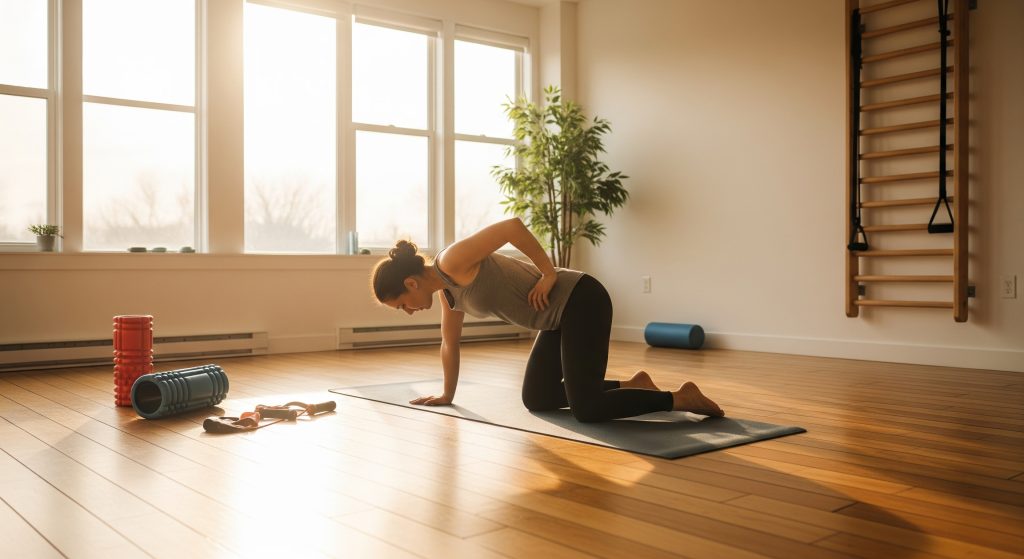
I start most programmes with Cat-Cow. It is gentle, repeatable, and it teaches segmental movement without strain. For many, this is the first safe way to explore motion again. As far as current data suggests, it also eases stiffness in the lower back.
-
Begin on hands and knees, wrists under shoulders, knees under hips.
-
Exhale, press through the floor, round the spine, and look towards the navel.
-
Inhale, lift the chest, let the belly soften, and lengthen the front of the body.
-
Move slowly for 8 to 10 breaths. Keep range pain free.
Key cues: I keep elbows soft, ribs controlled, and movement smooth. These scoliosis exercises focus on easing protective tension rather than chasing excessive bend. I often pair Cat-Cow with two diaphragmatic breaths to reinforce calm control.
2. Pelvic Tilts for Lower Back Relief
Pelvic tilts recalibrate the relationship between pelvis and lumbar spine. Small shifts in pelvic position can reduce compressive loading and improve comfort in daily standing. In practice, a precise tilt can settle the back in under a minute.
-
Lie on your back with knees bent, feet hip width.
-
Exhale, gently flatten the lower back into the floor, tilting the pelvis.
-
Inhale, release to neutral without overarching.
-
Repeat 10 to 15 times with relaxed shoulders.
-
Progression: Hold the posterior tilt for 5 seconds while maintaining steady breathing.
-
Regression: Place a folded towel under the head to reduce neck strain.
These scoliosis exercises help people feel where neutral sits. Once that map is clearer, pain behaviour becomes less unpredictable.
3. Bird-Dog Exercise for Core Stability
Bird-Dog builds anti-rotation control. That matters when a scoliotic curve invites one side to dominate. I prefer slow holds over quick reps for better motor learning.
-
Start on hands and knees with a neutral spine.
-
Reach the right arm forward and the left leg back. Keep hips level.
-
Hold for 5 to 8 seconds, breathe steadily.
-
Switch sides and repeat 6 to 8 times per side.
Coaching notes: I cue a light abdominal brace, like zipping up trousers. I ask for a long neck, quiet ribs, and even weight through the hands. These scoliosis exercises teach the trunk to resist twisting, which is often enough to lower irritability after sitting.
4. Child’s Pose for Thoracic Pain
Child’s Pose decompresses the thoracic spine and ribs while downshifting the nervous system. I use it as a rest stop between higher effort sets.
-
Kneel, sit back towards the heels, and fold the torso over the thighs.
-
Walk the hands forward and lengthen the sides of the body.
-
Option: Walk both hands to the right, then left, to bias side opening.
-
Hold for 30 to 60 seconds with soft jaw and steady breath.
These scoliosis exercises can calm upper back pain that spikes with desk work. A simple example: 30 seconds after a long call can change a whole afternoon.
5. Wall Angels for Shoulder Alignment
Wall Angels reinforce scapular control and rib positioning. For many with scoliosis, shoulder height and rib prominence do not match. This drill quietly addresses both.
-
Stand with head, rib cage, and hips near a wall. Feet 10 cm forward.
-
Place arms in a goalpost shape against the wall if available range allows.
-
Slide the hands up and down while keeping ribs gently anchored.
-
Perform 2 sets of 8 slow repetitions.
-
Focus on smooth scapular glide, not forcing elbows flat to the wall.
-
Stop if shoulder pain appears. Adjust range and retry.
These scoliosis exercises can reduce the sense of heaviness at the base of the neck. Small, technical gains accumulate into posture that costs less energy.
6. Knee-to-Chest Stretches
Knee-to-chest reduces lower back and gluteal tension. It is a low-risk way to downregulate discomfort at night or after travel.
-
Lie on your back and bring one knee towards the chest.
-
Hold behind the thigh to avoid knee compression.
-
Hold 20 to 30 seconds, then switch sides.
-
Finish with both knees gently hugged for 15 seconds if comfortable.
In scoliosis, I avoid aggressive pulling. These scoliosis exercises favour calm range over maximal stretch. The release feels subtle at first. Then sleep improves.
7. Side Plank Modifications
Side planks strengthen lateral stabilisers and can be directed at the convex side when indicated by assessment. Compliance matters more than heroics here.
-
Start with knees bent. Support on the forearm and lower knee.
-
Lift hips, keep a straight line from shoulder to knee.
-
Hold 10 to 20 seconds, 3 to 5 repetitions per side.
-
Progress to straight legs when form is consistent.
As PubMed Central notes, a compliant group performing side planks showed a primary curve improvement of 49%, while less compliant routines saw limited change. The broader point remains. Consistent, well-aimed scoliosis exercises produce better outcomes than sporadic effort.
8. Schroth Method Breathing Exercises
Schroth-inspired breathing uses rotational expansion and targeted muscle activation. It aims to derotate and elongate segments while improving rib mobility.
-
Assume a supported position that biases opening on the concave side.
-
Inhale into the back and side ribs, directing air to the shortened area.
-
Exhale with gentle abdominal tension to anchor the correction.
-
Repeat for 6 to 8 breath cycles, maintaining length through the crown.
These scoliosis exercises refine proprioception. With practice, breathing becomes a lever for pain control and posture. A small correction repeated often beats a big correction attempted rarely.
How Scoliosis Physical Therapy Reduces Pain
Muscle Imbalance Correction Techniques
Scoliosis creates predictable asymmetries. One side tends to grip, the other underworks. In scoliosis physical therapy, I prioritise three levers:
-
Strengthen long, underactive lines with controlled tempo work.
-
Inhibit overactive lines using low-grade holds and breath pacing.
-
Integrate both sides through carries and anti-rotation tasks.
These scoliosis exercises reduce unnecessary co-contraction. Less guarding means less pain during ordinary tasks.
Postural Re-education Methods
Posture is a behaviour, not a statue. I teach micro-adjustments that translate to desks, bags, and sleep. The work is simple and repeatable.
-
Rib stacking: align ribs over pelvis without excessive bracing.
-
Foot tripod: distribute load across heel, big toe, and little toe.
-
Breath-led reset: one long exhale to soften back extensors.
These scoliosis exercises are not about holding a pose all day. They are about many small resets that prevent end-of-day spikes.
Pain Trigger Point Release
Trigger points often form along paraspinals and gluteals. I use precise pressure to downregulate them, then immediately reinforce with movement.
-
Locate the tender point. Apply gentle pressure for 30 seconds.
-
Release slowly, then perform a mobility drill for that area.
-
Finish with a stability task to hold the gain.
Done in this sequence, these scoliosis exercises reduce recurrence. Release without re-education rarely sticks.
Progressive Strengthening Protocols
Pain reduces when tissue capacity exceeds daily demand. I programme simple progressions and monitor load rather than chasing novelty.
|
Phase |
Primary Focus |
|---|---|
|
Stabilise |
Breath control, isometrics, anti-rotation holds |
|
Strengthen |
Split squats, rows, side planks, hip hinges |
|
Integrate |
Carries, step-downs, resisted marching |
These scoliosis exercises move from local control to whole-body resilience. The shift is gradual. That is by design.
Manual Therapy Integration
Manual therapy can unlock restricted segments and reduce tone. I integrate it as a gateway to movement, not as an endpoint.
-
Soft tissue release prepares the field.
-
Joint techniques restore glide when clearly indicated.
-
Immediate exercise consolidates new range.
Manual work lowers the drawbridge. The scoliosis exercises that follow secure the castle.
Targeted Scoliosis Stretches by Pain Location
Upper Back and Neck Pain Stretches
Upper back pain often reflects rib positioning and scapular strategy. I use low-load work that respects sensitivity.
-
Seated levator stretch with light chin nod, 20 seconds each side.
-
Thread-the-needle for gentle thoracic rotation, 5 slow reps.
-
Wall slides with neck in neutral to coordinate shoulder and rib cage.
These scoliosis stretches prioritise breath and smooth control. Sharp pulling is counterproductive here.
Mid-Back Tension Release Techniques
Mid-back tension benefits from rotation combined with side opening. I combine a foam roller with guided breath.
-
Lying open book: exhale into rotation, inhale to hold expansion.
-
Side-lying reach: top arm arcs overhead to lengthen lateral ribs.
-
Finish with a supported prone prop for 3 slow breaths.
These scoliosis exercises reduce that iron band feeling across the rib cage. Subtle work. Real relief.
Lower Back and Hip Flexor Stretches
Lower back relief often depends on hip control. Tight hip flexors amplify lumbar strain.
-
Half-kneeling hip flexor stretch. Posteriorly tilt the pelvis first.
-
Hold 20 to 30 seconds, then add a gentle side reach.
-
Repeat twice per side, then walk for one minute to reset.
These scoliosis stretches are simple. The order matters. Tilt first, then reach.
Rib Cage Expansion Exercises
Rib dynamics influence breathing comfort and pain. In clinical practice, rotational breathing and lateral expansion are central tools.
As PubMed Central reports, a short inpatient programme of scoliosis-specific exercises showed a reduction in Cobb angles alongside improved pulmonary function. The signal is clear. Carefully coached rib work pairs structural intent with measurable breathing gains.
-
Side-lying expansion: inhale into the underside ribs, exhale to anchor.
-
Wall-supported reach: direct air to the concave posterior ribs.
-
Seated rotation with breath holds: gentle 2 to 3 second holds post inhale.
These scoliosis exercises turn breath into an active ingredient, not an afterthought.
Hamstring and Leg Length Stretches
Apparent leg length differences can be functional, driven by pelvic position. I bias the shorter-feeling side with careful release.
-
Supine strap hamstring stretch, knee soft, ankle neutral.
-
Hold 20 seconds, 3 rounds per side, avoid neural tension signs.
-
Finish with two rounds of pelvic tilts to re-centre the lumbar spine.
These scoliosis stretches help walking feel even again. Not perfect. Just easier.
Adapting Exercise Routines for Different Age Groups
Gentle Movements for Young Children
For children, I train patterns, not numbers. The aim is coordinated play that supports alignment without fear.
-
Animal crawls to build cross-body control.
-
Balloon breathing to teach rib expansion.
-
Short holds, frequent breaks, praise anchored to effort.
These scoliosis exercises keep volume low and engagement high. Parents can integrate them into games at home.
Active Exercises for Teenagers
Teenagers tolerate more challenge. I use clear targets and visible progress to sustain adherence during growth spurts.
-
Loaded carries with rib stacking.
-
Split squats, side planks, and step-downs with tempo.
-
Breath-focused resets between sets to manage tone.
These scoliosis exercises respect changing levers during adolescence. Consistency beats intensity in this phase.
Modified Techniques for Older Adults
Older adults value stability, confidence, and pain control. I remove floor transfers when mobility is limited and keep equipment simple.
-
Chair-based thoracic mobility with elastic bands.
-
Wall-supported hinges and gentle rows.
-
Breathing drills to ease stiffness before walking.
The right scoliosis exercises improve balance and endurance for daily life. Safety first, steady gains second.
Safety Considerations Across Ages
-
Stop any drill that causes sharp or radiating pain.
-
Prefer shorter sets with perfect form over long, messy sets.
-
Progress one variable at a time: duration, load, or complexity.
-
Review medications and bone health when planning loading.
Good programmes are repeatable. Great programmes are also adjustable.
Making Scoliosis Exercises Part of Daily Pain Management
Set a small, non-negotiable routine that fits inside a normal day. I recommend three blocks: a morning reset, a midday mobility break, and an evening wind-down. This cadence keeps symptoms from accumulating across the day.
-
Morning reset (6 minutes): pelvic tilts, Bird-Dog, and two breaths of rib expansion.
-
Midday break (5 minutes): Wall Angels, Child’s Pose, and a 60 second walk.
-
Evening wind-down (7 minutes): knee-to-chest, Cat-Cow, and side plank holds.
These scoliosis exercises build tolerance through repetition. I also track two signals: morning stiffness and end-of-day fatigue. If both improve, the plan is working. If one stalls, I adjust dosage or exercise order. Sometimes I swap a drill for a simpler cousin.
Quick decision guide
|
Time available |
Pick 1 mobility, 1 stability, 1 breath drill |
|
Pain flare |
Downshift to breath, gentle mobility, short holds |
|
Busy travel day |
Chair drills, rib expansion, short walks |
|
Better day |
Add one set to the key stability exercise |
One final note. These scoliosis exercises work best when combined with sleep, stress control, and smart load management. It is basically a whole-system approach, just delivered in small, doable pieces.
Frequently Asked Questions
How quickly do scoliosis exercises reduce pain?
Most feel some relief within 2 to 4 weeks, assuming consistent practice. Structural change takes longer. I focus on daily function first, curve behaviour second. Early wins build momentum for the tougher work ahead.
Can exercises replace surgery for scoliosis pain relief?
Exercises can often manage pain effectively and improve function. Surgery addresses specific structural indications. I collaborate with medical teams when red flags or clear surgical criteria appear. Both approaches can be complementary.
Which scoliosis stretches work best for morning stiffness?
I favour Cat-Cow, half-kneeling hip flexor work, and a short rib expansion set. These scoliosis stretches warm the spine, reduce hip-driven pull, and set breathing rhythm for the day. Keep the first set gentle. The second can reach further.
How often should I perform scoliosis physical therapy exercises?
Daily light practice works best. Aim for 10 to 20 minutes most days, with one longer session each week. In clinic, I schedule reviews every 2 to 4 weeks to adjust intensity and selection.
Are yoga poses safe for managing scoliosis pain?
Many are safe when adapted. I avoid extreme ranges and end-range twists. I use props, breath pacing, and shorter holds. The test is simple. Leave the mat feeling steadier and calmer, not looser and irritable.
What equipment is needed for home scoliosis exercises?
A mat, a light resistance band, and a doorframe or wall cover most needs. A foam roller and a strap are helpful, not essential. For many, the most important equipment is a schedule that will be kept.

