






 We do what's right for you...


Exercise to Reduce Butt: What Actually Works
Dr. Ali Haider Khan
Endless side kicks and random booty circuits promise a smaller backside. The promise is misleading. For a smaller, firmer shape, I focus on a structured exercise to reduce butt plan that trims overall fat while keeping the lower body toned. The approach is simple but not easy. Moderate cardio for energy burn, high-rep lower body work for muscle endurance, and disciplined recovery. I also align nutrition and sleep so the training actually shows. It is basically control of the controllables. I will outline what works, what does not, and how to put it into a clear weekly routine.
Most Effective Exercises to Reduce Butt Size
My criteria are straightforward. Each movement must increase energy expenditure, bias muscle endurance over bulk, and be repeatable at home. Every exercise to reduce butt below meets those requirements. I keep intensity honest and technique strict to avoid knee or lower back issues.
1. Cardio Exercises for Overall Fat Loss
Cardio sets the ceiling for total daily energy burn. I prioritise modalities that are easy to repeat and gentle on joints. Brisk walking, incline treadmill walking, cycling, and low impact intervals work well. They help me maintain a sustainable calorie deficit without crushing leg recovery.
-
Brisk walking or incline walking: 30 to 45 minutes at a pace that allows short sentences.
-
Cycling or indoor bike: 25 to 35 minutes at moderate intensity.
-
Rowing machine, if available: 15 to 20 minutes of steady effort.
Short example. I use a 30 minute treadmill walk at 5 to 7 percent incline. The heart rate sits in a moderate zone, and the session does not wreck my legs. That matters for consistency. A consistent aerobic base supports every exercise to reduce butt on this list.
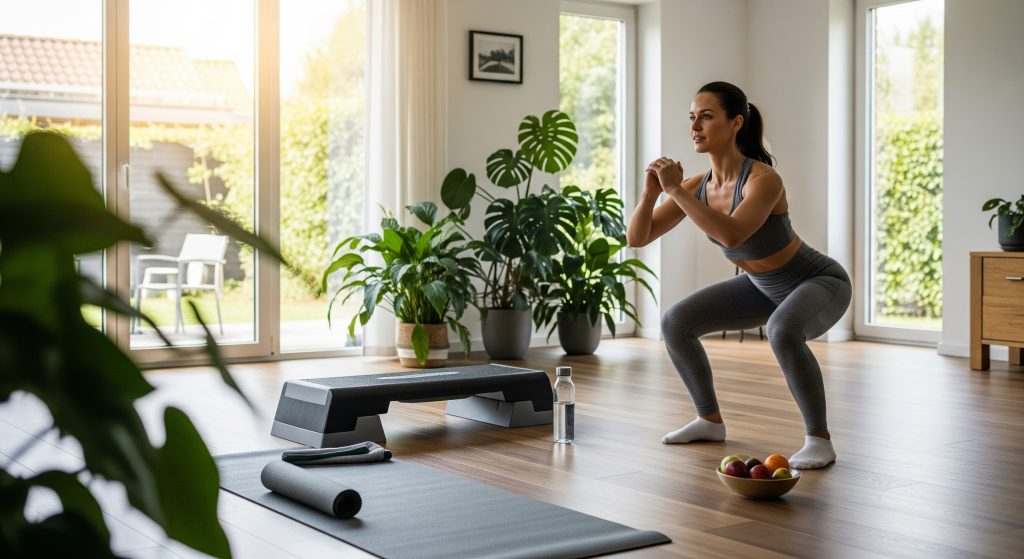
2. High-Rep Bodyweight Squats
High-rep squats build muscular endurance and raise session calorie burn. They also improve hip, knee, and ankle coordination. A 15 minute bodyweight session can be highly effective when kept focused. For added context, a six week bodyweight training programme was associated with increased muscle thickness and reduced body fat percentage, as Nature reported.
-
Setup: Feet shoulder width, toes slightly out, chest upright, core braced.
-
Movement: Push hips back first, then bend knees. Keep heels grounded.
-
Depth: Aim for hips at or just below knee height, within pain free range.
Programming example. 3 to 4 sets of 20 to 30 reps, 60 seconds rest. I keep the last 5 reps slow to emphasise control. This keeps the legs working without chasing heavy loads. It is a pragmatic exercise to reduce butt volume without undue bulk.
3. Walking Lunges with No Weights
Walking lunges challenge balance and hip control while driving meaningful time under tension. They encourage hip flexor mobility and build coordination through unilateral movement. They also raise heart rate quickly, which helps a calorie target.
-
Technique: Long step, front shin near vertical, torso tall, hips level.
-
Cadence: Controlled down, brief pause, drive through the front heel.
-
Volume: 2 to 4 sets of 16 to 24 steps total.
I often integrate walking lunges into a circuit with squats and step-ups. The combination keeps work continuous while sparing the knees. This pattern supports any exercise to reduce butt plan because it blends strength and light cardio in one block.
4. Step-Ups Without Resistance
Step-ups are quietly effective. They target glutes and quads while reinforcing single leg control. Height dictates difficulty. I choose a step that allows a near right angle at the knee for control and comfort. The key is smooth push and strict return. No bouncing. No twisting.
-
Setup: Whole foot on the step, chest tall, shoulders down.
-
Execution: Drive through the planted heel, squeeze the glute, control the descent.
-
Volume: 3 to 4 sets of 12 to 16 reps per leg.
I often pair step-ups with side-lying leg raises. The pairing trains frontal plane control and sagittal strength together. It tightens the loop between technique and purpose. In a formal exercise to reduce butt sequence, these are dependable anchors.
5. Glute Bridges with Extended Holds
Extended isometric holds at the top of a glute bridge reinforce posterior chain endurance. They also teach ribcage and pelvis control. Technique is the difference between useful work and lower back compensation. I focus on a neutral spine, ribs down, and a hard glute squeeze.
-
Setup: Feet hip width, heels close enough to graze with fingertips.
-
Execution: Drive through heels, squeeze glutes, avoid overextending the low back.
-
Hold: 15 to 30 seconds per rep, 6 to 10 total reps.
Bridges slot neatly into any exercise to reduce butt circuit because the load is self limiting. They build stamina without equipment. That allows frequent practice with low injury risk.
6. Side-Lying Leg Raises
Side-lying raises target the hip abductors, which stabilise the pelvis during walking and squatting. Strong abductors refine thigh contour and resist knee collapse. The movement is low impact and easy to scale. It also fits well on recovery days.
-
Setup: Lie on side, legs straight, head supported, hips stacked.
-
Execution: Lift top leg 10 to 15 inches, lead with the heel, control down.
-
Volume: 3 sets of 15 to 25 reps per side.
Small muscles fatigue quickly. I stop a set once the hips start to roll back. Quality over quantity. As a supporting exercise to reduce butt programme, side-lying work improves control that carries into squats and lunges.
Understanding How to Reduce Butt Fat
The physiology is not negotiable. To shrink the buttocks, I reduce total body fat while keeping lower body muscle. This section clarifies common myths and the practical framework I use to guide decisions.
Spot Reduction Myths vs Reality
Spot reduction is attractive. It is also unreliable in practice. Local muscle work can change muscle tone underneath fat. The fat still follows whole body energy balance. That means the hips and buttocks lean out as overall fat drops. Genetics set the order to an extent.
What this means. I still include targeted glute work for shape and support, but I do not expect it to strip fat locally. The heavy lifting for visible change comes from a well managed deficit and consistent training. That combination underpins every exercise to reduce butt programme I run.
Role of Caloric Deficit in Fat Loss
Roughly speaking, consistent fat loss requires a sustained energy deficit. I prefer a modest range. Around 300 to 500 kcal per day for most active adults. The precise number varies by size, activity, and schedule. Moderate deficits protect training quality and mood. They also reduce rebound risk.
-
Keep protein high to support satiety and recovery.
-
Use cardio and steps to raise expenditure without overtraining.
-
Track weekly averages, not single days, for weight and intake.
This is the backbone behind any exercise to reduce butt plan. Without an actual deficit, results stall. With it, progress becomes predictable.
Difference Between Muscle Toning and Building
Tone is a visual outcome, not a special form of training. Visible tone reflects sufficient muscle with less covering fat. Hypertrophy mechanisms are shared. Stimulate muscle, recover, and feed appropriately. The difference is often volume, load, and diet, not a mystical method. As Healthline explains, muscle fibres grow when resistance is adequate and nutrition supports repair.
So I bias higher reps, shorter rests, and controlled tempo for lower body work. That encourages endurance and shape without chasing maximal loads. It is still progressive. Just directed. This supports the goal of an effective exercise to reduce butt routine without unwanted bulk.
Hormonal Factors Affecting Fat Distribution
Hormones influence storage patterns. Oestrogen, progesterone, insulin, and cortisol all play roles in how and where fat accumulates. Genetics modulate the effect. There are exceptions. Some lean out fastest at the hips. Others hold stubborn glute fat until late in a cut.
I address the part I can control. Training consistency, sleep quality, protein intake, and measured stress. Over time, the pattern evens out. And yet, patience remains essential. Results arrive, then compound.
Complete Weekly Workout Programme
This plan balances aerobic work, high rep strength, and recovery. It is designed for eight to twelve weeks. I maintain the pattern, then adjust volume and pace as fitness improves. Every exercise to reduce butt session aims to be repeatable, not heroic.
Monday and Thursday Cardio Sessions
Two dedicated cardio slots anchor weekly energy burn. I prioritise incline walking or cycling. They are kind to knees and hips. I also add a brief finisher if recovery allows.
-
Main set: 35 minutes incline walk or cycle at steady pace.
-
Optional finisher: 6 rounds of 30 seconds hard, 60 seconds easy.
-
Cooldown: 5 minutes easy pace and light stretching.
If time is tight, I split into two 20 minute brisk walks. Morning and evening. It fits busy schedules and keeps total burn high. This supports the wider exercise to reduce butt programme reliably.
Tuesday and Friday Toning Workouts
These are the key lower body sessions. High repetition sets, strict form, and short rests. The goal is fatigue and control, not maximal load. I structure them as circuits to maintain heart rate.
|
Exercise |
Sets x Reps / Time |
|---|---|
|
Bodyweight Squats |
4 x 20 to 30 |
|
Walking Lunges |
3 x 18 total steps |
|
Step-Ups |
3 x 12 per leg |
|
Glute Bridge Holds |
2 x 8 reps, 20 second hold |
|
Side-Lying Leg Raises |
3 x 20 per side |
Rest 45 to 75 seconds between sets. I keep posture cues front of mind. Chest tall, ribs down, knees tracking toes. This is the technical spine of an exercise to reduce butt routine that shapes without swelling unwanted muscle size.
Wednesday Active Recovery Options
Recovery protects progress. I use low impact activity to promote blood flow and reduce stiffness. This preserves momentum without adding fatigue.
-
20 to 30 minute easy walk outdoors.
-
Gentle yoga or mobility flow for hips and ankles.
-
Breathing drills to lower stress and aid sleep quality.
Active recovery keeps the calorie tally moving as well. It is a quiet but necessary part of a complete exercise to reduce butt plan.
Weekend Activities for Extra Calorie Burn
Weekends allow longer, social sessions. I choose hiking, long walks, or casual cycling. The trick is to go longer, not harder. This builds weekly energy expenditure without taxing Monday’s session.
-
Option A: 60 to 90 minute hike or park walk.
-
Option B: 45 to 60 minute casual cycle.
-
Option C: Sports play that stays mostly aerobic.
I also use weekends to tidy meals and sleep. That raises adherence for the coming week. It is unglamorous. It works.
Progressive Overload Without Adding Bulk
Progress must be present. I increase difficulty without jumping to heavy barbells. Four levers deliver safe progress for an exercise to reduce butt protocol:
-
Reps: Add 1 to 3 reps per set, then reset and add again.
-
Tempo: Slow the lowering phase to 3 seconds for control.
-
Rest: Trim rest by 10 to 15 seconds once technique is stable.
-
Range: Increase squat depth or step height slightly when ready.
I rotate these levers weekly. It limits plateaus and protects joints. Simple and systematic. Not flashy.
Nutrition and Lifestyle Changes
Training cannot outpace poor recovery and chaotic meals. I align food quality, hydration, and sleep with the training plan. This makes each exercise to reduce butt session produce visible change sooner.
Foods That Support Fat Loss
I prioritise protein, produce, and fibre. They increase satiety and protect training output in a deficit. Carbohydrates cluster around training. Fats fill the remainder of calories with a bias toward unsaturated sources.
-
Protein anchors: eggs, Greek yoghurt, tofu, fish, lean meats, legumes.
-
Fibre and micronutrients: mixed vegetables, berries, leafy greens.
-
Smart carbs: oats, rice, potatoes, wholegrain bread, fruit around sessions.
-
Fats: olive oil, nuts, seeds, avocado in measured portions.
This framework makes an exercise to reduce butt schedule more productive. Energy stays stable. Cravings reduce. Adherence rises.
Proper Hydration for Results
Hydration influences performance and appetite cues. Mild dehydration often masquerades as hunger. I keep water intake steady across the day. I add a pinch of salt with long or sweaty sessions. Tea and coffee count toward fluids. Excess sugar drinks do not.
Practical cue. I target pale straw coloured urine most of the time. It is an easy field check.
Sleep’s Impact on Fat Metabolism
Sleep quality heavily affects appetite and energy choices. Short sleep increases hunger signals and lowers impulse control. That combination derails a tight calorie plan. In line with current evidence, insufficient sleep correlates with greater weight gain risk, as Sleep Foundation outlines.
I protect a seven to nine hour window, with a consistent schedule. Room cool, dark, and quiet. Screens away an hour before bed. The change is often noticeable in a week. Training feels easier. Food choices improve.
Common Mistakes to Avoid
-
Chasing spot reduction and skipping cardio.
-
Using loads that force sloppy knee collapse in squats or lunges.
-
Cutting calories too hard, then rebounding on weekends.
-
Ignoring sleep and wondering why hunger is constant.
-
Dropping all glute exercises and losing shape along with fat.
Avoid these traps and the full exercise to reduce butt plan runs smoother. Fewer relapses. Better training quality.
Achieving Your Ideal Butt Size
Results come from aligned elements. A measured deficit, structured cardio, high rep lower body circuits, and disciplined recovery. That is the engine. I retain key glute exercises to keep shape while reducing overall fat. The process feels steady, not extreme. Progress compounds.
One final note. Trends will keep promising shortcuts. The fundamentals remain. Build a repeatable plan and stay with it for twelve weeks. That is the honest path for any exercise to reduce butt objective.
Frequently Asked Questions
How long does it take to see results from butt reduction exercises?
Early changes usually appear within four to six weeks. That assumes a weekly calorie deficit and consistent training. Visible size reduction often requires eight to twelve weeks. Genetics and adherence influence the pace. I track tape measurements and photos, not just weight. The data keeps decisions objective.
Can I reduce my butt size without losing curves?
Yes, to a degree. The method is a modest deficit with targeted endurance work to keep muscle. Think squats, lunges, step-ups, and bridges. This preserves shape while total fat drops. The look becomes smaller and firmer rather than flat. It is a precise exercise to reduce butt approach, not a starvation plan.
Will squats make my butt bigger or smaller?
Both outcomes are possible. In a calorie deficit with high reps, squats usually refine shape and reduce size. In a surplus with heavy loads, squats can increase glute size. I match reps and nutrition to the goal. That is the decisive factor, not the exercise itself.
Should I avoid all glute exercises if I want a smaller butt?
No. Dropping glute work removes the shaping effect and can reduce hip stability. Keep the movements and adjust volume and intensity. Use higher reps, slower tempo, and shorter rests. This supports how to reduce butt fat without building excessive mass.
What’s the best cardio for reducing butt fat specifically?
There is no single best type. The best option is the one that you will repeat four times per week. Brisk incline walking and cycling are reliable. They are joint friendly and easy to scale. Combined with strength circuits, they are potent in any exercise to reduce butt plan.

