






 We do what's right for you...


Everything About Ankle Muscles: From Injuries to Exercises
Dr. Ali Haider Khan
Common advice says to just strengthen the calves and the ankle will follow. That shortcut fails. The ankle is a complex joint that relies on a coordinated network of movers and stabilisers. In this guide, I map how ankle muscles function, how they get injured, and how to train them intelligently without guesswork.
Ankle Muscle Anatomy and Function
I start with the map because strategy follows structure. Understanding ankle muscle anatomy clarifies why certain drills work and others do not. It also explains why pain often appears far from the true source.
Major Muscle Groups of the Ankle
The ankle relies on four functional groups that act across the foot and lower leg. Together, these groups position the foot, control the arch, and steady movement under load. When one group is slow or weak, compensations emerge and the joint loses control.
|
Group |
Primary role |
|---|---|
|
Dorsiflexors |
Lift the forefoot and clear the toes during swing. |
|
Plantarflexors |
Push the body forward and upward during gait and jump. |
|
Lateral stabilisers |
Resist inversion and protect against rolling outward. |
|
Medial stabilisers |
Support the arch and control pronation mechanics. |
When I coach movement, I test each group in isolation first. Then I check how the system works together under speed. That is where gaps in the ankle muscles usually appear.
Dorsiflexors and Their Role
The dorsiflexors include tibialis anterior, extensor hallucis longus, and extensor digitorum longus. They lift the foot and position the ankle for safe landing. Insufficient dorsiflexion strength reduces toe clearance, which subtly changes stride mechanics.
-
Key tasks: toe lift, controlled lowering of the foot, fine control on descent.
-
Common signs of weakness: slapping foot, reduced stride efficiency, early fatigue.
-
Training focus: slow eccentrics and end-range holds in dorsiflexion.
Strong dorsiflexors make the rest of the ankle muscles more effective. The chain prefers that order.
Plantarflexors and Movement Control
The plantarflexors are led by gastrocnemius and soleus, with help from intrinsic foot muscles. They are the prime movers for push-off, sprinting, and jumping. They also act as brakes during landing and downhill walking.
-
Gastrocnemius drives power with the knee straight.
-
Soleus manages control with the knee bent and under steady loads.
-
Training should separate these roles for precision and capacity.
I like to treat these as distinct modules. It keeps loading clear and improves how the ankle muscles share work.
Lateral and Medial Stabilisers
Lateral stabilisers include peroneus longus and brevis. They resist unwanted inversion and support the first metatarsal during push-off. Medial stabilisers include tibialis posterior and flexor digitorum longus, which uphold the arch and guide pronation.
-
Lateral bias errors often lead to recurrent sprains.
-
Medial underactivity presents as a collapsing arch under fatigue.
-
Both respond well to low-load, high-control drills and balance work.
When these stabilisers are tuned, the larger ankle muscles stop overworking, which reduces irritation upstream.
How Ankle Muscles Work Together
The joint relies on co-contraction. Dorsiflexors set the foot for contact while plantarflexors modulate impact. Lateral and medial stabilisers guide motion so the forefoot and rearfoot track together. This is the quiet skill of gait.
Two examples illustrate the point. A steady single-leg squat needs tibialis posterior holding the arch while peroneals guard the outside. A short sprint requires rapid dorsiflexion recovery and a powerful plantarflexion finish. Different tasks, same principle.
I see better outcomes when training integrates tempo, speed, and stability in one plan. That plan must challenge ankle muscles in their real roles, not just in isolation.
Common Ankle Muscle Injuries and Treatment
Muscle injuries follow predictable patterns. The mechanism, tissue capacity, and training errors usually explain the symptoms. I outline practical categories that align with clinical decision making.
Types of Ankle Muscle Strains
Strains range from mild overstretch to partial tear. They often occur during sudden direction changes or unplanned landings. Most respond to graded loading and careful progressions.
-
Grade 1: soreness with minimal strength loss. Train around it with low pain.
-
Grade 2: partial tear with local weakness. Load gently and restore range.
-
Grade 3: significant tear and marked weakness. Medical review is advised.
Early swelling settles with relative rest and elevation. Then I initiate isometrics to reintroduce safe tension for the ankle muscles.
Achilles Tendonitis Causes and Symptoms
Achilles tendon pain typically develops after abrupt load increases or changes in footwear. Morning stiffness, local tenderness, and reduced plyometric capacity are common. Runners report difficulty with hills and fast finishes.
Management relies on progressive loading rather than complete rest. I use slow heel drops, heavy isometrics, and later, faster tempos. Calf-soleus balance matters because it shapes how the ankle muscles share work during push-off.
Peroneal Tendon Injuries
Peroneal tendons can irritate with repeated inversion or unstable surfaces. Symptoms include pain behind the lateral malleolus and discomfort on sloped ground. Weak eversion capacity is often present.
Rehab emphasises controlled eversion and balance on uneven surfaces. I add resisted eversion holds and short foot drills. This directly supports the lateral ankle muscles during unpredictable tasks.
Tibialis Posterior Dysfunction
Tibialis posterior dysfunction appears as a dropping arch and fatigue on longer walks. The foot feels less springy and the heel may drift outward. Over time, this can alter midfoot mechanics.
Targeted strengthening of tibialis posterior is effective. I combine heel raises with a ball squeeze and slow foot control drills. It restores medial support and allows the rest of the ankle muscles to load efficiently.
Recovery Timeline for Different Injuries
Timelines vary with tissue type and severity. The sequence is similar even when the calendar changes. Load tolerance should guide decisions more than a fixed week count.
|
Condition |
Typical progression window |
|---|---|
|
Grade 1 muscle strain |
1 to 3 weeks of graded load and return to activity. |
|
Grade 2 muscle strain |
3 to 6 weeks with structured strengthening and control. |
|
Achilles tendinopathy |
6 to 12 weeks for strength and tendon capacity gains. |
|
Peroneal tendinopathy |
4 to 8 weeks depending on balance demands. |
|
Tibialis posterior dysfunction |
6 to 12 weeks with arch control retraining. |
These windows are guides. Pain trends, strength symmetry, and task demands should lead the next step.
When to Seek Medical Attention
Seek evaluation if pain escalates rapidly, strength drops suddenly, or weight bearing becomes difficult. Visible deformity, night pain, or locking warrants prompt review. Recurrent sprains also merit assessment for mechanical instability.
I prefer early diagnostics when red flags appear. It saves time and protects the ankle muscles from chronic overload patterns.
Ankle Muscle Strengthening Exercises
Effective training respects sequence, dosage, and context. I prioritise control at slow tempos before adding speed or impact. Each drill below fits a role within a coherent plan.
1. Resistance Band Exercises
Resistance bands allow precise loading at end ranges. They also make home programmes realistic and consistent. Slow tempos protect form while building durable control in the ankle muscles.
-
Band dorsiflexion: 3 sets of 10 to 15 reps with a 2 second hold.
-
Band plantarflexion: 3 sets of 12 to 15 reps with a slow return.
-
Band inversion and eversion: 2 to 3 sets of 12 reps each direction.
For ankle muscle strengthening, pause at the hardest point. That pause builds the control needed for cutting and landing.
2. Calf Raises and Variations
Calf raises are a mainstay for plantarflexor strength. I split the work between knee-straight and knee-bent positions. This approach targets gastrocnemius and soleus without confusion.
-
Double-leg calf raise to single-leg: progress to 3 sets of 8 to 12 reps.
-
Seated calf raise: 3 sets of 12 to 15 reps for soleus capacity.
-
Deficit calf raise: slow eccentric, 3 seconds down for tendon health.
If balance is limiting, hold a support and load the range fully. The goal is strong and even ankle muscles, not wobble practice.
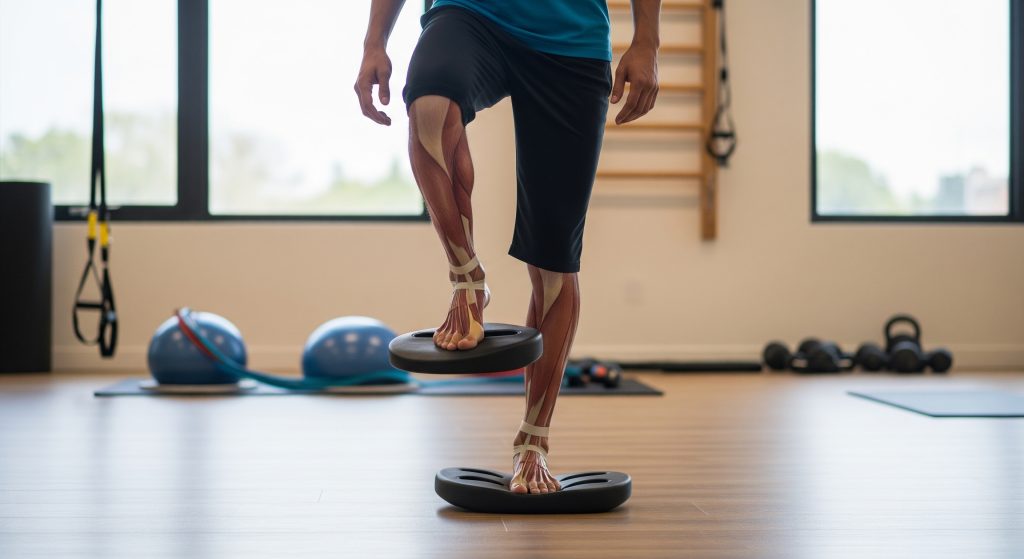
3. Balance and Proprioception Training
Balance drills train the stabilisers to act on time. Proprioception improves with small perturbations and progressive chaos. This is where most prevention gains for ankle muscles occur.
-
Single-leg stand eyes open, then eyes closed for 20 to 30 seconds.
-
Reach matrix: three directional reaches while maintaining arch control.
-
Foam pad or wobble board holds with soft knee and steady breath.
Pros
-
Improves joint timing and reflexive control.
-
Low equipment and adaptable to any setting.
Cons
-
Progress can feel slow without clear metrics.
-
Poor form may teach compensations if unsupervised.
Measure progress with hold time and movement quality. Simple, reliable, effective.
4. Toe Walks and Heel Walks
Toe walks develop endurance in plantarflexors. Heel walks challenge dorsiflexors and foot lift control. Both help the ankle muscles manage repetitive tasks like distance walking.
-
Toe walks: 3 to 4 sets of 20 to 40 metres at a smooth pace.
-
Heel walks: 3 to 4 sets of 15 to 30 metres with upright posture.
-
Progress by adding slight incline or longer distances.
A small note on form. Keep the ankles quiet and the steps light.
5. Ankle Circles and Alphabets
Circles and alphabets are simple and reliable. They mobilise the joint and restore low-level control. I use them during warm-ups and between heavier sets to keep the ankle muscles responsive.
-
Ankle circles: 30 seconds each direction per side.
-
Alphabet drill: trace the letters slowly without hip compensation.
-
Do not rush. Quality beats speed here.
This work is light, but it builds the fine control that protects more intense sessions.
Progressive Exercise Routine Planning
Progression should be staged and specific. I use a four-phase framework that moves from control to power. Each phase respects tissue recovery while advancing capacity in the ankle muscles.
|
Phase |
Primary focus and sample work |
|---|---|
|
1. Control |
Bands, isometrics, slow eccentrics, balance holds, 2 to 3 weeks. |
|
2. Strength |
Calf raises heavy, split stance holds, 3 to 5 weeks. |
|
3. Power |
Tempo changes, small hops, low amplitude plyometrics, 2 to 3 weeks. |
|
4. Performance |
Sport drills, cutting patterns, reactive tasks, ongoing. |
Load should increase by modest increments. If form degrades, reduce volume and retest the basics. A simple rule that ankle muscles respect.
Prevention and Long-Term Ankle Health
Prevention is not passive. It is systematic exposure to the right stress with adequate recovery. I prioritise warm-up quality, fit-for-purpose footwear, and sport-matched workloads.
Proper Warm-Up Techniques
A good warm-up raises tissue temperature and primes neuromuscular timing. I build it in three parts that take minutes and pay off in stability. It is basically a checklist for the ankle muscles.
-
Mobilise: ankle circles, calf pumps, and gentle knee-overs, 2 to 3 minutes.
-
Activate: band dorsiflexion, short foot holds, heel raises, 3 to 4 minutes.
-
Integrate: skips, pogo hops, short accelerations, 3 to 5 minutes.
This sequence transitions from range to activation and then to movement. The ankle muscles are ready when landing feels quiet.
Footwear Selection Guidelines
Footwear directs load across the foot and ankle. Selection should match task demands and individual mechanics. I consider three practical variables and keep the rest simple.
|
Variable |
Guideline |
|---|---|
|
Stability |
Choose stable platforms for cutting and field sports. |
|
Cushioning |
Moderate cushioning for daily miles and repetitive impact. |
|
Heel to toe drop |
Gradual changes only to avoid Achilles irritation. |
Minimal or maximal designs can both work to an extent. The right choice is the one that keeps the ankle muscles working without protest across the session.
Sport-Specific Ankle Conditioning
Training should mirror the forces of the sport. Sprinters need acceleration mechanics and elastic power. Field athletes need deceleration, cutting, and reaction under fatigue.
-
Sprint prep: high knee drills, ankling, and progressive bounds.
-
Field prep: lateral shuffles, decel to stick, and change of direction.
-
Court prep: multi-direction hops and short reactive ladders.
I scale complexity slowly. The ankle muscles adapt best when new tasks arrive one variable at a time.
Flexibility and Mobility Work
Mobility supports mechanics, but excess laxity helps no one. I target dorsiflexion range, calf flexibility, and midfoot glide. These choices maintain joint options without dulling stiffness that stores energy.
-
Knee-to-wall dorsiflexion: 2 sets of 45 to 60 seconds per side.
-
Calf stretch straight and bent knee: 2 sets each angle.
-
Toe extension stretch and short foot holds for arch control.
Mobility should end with light activation. It locks in the range so the ankle muscles can use it during tasks that matter.
Conclusion
Strong, coordinated ankle muscles do more than prevent sprains. They improve stride efficiency, reduce wasted energy, and support confident movement under pressure. The path is clear. Map the roles, train the stabilisers, load the movers, and then integrate speed and reaction. Build capacity that lasts.
Start with a simple cycle. Two phases on control and strength, then one phase on power and performance. Reassess, refine, and repeat. Consistency, not novelty, produces resilient ankles.
Frequently Asked Questions
How long does it take to strengthen weak ankle muscles?
Most individuals notice tangible changes in 4 to 6 weeks with structured work. Endurance improves first, then maximal strength. Power and reactivity usually follow in weeks 6 to 12.
Progress faster by keeping form strict and recovery adequate. The ankle muscles respond well to consistent, moderate progression.
Can ankle muscle exercises prevent sprains?
They reduce risk significantly, especially when balance and reactive drills are included. Strength alone is not enough without timing and control. Combine strength with proprioception and sport patterns for the best effect.
That blend trains how ankle muscles stabilise in real time. It is the practical route to fewer sprains.
What causes chronic ankle muscle tightness?
Chronic tightness often reflects protective guarding or low-level overload. Limited dorsiflexion, weak stabilisers, and poor recovery are frequent drivers. Footwear changes can also shift load and create perceived stiffness.
Address the cause with targeted strength, sensible mobility, and better load management. The ankle muscles then stop bracing reflexively.
Should I exercise ankle muscles daily or rest between sessions?
Low-load control drills can be daily. Heavier strength work benefits from 24 to 48 hours between sessions. Power and plyometric work should include more recovery, especially early on.
Monitor how the ankle muscles feel the next morning. Stiff and heavy means pull back slightly on volume or intensity.
Which ankle muscle is most commonly injured in sports?
Peroneal structures are frequently involved due to inversion sprains. Calf strains around the gastrocnemius are also common during acceleration. Patterns vary by sport and position.
Prevention emphasises lateral control, balanced calf strength, and reactive drills. That combination protects the ankle muscles where they are most exposed.
Key Takeaways
-
Train roles, not just muscles. Make the ankle muscles earn stability under speed.
-
Sequence matters. Control, then strength, then power and performance.
-
Footwear, warm-up, and sport context shape load and outcomes.
-
Consistency and measured progress outpace intensity alone.
Suggested Weekly Structure
-
Day 1: Strength focus, heavy calf work and band control.
-
Day 2: Balance and mobility, light activation finish.
-
Day 3: Strength focus, knee-bent and end-range control.
-
Day 4: Power and reactive drills matched to sport.
This rhythm respects recovery while keeping the ankle muscles primed for real work.
Two final notes. Use ankle muscle anatomy as your compass. Keep testing simple outcomes like quiet landings, even push-off, and stable single-leg holds.
If in doubt, regress the drill and progress the quality.
References are not included here because the guidance is practical and non-statistical. Where quantified data is required, consult current clinical guidelines and sport science reviews.
SEO use of secondary terms: ankle muscle exercises and ankle muscle strengthening are integrated in the training sections as described.

