






 We do what's right for you...


Essential Heart Attack First Aid: Warning Signs and Immediate Actions
Dr. Hriday Kumar Chopra
Standard advice often says to stay calm and wait for help. In a cardiac emergency, waiting silently costs minutes and sometimes lives. I wrote this guide to make first aid for heart attack practical, precise, and doable under pressure. It covers the warning signs to act on and the immediate actions that improve survival.
Recognising Heart Attack Warning Signs
Chest Pain and Discomfort Symptoms
I watch for central chest pressure that feels heavy, tight, or squeezing. It may last several minutes or come and go. It might feel like indigestion, but it builds and does not fully ease with rest. Treat persistent chest discomfort as a heart attack until proven otherwise.
Upper Body Pain Indicators
Pain can spread to one or both arms, the back, neck, jaw, or upper stomach. I pay attention to pain that radiates or feels unfamiliar. Sudden shoulder or jaw pain paired with chest pressure is a strong red flag.
Breathing Difficulties and Shortness of Breath
Unexplained breathlessness, with or without chest pain, warrants urgent action. I look for shallow breathing, difficulty speaking full sentences, or an anxious, air-starved look. Breathing trouble plus sweating or nausea points to serious cardiac strain.
Additional Warning Signs in Women
Women can present atypically. I watch for unusual fatigue, light-headedness, nausea, or back and jaw discomfort. Chest pain may be mild or absent. The rule is simple. New, concerning symptoms that do not settle quickly should be treated as cardiac until assessed.
Silent Heart Attack Symptoms
Some heart attacks are subtle. I look for sudden weakness, mild chest pressure that feels like fullness, or brief breathlessness during routine activity. If symptoms pass, the risk remains. Seek medical evaluation promptly, since delayed care raises complications.
Immediate First Aid Actions and CPR Steps
Call Emergency Services 108 Immediately
Call 108 at once. Put the phone on speaker so I can keep hands free. Early contact triggers dispatch and pre-arrival instructions. Describe symptoms clearly, share location details, and do not hang up until told to. This is the first and most important step in first aid for heart attack.
Position the Person Correctly
I help the person sit upright with back supported and knees bent. Loosen tight clothing. Keep the environment calm and cool. If they become unresponsive, I lay them on a firm surface and prepare for CPR.
Administer Aspirin if Available
If the person is conscious, not allergic to aspirin, and not bleeding, I offer a standard adult aspirin to chew. Chewing works faster than swallowing whole. Avoid aspirin if there is any doubt about allergy, recent bleeding, or severe stomach issues.
CPR Chest Compression Technique
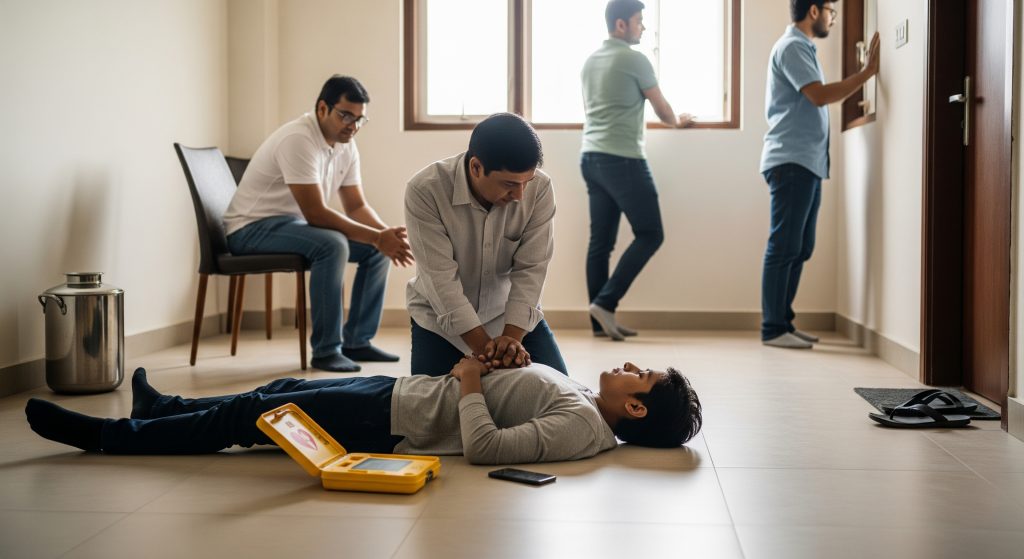
If the person is unresponsive and not breathing normally, I start CPR. Place the heel of one hand in the centre of the chest. Lock the other hand on top. Keep arms straight and press hard and fast at a steady rhythm. Aim for strong, consistent compressions that allow full chest recoil. These are the core cpr steps for heart attack when breathing has stopped.
Rescue Breathing Method
If trained and confident, I add rescue breaths. After 30 compressions, open the airway with a head tilt and chin lift. Pinch the nose, seal the mouth, and give 2 slow breaths. Watch for chest rise. Return immediately to compressions. If untrained, continue compressions only.
Using an AED Device
Send someone to fetch an AED. Switch it on and follow the voice prompts. Expose the chest, attach pads as shown, and stand clear during analysis. If a shock is advised, ensure no one touches the person, then press shock. Resume compressions straight away. AED access is a decisive part of first aid for heart attack that has progressed to cardiac arrest.
What Not to Do During Heart Attack
-
Do not delay the 108 call while assessing symptoms.
-
Do not let the person drive. Arrange ambulance care instead.
-
Do not offer food, alcohol, or unnecessary medication.
-
Do not stop CPR until professionals take over or the person recovers.
-
Do not apply chest thumps or unproven remedies.
Be Prepared to Save a Life
Preparation beats improvisation. I keep the basics in mind, practise cpr steps for heart attack, and know where the nearest AED is located. A brief workplace drill or a local CPR course builds muscle memory. In practice, that confidence shortens hesitation and buys critical minutes.
Here is my compact checklist for first aid for heart attack under stress:
-
Call 108 on speaker and state the emergency and location.
-
Seat and reassure. Loosen clothing and monitor breathing.
-
Offer chewable aspirin if appropriate and not allergic.
-
If unresponsive and not breathing normally, start CPR.
-
Apply an AED as soon as it arrives and follow prompts.
-
Do not stop until help takes over or signs of life return.
The principle is simple. Recognise fast and act faster. That is the essence of effective first aid for heart attack.
Frequently Asked Questions
How long do I continue CPR during a heart attack?
I continue until emergency services arrive, an AED advises pause, or the person shows signs of life. If exhausted and alone, I rotate brief rests as safely as possible, but I prioritise compressions.
Can I give nitroglycerin tablets for heart attack first aid?
Only if these are prescribed to the person and they are conscious and able to take them. Never give someone else’s medication. If there is uncertainty, I withhold and focus on 108, positioning, aspirin if suitable, and monitoring.
What’s the difference between heart attack and cardiac arrest?
A heart attack is a circulation problem caused by blocked blood flow to heart muscle. Cardiac arrest is an electrical failure where the heart stops pumping effectively. A heart attack can lead to arrest. Arrest demands immediate CPR and AED use.
Should I drive someone having a heart attack to hospital myself?
No. I call 108. Ambulances provide monitoring, oxygen, and early defibrillation. Driving delays treatment and adds risk on the road.
How many chest compressions per minute for heart attack CPR?
Deliver compressions at a fast, regular pace that matches an upbeat track. Aim for strong depth with full recoil. Consistency matters more than exact counting during stress.

