






 We do what's right for you...


Best Hip Pain Exercises for Arthritis: Simple Moves for Daily Comfort
Dr. Ali Haider Khan
Advice about arthritis often starts and ends with rest. That is incomplete. The right movement protects joints, builds capacity, and reduces pain over time. In this guide, I set out a practical, safe approach to hip pain exercises that fits real daily life. The goal is simple: steadier mobility, stronger support, and more comfortable days. No fads. Just clear, progressive work that respects arthritic hips and still delivers results.
Top Hip Pain Relief Exercises for Arthritis
1. Gentle Range of Motion Exercises
I start with low-load movements that keep the joint moving without stress. The aim is smooth arcs, not force. These hip pain exercises maintain lubrication in the joint and reduce stiffness after sitting.
-
Supine heel slides: Lie on your back. Slide one heel towards the buttock, then return. Perform **10 to 15** smooth reps per side.
-
Hip pendulums: Stand with light support. Gently swing the leg forward and back, then side to side. Keep the motion small and controlled.
-
Seated external rotations: Sit upright. Place the ankle over the opposite knee if comfortable. Rotate the shin outward and back to neutral.
Keep breath steady. I use a slow count of three on the way out and back. It calms the system and reduces guarding. If soreness flares, I reduce range and repeat. Consistency matters more than intensity here. These are foundational hip mobility exercises, and they underpin everything that follows.
2. Hip Flexor Stretches
Tight hip flexors can tilt the pelvis and load the front of the hip. I prioritise position and support. Comfort first, stretch second. These are effective hip pain relief exercises when performed with patience.
-
Half-kneeling stretch: One knee down, the other foot forward. Tuck the pelvis gently. Shift forward until a mild stretch appears at the front hip. Hold **20 to 30** seconds.
-
Standing desk stretch: Hold a stable surface. Step one leg back. Soften the back knee. Tuck the pelvis. Hold **20 to 30** seconds and breathe.
Do not chase a deep pull. A modest stretch held longer works better for irritated tissue. I add light glute tension on the back leg to enhance the effect. That co-contraction supports the joint and improves the stretch quality.
3. Seated Hip Marches
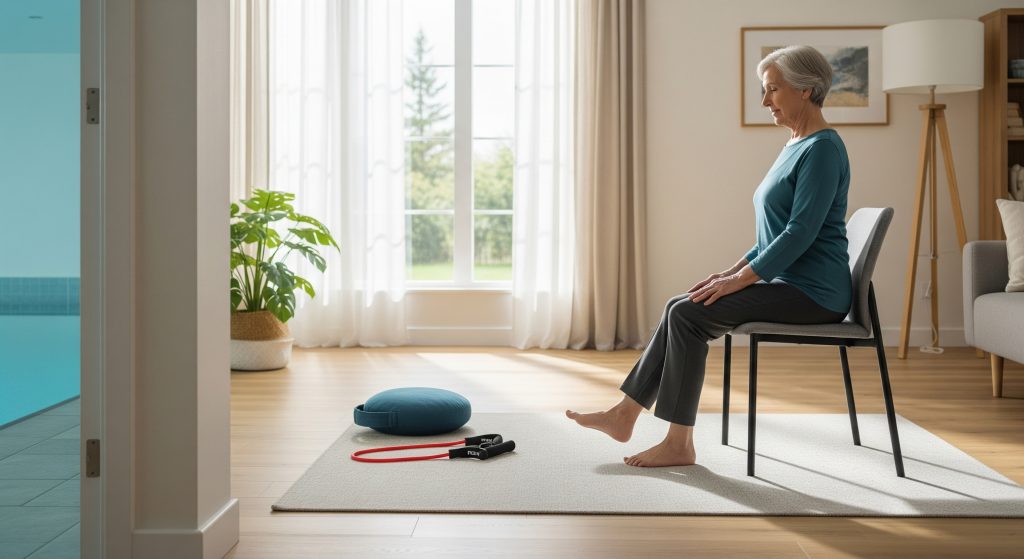
Seated marching builds active range and core-hip coordination with minimal load. It is simple, scalable, and joint friendly. I often include it early in a programme of hip pain physiotherapy exercises to build confidence.
-
Sit tall on a chair, feet flat, hands resting lightly on the sides.
-
Brace the midsection gently. Lift one knee without leaning back.
-
Lower with control. Alternate sides for **20 to 30** total reps.
To progress, I pause for one second at the top. To regress, I raise the seat height. If the front of the hip pinches, I lift a little lower. Subtle adjustments keep the movement pain free while still training useful hip control.
4. Standing Hip Abductions
Abductors stabilise the pelvis during walking and stairs. Stronger abductors often mean easier steps and fewer jolts. This makes them central to effective hip pain exercises for everyday function.
-
Stand tall, lightly holding a worktop. Toes point forward.
-
Move the leg out to the side without leaning. Lead with the heel.
-
Perform **8 to 12** reps per side. Two sets. Slow and steady.
If balance is limited, I use a resistance band above the knees instead. The band allows small-range abduction with less stress. A gentle burn in the side hip is expected. Sharp pain is not. I keep tempo slow to avoid momentum and improve control.
5. Bridge Exercises
Glute bridges strengthen the posterior chain and reduce strain on the anterior hip. They also improve hip extension, which helps walking mechanics. Bridges fit well among hip pain relief exercises because load is easy to grade.
-
Lie on the back, knees bent, feet hip width.
-
Exhale and press through heels. Lift the hips until the body forms a straight line.
-
Pause, then lower with control. Complete **8 to 12** reps.
I cue a slight posterior pelvic tilt before lifting. It takes pressure off the lower back. Progressions include banded bridges, longer pauses, or single leg variations. For irritable joints, I reduce the height and add more sets with fewer reps. Quality first, then load.
6. Clamshells for Hip Stability
Clamshells target the deep rotators and gluteus medius. They stabilise the pelvis during turning and single leg tasks. As part of hip pain physiotherapy exercises, they are reliable and easy to monitor.
-
Lie on your side with knees bent and stacked. Heels together.
-
Keep the pelvis steady. Open the top knee like a book.
-
Lower slowly. Perform **12 to 15** reps per side.
If the hip flexors take over, I roll slightly forward and shorten the arc. A light mini band above the knees adds challenge without joint compression. The key is strict control. No rocking. No rush. Small muscles, precise work.
7. Water-Based Hip Exercises
Pool work offers offloading with resistance. Buoyancy reduces joint stress while water drag builds strength. For painful hips, this is a practical bridge between stretching and land strength.
-
Water walking in chest-deep water for **5 to 10** minutes.
-
Side steps with a gentle push against the water wall.
-
Standing knee lifts and mini kicks holding the pool edge.
Pros vs Cons
-
Pros: Lower impact, natural resistance, improved confidence during flares.
-
Cons: Pool access, temperature tolerance, and time logistics.
I combine pool sessions with shorter land sessions the same week. Strength still needs ground contact. Water complements. It does not replace land-based hip pain exercises for the long term.
Building Your Daily Exercise Routine for Arthritis Management
Morning Hip Mobility Exercises
Mornings favour gentle motion to reduce overnight stiffness. I stack small wins. Ten focused minutes can change the rest of the day.
-
Breathing and pelvic tilts in supine for **1 to 2** minutes.
-
Heel slides and hip pendulums for **2 to 3** minutes.
-
Hip flexor stretch holds for **2 x 20** seconds per side.
-
Seated hip marches for **2 x 10** per side.
This sequence prepares the joints without fatigue. It is basically a primer. It also sets the tone for later strength work. If time is tight, I keep the stretches and one controlled activation drill. That quick combination preserves momentum.
Afternoon Strengthening Sessions
Strength is the insurance policy for painful joints. Afternoon energy is usually better, and tissue is warmer. I schedule the main hip pain exercises here for dependable progress.
-
Bridges: **3 x 10** with a one second pause at the top.
-
Standing hip abductions: **2 x 12** per side.
-
Clamshells: **2 to 3 x 12** per side with control.
-
Optional: Sit to stand from a chair, **2 x 8**.
I keep rest periods short and movement quality high. If a day runs long, I reduce sets, not form. Consistency produces adaptation. And yet, discretion matters. On a higher pain day, I maintain pattern practice with light bands and smaller ranges.
Evening Flexibility Work
Evenings suit downregulation. I use gentle holds to lengthen and calm. This balances the stronger work earlier and promotes sleep quality.
-
Supine figure four stretch: **2 x 30** seconds per side.
-
Half-kneeling hip flexor stretch: **2 x 30** seconds per side.
-
Side lying trunk rotations to rinse residual stiffness.
These are quiet minutes that pay back. Joints settle, and muscles release. It is not complicated. It is consistent. These small inputs support the broader plan of hip pain relief exercises across the week.
Tracking Progress and Adjustments
I track three items: pain during activity, pain the next morning, and function metrics. Simple and concrete. It prevents guesswork and keeps the plan honest.
|
Measure |
Definition |
|---|---|
|
During-activity pain |
Discomfort stays at or below **3/10** and settles within **24** hours. |
|
Next-morning feel |
Stiffness duration is shortening week by week. |
|
Function |
Stairs, walking time, and sit to stand count improving. |
Progress is not linear. It trends. I review weekly and adjust volume by **10 to 20** percent up or down. That measured drift keeps training within the joint’s current capacity.
Important Safety Tips and Modifications
When to Exercise vs Rest
If baseline pain is high and rising, I shorten sessions and reduce range. Rest does not mean inactivity. It means strategic dosing. Low-load hip pain exercises maintain circulation and reduce stiffness while the flare settles.
Proper Warm-Up Techniques
A brief warm up improves tolerance. I suggest two minutes of easy marching or a short hallway walk. Then perform gentle hip mobility exercises for small arcs. Finish with one activation drill before strength work. Simple, effective, and repeatable.
Using Support Equipment
|
Stable support |
Worktop or rail to improve balance during abductions and mini squats. |
|
Mini bands |
Light resistance without joint compression for clamshells and bridges. |
|
Wedge or cushion |
Elevates seating to reduce hip pinch when standing up. |
|
Heat or cold |
Heat before for comfort. Cold after if soreness lingers. |
Equipment is optional. It should help form and comfort. If it creates reliance, I phase it out gradually while strength improves.
Warning Signs to Stop
-
Sharp, catching pain that escalates with each rep.
-
Visible swelling or heat that increases after sessions.
-
Night pain that disrupts sleep for more than **48** hours.
These signals warrant modification or a clinical review. Better to pause and adjust than to push into a setback.
Adapting Exercises for Flare-Ups
During flares, I bias range of motion drills, water work, and short holds. Reduce load by **30 to 50** percent and keep reps low. Retain daily movement. It shortens the recovery window and protects momentum.
Making Hip Exercises Part of Your Arthritis Management
Arthritis management is a long game. A steady plan of hip pain exercises, scaled to your week, builds capability and confidence. Think in blocks of eight to twelve weeks. Train gently most days and challenge a little twice per week. Review, then progress. The body adapts to what it does regularly.
I also tie exercises to anchors in the day. Morning movement after tea. Strength after lunch. Flexibility before bed. These anchors turn intent into habit. To an extent, that is the difference between sporadic relief and durable change.
Two final points. First, pain relief and function often improve together, though not perfectly. Second, setbacks will occur. They do not erase gains. They guide the next adjustment. Keep the plan simple and visible. That is how hip pain exercises move from a task to a supportive routine.
Frequently Asked Questions
How often should I do hip pain exercises if I have arthritis?
I recommend daily light mobility, with strength on two to three nonconsecutive days. Short sessions work well. Ten minutes in the morning, and fifteen in the afternoon. On higher pain days, maintain gentle range drills only. Consistency outperforms occasional long workouts. This rhythm respects recovery while still building capacity.
Can hip exercises actually reduce arthritis pain or just maintain mobility?
Both, in many cases. Strengthening improves joint support and reduces irritability during daily tasks. Mobility drills help synovial movement and stiffness. Over several weeks, pain often decreases and function improves. Results vary, depending on severity and overall health. Still, structured hip pain exercises deliver meaningful gains for most people.
Which hip exercises should I avoid with severe arthritis?
Avoid deep end range loading and high impact drills during flares. Examples include deep squats, jump variations, and heavy single leg work. Replace them with partial range patterns and supported variations. Water-based work is helpful here. The principle is simple. Reduce compressive load, keep quality movement, and rebuild gradually.
Should I exercise during an arthritis flare-up in my hip?
Yes, but modify. Use short bouts of range of motion work, supported walking, and water sessions if available. Reduce volume and intensity by roughly half. Pain should remain at or below **3/10** and settle within a day. If pain escalates or night pain appears, pause and reassess the plan.
How long before I see improvement from hip pain physiotherapy exercises?
Roughly speaking, mobility changes appear within two to three weeks. Strength and function gains usually take four to eight weeks. Rate of change depends on frequency, sleep, and load management. Track simple metrics like stairs or sit to stand counts. Measured progress keeps motivation high and adjustments precise.
Can I do hip exercises without supervision from a physiotherapist?
Yes, many can begin safely using the progressions here. Choose low pain variations and build gradually. If pain is severe or complex, seek assessment. A physiotherapist can refine exercise selection and dosage. Blending guided sessions with independent practice often produces the best outcomes.

