






 We do what's right for you...


Why Your Doctor Still Makes the Call, and How AI Helps Them Make It Better
Dr. Hriday Kumar Chopra
AI in healthcare India is moving from pilot projects into everyday hospital care, but at Moolchand Healthcare your doctor, not a machine, makes every decision about your treatment. AI works in the background. It cuts paperwork, watches for early warning signs and gives your care team better information, so they have more time for you.
If you have ever wondered, “Will AI replace my doctor?”, this guide gives you a straight answer. It explains where AI is used at Moolchand, what it does, and exactly where it stops.
Key takeaways
- No, AI does not replace doctors at Moolchand. It supports them. Your doctor reviews, decides and stays accountable for your care.
- AI is used in four places: OPD consultations, CT scan analysis, ICU and ward monitoring, and robotic surgery.
- Every AI suggestion passes three human checkpoints: review, override and accountability.
- AI in healthcare is guided by clear principles. WHO, ICMR and India’s data protection law all put people, ethics and consent first.
- You can ask questions. Your care team will explain how AI is used in your care.
In this article
What AI in healthcare means for you as a patient
AI in healthcare means using computer systems that can find patterns in large amounts of information, such as conversations, scans and vital signs. These systems do not think or feel. They process data quickly and point out what may need attention.
For you as a patient, that usually means three things. Your doctor spends less time typing. Your scans and test results get a careful second look. Your vital signs can be watched around the clock when you are admitted.
The World Health Organization (WHO) says AI holds great promise for improving diagnosis and care, but only if ethics and human rights sit at the heart of how it is designed and used. You can read their guidance in the WHO report on ethics and governance of artificial intelligence for health.
Moolchand follows the same idea. AI is a tool in the hands of trained people.
AI in healthcare India: why hospitals are adopting it
AI in healthcare India is growing because it can help with problems hospitals face every day: heavy documentation, large scan workloads and the need to watch many patients at once. India’s national medical research body, ICMR, released its ethical guidelines for AI in healthcare because the use of AI in the country’s healthcare is expanding.
News coverage of the guidelines lists areas where AI could help, including diagnosis and screening, treatment, prevention, clinical decision-making and public health surveillance. WHO adds that AI is already used in some countries to improve the speed and accuracy of diagnosis and screening.
Growth brings responsibility. Leading bodies agree that AI must support clinicians, protect patients’ rights and stay under human control. Moolchand’s approach is built on the same idea.
Replacing vs. integrating: how Moolchand uses AI in healthcare
Replacing means a machine takes over a person’s job. Integrating means a machine takes over the repetitive, time-consuming parts of a job, so the person can focus on what only a person can do.
At Moolchand, we integrate. AI handles tasks such as typing up notes, scanning images for patterns and watching vital signs. Your doctor listens to you, examines you, weighs the options and decides what is right for you.
| Replacing people | Integrating tools (the Moolchand approach) | |
|---|---|---|
| Who decides? | The machine | Your doctor, together with you |
| Role of AI | Takes over the job | Handles repetitive tasks and flags patterns |
| Human oversight | Little or none | Every suggestion is reviewed |
| Accountability | Unclear | The treating doctor |
| Result for you | Less human contact | More time with your care team |
A simple way to think about it: AI can read thousands of data points in seconds, but it cannot sit beside you, understand your worries or take responsibility for your care. Your doctor can.
4 ways AI supports your care team at Moolchand
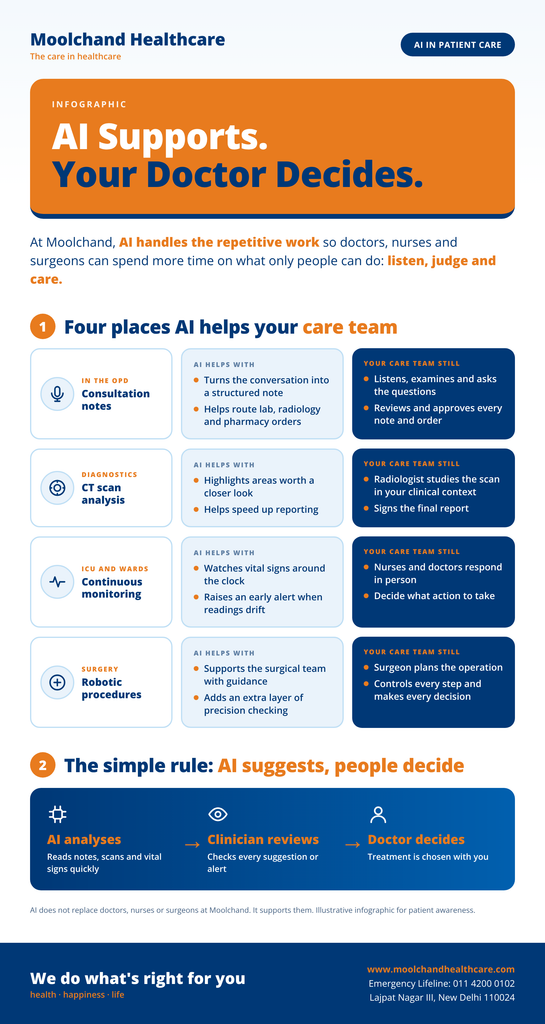
Here is where AI is used at Moolchand, and what your care team still does themselves at each step.
1. In the OPD: more eye contact, less typing
Our AI-powered clinical documentation tool listens to the conversation between you and your doctor. It turns that conversation into a structured note in your electronic medical record. It can also help route lab, radiology and pharmacy orders and prescriptions.
What your doctor still does: asks the questions, examines you, and reviews and approves every note and order. Because the doctor is not typing, they can look at you instead of the screen.
2. In diagnostics: a second set of eyes on your CT scan
AI-assisted CT scan analysis helps highlight areas of a scan that deserve a closer look. It can also help speed up reporting. This is one of the most common uses of AI in hospitals worldwide.
What your radiologist still does: studies the scan, interprets the findings in the context of your history and signs the final report. If you need a scan, you can learn more about our radiology services.
3. In the ICU and wards: AI patient monitoring around the clock
Moolchand has moved from plain biosensors to AI-enabled biosensors. These track vital signs continuously and feed them into the Presense Nexus dashboard. When readings start to drift in a worrying direction, the system raises an early alert. The same approach can extend to ambulances and home monitoring.
What your nurses and doctors still do: respond to the alert, check on you in person and decide what action to take. Our Critical Care department and Cardiology department use these tools to support, not replace, bedside care.
4. In robotic surgery: guidance, not control
AI-assisted guidance supports the surgical team during robotic procedures. Our Institute of Advanced AI-Assisted Robotics brings these technologies together.
What your surgeon still does: plans the operation, controls every step and makes every decision in the operating room.
How an AI-assisted decision works: 5 steps and 3 human checkpoints
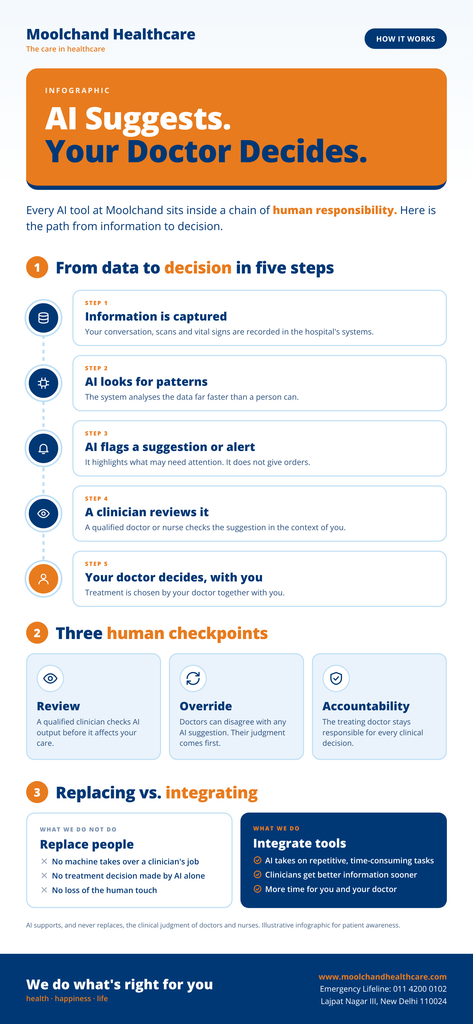
Every AI tool at Moolchand sits inside a chain of human responsibility. AI suggests, and a clinician decides.
Here is the path from information to decision:
- Information is captured. Your conversation, scans and vital signs are recorded in the hospital’s systems.
- AI looks for patterns. The system analyses the data far faster than a person can.
- AI flags a suggestion or alert. It highlights what may need attention. It does not give orders.
- A clinician reviews it. A qualified doctor or nurse checks the suggestion in the context of you as a patient.
- Your doctor decides, with you. Treatment is chosen by your doctor together with you.
Three human checkpoints keep this safe:
- Review: a qualified clinician checks AI output before it affects your care.
- Override: doctors can disagree with any AI suggestion. Their judgment always comes first.
- Accountability: the treating doctor remains responsible for every clinical decision, with or without AI.
A patient journey: how AI and your care team work together
Here is an illustrative example. It is not a real patient.
Imagine a patient in their fifties who visits the OPD with a persistent cough and breathlessness. During the consultation, the AI documentation tool prepares the note while the doctor listens and examines. The doctor orders a CT scan. AI highlights an area for the radiologist to study, and the radiologist signs the report.
If the patient is admitted, AI biosensors track vital signs continuously. When a reading drifts, the nurse receives an alert and checks the patient at the bedside. The doctor reviews all the findings and decides on treatment with the patient and family.
At every step, AI saves time or adds information. At every step, a person makes the decision.
AI vs. your doctor: who does what
| Area | What AI does | What your care team does |
|---|---|---|
| OPD consultation | Drafts the structured note and supports order routing | Listens, examines, approves the note and orders |
| CT scan | Highlights areas worth a closer look | Radiologist interprets and signs the report |
| ICU and wards | Tracks vital signs and raises early alerts | Nurses and doctors assess you and act |
| Robotic surgery | Supports the team with guidance | Surgeon plans and controls the procedure |
| Treatment plan | Provides information | Doctor decides together with you |
Is AI in healthcare safe and regulated in India?
Safe use of AI in healthcare depends on good rules and good habits. Three frameworks matter for patients in India.
WHO principles. WHO’s guidance sets out six principles for AI in health: protect human autonomy; promote human well-being, safety and the public interest; ensure transparency and explainability; foster responsibility and accountability; ensure inclusiveness and equity; and promote AI that is responsive and sustainable. You can read more in the WHO announcement of the first global report on AI in health.
ICMR ethical guidelines. India’s national medical research body has issued Ethical Guidelines for Application of Artificial Intelligence in Biomedical Research and Healthcare (2023). They cover ethical principles, guidance for stakeholders, ethics review, governance and informed consent.
Data protection law. The Digital Personal Data Protection Act, 2023 sets rules on how personal digital data is collected and used, with consent at the centre. Moolchand’s AI tools are designed to work within the hospital’s own secure systems and to follow these rules.
Moolchand is also accredited by JCI and NABH, two quality standards that expect hospitals to manage patient safety and information carefully.
How patients benefit from AI in healthcare
- More time with your doctor. Less typing and paperwork during the consultation means more conversation.
- Earlier warnings. Continuous monitoring can flag changes in your condition sooner, so your care team can act sooner.
- A careful second look. AI support during scans and procedures adds another layer of checking.
- Less repetition. Notes and orders are prepared faster, which can reduce delays.
- The same accountable doctor. You still know exactly who is responsible for your care.
What AI cannot do
Honest information matters, so here are the limits.
AI cannot examine you, understand your fears or weigh what matters to you and your family. It can be wrong, especially when information is incomplete. It can also reflect gaps in the data it was built on, which is why WHO stresses inclusiveness and equity.
That is exactly why the checkpoints exist. A clinician reviews AI output, can override it, and remains accountable. So will AI replace doctors? Not at Moolchand, and not in any setting where patient safety comes first.
Common myths about AI in healthcare
| Myth | Fact |
|---|---|
| “AI will replace my doctor.” | AI supports clinicians. Doctors make and own every decision. |
| “AI makes treatment decisions.” | AI offers information and alerts. Your doctor decides with you. |
| “AI is never wrong.” | Any tool can be wrong, so clinicians review its output and can override it. |
| “AI means less human care.” | AI handles paperwork and monitoring so staff can spend more time with you. |
Questions to ask your care team about AI
You have every right to understand how your care works. You can ask:
- Is any AI tool being used in my consultation, scan, monitoring or procedure?
- What does it do, and what will you decide yourself?
- Who reviews the AI output before it affects my treatment?
- How is my information stored and who can see it?
- What should I do if I have a concern?
If you feel unwell, never delay care because of a tool or a question. For emergencies, call the Moolchand Emergency Lifeline on 011 4200 0102.
Frequently asked questions about AI in healthcare
Will AI replace doctors?
No. At Moolchand, AI supports doctors and nurses with documentation, analysis and monitoring. Your doctor makes the clinical decisions and is accountable for them. AI cannot replace human judgment, empathy or responsibility.
What is AI in healthcare in simple terms?
AI in healthcare means computer systems that find patterns in medical information such as notes, scans and vital signs. They help clinicians work faster and notice things sooner. They do not replace the clinician’s judgment.
How does Moolchand use AI in patient care?
Moolchand uses AI in four main areas: OPD documentation, CT scan analysis, ICU and ward monitoring with AI biosensors, and AI-assisted robotic surgery. In each area, a qualified clinician reviews the output and makes the final decision.
Does AI make treatment decisions at Moolchand?
No. AI provides information, suggestions and alerts. Treatment decisions are made by your doctor together with you. Every AI suggestion is reviewed by a clinician, who can accept, change or override it.
Can AI make mistakes?
Yes, any tool can be wrong. That is why a qualified clinician reviews AI output before it affects your care, and can override it at any time. The human checkpoints are designed to catch errors early.
Is my health data safe when AI is used?
Moolchand’s AI tools are designed to keep patient data within the hospital’s secure systems and to follow India’s Digital Personal Data Protection Act, 2023. If you want to know how your information is handled, ask your care team or the patient services desk.
Is AI in healthcare regulated in India?
India has ethical guidelines from ICMR (2023) for AI in biomedical research and healthcare, and a data protection law, the Digital Personal Data Protection Act, 2023. WHO also publishes global principles that hospitals and developers can follow.
Does the AI listen to my consultation?
In the OPD, the AI documentation tool listens to the conversation between you and your doctor to prepare a structured note. Your doctor reviews the note before it is saved. If you have concerns, you can ask your doctor how it works before you begin.
How do AI biosensors help patients in the ICU or at home?
AI biosensors track vital signs continuously and send them to a live dashboard. If readings drift in a worrying direction, the system raises an early alert. Nurses and doctors then check on the patient and decide what to do.
Can I ask my doctor not to use AI in my care?
You are welcome to discuss any concern with your doctor. Please speak to your care team, and they will explain how AI is used in your care and what options are available to you.
The bottom line
Technology is changing how hospitals work, but healing still depends on people. At Moolchand, AI gives our doctors better tools, and the final call stays with them.
Have a question about how AI is used in your care? Book an appointment with a Moolchand specialist, contact us, or explore more patient guides on the Moolchand health blog. For emergencies, call 011 4200 0102.
Moolchand Kharaiti Ram Hospital, Lajpat Nagar III, New Delhi 110024. Tel: +91 11 4200 0000.
Sources
- World Health Organization, Ethics and governance of artificial intelligence for health: WHO guidance (2021)
- World Health Organization, WHO issues first global report on AI in health and six guiding principles (28 June 2021)
- Indian Council of Medical Research, Ethical guidelines for application of AI in biomedical research and healthcare (2023)
- Daily Pioneer, ICMR releases first ethical guidelines for AI application in biomedical research and healthcare (2023)
- Business Insider India, ICMR comes up with first ethical guidelines for application of AI in biomedical research and healthcare (2023)
- Government of India, The Digital Personal Data Protection Act, 2023