






 We do what's right for you...


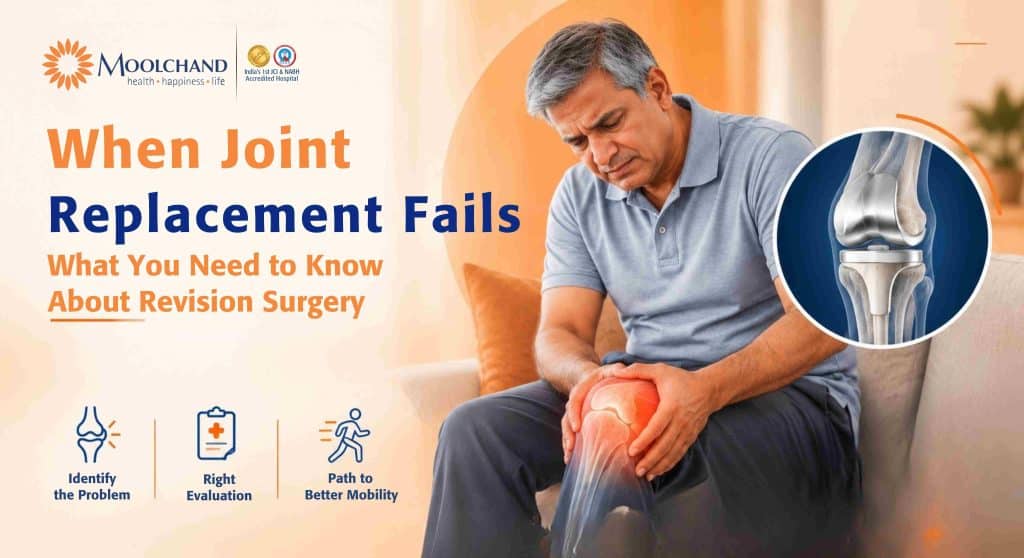
When Joint Replacement Fails – What You Need to Know About Revision Surgery
Revision joint replacement surgery becomes necessary when a primary implant fails due to infection, loosening, wear, or fractureand early diagnosis and treatment significantly reduce surgical complexity and recovery time. At the best orthopaedic hospital in Delhi, experienced joint replacement surgeons use advanced techniques to restore function.
Key Takeaways
- Persistent pain, instability, or discharge after joint replacement warrants immediate evaluation by the best doctor for orthopedic care in Delhi
- Revision surgery is more complex than primary replacement but has outcomes comparable to first-time surgery
- Single-stage revisions allow earlier mobilization; two-stage revisions (for infection) require 3–4 months between stages
- Hospital stay is typically 3–4 days; most patients walk home with support
- Early intervention prevents bone loss and reduces revision complexity by up to 40%
- Top hospitals in Delhi now offer robotic knee replacement surgery for precision-guided revisions
When Does A Joint Replacement Need Revision?
Joint implants are designed to last 15–20+ years, but about 1–2% of primary replacements fail within the first decade. If you’ve had a primary knee or hip replacement and are experiencing complications, seeking care from the best knee replacement surgeon in Delhi ensures accurate diagnosis and optimal outcomes.
Common reasons for revision include:
| Failure Type | Typical Timeline | Cause | Treatment |
| Aseptic Loosening | 5–15 years | Implant gradually separates from bone | Single-stage revision |
| Infection (Prosthetic Joint Infection) | Months to years | Bacterial colonization post-op or hematogenous spread | Two-stage revision (3–4 months apart) |
| Wear | 10–20+ years | Normal material degradation | Single-stage revision |
| Fracture | Variable | Trauma or stress fracture around implant | Single-stage or two-stage, depending on severity |
| Instability | Months to years | Ligament damage or component malpositioning | Single-stage revision |
At Moolchand Healthcare — the best hospital in Delhi for orthopedics — our revision specialists diagnose and treat all failure modes with equal expertise.
WARNING SIGNS: When to Seek Immediate Evaluation
Do not dismiss these symptoms as “normal” post-surgical discomfort:
✓ Persistent or worsening pain beyond 4–6 weeks post-op
✓ Feeling of instability or “giving way” in the joint
✓ Difficulty walking or bearing weight
✓ Redness, warmth, or discharge from the surgical site
✓ Fever or chills (possible infection)
✓ Swelling that doesn’t improve with rest and elevation
When to call the best orthopedic surgeon in Delhi: Contact within 24–48 hours of symptom onset. Early diagnosis prevents bone loss, which accelerates implant failure. At Moolchand Hospital Delhi, we prioritize urgent joint assessments.
The Diagnostic Process
Your orthopedic specialist will conduct a systematic evaluation. The best doctors for orthopedic care in Delhi follow evidence-based protocols:
Clinical Assessment
- Review of symptom timeline and activity level
- Physical examination for joint stability, range of motion, and signs of infection
Imaging & Blood Work
- X-rays: Standard first-line imaging to assess implant position and bone loss
- MRI or CT scan: Detailed view of soft tissue, bone, and implant interface
- Blood markers (if infection suspected): ESR (Erythrocyte Sedimentation Rate) and CRP (C-Reactive Protein)
- Normal ESR: <20 mm/hr
- Normal CRP: <10 mg/L
- Elevated levels suggest prosthetic joint infection (PJI)
- Joint aspiration: Fluid sample from the joint; cultured to identify infection
Specialized Imaging
- Bone scan or PET-CT: Used to differentiate infection from mechanical loosening
- Essential when diagnosis is unclear after initial imaging
- Available at top hospitals in Delhi with advanced diagnostic capabilities
The Two Paths: Single-Stage vs. Two-Stage Revision
Single-Stage Revision (Non-Infected Implants)
Used for: Aseptic loosening, wear, instability, fracture
What happens:
- Previous implant and cement (if present) are removed
- Bone defects are filled using bone grafts or specialized augments
- New revision implant is inserted in a single surgery
- Many best knee replacement surgeons in Delhi now offer robotic guidance for precision alignment
Recovery timeline:
- Hospital stay: 3–4 days
- Early mobilization: Begin walking with support within 24–48 hours
- Weight-bearing: Gradual progression over 4–6 weeks
- Return to desk work: 4–6 weeks
- Full recovery: 3–6 months
Two-Stage Revision (Infected Implants)
Used for: Prosthetic joint infection (PJI)
Stage 1 (Removal & Treatment):
- Implant is removed
- Joint is thoroughly cleaned; membranes and infected tissue are debrided
- Antibiotic spacer (cement or metal articulating spacer) may be inserted
- IV antibiotics started: Typically 3 weeks of intravenous therapy
- Hospital stay: 3–4 days
- At the best orthopedic hospital in Delhi, infection management protocols exceed standard care
Between stages (3–4 months):
- Continued IV or oral antibiotics based on culture results
- Infection must be cleared before re-implantation (confirmed by repeat joint aspiration and negative cultures)
- Limited weight-bearing; focus on gentle range-of-motion exercises
Stage 2 (Re-implantation):
- New implant inserted (often with robotic knee replacement surgery precision if available)
- Hospital stay: 2–3 days
- Recovery mirrors single-stage revision
Total timeline: 4–6 months from diagnosis to full mobilization
Post-Operative Recovery: What to Expect
Week 1–2: Early Mobilization
- Walking with walker or crutches begins within 24 hours
- Pain managed with prescribed analgesics
- Wound care: Keep site clean and dry; watch for signs of infection
- DVT (blood clot) prevention: Compression stockings and leg exercises
- At Moolchand — the best hospital in Delhi — dedicated nursing staff ensure optimal wound care
Week 3–4: Building Confidence
- Gradual increase in walking distance
- Basic physiotherapy exercises: Quad sets, hamstring stretches, ankle pumps
- Range of motion exercises: Passive to active-assisted progression
- Pain typically decreases; swelling begins to resolve
Week 5–12: Strengthening Phase
- Advance to crutches or single walking aid
- Physiotherapy intensifies: Strengthening, balance, gait training
- Return to desk-based work possible at 4–6 weeks
- Avoid high-impact activities (running, jumping)
- The best doctors for orthopedic care in Delhi monitor progress closely during this phase
3–6 Months: Return to Function
- Most daily activities resume without pain
- Low-impact exercise (swimming, cycling, walking) encouraged
- Full return to work and light recreational activities
- Joint feels stable and pain-free during routine tasks
6–12 Months: Long-Term Stability
- Implant integration complete
- Muscle strength fully restored
- Scar tissue matures and softens
- Outcomes comparable to primary replacement
REVISION IMPLANTS: WHAT’S DIFFERENT?
Modern revision implants are engineered for compromised bone. Top hospitals in Delhi stock a full range of specialized implants:
✓ Longer stems or sleeves to bypass bone loss
✓ Modular components for customized fit
✓ Enhanced surfaces (porous coating, hydroxyapatite) for better fixation
✓ Augments and bone grafts to restore bone stock
✓ Robotic knee replacement surgery systems for intra-operative precision alignment (available at best orthopedic hospital in Delhi)
With current technology and surgical expertise from the best knee replacement surgeon in Delhi, revision implant survival rates are now 90–95% at 10 years—comparable to primary replacements.
PREVENTING INFECTION AFTER REVISION (CRITICAL)
Prosthetic joint infections are rare (~1–2% of revisions) but serious. Protect your implant:
Before Any Dental Work or Invasive Procedure:
- Inform your dentist and physician that you have a joint implant
- Prophylactic antibiotics may be recommended within 2 hours of dental work
- Follow ACPA (American Academy of Orthopaedic Surgeons) guidelines
- Patients at Moolchand — the best hospital in Delhi — receive detailed post-operative precaution instructions
Daily Prevention:
- Maintain good oral hygiene (infection can spread hematogenously)
- Treat skin infections promptly
- Avoid high-impact activities that could cause implant loosening
Actionable Checklist: When to See a Doctor
Contact the best orthopedic surgeon in Delhi immediately if you experience:
□ Pain that worsens despite rest and medication
□ Sudden severe pain with no clear cause
□ Fever (≥101°F or 38.3°C) with joint pain or swelling
□ Redness, warmth, or drainage from the surgical site
□ Swelling that spreads beyond the joint
□ Sudden difficulty bearing weight or loss of stability
□ Calf pain, warmth, or swelling (possible blood clot)
Schedule a follow-up appointment if:
□ You have questions about activity restrictions
□ Swelling persists beyond 8–12 weeks
□ Pain plateaus and doesn’t improve with physiotherapy
Moolchand Healthcare operates multiple facilities across Delhi hospitals to serve you conveniently.
FAQs about
Q: How long do revision implants last?
A: Modern revision implants typically last 15–20 years or longer, depending on activity level and patient age. The best knee replacement surgeon in Delhi will discuss longevity expectations based on your specific case.
Q: Can I have more than one revision?
A: Yes. Multiple revisions are possible, though each successive revision becomes more complex due to progressive bone loss. Outcomes remain good with proper surgical technique from experienced specialists at the best hospital in Delhi for orthopedics.
Q: What activities can I do after revision surgery?
A: Low-impact activities (walking, swimming, cycling, golf) are encouraged. Avoid running, jumping, contact sports, and high-impact exercises. Ask the best doctor for orthopedic care in Delhi about specific activities.
Q: Will I need antibiotics before dental work after revision?
A: Possibly. The American Academy of Orthopaedic Surgeons recommends prophylactic antibiotics for dental procedures within 2 years of joint surgery and for patients with compromised immune systems. Ask the best orthopedic surgeon in Delhi at your follow-up.
Q: How successful is revision surgery at top Delhi hospitals?
A: With modern techniques at top hospitals in Delhi, 90–95% of revision implants survive 10+ years. Success depends on cause of failure, surgical expertise, and patient compliance with rehabilitation.
Q: Can infection be completely cleared without revision?
A: No. Prosthetic joint infections cannot be treated with antibiotics alone once biofilm forms on the implant. Two-stage revision is the gold standard, with >90% cure rates when performed correctly at the best orthopedic hospital in Delhi.
Q: Is robotic knee replacement surgery better for revisions?
A: Robotic knee replacement surgery offers precision-guided alignment, which can improve outcomes in complex revisions. Best knee replacement surgeons in Delhi now offer this technology to select patients. Ask if it’s appropriate for your case.
WHY EARLY DIAGNOSIS CHANGES EVERYTHING
Delay in diagnosis and treatment accelerates bone loss. A patient who seeks care within 3 months of symptom onset—preferably from the best doctor for orthopedic care in Delhi—typically requires simpler surgery, shorter operative time, and faster recovery compared to someone who waits 12+ months.
At Moolchand Healthcare — recognized as the best hospital in Delhi for orthopedics — our joint replacement specialists use advanced imaging, intraoperative navigation, and specialized revision implants to restore function and extend implant longevity.
Moolchand Healthcare: Best Orthopedic Hospital in Delhi
✓ Dual JCI & NABH accreditation — highest quality standards
✓ Revision specialists with 20+ years’ experience — complex cases welcome
✓ Advanced diagnostic imaging (MRI, CT, PET-CT) on-site
✓ Robotic knee replacement surgery technology for precision guidance
✓ Dedicated post-operative physiotherapy to accelerate recovery
✓ Infection management protocols exceeding global standards
✓ Convenient Delhi hospital locations in Lajpat Nagar and across the city
You can easily book your appointment online, through the Moolchand MyHealth App, by calling 011 4200 0000

