






 We do what's right for you...


What Is the Spirometry Test Procedure and Why It Matters


Conventional advice says breathing tests are simple. They are not. Precision in the Spirometry Test Procedure is what separates guesswork from reliable diagnosis. I will explain the workflow, the parameters, and how to prepare for a smooth appointment. It is basically a practical guide for anyone who wants clarity, not confusion.
Step-by-Step Spirometry Test Procedure
1. Pre-Test Preparation Requirements
I start by confirming eligibility and preparation. The Spirometry Test Procedure depends on stable conditions and consistent technique. Patients should avoid heavy meals for two to three hours. Caffeine and vigorous exercise can distort results. Loose clothing is ideal, as chest expansion matters. If a respiratory infection is present, I reschedule unless testing is clinically urgent.
-
Avoid smoking for at least 1 hour, preferably longer.
-
Skip intense exercise on the day of testing.
-
Arrive early to rest and settle breathing.
-
Bring a complete medication list, including inhalers.
Hydration helps, but I discourage excessive water right beforehand. Small details reduce variability and improve repeatability. This is how I safeguard the integrity of a lung function test.
2. Patient Positioning and Equipment Setup
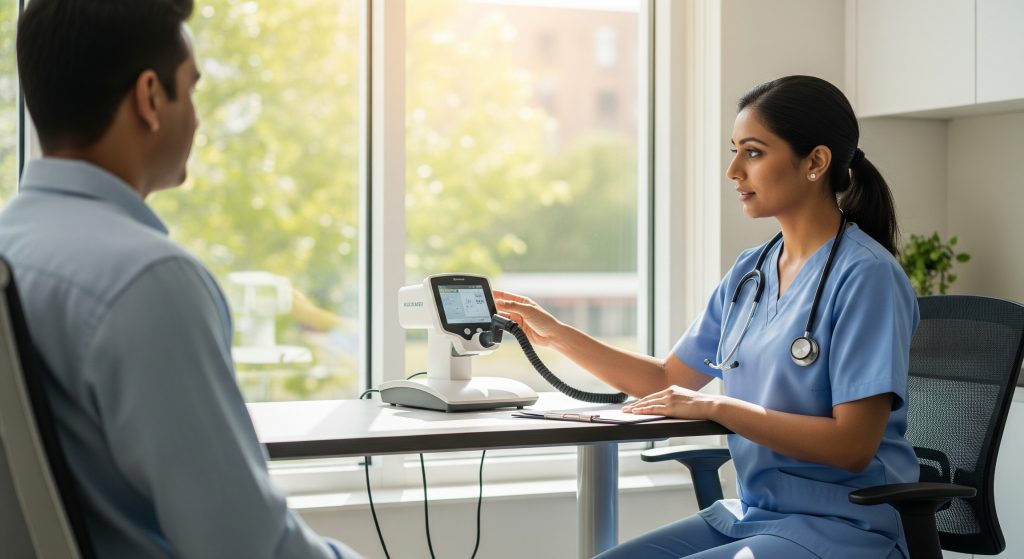
Positioning is straightforward, though it must be consistent. I seat the patient upright with feet flat and back supported. The Spirometry Test Procedure uses a calibrated spirometer with a clean, disposable mouthpiece and a bacterial-viral filter. A nose clip prevents air escaping through the nose. I demonstrate the posture and the mouth seal before any recording.
-
Neutral head position to avoid airway kinking.
-
Tight lip seal around the mouthpiece from start to finish.
-
Hands resting on thighs or armrests to avoid chest compression.
Calibration checks are performed per manufacturer guidance. Small leaks ruin curves and waste time. Firm setup prevents that.
3. Breathing Manoeuvres During Testing
Clear instructions make or break the Spirometry Test Procedure. I coach with concise cues. First, take a steady full breath in to total lung capacity. Seal the lips. Blast the air out as fast and hard as possible. Keep exhaling until completely empty, then inhale quickly if the device requests it. That blast must begin immediately. No hesitation.
I monitor for cough, early termination, and poor effort. If a trace shows a slow start or an abrupt stop, I repeat the attempt after rest. Short rests protect the patient from hyperventilation and dizziness.
4. Forced Vital Capacity Test Steps
The forced vital capacity component is the core of the Spirometry Test Procedure. It measures the total exhaled volume and how fast it leaves in the first second. Here is the sequence I use:
-
Inhale fully to total lung capacity.
-
Seal lips, keep the tongue low, and chin slightly elevated.
-
Exhale explosively to residual volume, with no pause at the start.
-
Continue until the flow plateaus and the device signals end.
-
Optionally inhale rapidly for flow-volume loop completion.
Three acceptable manoeuvres are required, with two within close agreement. The device typically flags acceptability. I still review traces visually. Algorithms can miss nuance.
5. Slow Vital Capacity Test Steps
Slow vital capacity is useful when forced efforts provoke airway collapse. It remains part of a thorough Spirometry Test Procedure. The steps are simple. Breathe in to full, then exhale steadily without force until empty. No blasting, just continuous flow. It reveals volumes less confounded by dynamic compression. I use it when FVC seems artificially low or when patients struggle with explosive exhalation.
6. Post-Bronchodilator Testing Process
Reversibility testing checks airway response to a short-acting bronchodilator. It sits within the Spirometry Test Procedure when asthma is suspected or when variability is likely. I record baseline spirometry first. Then the patient inhales the prescribed bronchodilator dose using correct technique. A rest period follows to allow effect. I repeat the spirometry with identical coaching and positioning. Any improvement is measured against baseline using the same device and criteria. Consistency is non-negotiable here.
7. Test Duration and Repetitions
A full Spirometry Test Procedure usually takes 20 to 40 minutes. It depends on technique, rest periods, and whether bronchodilator steps are required. I aim for at least three acceptable efforts, with two reproducible results. More attempts only if the patient is comfortable. Quality beats speed. Fatigued patients deliver poorer curves and misleading numbers.
Types of Spirometry Tests and Lung Function Test Parameters
Basic Spirometry vs Complete Pulmonary Function Testing
Basic spirometry focuses on volumes and flows during forced and slow breathing. It is the backbone of the Spirometry Test Procedure in most clinics. Complete pulmonary function testing expands the picture. It adds lung volumes by body plethysmography or gas dilution, and diffusing capacity for carbon monoxide. That extended panel clarifies restrictive disorders and gas exchange problems that spirometry alone can miss.
In practice, I start with spirometry and escalate when the clinical question remains open. A targeted lung function test strategy reduces unnecessary investigations.
Key Parameters Measured in Spirometry
|
Parameter |
What it indicates |
|---|---|
|
FVC |
Total exhaled volume after a full inspiration. |
|
FEV1 |
Volume exhaled in the first second of forced exhalation. |
|
FEV1/FVC |
Ratio indicating airflow limitation when reduced. |
|
PEF |
Peak flow achieved during forced exhalation. |
|
FEF25-75 |
Mid-expiratory flow, sometimes reflecting small airway function. |
I interpret these in context. The Spirometry Test Procedure produces curves and numbers that require pattern recognition, not just thresholds.
FEV1/FVC Ratio Significance
The FEV1/FVC ratio is central. A reduced ratio suggests obstructive physiology. Normal or high ratios with low volumes suggest restriction. I compare with predicted values adjusted for age, height, sex, and ethnicity. The Spirometry Test Procedure must achieve full inhalation before exhalation to avoid false low ratios. Start hesitation and submaximal inspiration are common pitfalls.
Peak Expiratory Flow Rate Testing
PEF testing can be done with the spirometer or a handheld peak flow meter. It is quick and responsive to airway calibre. Still, it is effort dependent and variable. I treat it as supportive rather than definitive evidence. During the Spirometry Test Procedure, PEF helps validate technique. A very low PEF with normal curves hints at poor effort or a learning effect.
Reversibility Testing with Bronchodilators
Reversibility suggests airway hyperreactivity. Clinically, it supports asthma when appropriate. The Spirometry Test Procedure quantifies change in FEV1 or FVC after bronchodilator. I look for a meaningful rise paired with symptom history and examination. A negative test does not exclude asthma. Disease fluctuates and timing matters.
Understanding Spirometry Test Normal Values and Results
Age-Specific Normal Value Ranges
Predicted values shift with age. Younger adults often show higher flows and volumes. With ageing, elasticity declines and chest wall mechanics change. I therefore anchor interpretation to age-adjusted predictions. The Spirometry Test Procedure is the same, but the expectations differ. A perfectly normal effort at 70 years looks different to an elite 25-year-old. That does not diminish its validity. It just reflects physiology.
Height and Gender Impact on Results
Taller individuals generally have higher lung volumes. Sex also influences predictions through anatomical differences. I apply reference equations that incorporate both. Accurate height measurement is essential. Footwear off, posture upright. The Spirometry Test Procedure relies on these baseline details to produce fair comparisons and defensible conclusions.
Obstructive vs Restrictive Pattern Recognition
I classify patterns by looking at the ratio, volumes, and curve morphology. Obstruction shows a reduced FEV1/FVC and concave flow-volume loops. Restriction shows reduced FVC with a preserved or high ratio. Mixed patterns coexist. The Spirometry Test Procedure offers the first pass. If restriction is suspected, I often recommend formal lung volumes to confirm low total lung capacity. That avoids mislabelling air trapping as restriction.
Severity Classification of Abnormal Results
Severity is usually graded using percent predicted for FEV1. Categories range from mild to very severe. I pair this with symptom burden and exacerbation history. Numbers do not live in isolation. The Spirometry Test Procedure generates objective data that must align with clinical trajectories. A measured approach prevents overdiagnosis and under-treatment.
Common Conditions Diagnosed Through Spirometry
-
Asthma with variable airflow limitation and possible reversibility.
-
Chronic obstructive pulmonary disease with persistent airflow limitation.
-
Bronchiectasis with obstructive features and frequent infections.
-
Restrictive syndromes that require confirmation of total lung capacity.
-
Pre-operative assessment and fitness evaluations (when clinically indicated).
In each scenario, I use the Spirometry Test Procedure as a structured filter. It clarifies probability and guides next steps. Diagnosis is a process, not a single printout.
Finding Spirometry Test Near Me and Preparation Guidelines
Types of Healthcare Facilities Offering Spirometry
Most tertiary hospitals, respiratory clinics, and many community practices offer spirometry. Occupational health units use it for surveillance in dust or fume exposure. If searching for a spirometry test near me, I advise checking that trained technicians and calibrated equipment are available. Accreditation or documented quality control is a practical marker of reliability.
-
Hospital pulmonary function laboratories.
-
Specialist respiratory clinics and asthma centres.
-
Occupational health providers for workplace screening.
-
Primary care units with spirometry-trained nurses or physiologists.
The Spirometry Test Procedure does not require an operating theatre. It does demand disciplined technique and consistent coaching.
Cost of Spirometry Tests in India
Costs vary by city, facility, and whether bronchodilator testing is included. Roughly speaking, fees range from modest primary care rates to higher tertiary hospital charges. Transparent pricing is preferable. I encourage patients to confirm what the fee includes. A complete Spirometry Test Procedure with pre and post bronchodilator steps typically costs more than a single baseline run. Value lies in quality and proper interpretation.
Pre-Test Instructions and Restrictions
Preparation mirrors the earlier checklist. Light meals only, comfortable clothing, and no strenuous exercise on the day. If possible, avoid caffeinated drinks for several hours. Arrive early to relax and normalise breathing. The Spirometry Test Procedure rewards calm, focused effort. Fast arrivals produce rushed instructions and inconsistent curves.
-
No smoking for at least 1 hour pre-test.
-
No heavy meals within 2 to 3 hours.
-
Bring spectacles if needed for reading consent and instructions.
I prefer to review any recent respiratory symptoms. Mild colds can still affect airway reactivity. Timing matters, and so does comfort.
Medications to Avoid Before Testing
Do not stop prescribed medication without advice. That point stands. For diagnostic clarity, some services advise withholding short-acting bronchodilators for several hours, and long-acting agents for longer intervals. Plans differ by clinic, indication, and safety assessment. I document any medication timing in the report. The Spirometry Test Procedure is then interpreted in that pharmacological context.
For monitoring control rather than diagnosing, continuing regular therapy may be appropriate. The purpose dictates the protocol. And yet, patient safety always supersedes protocol purity.
When to Schedule Your Spirometry Test
Schedule when respiratory symptoms are stable and infections have resolved. Early morning or mid-morning slots work well for most. Fatigue can blunt effort late in the day. If the appointment includes a bronchodilator step, allow extra time. The Spirometry Test Procedure benefits from unhurried pacing. Better a single high-quality session than two low-quality attempts.
Making Sense of Your Spirometry Test Journey
Spirometry is technical, but it is not opaque. I think in workflows and checks. I prepare the patient, set the equipment, and coach the manoeuvres. I then validate curves, examine numbers, and align them with the clinical picture. That disciplined loop is the Spirometry Test Procedure in action. It converts effort into insight.
Two closing thoughts. First, technique is teachable. Many first attempts improve sharply with precise coaching and a brief rest. Second, interpretation gains power when paired with history and examination. Numbers guide. They do not dictate. If you seek a lung function test for diagnosis or monitoring, choose a service that values both quality control and clear reporting.
For searchers typing spirometry test near me, confirm training, calibration, and reporting standards before booking. For those wondering about spirometry test normal values, ensure that reference equations appropriate for age, height, sex, and ethnicity are used. Get the method right and the meaning follows.
Frequently Asked Questions
How painful is a spirometry test?
Spirometry is not painful. It is effortful. The forced exhalation can feel strenuous and may provoke brief cough. Dizziness can occur if over-breathing happens. I mitigate this with clear cues and short rests. The Spirometry Test Procedure prioritises safety and patient comfort at every stage.
Can children undergo spirometry testing safely?
Yes, with age-appropriate coaching and equipment. Many children from about six years can perform reliable manoeuvres. I use visual cues and short, clear instructions. The Spirometry Test Procedure remains the same in principle, but pacing and encouragement are tailored. Patience improves validity dramatically.
How often should spirometry tests be repeated?
Frequency depends on diagnosis, treatment changes, and occupational requirements. For stable chronic disease, annual testing may suffice. During treatment initiation or flare assessment, I may repeat sooner. The Spirometry Test Procedure should not be repeated so frequently that fatigue or learning effects distort trends. Balanced intervals produce meaningful comparisons.
What happens if I cannot complete the breathing manoeuvres?
If repeated attempts remain unacceptable, I pause the session. I may reschedule when the patient is rested or symptom-free. Alternative assessments can be considered if needed. The Spirometry Test Procedure relies on maximal effort and correct technique. For some, a slow vital capacity measurement proves more achievable on the day.
Is spirometry testing safe during pregnancy?
Spirometry is generally considered safe in pregnancy. It is non-invasive and brief. I still assess comfort, posture, and avoid prolonged breath-holding. The Spirometry Test Procedure is adjusted for rest and hydration as needed. Clinical necessity guides timing and frequency.
How accurate are portable spirometry devices compared to hospital equipment?
Many portable devices are accurate when calibrated and used correctly. Variability increases outside controlled settings. I prefer laboratory-grade equipment for diagnosis and trend baselining. Portable devices can support monitoring once a robust baseline exists. Whatever the device, the Spirometry Test Procedure and technique discipline remain decisive for accuracy.

