






 We do what's right for you...


What Is CRRT Full Form in Medical? Definition and Key Facts
Dr. Deepak Jain
CRRT is often described as slower dialysis. That framing misses what matters in the ICU. I prefer to define its role by outcomes and physiology. It is a gentle, continuous therapy designed to stabilise fluid, electrolyte, and acid-base balance when intermittent dialysis would be too abrupt. If someone has searched for crrt full form in medical contexts, clarity beats jargon. Here is a precise, practice-grounded overview.
What Is CRRT and Its Primary Uses in Critical Care
Definition of Continuous Renal Replacement Therapy
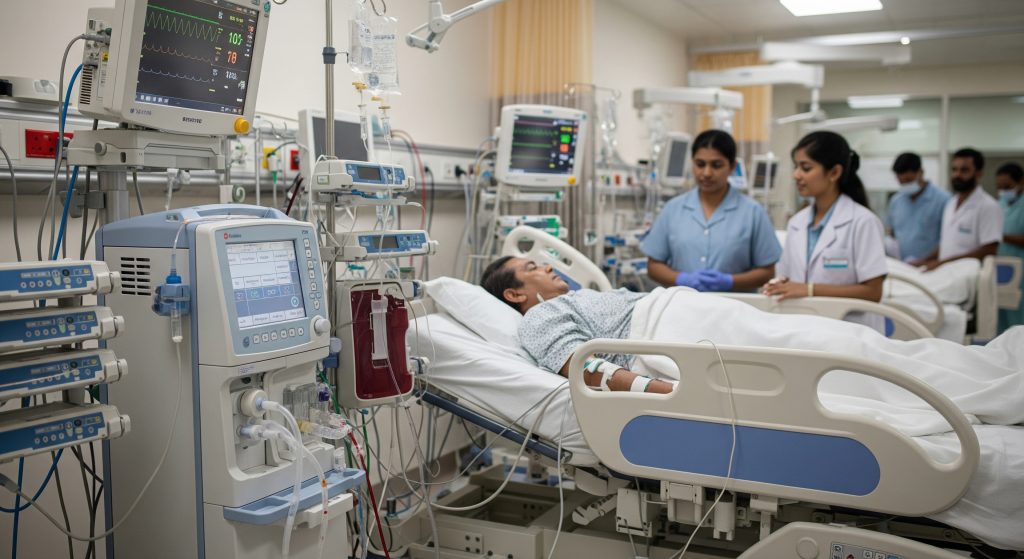
Continuous Renal Replacement Therapy is a 24-hour kidney support technique used in the intensive care unit. It removes solutes and fluid slowly and continuously using convection, diffusion, or both. I use it when haemodynamic stability is fragile and metabolic control must be steady rather than episodic.
CRRT provides continuous solute clearance and precise fluid management for critically ill patients with acute kidney injury or severe fluid overload.
For readers asking for the crrt full form in medical references, it is Continuous Renal Replacement Therapy. The name itself signals the core idea: continuous support rather than episodic sessions.
How CRRT Differs from Regular Dialysis
|
Aspect |
CRRT vs Intermittent Haemodialysis |
|---|---|
|
Duration |
CRRT runs continuously. Intermittent dialysis runs for 3-5 hours per session. |
|
Haemodynamics |
CRRT is gentler with lower ultrafiltration rates. Intermittent dialysis can cause blood pressure swings. |
|
Clearance |
CRRT delivers steady small and middle molecule control. Intermittent focuses on rapid small solute removal. |
|
ICU Integration |
CRRT integrates with vasopressors, ventilators, and nutrition. Intermittent sessions require scheduling and transport. |
|
Targets |
CRRT prioritises fluid neutrality and acid-base balance. Intermittent prioritises rapid toxin clearance. |
Put simply, the crrt full form in medical usage reflects a modality designed for stability when ordinary dialysis would be too abrupt for a sick heart.
Primary Indications for CRRT Treatment
-
Acute kidney injury with haemodynamic instability or vasopressor dependence.
-
Refractory fluid overload, including severe pulmonary oedema not responding to diuretics.
-
Severe metabolic acidosis or electrolyte derangements requiring tight, continuous control.
-
Sepsis and multi-organ dysfunction where precise fluid balance supports recovery.
-
Neurological indications where stable osmolar control is preferred.
Clinicians also use CRRT to fine-tune nutrition and drug dosing. That nuance matters for antibiotics with narrow therapeutic windows.
Types of CRRT Modalities Available
-
CVVH (haemofiltration): convection-based clearance with ultrafiltration plus replacement fluid.
-
CVVHD (haemodialysis): diffusion-based clearance with dialysate flow across a semi-permeable membrane.
-
CVVHDF (haemodiafiltration): combined convection and diffusion for broader solute control.
-
SCUF (slow continuous ultrafiltration): fluid removal focus with minimal solute clearance.
In practice, I select the modality by clinical target: volume, urea, or both. The crrt full form in medical shorthand covers all four modalities, not a single technique.
CRRT Availability and Cost in India
List of Major Hospitals Offering CRRT in India
CRRT capability concentrates in tertiary and quaternary centres with 24×7 ICUs, perfusion support, and trained dialysis teams. Availability is strongest in metropolitan hubs and large teaching hospitals.
-
Large academic institutes and national centres in Delhi, Mumbai, Bengaluru, Chennai, and Kolkata.
-
Corporate hospital networks with multi-speciality ICUs in tier-1 and select tier-2 cities.
-
Empanelled cardiac, transplant, and neuro-ICUs where fluid precision is mission critical.
For readers evaluating crrt in india, call the ICU or nephrology desk and confirm machine availability, nursing ratios, and 24-hour cover.
Current Cost Structure for CRRT Treatment
Costs accrue per day rather than per session. I advise breaking them down transparently for families.
-
ICU bed charges and clinical care fees.
-
CRRT machine use and disposables, including filter set and lines.
-
Dialysate and replacement fluids by prescribed flow rates.
-
Anticoagulation (heparin or regional citrate) and monitoring.
-
Laboratory monitoring, imaging if required, and pharmacy items.
Actual totals vary with dose, downtime, and filter change frequency. Longer runs and higher effluent rates increase expense.
Factors Affecting CRRT Pricing
-
Prescribed dose and effluent rate, which drive fluid consumption.
-
Anticoagulation strategy and filter lifespan.
-
Hospital tier, city, and ICU staffing model.
-
Need for isolation, advanced monitoring, or organ support bundles.
-
Duration in days and interruptions for procedures.
A brief example helps. A vasopressor-dependent patient on CVVHDF at higher doses uses more dialysate and more filters. That single choice shapes total cost.
Insurance Coverage and Government Schemes
Most comprehensive health insurance policies cover CRRT when medically indicated during ICU admission. Pre-authorisation, medical necessity notes, and daily documentation remain essential. Government schemes such as Ayushman Bharat – Pradhan Mantri Jan Arogya Yojana offer package-based coverage in empanelled hospitals, subject to eligibility and caps.
-
Confirm package codes that include dialysis or CRRT in critical care.
-
Request daily utilisation updates to avoid unexpected exclusions.
-
Check whether disposables and citrate are within the package or billed separately.
The prudent approach is simple. Obtain a written estimate and align it with the policy wording before initiation.
Key Takeaways About CRRT in Medical Settings
-
CRRT supports unstable ICU patients by delivering slow, continuous clearance and precise fluid control.
-
Modality choice (CVVH, CVVHD, CVVHDF, SCUF) should match the physiological target.
-
Cost reflects dose, duration, consumables, and ICU complexity rather than a single line item.
-
For clarity on the crrt full form in medical usage, remember it spans several modalities and a 24-hour care model.
-
Availability is strongest in staffed tertiary centres with round-the-clock nephrology support.
Frequently Asked Questions
How long does CRRT treatment typically last?
CRRT often runs continuously for several days, adjusted to clinical goals and stability. Therapy pauses for procedures or filter changes, then resumes as indicated.
Which cities in India have the best CRRT facilities?
Major centres in Delhi, Mumbai, Bengaluru, Chennai, and Kolkata typically offer the widest expertise and capacity. For crrt in india outside metros, large teaching hospitals and select corporate networks provide access.
Can CRRT be used for children with kidney failure?
Yes, paediatric CRRT is feasible in centres with suitable machines, paediatric circuits, and trained teams. Unit experience and nursing ratios are critical determinants of safety.
What are the success rates of CRRT therapy?
Outcomes depend on underlying illness severity, not the device alone. Early initiation, careful anticoagulation, and dose matching to targets improve the chance of stabilisation.
Is CRRT better than conventional dialysis for all patients?
No. Intermittent dialysis is appropriate for stable patients who tolerate faster fluid shifts. CRRT is preferable when haemodynamic stability and tight control are priorities.

