






 We do what's right for you...


What Is Colloid Goitre? A Simplified Medical Overview
Dr. Rajesh Kumar Meena
Conventional advice says every thyroid swelling is high risk and must be removed. That view wastes resources and alarms patients. I focus on what actually matters: pattern recognition, risk triage, and precise testing. Colloid goitre sits at the benign end of thyroid enlargement. It is common, often quiet, and very manageable. I will outline how to identify it, how it behaves, and how to manage it without unnecessary intervention.
Types and Characteristics of Colloid Goitre
Simple Colloid Goitre
I use this term for a non-toxic, diffuse thyroid enlargement with normal hormone output. It usually reflects inefficient hormone synthesis with compensatory follicular expansion. The gland feels smooth, rubbery, and moves with swallowing. Patients may be asymptomatic for years. A mild sense of throat fullness can appear later. In practice, simple dietary shifts and observation are often sufficient, provided testing confirms euthyroidism.
-
Typical status: clinically euthyroid.
-
Texture: smooth and mobile on swallowing.
-
Course: slow growth, often plateauing.
Endemic Colloid Goitre
I encounter this pattern in regions with low iodine intake. The thyroid enlarges uniformly as the pituitary increases TSH to drive hormone production. The change is adaptive, not malignant. Public health measures that ensure adequate iodine usually reduce prevalence over time. For individual patients, the management mirrors the simple form, with nutritional correction and periodic review.
-
Driver: chronic iodine scarcity in a community.
-
Pattern: diffuse, non-toxic enlargement.
-
System fix: sustained iodine sufficiency policies.
Sporadic Colloid Goitre
This label applies when a single patient develops a similar enlargement outside an iodine-deficient area. Causes include relative iodine insufficiency, goitrogen exposure, or genetic variation in thyroid hormone synthesis. It behaves benignly in most cases. My approach is conservative unless symptoms progress, labs drift, or imaging shows atypical features.
-
Context: normal-iodine region, individual susceptibility.
-
Risk: low malignancy probability if imaging is bland.
-
Action: monitor size, voice, swallowing, and thyroid function.
Multinodular Colloid Goitre
Long-standing growth can remodel a diffuse gland into nodules. The result is a multinodular colloid goitre with mixed cystic and solid areas. Function remains normal in many, though autonomous nodules may develop later. Large nodules can distort the neck contour or cause pressure effects. Here, ultrasound detail and, if needed, fine needle aspiration guide care.
-
Imaging: heterogeneous gland with multiple nodules.
-
Complications: mass effect, occasional functional autonomy.
-
Management: targeted investigation of dominant or suspicious nodules.
Key Differences from Other Thyroid Enlargements
Several thyroid conditions can mimic this presentation. A rapid, hard enlargement is atypical and deserves urgent review. Pain and tenderness suggest thyroiditis rather than a classic colloid process. Hyperthyroid symptoms point toward Graves disease or a toxic nodule. I summarise common differentiators below.
|
Condition |
Typical distinguishing features |
|---|---|
|
Colloid goitre |
Slow growth, smooth or multinodular, euthyroid, compressive symptoms only if large. |
|
Graves disease |
Diffuse goitre, eye signs, hyperthyroid symptoms, raised antibodies. |
|
Thyroiditis |
Painful gland, transient hyper then hypo patterns, high inflammatory markers. |
|
Thyroid cancer |
Hard nodule, fixation, vocal cord palsy, suspicious nodes. |
Pattern recognition narrows the field quickly. Then tests confirm the direction of travel.
Recognising Colloid Goitre Symptoms and Clinical Presentation
Early Stage Symptoms
Many patients notice nothing at first. The earliest clue is often a subtle neck fullness. Collars feel tighter. There may be mild swallowing awareness with dry foods. I ask about energy, weight change, and heat or cold intolerance to screen thyroid function, which is usually normal.
-
Neck awareness without pain.
-
No voice change or breathing issues.
-
Stable weight and pulse in most cases.
Progressive Symptoms with Gland Enlargement
As the gland enlarges, visibility increases. The mirror test often reveals a midline bulge that moves with swallowing. Patients describe intermittent discomfort rather than pain. Exercise tolerance remains normal unless tracheal narrowing develops. The pace is slow, measured in months to years.
-
Cosmetic concern from visible swelling.
-
Intermittent dysphagia to solids.
-
Occasional cough from tracheal irritation.
Compressive Symptoms in Advanced Cases
Large multinodular glands can cause mechanical effects. Red flags include dyspnoea on lying flat, stridor, or a new husky voice. These signs warrant urgent imaging. I consider airway and nerve integrity first, then discuss size reduction options.
-
Positional breathlessness or orthopnoea.
-
Progressive dysphagia, especially to solids.
-
New hoarseness or weak voice.
Physical Examination Findings
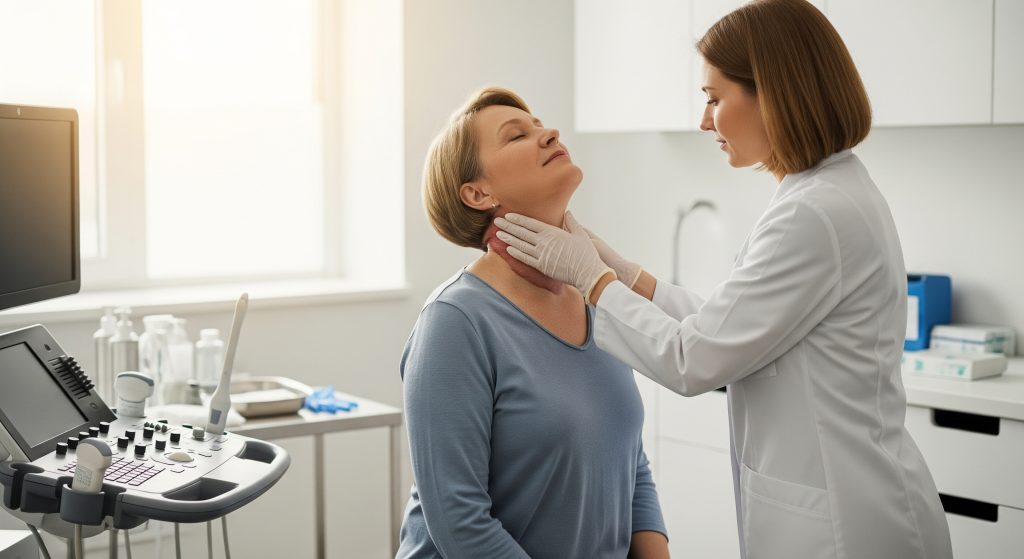
Examination begins with inspection from the front and side. I assess symmetry, surface, and deglutition movement. Palpation confirms consistency and nodularity. A bruit suggests Graves disease rather than colloid enlargement. I also examine cervical nodes and perform a simple Pemberton manoeuvre for venous obstruction.
-
Mobility with swallowing indicates thyroid origin.
-
Rubbery consistency suggests benignity.
-
Focal hardness or fixation demands escalation.
When to Seek Medical Attention
Evaluation is advised for any persistent thyroid swelling. Immediate review is prudent if there is rapid growth, pain, hoarseness, or breathing difficulty. Patients with previous irradiation, strong family cancer history, or endocrine syndromes should not delay. Early assessment keeps decisions clear and proportionate.
For searchers asking about colloid goitre symptoms, the summary is straightforward: slow growth, little pain, and often normal thyroid function.
Colloid Goitre Treatment Options and Management Strategies
Conservative Management and Monitoring
For a stable, asymptomatic gland, I prioritise observation. Baseline tests, ultrasound, and a photographic record provide reference points. Review intervals are typically 6 to 12 months. I educate patients on warning signs and document size change in millimetres rather than impressions.
-
Structured follow up with consistent measurement technique.
-
Reassurance when features remain bland and stable.
-
Escalation only if growth, symptoms, or suspicious imaging appear.
This is the backbone of colloid goitre treatment when risk is low.
Iodine Supplementation Therapy
In areas with relative deficiency, iodine repletion addresses the driver. I prefer dietary sources first, then supplements if necessary. Excess iodine can precipitate thyroid dysfunction, so dosing is careful. Monitoring ensures that euthyroidism is maintained.
-
Assess baseline intake and adjust through diet.
-
Avoid high-dose supplements without clinical indication.
-
Repeat thyroid function tests after changes.
Thyroid Hormone Replacement
Levothyroxine is indicated for overt hypothyroidism. Suppressive therapy to shrink benign goitres is controversial and, in my practice, uncommon. The benefit is often modest and the risk includes subclinical hyperthyroidism. I reserve suppression for select cases with precise targets and tight monitoring.
-
Treat true deficiency. Do not chase marginal TSH values.
-
Set a clear end point before starting suppression.
-
Reassess bone and cardiac status if long-term suppression is used.
Surgical Treatment Indications
Thyroidectomy is appropriate when there are compressive symptoms, suspicious cytology, or significant cosmetic concern. The extent depends on disease distribution and risk. I arrange preoperative laryngoscopy when voice change is present. Patients value a plain explanation of risks, including hypocalcaemia and recurrent laryngeal nerve injury.
-
Indication confirmed by symptoms or cytology.
-
Extent mapped to nodular pattern and risk profile.
-
Plan for calcium monitoring and voice assessment postoperatively.
When selected carefully, surgery provides definitive relief for colloid goitre treatment needs.
Radioactive Iodine Therapy
Radioiodine can reduce goitre volume in patients unfit for surgery or those preferring a non-surgical route. It is most effective in glands with sufficient iodine uptake. I counsel about a gradual response over months and the possibility of later hypothyroidism. A tailored dose, not a standard one-size approach, works best.
-
Consider for symptomatic enlargement without surgical suitability.
-
Expect a staged reduction rather than instant change.
-
Monitor thyroid function for delayed hypothyroidism.
Lifestyle Modifications and Dietary Considerations
I advise a balanced diet with reliable iodine sources. Avoid excess goitrogen intake from large amounts of raw cruciferous vegetables. Smoking cessation supports thyroid health and reduces eye complications if autoimmune disease coexists. Sleep, stress control, and consistent exercise aid recovery and symptom perception.
-
Prefer cooked crucifers over raw in large quantities.
-
Use iodised salt within general health limits.
-
Maintain a steady routine to stabilise symptoms and expectations.
Understanding Colloid Goitre Histology and Diagnostic Approach
Microscopic Features and Histological Patterns
On microscopy, follicles are enlarged and packed with colloid. The lining cells are flattened from low functional demand. There may be areas of haemorrhage, cystic change, or fibrosis in older lesions. Nuclear features of papillary carcinoma are absent. This bland appearance underpins the prognosis.
For readers searching for colloid goitre histology, that picture captures the essentials in practice.
Thyroid Function Tests and Blood Work
I start with TSH as the screening anchor. Free T4 and Free T3 provide context if TSH is outside range. Thyroid peroxidase antibodies help exclude autoimmune disease when the picture is mixed. A full blood count and calcium may be useful before surgery. Abnormalities guide, but I match them to clinical reality.
-
TSH: first-line marker of thyroid status.
-
Free T4 and T3: clarify direction and severity.
-
Antibodies: support or refute autoimmune overlap.
Ultrasound Imaging Characteristics
Ultrasound is my workhorse. Colloid nodules often show spongiform or cystic areas with comet tail artefacts. The background gland may be heterogeneous in long-standing disease. I report using TI-RADS, the standardised nodule risk system, and select nodules for sampling accordingly. Stable, low-risk features favour observation.
-
Spongiform texture and comet tails suggest benignity.
-
Regular margins and peripheral vascularity are reassuring.
-
Microcalcifications or tall-than-wide shape prompt escalation.
Fine Needle Aspiration Cytology
FNAC provides cellular confirmation when imaging raises a question. Colloid-rich background with benign follicular cells supports the diagnosis. If the result is indeterminate, molecular testing or diagnostic surgery may be discussed. I integrate cytology with ultrasound and clinical course rather than relying on a single data point.
-
Use FNAC for dominant or suspicious nodules.
-
Triage indeterminate results with imaging and risk factors.
-
Repeat sampling if clinical behaviour changes.
Differential Diagnosis Considerations
The short list includes Graves disease, thyroiditis, follicular neoplasm, and papillary carcinoma. I map each case against function, speed, texture, and imaging detail. A concise comparison helps prevent anchoring bias.
|
Feature |
Colloid goitre vs alternatives |
|---|---|
|
Function |
Usually euthyroid; Graves is hyperthyroid; thyroiditis often fluctuates. |
|
Tempo |
Slow; malignancy or subacute thyroiditis can be rapid. |
|
Ultrasound |
Spongiform or cystic nodules; cancer shows suspicious echo patterns. |
|
Cytology |
Colloid rich and benign cells; neoplasms show microarchitectural atypia. |
The aim is simple. Rule out danger, then choose the lightest effective touch.
Conclusion
Colloid goitre is common, typically benign, and highly manageable. Diagnosis rests on a calm synthesis of history, examination, targeted bloods, ultrasound, and, when indicated, FNAC. In low-risk cases, observation is often ideal. Iodine repletion, judicious hormone therapy, radioiodine, or surgery each have a place for specific, defensible indications. Over-treatment helps nobody. The best pathway protects the airway, the voice, and the patient’s confidence.
Frequently Asked Questions
Can colloid goitre become cancerous?
Malignant transformation of a genuine colloid process is rare. The real issue is missed coexistence of an unrelated cancerous nodule. That is why ultrasound triage and, when appropriate, FNAC are central. If imaging and cytology remain benign, the long-term outlook is excellent.
How long does colloid goitre treatment typically take?
Timeframes vary by approach. Observation is ongoing, with reviews every 6 to 12 months. Radioiodine reduction is gradual and may take several months. Surgical relief is immediate for compression, with full recovery usually within weeks. I align timing with symptoms and patient preference.
Is colloid goitre hereditary?
There is a modest familial tendency to develop multinodularity, likely polygenic. That said, environment and iodine intake exert stronger effects. A family history raises vigilance but does not imply inevitability. Screening remains clinical: examination plus ultrasound if a swelling appears.
Can pregnant women safely undergo colloid goitre treatment?
Yes, with adjustments. Observation is preferred when symptoms are mild. FNAC is safe if a nodule is suspicious. Surgery is reserved for significant compression or strong oncologic concern, typically in the second trimester. Radioiodine is contraindicated during pregnancy and lactation.
What dietary changes help prevent colloid goitre?
Prioritise consistent iodine intake through iodised salt and seafood, within general health guidelines. Avoid excessive raw goitrogenic foods, especially in very large quantities. Selenium sufficiency supports thyroid enzyme function, though supplementation should be tailored. Diet helps the gland work without overgrowth.
How often should colloid goitre be monitored without treatment?
Most stable cases are reviewed every 6 to 12 months. I re-measure nodules, reassess symptoms, and repeat labs if the clinical picture changes. Accelerate the schedule if there is new hoarseness, rapid size increase, or compressive complaints. Surveillance keeps intervention targeted and timely.
For clarity, I have used the term colloid goitre consistently. Where readers searched for colloid goitre symptoms, colloid goitre treatment, or colloid goitre histology, the guidance above maps to those practical questions with a measured plan.

