






 We do what's right for you...


What Is CECT Full Form? A Simple Guide for Patients
Dr. Beenish Khan


Conventional advice says a scan is a scan, and the machine does all the work. That view misses crucial detail. If you understand the CECT Full Form and what it implies for your body, you make better choices, ask sharper questions, and step into your appointment prepared. This guide explains what actually happens during a ct scan with contrast, why contrast is used, and how to prepare without stress. It is practical, formal, and designed so you can skim and still keep the essentials.
CECT Full Form and Essential Information
Contrast-Enhanced Computed Tomography Explained
CECT Full Form stands for Contrast-Enhanced Computed Tomography. In simple terms, you receive a contrast agent so the scanner can map vessels, organs, and tissues with higher clarity. That contrast improves the visibility of disease patterns that might be subtle or small.
CECT Full Form indicates a CT study performed after administering a contrast medium to highlight differences in blood flow and tissue characteristics.
During contrast-enhanced computed tomography, X rays rotate around you and produce cross sectional images. The computer reconstructs those images into detailed slices. Radiologists then interpret density differences measured in Hounsfield units (HU). Contrast shifts those values in key structures, which improves detection and characterisation.
-
CECT Full Form helps identify inflammation, infection, bleeding, and tumours with greater confidence.
-
It can delineate vessels, which supports vascular assessments and surgical planning.
-
It often reduces ambiguity and avoids further testing in many cases.
Here is why this matters. You get faster answers with fewer grey areas. But there is still a protocol to follow for safety and image quality.
How CECT Differs from Regular CT Scans
A routine CT creates detailed images without contrast. CECT Full Form indicates contrast is added to improve differentiation. You may notice brighter vessels, clearer organ borders, and more precise lesion detection. The choice depends on the clinical question your doctor needs to answer.
Key differences in practice:
-
Timing phases matter. Arterial, portal venous, or delayed images target different findings.
-
Contrast demonstrates perfusion and leaks, which a non contrast scan may miss.
-
CECT can show post operative changes and complications with more precision.
Some indications still favour non contrast CT, such as certain stone studies. But CECT Full Form points to a scan designed for clarity when blood flow or tissue enhancement holds the clue.
Types of Contrast Media Used
In most centres, iodinated contrast is used for CECT Full Form studies. Modern agents are low osmolality and designed for better tolerability. They travel through your bloodstream and temporarily enhance tissues on the images.
|
Contrast type |
Definition |
|---|---|
|
Iodinated intravenous |
Injected into a vein for vascular and organ enhancement across the body. |
|
Oral contrast |
Swallowed to outline the gastrointestinal tract when the abdomen is imaged. |
|
Rectal contrast |
Inserted via the rectum to delineate the colon in select protocols. |
Jargon you may hear includes osmolality and viscosity. Osmolality relates to particle concentration in the solution and can influence comfort during injection. Viscosity affects flow through the cannula. CECT Full Form does not change the chemical choice, but it signals that contrast is central to the protocol.
Common Reasons for CECT Scans
Doctors request CECT Full Form studies when contrast will clarify the diagnosis. You may be referred for one of the following reasons:
-
Suspected appendicitis, diverticulitis, or bowel obstruction.
-
Evaluation of liver, pancreas, or kidney lesions.
-
Trauma assessment to detect internal bleeding.
-
Vascular mapping for aneurysm or clot evaluation.
-
Oncology staging, treatment response, or surveillance.
A ct scan with contrast can also assist before surgery by showing anatomy and variants. The same applies after procedures, to check for leaks or abscesses. CECT Full Form in your referral indicates contrast is expected because it contributes decisive information.
The CECT Scan Procedure Step by Step
1. Initial Patient Assessment
Your team will review your history, renal function, allergies, and prior imaging. Expect questions about asthma, previous contrast reactions, and recent lab results such as estimated GFR. This is routine and critical for safe CECT Full Form practice.
-
Hydration status is checked, particularly if you have kidney risk factors.
-
Diabetes medication, especially metformin, is reviewed with timing guidance.
-
Consent is taken after explaining benefits, risks, and alternatives.
If you are anxious, mention it early. A brief explanation of the cect scan procedure usually lowers stress and improves cooperation.
2. Contrast Administration Methods
For CECT Full Form examinations, contrast is commonly delivered through a cannula in your arm. Power injectors control the flow, often synchronised with bolus tracking. This timing allows arterial or venous phase images at the right moment for the organ of interest.
-
Intravenous contrast: mainstay for CECT in chest, abdomen, pelvis, and angiography.
-
Oral contrast: used when the gut needs outlining or differentiation.
-
Rectal contrast: reserved for specific colorectal questions.
Staff will flush the line with saline to confirm position. If extravasation occurs, they treat it promptly. The cect scan procedure prioritises comfort and swift imaging, so each step is streamlined.
3. During the Scanning Process
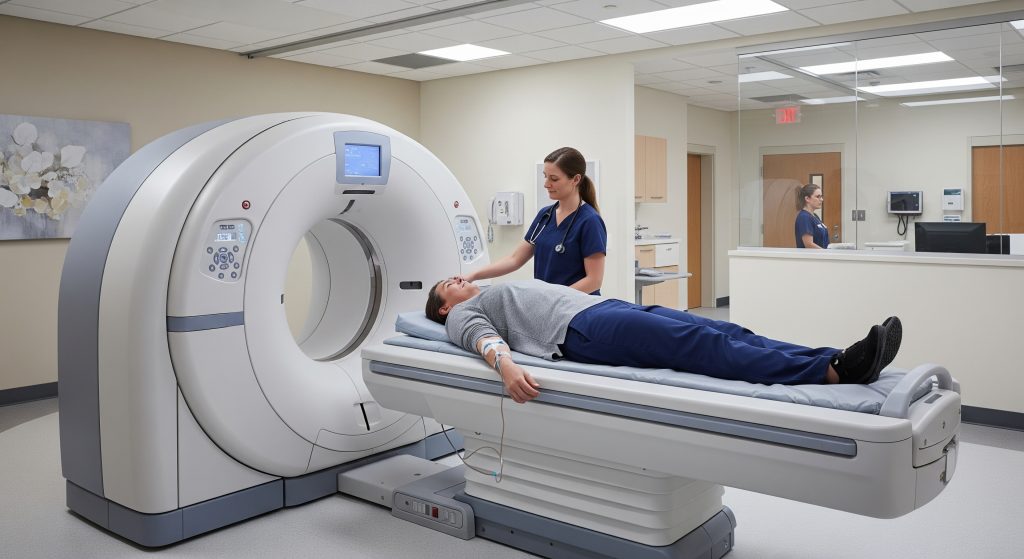
You lie on the table, which moves through the gantry. The scanner acquires images in seconds and may ask you to hold your breath. CECT Full Form scans often involve multiple phases, so the table may pass through more than once.
-
Expect a warm sensation or metallic taste during injection. It fades quickly.
-
Breath holds are short. Clear instructions are given in your language.
-
The radiographer monitors you from the console with two way audio.
The system reconstructs images rapidly. Modern scanners can generate hundreds of slices for detailed review after your cect scan procedure.
4. Duration and Positioning
Most studies, including preparation, take about 15 to 30 minutes. The actual scan time is often under 5 minutes. Positioning depends on the body part. Arms up for chest or abdomen reduces artefact, while neutral positioning is used for head scans.
CECT Full Form protocols may include delayed imaging at 5 to 15 minutes if the diagnosis requires it. That extends total time but improves diagnostic yield.
5. Communication with Medical Staff
Tell the radiographer if you feel pain, itching, or shortness of breath. Clear communication ensures a safe experience. For CECT Full Form cases, staff remain attentive during and after injection to detect early reactions.
Ask questions about timing, phases, or next steps. A short briefing can clarify the cect scan procedure and reduce uncertainty. Good communication is not a courtesy. It is a safety tool.
Preparing for Your CECT Scan
Pre-Scan Dietary Restrictions
Many centres advise a short fast, often around 4 to 6 hours before contrast. Light water intake is usually allowed and often encouraged. For abdominal studies, oral contrast timing will be explained so the gut is appropriately outlined.
-
Avoid heavy meals and high fat foods before your slot.
-
Do not take black coffee if fasting is required.
-
Bring a water bottle to rehydrate afterwards.
CECT Full Form imaging benefits from steady hydration. It supports vein access and post scan clearance of contrast.
Medications to Discuss with Your Doctor
Discuss metformin, diuretics, and nephrotoxic medicines with your clinician. Timing adjustments may be advised depending on kidney function and local policy. Blood thinners rarely affect CECT Full Form imaging, but always disclose them.
If you take beta blockers or have thyroid disease, raise this at booking. Your team will align the cect scan procedure with your regimen to keep risks low.
What to Wear and Bring
Wear comfortable clothing without metal fasteners. Leave jewellery at home where possible. You may change into a gown for some studies.
-
Bring previous imaging and reports for comparison.
-
Carry your medication list and allergy details.
-
If you have implants, bring the device card or documentation.
These small steps speed up CECT Full Form appointments and reduce clerical delays.
Allergy and Medical History Disclosure
Tell staff about any prior contrast reaction, no matter how mild. Describe rashes, wheezing, swelling, or faintness if they occurred. For CECT Full Form studies, a previous reaction may warrant premedication, an alternative agent, or additional monitoring.
Also disclose asthma, atopy, cardiac disease, and kidney issues. Accurate history shapes the protocol. It improves safety and image quality in one move.
Special Preparations for Different Body Areas
Protocols vary by organ system. For example, multiphasic liver imaging has precise timing to characterise lesions. CT urography requires hydration and delayed phases to assess the collecting systems.
-
Head and neck: remove dentures and removable dental work.
-
Chest: practise brief breath holds to reduce motion blur.
-
Abdomen and pelvis: follow oral contrast timing and arrive slightly early.
CECT Full Form protocols are not one size fits all. They are tailored to the clinical question and your physiology.
After Your CECT Scan
Immediate Post-Scan Instructions
You can usually resume normal activities immediately. Drink water across the next 24 hours unless advised otherwise. The injection site may be tender briefly. If bandaged, keep it clean and dry.
CECT Full Form scanning does not restrict you from most tasks. If you feel light headed, sit and rest for a few minutes, then inform staff.
Managing Contrast Side Effects
Most side effects are mild and short lived. Warmth, flushing, or a brief metallic taste are common. A small bruise at the cannula site can occur. These settle without treatment.
-
Itching or a mild rash may appear in rare cases. Antihistamines can help.
-
Significant reactions are uncommon, and teams are trained to manage them.
-
Hydration assists clearance and comfort after CECT Full Form imaging.
If symptoms persist or worsen, contact the department or attend urgent care. Err on the side of caution. That is prudent and responsible.
When to Expect Results
Images are reported by a consultant radiologist. Turnaround varies by site and urgency. Routine results often return within a few working days, while urgent cases are prioritised much sooner.
Ask how your report will be delivered. Some services share summaries electronically with your clinician. CECT Full Form reports are structured, with impressions that answer the clinical question directly.
Warning Signs to Watch For
Seek help promptly if you notice any of the following:
-
Breathing difficulty, chest tightness, or facial swelling.
-
Severe hives or persistent vomiting.
-
Painful swelling at the injection site or spreading redness.
-
Reduced urine output after the scan, especially if you have kidney disease.
Serious events after CECT Full Form imaging are uncommon. And yet, vigilance matters in the small number of cases where rapid action helps most.
Understanding CECT for Better Healthcare Decisions
Clarity improves decisions. When you know the CECT Full Form, you understand why contrast is proposed, which safety checks matter, and how timing phases reveal disease. You also know the trade offs. A non contrast study is quicker, but it may miss vascular or subtle inflammatory changes. A ct scan with contrast can answer those questions in one sitting.
Use industry shorthand when helpful. For instance, CAC in imaging often refers to coronary artery calcium, which is a non contrast technique. That distinction matters when you discuss the right test for chest pain. CECT Full Form signals a different purpose and method.
If you remember one idea, let it be this: protocol quality drives diagnostic quality. Ask simple questions about phases, preparation, and reporting timelines. That is not overbearing. It is how you advocate for accurate care during the cect scan procedure.
Frequently Asked Questions
Is CECT scan painful?
The scan itself is not painful. You may feel a brief pinch for the cannula and a warm sensation during injection. These settle in seconds. CECT Full Form procedures are designed to be tolerable and efficient.
How long does contrast stay in your body?
For most people, contrast is cleared through the kidneys within 24 hours. Hydration helps. If kidney function is reduced, clearance may take longer, though still typically short. CECT Full Form imaging does not leave permanent contrast in your system.
Can pregnant women have CECT scans?
CT uses ionising radiation. Pregnancy requires a careful risk benefit discussion with your clinician and radiologist. Alternative imaging, such as ultrasound or MRI, is often preferred. If essential, CECT Full Form protocols may be adapted with strict justification.
What’s the difference between CECT and MRI with contrast?
CECT uses X rays with iodinated contrast, while MRI uses magnetic fields with gadolinium based agents. CT is fast and excellent for acute issues and bone detail. MRI excels in soft tissue characterisation. Your clinician selects the modality that best answers the question at hand.
How much does a CECT scan cost?
Costs vary by region, facility, and protocol complexity. Prices also differ for single phase versus multiphasic studies. Ask for an itemised estimate. It should specify the scan, the contrast, and the reporting fee. CECT Full Form requests often involve more phases, which can influence price.
Can children undergo CECT scans safely?
Yes, with paediatric protocols and dose optimisation. Teams use child specific settings, smaller contrast doses, and careful monitoring. The guiding principle is simple. Use the lowest radiation that achieves diagnostic images and only when clinically indicated.
Quick recap
-
CECT Full Form means contrast is central to the CT protocol for clearer answers.
-
Preparation and hydration improve safety and image quality.
-
Tell staff your history. It shapes the plan and prevents complications.
-
Ask about phases and reporting timelines to set expectations early.
Maybe that is the point. Better preparation leads to better images, and better images lead to better decisions.

