






 We do what's right for you...


What Is a Low Fat Diet Chart? A Beginner’s Explainer
Dr. Sunil M Raheja
For decades, the nutrition world has hammered home one message: cut the fat. But here’s what most low fat diet advice gets wrong. It’s not simply about slashing fat grams until they hit zero. That approach leaves people hungry, nutritionally depleted, and frankly, miserable. The real skill lies in understanding exactly how much fat different bodies actually need, which fats to keep, and how to structure meals so a low fat diet chart becomes something sustainable rather than a two-week experiment that ends in a biscuit binge.
This guide breaks down the essential components of building a low fat diet chart that works. It covers everything from age-specific fat allowances to practical seven-day meal plans, and dives into specialised applications like a low fat diet for pancreatitis or a low fat diet for vegetarians. Whether the goal is managing a health condition, supporting weight loss, or simply cleaning up eating habits, this explainer provides the framework to make it happen.
Essential Components of a Low Fat Diet Chart
A low fat diet chart isn’t just a list of foods to avoid. It’s a structured approach to eating that balances nutritional needs with fat reduction goals. The foundation starts with understanding how much fat is appropriate, then builds outward to meal planning and label reading.
Daily Fat Intake Guidelines by Age Group
Here’s where things get interesting. Fat requirements aren’t universal. They shift dramatically based on age, and getting this wrong can cause real problems.
For babies under one year, fat intake should not be restricted at all. Their growing brains and bodies depend on it. According to American Heart Association, fat restriction in this age group can actually harm development. Between ages one and three, fat should constitute 30-40% of total caloric intake. For children aged four and older, that range drops to 25-35%.
Adults face different parameters entirely. Evidence from the WHO shows that limiting total fat intake to 30% of total energy is crucial for preventing obesity-related noncommunicable diseases. Saturated fat specifically should stay below 10% of total calories.
|
Age Group |
Total Fat (% of calories) |
Saturated Fat Limit |
|---|---|---|
|
Under 1 year |
No restriction |
N/A |
|
1-3 years |
30-40% |
Less than 10% |
|
4+ years to adult |
25-35% |
Less than 10% |
|
Adults (general health) |
20-30% |
Less than 10% |
|
Adults (therapeutic low fat) |
15-20% |
Less than 7% |
The NHS recommends adults aim for no more than 30g of saturated fat per day, with children’s limits scaled lower based on their age. Most dietary fats in any age group should come from polyunsaturated and monounsaturated sources. That’s fish, nuts, and vegetable oils.
Sample 7-Day Low Fat Diet Chart
Theory is fine. Practical application is what actually matters. Here’s a week-long framework that keeps fat intake around 40-50 grams daily for adults.
|
Day |
Breakfast |
Lunch |
Dinner |
Snacks |
|---|---|---|---|---|
|
Monday |
Oat porridge with banana, fat-free milk |
Grilled chicken salad, wholemeal bread |
Baked fish with steamed vegetables, rice |
Apple slices, rice cakes |
|
Tuesday |
Egg whites on toast, fresh orange juice |
Lentil soup, mixed greens |
Skinless turkey breast, roasted sweet potato |
Carrot sticks, low-fat yoghurt |
|
Wednesday |
Low-fat yoghurt with berries, wholegrain cereal |
Chickpea salad, pitta bread |
Grilled prawns, quinoa, steamed broccoli |
Cucumber slices, air-popped popcorn |
|
Thursday |
Smoothie with spinach, banana, skimmed milk |
Vegetable stir-fry with tofu, brown rice |
Lean beef strips, mixed vegetables, noodles |
Fresh fruit salad, crackers |
|
Friday |
Wholemeal toast with low-fat cottage cheese |
Black bean soup, wholegrain roll |
Baked cod, mashed potato, green beans |
Celery with hummus, grapes |
|
Saturday |
Buckwheat pancakes, fresh berries |
Tuna salad (in water), mixed leaves |
Chicken breast, roasted vegetables, couscous |
Melon cubes, low-fat cheese |
|
Sunday |
Poached eggs, tomatoes, mushrooms |
Minestrone soup, crusty bread |
Grilled salmon, asparagus, new potatoes |
Pear, handful of plain pretzels |
This chart provides roughly 1,800-2,000 calories daily with fat content between 40-55 grams. Portion sizes need adjustment based on individual caloric needs.
Meal Timing and Portion Control
What drives people mad about low fat eating is the hunger. It’s completely real. Fat provides satiety, and when it’s reduced, the body notices.
The solution isn’t willpower. It’s structure. Eating four to six smaller meals throughout the day prevents the blood sugar crashes that send people running toward the nearest high-fat snack. Think of it like maintaining a fire. It’s easier to keep a small flame burning steadily than to let it die out and try to restart it with a massive log.
Portion control becomes especially critical on a low fat diet chart because the tendency is to overcompensate with carbohydrates. A single serving of protein should be roughly the size of a palm. Grains should fill about a quarter of the plate. Vegetables get the largest share. This visual approach works better than obsessive measuring for most people.
Reading Food Labels for Fat Content
Here’s where most beginners stumble. The front of a package might scream “low fat” while the back tells a different story entirely.
The key numbers to find:
-
Total fat per serving – aim for 3 grams or less per 100 calories for truly low-fat foods
-
Saturated fat – this should be minimal; it’s the fat most linked to health problems
-
Trans fat – should be zero; there’s no safe level
-
Serving size – manufacturers often list unrealistically small portions to make fat content appear lower
A product claiming to be “reduced fat” only needs to contain 25% less fat than the original version. That original might have been loaded. Always check actual grams, not marketing claims.
Calculating Daily Fat Allowance
The maths here is straightforward once the principle is understood. Fat contains 9 calories per gram, unlike protein and carbohydrates which contain 4.
For someone eating 2,000 calories daily who wants fat to comprise 20% of their intake:
2,000 × 0.20 = 400 calories from fat
400 ÷ 9 = approximately 44 grams of fat daily
For therapeutic low fat diets (around 15%), that drops to roughly 33 grams. For general healthy eating (30%), it rises to about 67 grams. The calculation adjusts based on total caloric needs and health goals.
Comprehensive Low Fat Foods List by Category
Building a proper low fat foods list requires understanding which foods naturally contain minimal fat and which need careful selection. This breakdown covers every major food group.
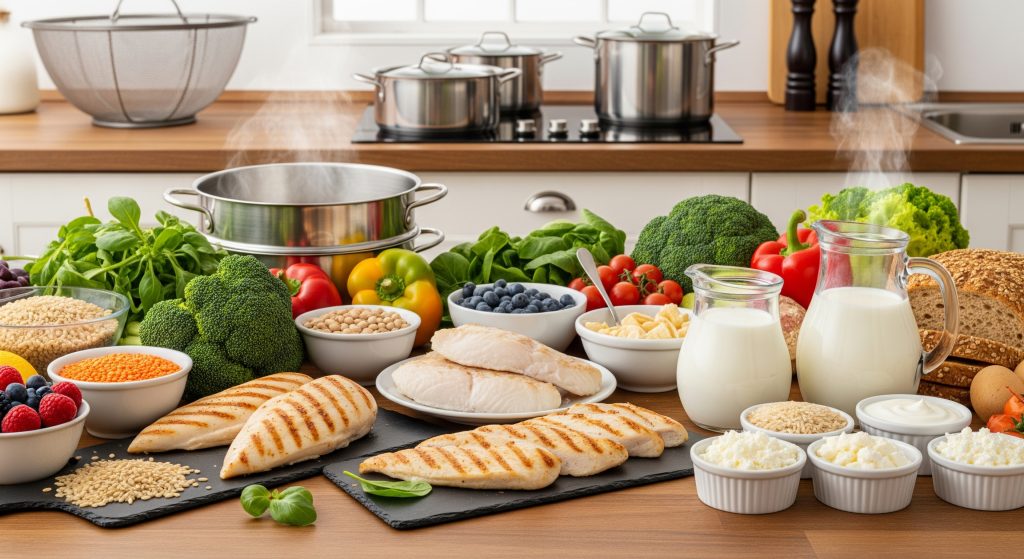
Proteins Under 3 Grams Fat
Protein is non-negotiable on any diet. The challenge is finding sources that don’t come packaged with excess fat.
According to StatPearls, foods with 3 grams or less of fat per 100 calories qualify as low-fat. For protein specifically, the best options include:
-
Skinless chicken breast – roughly 3g fat per 100g cooked
-
Turkey breast – even leaner at about 1.5g fat per 100g
-
Egg whites – virtually zero fat, pure protein
-
White fish (cod, haddock, tilapia) – typically under 2g fat per serving
-
Prawns and shellfish – low fat, high protein
-
Lentils and beans – fibre-rich with minimal fat
-
Fat-free cottage cheese – excellent protein density
Plant-based proteins deserve special mention for those following a low fat diet for vegetarians. Lentils, chickpeas, and black beans offer substantial protein with virtually no fat, plus fibre that aids satiety.
Grains and Cereals
Grains form the backbone of most low fat eating plans. They provide energy without the fat burden.
Whole grains are the priority here. According to Mayo Clinic, options like oats, brown rice, and whole wheat products are rich in nutrients and inherently low in fat while promoting heart health.
The low fat foods list for grains includes:
-
Brown rice and wild rice
-
Oatmeal (not the instant flavoured varieties)
-
Whole wheat pasta
-
Quinoa
-
Barley
-
Buckwheat
-
Wholemeal bread
-
Plain cereals without added oils
The trap? Granola and muesli. These sound healthy but often contain significant added oils and fats. Always check labels.
Fruits and Vegetables
This is the easiest category. Almost all fruits and vegetables are naturally low in fat. The exceptions are few: avocados, olives, and coconut.
The freedom here is liberating. Eat freely from:
-
All leafy greens
-
Cruciferous vegetables (broccoli, cauliflower, cabbage)
-
Root vegetables
-
Berries, apples, citrus fruits
-
Melons and tropical fruits (except coconut)
-
Tomatoes, peppers, cucumbers
Vegetables become even more important on a low fat diet because they provide volume and nutrients without fat. The visual of a plate should be at least half vegetables.
Dairy and Alternatives
Dairy requires the most careful navigation. Full-fat versions can sabotage a low fat diet chart within a single meal.
Smart swaps include:
-
Skimmed or semi-skimmed milk instead of whole milk
-
Low-fat or fat-free yoghurt (watch for added sugars)
-
Cottage cheese and mozzarella – lower in saturated fat than harder cheeses
-
Plant-based milks – almond, soy, and oat milk often contain less fat than dairy
However, dairy alternatives often require fortification to match cow’s milk nutritionally. Check that calcium and vitamin D have been added.
Snacks and Beverages
Snacking is where low fat intentions often die. The office biscuit tin or the corner shop crisps become irresistible when hunger strikes.
Prepared low-fat snack options include:
-
Air-popped popcorn (without butter)
-
Rice cakes
-
Plain pretzels
-
Fresh fruit
-
Raw vegetables with salsa
-
Low-fat yoghurt
-
Dried fruit (in moderation – high in sugar)
For beverages, most are naturally fat-free. Water, tea, coffee (black), and fruit juices contain no fat. The danger comes from additions: cream in coffee, whole milk in tea, or creamy smoothie bases.
Cooking Methods That Reduce Fat
A chicken breast can be a low-fat hero or a fat bomb depending entirely on how it’s cooked. This distinction matters enormously.
Fat-reducing cooking methods:
-
Grilling – fat drips away from food
-
Steaming – no added fat required
-
Baking or roasting – on a rack allows fat to drain
-
Poaching – cooking in water or stock
-
Air-frying – achieves crispy texture with minimal oil
-
Stir-frying – small amounts of oil, quick cooking
Fat-adding methods to avoid or limit:
-
Deep-frying
-
Pan-frying in oil or butter
-
Sautéing in large amounts of fat
-
Adding cream-based sauces
A non-stick pan with a spray of oil can reduce fat content by 90% compared to traditional frying methods.
Specialised Low Fat Diet Applications
General low fat guidelines work for most people. But certain conditions require stricter protocols and specific modifications.
Low Fat Diet for Pancreatitis Recovery
This is not optional territory. A low fat diet for pancreatitis is medically necessary, not a lifestyle choice.
The pancreas produces enzymes that digest fat. When inflamed, processing fat becomes painful and potentially dangerous. According to Healthline, the pancreatitis diet focuses on reducing fat intake, ideally limiting to 30 grams per day for better digestion and recovery.
Key principles for pancreatitis recovery:
-
Fat limit: 30-50 grams daily maximum
-
Meal frequency: 4-6 smaller meals rather than 3 large ones
-
Hydration: Essential for supporting digestion
-
Protein focus: High-protein, very low-fat foods become staples
-
Complete alcohol avoidance: Non-negotiable
Foods to strictly avoid include fried foods, fatty meats, full-fat dairy, pastries, and anything cooked in oil. The pancreas needs rest to heal.
Supplementation often becomes necessary. Fat-soluble vitamins (A, D, E, K) may require supplementation due to malabsorption issues. Working with a dietitian is essential rather than optional.
Low Fat Diet for Vegetarians
Vegetarian eating can be naturally lower in fat. Or it can be surprisingly high. The difference comes down to food choices.
The hidden fat sources in vegetarian diets include:
-
Cheese (even vegetarian varieties are often high-fat)
-
Nuts and nut butters
-
Avocado
-
Coconut-based products
-
Fried vegetarian foods
-
Pastries and baked goods
A low fat diet for vegetarians centres on:
-
Legumes: Lentils, beans, and chickpeas for protein
-
Whole grains: Quinoa, brown rice, oats
-
Vegetables: Unlimited quantities of most varieties
-
Low-fat dairy: If included in the diet
-
Tofu: Especially firm varieties which are lower in fat
-
Tempeh: Fermented soy with good protein content
Protein combining isn’t necessary at every meal. But over the course of a day, vegetarians should ensure varied protein sources to get all essential amino acids. The good news? Most plant proteins are naturally low in fat.
Modifications for Children and Seniors
What works for a healthy adult doesn’t automatically translate to other age groups. Children and seniors have distinct nutritional needs that require careful consideration.
For children, American Heart Association emphasises limiting sugary and high-fat foods to prevent obesity while ensuring adequate nutrition for growth. But overly restrictive fat diets can harm development. The balance matters.
Children’s modifications:
-
Fat restriction should be gentle, not severe
-
Focus on replacing saturated fats with healthy fats rather than eliminating all fat
-
Ensure adequate calcium and vitamin D intake
-
Make low-fat options appealing rather than punitive
For seniors, concerns shift. Absorption issues become more common. Appetite often decreases. Nutrient density becomes paramount.
Senior-specific considerations:
-
Smaller, more frequent meals may be better tolerated
-
Protein needs may actually increase to prevent muscle loss
-
B12 and vitamin D supplementation often necessary
-
Hydration requires active attention
Managing Nutritional Deficiencies
Here’s the uncomfortable truth about low fat diets. They can create deficiencies if not managed properly. Fat isn’t just calories. It’s a carrier for essential nutrients.
Fat-soluble vitamins – A, D, E, and K – require dietary fat for absorption. Cut fat too severely, and these vitamins pass through the body without being used, regardless of how much is consumed.
Common deficiencies to watch for:
-
Vitamin D: Already deficient in many people; low fat diets increase risk
-
Vitamin E: Found primarily in fat-rich foods like nuts and oils
-
Essential fatty acids: Omega-3 and omega-6 must come from diet
-
Vitamin A: Better absorbed with fat present
Mitigation strategies include:
-
Including small amounts of healthy fats at each meal
-
Eating fat-soluble vitamin sources with a small fat serving
-
Considering supplementation under medical guidance
-
Regular blood tests to monitor nutrient levels
A low fat diet doesn’t mean a no-fat diet. That distinction saves people from preventable health problems.
Making Your Low Fat Diet Chart Work Long-Term
The single most frustrating part of dietary change is the gap between initial enthusiasm and long-term reality. Week one feels manageable. Week eight feels impossible.
Sustainability comes down to a few core principles.
Build flexibility into the system. A rigid low fat diet chart that allows no variation will fail. Life includes birthday meals and restaurant dinners and unexpected work lunches. Planning for these rather than treating them as failures keeps people on track.
Focus on additions, not just subtractions. Rather than obsessing over what’s forbidden, concentrate on adding more vegetables, more lean proteins, more whole grains. The low-fat choices naturally crowd out higher-fat options without the psychological deprivation.
Make preparation easy. The moment cooking feels like a chore, takeaway becomes tempting. Batch cooking proteins, prepping vegetables in advance, and having low-fat snacks readily available removes decision fatigue.
Track progress meaningfully. This doesn’t necessarily mean daily weigh-ins. Energy levels, digestive comfort, and how clothes fit often tell a more accurate story than the scale. Some people benefit from food journaling. Others find it obsessive. Know thyself.
But what does success actually look like? It looks like not thinking about the diet constantly. It looks like the low fat choices becoming automatic rather than effortful. It looks like the low fat diet chart becoming simply “how I eat” rather than a temporary restriction.
That transformation takes time. Most dietary research suggests habits solidify somewhere between two and six months. The first few weeks are always harder than what follows.
Frequently Asked Questions
How many grams of fat should I eat daily on a low fat diet?
For general low fat eating, aim for 40-60 grams of fat daily on a 2,000-calorie diet (about 20-30% of total calories). Therapeutic low fat diets for specific conditions may drop to 30-40 grams daily. Children, athletes, and those with certain medical conditions have different requirements, so individual guidance matters.
Can a low fat diet chart help with weight loss?
Yes, primarily through calorie reduction since fat contains 9 calories per gram compared to 4 for protein and carbohydrates. However, sustainability matters more than speed. Many people find moderate fat reduction combined with increased protein and fibre more effective long-term than severe fat restriction.
What are the best protein sources for a low fat diet?
Skinless poultry breast, white fish (cod, haddock, tilapia), egg whites, fat-free cottage cheese, prawns, and legumes (lentils, beans, chickpeas) all provide excellent protein with minimal fat. For vegetarians, tofu, tempeh, and seitan offer low-fat protein options.
Is a low fat diet safe for children and teenagers?
Moderate fat reduction is safe for children over age two, but severe restriction can harm development. Children under two should not have fat restricted at all. Focus on replacing saturated fats with healthier options rather than eliminating fat entirely. Always consult a paediatrician before implementing dietary restrictions for children.
How long should someone with pancreatitis follow a low fat diet?
Duration depends on severity and recovery progress. Acute pancreatitis may require strict low fat eating for several weeks to months during recovery. Chronic pancreatitis often necessitates permanent dietary modification. Medical supervision determines appropriate duration and any gradual reintroduction of fats.
What vitamins might I need to supplement on a low fat diet?
Fat-soluble vitamins (A, D, E, and K) are most at risk since they require dietary fat for absorption. Vitamin D supplementation is commonly needed, especially in less sunny climates. Essential fatty acids (omega-3s) may also require supplementation if fish and nuts are severely limited. Blood tests can identify specific deficiencies.

