






 We do what's right for you...


What Is a Chest CT and Why It’s Done
Dr. Beenish Khan


Conventional wisdom says a chest X-ray answers most questions. For subtle disease, it usually does not. A Chest CT shows what X-ray cannot, from tiny nodules to clots and complex infections. Used well, it shortens diagnosis time and clarifies treatment decisions. Used poorly, it adds radiation without benefit. This guide explains when you should have one, how it works, and the trade-offs to consider.
Types of Chest CT Scans and Their Uses
Standard Chest CT for Lung Disease Detection
A standard Chest CT maps your lungs, airways, heart, and mediastinum in high detail. It helps confirm suspected disease and establish a baseline for follow-up. As Imaging protocols for CT chest: A recommendation notes, consistent protocols balance image quality with safety, so your results are both reliable and comparable over time.
Protocol consistency matters. As Comparison of different computed tomography scanning methods discusses, different techniques can yield different emphysema severity scores, which affects clinical decisions. For diffuse lung disease, volumetric acquisition and multiplanar reconstruction are often preferred because they reduce misses at the lung bases and apices. As CT protocols in interstitial lung diseases observes, European radiologists prioritise volumetric scans and 3D imaging for interstitial questions.
-
Best for: unexplained cough, abnormal X-ray, suspected masses, follow-up of known lung disease.
-
What you get: thin-slice images through the entire chest, often reconstructed in multiple planes.
-
Key tip: bring prior imaging. Side-by-side comparison saves time and avoids repeat scans.
Chest CT with Contrast for Vascular Assessment
When you need to see vessels clearly, a chest ct scan with contrast is the tool. Iodinated contrast enhances arteries and veins so clots, dissections, and malformations stand out. As Jornal Brasileiro de Pneumologia explains, contrast-enhanced Chest CT is vital when assessing pulmonary embolism because vessel detail drives diagnosis.
Contrast also guides surgical planning. As Laryngoscope reports, routine contrasted scans can identify proximal subscapular artery variants, which matter during complex thoracic procedures. For you, the practical point is simple. If vascular disease is suspected, expect contrast unless there is a specific contraindication.
-
Best for: embolism, aortic pathology, vascular malformations, preoperative mapping.
-
Alternative terms: pulmonary ct scan or CTPA when the target is pulmonary arteries.
Low-Dose Chest CT for Screening
Low-dose protocols cut radiation while keeping enough detail to detect small nodules. For high-risk smokers, this is the backbone of screening. As USPSTF recommends, adults aged 50 to 80 with at least 20 pack-years should undergo annual LDCT, with screening stopping after 15 smoke-free years or when serious comorbidities limit benefit.
Mortality reduction is real. As Low-dose computed tomography lung cancer screening notes, LDCT reduces lung cancer deaths by roughly 20% versus X-ray. There are challenges, including false positives and downstream testing, especially in regions with old tuberculosis changes. As Low Dose Computed Tomography for Lung Cancer… reports, screen-positive rates near 18.36% in TB-endemic settings highlight this tension.
Clinical reality. Nodules trigger follow-up. As Lung Cancer Screening with Low-Dose Computed… outlines, you may need interval scans or further tests. Newer tools help. As Current evidence of low-dose CT screening benefit adds, AI-assisted reading is improving accuracy and efficiency, which reduces unnecessary anxiety and procedures.
High-Resolution CT for Detailed Lung Imaging
High-resolution CT (HRCT) uses thin slices to reveal fine lung structures. Think interstitial patterns, subtle air trapping, early bronchiectasis. As StatPearls summarises, HRCT is often the most useful modality for detailed thoracic assessment.
Technique matters here. As Computed tomography scanning techniques for the evaluation of cystic fibrosis lung disease notes, modern HRCT can achieve lower doses while producing comprehensive volumetric datasets. Expiratory series help expose small airways disease. As Volumetric expiratory HRCT of the lung: clinical applications explains, inspiratory and expiratory imaging together clarifies COPD and bronchiectasis physiology.
In practice, HRCT is the protocol of choice for suspected interstitial lung disease. As Imaging protocols for CT chest: A recommendation indicates, the clinical scenario should drive the protocol, and HRCT leads when fibrosis is the central question.
Medical Conditions Diagnosed Through Chest CT
Detecting Lung Cancer and Pulmonary Nodules
A lung ct scan detects nodules that X-ray often misses. Screening uses low-dose techniques; diagnostics use standard-dose or contrast when needed. As Advances in lung cancer screening and early detection reviews, early detection with LDCT has a measurable effect on mortality.
AI supports accuracy. As Evaluation of the Effectiveness of … suggests, AI can outperform humans in sensitivity and specificity for nodule detection, especially on non-screening scans. Research continues to refine malignancy risk scoring. As A new lung cancer detection method based on … shows, models now classify severity to guide follow-up intervals.
-
Typical next steps: interval imaging, PET-CT, or biopsy depending on nodule size and features.
-
Your role: attend follow-up on time. Early change is easier to treat than late-stage progression.
Evaluating Pneumonia and Infections
In complex infections, Chest CT is often decisive. It maps the extent of disease, identifies abscess, and distinguishes overlapping diagnoses. As Computed tomography scan contribution to the diagnosis of… reports, CT improves diagnostic accuracy for community-acquired pneumonia and reduces antibiotic overuse by clarifying atypical presentations.
Typical findings include ground-glass opacities and consolidation. As A Comparison among Three Commercial Software indicates, these features help characterise severity, especially in viral pneumonias. Comparative work, such as Comparison of Chest CT Findings of COVID-19, Influenza…, shows CT can help differentiate patterns, though clinical context remains crucial.
Radiation remains a consideration. For fragile patients, ultra-low-dose options exist. As Denoised Ultra-Low-Dose Chest CT to Assess Pneumonia… demonstrates, denoised ultra-low-dose scans can assess pneumonia in immunocompromised patients with minimal exposure.
Assessing Pulmonary Embolism
For suspected PE, contrast-enhanced CT pulmonary angiography is standard. It visualises clots directly and rules in or out alternative causes of chest pain. As Imaging of acute pulmonary embolism: an update notes, modern techniques including dual-energy CT improve perfusion assessment and reduce indeterminate exams.
Speed matters. As CT diagnosis of acute pulmonary embolism: the first 10 years documents, multislice scanners capture peripheral arteries in a short breath-hold, improving sensitivity. Clinical probability and D-dimer still guide whether you should scan. As Acute Pulmonary Embolism – StatPearls outlines, pretest scoring reduces unnecessary radiation and contrast exposure.
Diagnosing Interstitial Lung Disease
HRCT underpins ILD diagnosis. You will often see terms like UIP or NSIP in the report, which are pattern-based. As Role of High-Resolution CT Thorax in Diagnosing … confirms, HRCT patterns correlate with connective tissue disease in a meaningful share of cases.
Guidelines recommend multidisciplinary discussion. As Korean Guidelines for the Diagnosis and Management of Interstitial Lung Disease… highlight, imaging features such as reticular opacities, ground-glass change, and honeycombing are critical for typing fibrosis and planning treatment. Automated tools are emerging to support interpretation. As Diagnosis of interstitial lung abnormalities suggests, quantitative CT assists both detection and monitoring of early interstitial changes.
Identifying Bronchiectasis and COPD
Chest CT separates COPD phenotypes and reveals coexisting bronchiectasis. That nuance matters for therapy. As The Role of Chest Computed Tomography in the Evaluation and Management of the Patient with COPD explains, structural detail aligns with exacerbation risk and helps personalise treatment.
For COPD with frequent infections, HRCT looks for traction bronchiectasis and mucus plugging. As Relationship between clinical and radiological signs of bronchiectasis in COPD patients: Results from COSYCONET shows, imaging-identified bronchiectasis influences management decisions and prognosis.
Examining Chest Wall and Mediastinal Masses
CT is the primary tool for mediastinal and chest wall masses. Density differences help narrow the differential and guide biopsy. As Chest and Mediastinal Imaging – StatPearls. notes, MRI is reserved for specific soft tissue questions or vascular invasion detail.
Infection can track from the chest wall to the mediastinum. As Anterior mediastinal extension of primary chest wall infections. reports, nearly half of studied patients had extension, with fat stranding and fluid collections as key signs. Chest wall tumours vary. As Chest Wall Tumors – StatPearls. summarises, about half are benign, while malignant cases often need surgical management.
Preparation and Procedure
Pre-Scan Instructions and Fasting Requirements
Policies differ between centres. As Preprocedural fasting for contrast-enhanced CT outlines, routine fasting before intravenous iodinated contrast is not generally required and excessive fasting may be counterproductive. Yet many hospitals still request a short fast.
When institutions do require fasting, expect a modest window. As Stanford Health Care notes, 2.5 to 4 hours is typical for contrast studies, with clear fluids allowed. Declare any prior contrast reactions early. Avoid caffeine if instructed, especially when contrast is planned.
-
Bring your medication list and allergy history.
-
Wear metal-free clothing if possible to avoid artefacts.
-
Hydrate unless told otherwise. It helps post-contrast clearance.
Understanding Contrast Agent Administration
Iodinated contrast is delivered through a cannula, typically in the forearm. It improves tissue separation and vessel detail. As Intravenous Contrast – StatPearls explains, proper administration and screening for risks are essential because adverse reactions, while uncommon, range from mild to severe.
Allergy risks are often overstated. As Allergic-type reactions to radiographic contrast media clarifies, seafood allergy is not a specific risk factor, while a prior contrast reaction, asthma, or certain drug allergies may increase risk. If you are high risk, premedication can be considered, and emergency management protocols are in place.
What Happens During the Scan
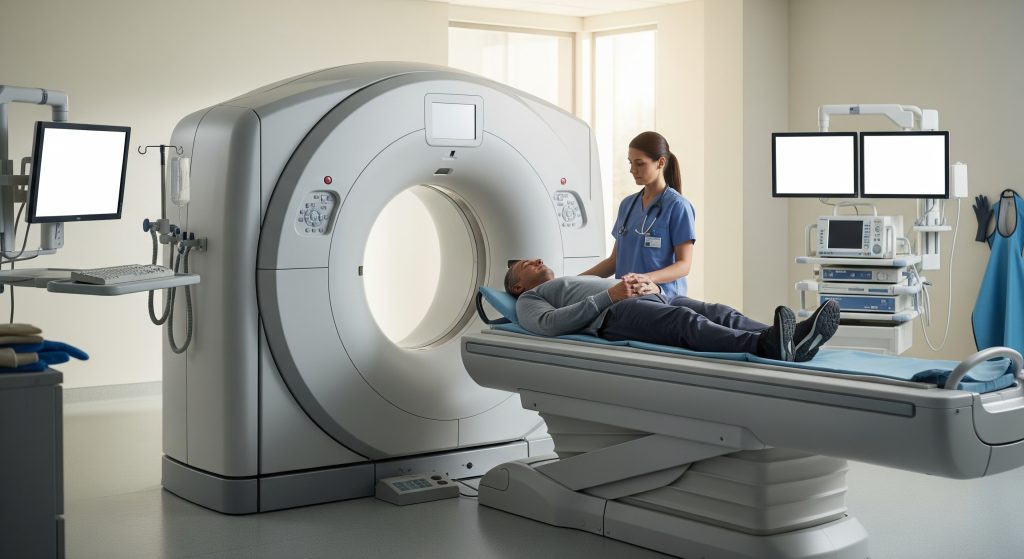
You will lie on a motorised table that moves through a ring-shaped scanner. The scanner acquires X-ray data and reconstructs them into thin slices and 3D views. As StatPearls – NCBI – NIH describes, image quality depends on both technology and positioning.
-
Breathing instructions: you will be asked to hold your breath for short periods.
-
With contrast: you may feel warmth or a metallic taste for several seconds.
-
Motion control: keeping still prevents repeat imaging and extra dose.
Duration and Patient Positioning
The scan time is brief. As Johns Hopkins Medicine notes, acquisition often takes 15-20 minutes, with longer total time if contrast is used. Preparation, cannulation, and circulation time add to the visit.
Positioning is not trivial. As Qaelum reports, poor centring can increase dose by up to 91% and degrade images. Radiographers use lasers and sometimes 3D body contouring to centre you accurately.
Special Considerations for Children
Paediatric Chest CT follows the principle of lowest reasonable dose and highest cooperation. As CHOP emphasises, child-specific protocols and careful allergy screening are essential, and the team will tailor parameters to size and indication.
Preparation reduces anxiety and movement. As Preparation of children for elective surgery and hospitalization underlines, informed parents help children cope better. A calm environment reduces the need for repeat scans. That protects dose and improves results.
Risks and Safety Considerations
Understanding Radiation Exposure Levels
Radiation is a real risk, though the risk from a single Chest CT is small for most adults. The principle is to justify each scan and keep the dose as low as reasonably achievable. As Radiation Safety and Protection stresses, ALARA underpins practice to minimise exposure while preserving diagnostic value.
Population-level concerns remain. As Projected Lifetime Cancer Risks From Current Computed Tomography Imaging estimates, modern CT use could contribute tens of thousands of future cancers in the U.S., which argues for careful indication and dose management. As NIH Research Matters notes, preventing unnecessary scans and optimising dose per scan meaningfully reduces projected harms.
The individual benefit must exceed the incremental lifetime risk. That is the calculus, and it should be explicit.
Comparing CT Radiation to Other Sources
CT delivers more radiation than a standard chest X-ray. In hybrid studies such as PET-CT, dose can be higher again. As Operational radiation safety for PET-CT, SPECT-CT, and … notes, combined modalities increase exposure, so indications must be strong and protocols optimised.
|
Source |
Relative exposure (qualitative) |
|---|---|
|
Chest X-ray |
Low |
|
Chest CT |
Moderate |
|
PET-CT |
Moderate to higher |
Risk Factors for Different Age Groups
Children are more sensitive to ionising radiation and have more years ahead for potential effects to manifest. As NCI explains, you should apply stricter thresholds for paediatric imaging and adjust technical factors to body size. Adults still need caution, especially with repeated scans.
Strategies for Minimising Radiation Dose
Three principles guide dose reduction: justification, optimisation, and limitation. As Radiation Safety and Protection – StatPearls sets out, these principles should shape every protocol. In practice that means tailored protocols and robust quality assurance.
Technology helps. As Radiation Dose Optimization in Radiology details, automatic exposure control, iterative reconstruction, and size-specific protocols lower dose without sacrificing diagnostic confidence. For HRCT, Optimizing Radiation Dose in High-Resolution Chest CT highlights SSDE as a better metric and urges tube current and voltage adjustments based on patient size.
Operational checks matter too. As ACR advises, accurate CTDI testing and medical physicist input help identify overexposure risks and maintain adherence to diagnostic reference levels.
Contrast Agent Reactions and Allergies
Adverse reactions to iodinated contrast are uncommon and usually mild, such as warmth, rash, or nausea. Severe events are rare. As Allergic-type reactions to radiographic contrast media explains, immediate reactions occur within an hour, while delayed reactions may arise later the same day. Prior contrast reaction, asthma, and certain drug allergies increase risk, while seafood allergy does not.
Preparedness reduces harm. As Management and Prevention of Hypersensitivity Reactions recommends, clear documentation, premedication for high-risk patients, and ready access to emergency treatments are standard. In practice, teams stop the infusion, monitor vital signs, and treat promptly. As MD Anderson outlines, antihistamines handle mild cases, while severe reactions may require intravenous epinephrine and airway support.
Making Informed Decisions About Chest CT Scans
Use a Chest CT when the result will change management. Not when it will simply confirm what is already known. That is the cleanest rule of thumb.
-
Clarify the clinical question in advance. Vascular vs parenchymal queries drive whether you need a pulmonary ct scan, HRCT, or standard imaging.
-
Confirm whether contrast is required. A chest ct scan with contrast helps when vessels, perfusion, or enhancement characteristics matter.
-
Ask about dose optimisation. Request low-dose protocols when appropriate and ensure prior scans are available to avoid duplication.
-
Plan follow-up. If a nodule is expected, discuss a surveillance schedule upfront.
Radiology has its own shorthand. You may see CAC, SSDE, CTDI, or DRL in reports. CAC refers to coronary artery calcium if incidentally noted, SSDE is size-specific dose estimate, CTDI is a scanner dose index, and DRL means a reference level for typical exams. These terms help teams manage both quality and risk.
One final thought. Imaging does not treat disease. It directs treatment. Insist that every scan earns its place by answering a real question.
Frequently Asked Questions
How long does a chest CT scan typically take?
The image acquisition usually takes 15-20 minutes, with extra time for preparation and any contrast circulation. As Johns Hopkins Medicine notes, plan for a longer appointment if IV access is needed.
Can I eat before a chest CT scan?
Many centres no longer require fasting for routine IV contrast. As Preprocedural fasting for contrast-enhanced CT indicates, non-fasting does not increase aspiration risk. Follow local instructions, which may still recommend a short fast for contrast studies.
Is chest CT better than a regular chest X-ray?
For detecting nodules, early interstitial disease, or subtle complications, yes. CT is more sensitive. As Dove Medical Press reports, CT has the highest sensitivity for pneumonia as well. But X-ray remains appropriate for many routine checks.
How much radiation exposure comes from a chest CT?
It is higher than a chest X-ray but varies by protocol and scanner. The overall risk from a single study is small for most adults. As American Cancer Society stresses, cumulative exposure matters, so avoid unnecessary repeats.
What’s the difference between CT and MRI for chest imaging?
CT uses X-rays and is fast and excellent for lungs, bone, and vessels with contrast. MRI uses magnetic fields and excels at soft tissue characterisation without radiation. As StatPearls notes, CT is first-line for lung parenchyma and mediastinum, while MRI is adjunct for select questions.
How often can you safely have chest CT scans?
As infrequently as possible while still answering clinical questions. For high-risk smokers in screening, annual LDCT is recommended. As USPSTF states, stop screening when criteria are no longer met.
Will I need contrast dye for my chest CT?
Only if the question involves vessels, perfusion, or enhancement. For pulmonary embolism or vascular mapping, yes. As Jornal Brasileiro de Pneumologia explains, contrast is critical for accurate vascular assessment. For interstitial disease, HRCT usually proceeds without contrast.

