






 We do what's right for you...


What Causes Speech Delay and How Treatment Can Help at Home
Dr. Sanjay Siddharth
Talk to most paediatricians about speech delay and they’ll tell parents to wait. Give it time. Children develop at their own pace. That advice isn’t wrong, exactly. But here’s the thing. It’s incomplete. Because while some late talkers do catch up on their own, others don’t. And the difference between those two outcomes often comes down to what happens at home in the months (and sometimes years) before anyone officially diagnoses a problem.
Understanding the causes behind speech delay is half the battle. The other half? Knowing which speech delay treatment approaches actually work in your living room, at your kitchen table, during bath time. This isn’t about replacing professional help. It’s about becoming your child’s best communication partner while you figure out whether professional help is needed at all.
Common Causes of Speech Delay in Different Age Groups
Before diving into treatment, it helps to understand what might be causing the delay in the first place. The causes vary wildly depending on age, and pinpointing the likely culprit can shape your entire approach to supporting your child.
Hearing Problems and Ear Infections
This is the one that gets overlooked most often. A child who can’t hear clearly can’t learn to speak clearly. It’s that simple. Chronic ear infections, fluid buildup behind the eardrums, or even mild hearing loss can dramatically affect how a toddler processes and reproduces sounds.
The frustrating part is that children with hearing issues don’t always show obvious signs. They might respond to some sounds but miss others. They might seem to “ignore” you when really they just didn’t catch what you said. If your child has had multiple ear infections before age two, or if speech seems stuck despite other developmental progress, a hearing test should be your first port of call. Not your third. Not something you get around to eventually. First.
Oral-Motor Development Issues
Sometimes the brain knows exactly what it wants to say but the mouth can’t quite coordinate the movements to say it. This disconnect between intention and execution is at the heart of conditions like childhood apraxia of speech, where difficulty coordinating lip, jaw and tongue movements leads to varying levels of speech delays, as noted by Mayo Clinic.
Physical structures matter too. A short lingual frenulum (that little band of tissue connecting the tongue to the floor of the mouth) can restrict tongue movement and affect speech clarity. You might notice your child struggling with certain sounds, drooling more than expected for their age, or having difficulty with feeding in early infancy.
The good news? Oral-motor issues often respond brilliantly to targeted exercises and speech therapy techniques, many of which can be practised at home.
Neurological and Developmental Disorders
Conditions affecting brain development can impact speech and language in complex ways. This includes:
-
Cerebral palsy, which affects muscle control throughout the body including the muscles needed for speech
-
Intellectual disabilities that affect the pace of learning language rules
-
Genetic conditions like Down syndrome, which often involves both hearing issues and oral-motor challenges
-
Brain injuries from birth complications or accidents
These situations typically require professional intervention alongside home support. But home-based practice remains crucial. Therapy sessions might happen once or twice a week. Home is where the other 165 hours happen.
Speech Delay and Autism Connection
Let’s address this directly because it’s often the elephant in the room. Yes, speech delay can be an early indicator of autism spectrum disorder. But no, speech delay doesn’t mean your child has autism. The two can exist completely independently.
The key difference lies in the nature of the communication difficulty. Children with autism often struggle with the social aspects of communication. They might not make eye contact, might not point at things to share interest, might not respond to their name consistently. A child with a “pure” speech delay usually communicates enthusiastically through gestures, facial expressions and other non-verbal means. They desperately want to communicate. They just can’t get the words out.
If you’re seeing delays in speech alongside unusual social behaviour, limited imaginative play, or repetitive movements, it’s worth seeking a comprehensive developmental assessment. Early intervention for autism makes an enormous difference to outcomes.
Environmental and Social Factors
Here’s where things get uncomfortable for parents. Sometimes speech delay isn’t caused by anything “wrong” with the child. Sometimes it’s the environment.
Children learn language through interaction. Constant, repetitive, back-and-forth interaction. A child who spends most of their day in front of screens, or in a home where adults rarely engage them in conversation, will have fewer opportunities to develop language skills. This isn’t about blame. Modern life is exhausting, and screens are convenient. But the research is clear: children need thousands of direct conversational exchanges to build language. There’s no shortcut.
Neglect and trauma can also impact speech development. A child who doesn’t feel safe may have difficulty with all forms of communication, including speech.
Bilingual Language Development Challenges
Growing up bilingual is ultimately an advantage. But in the early years, it can look like a delay. Children learning two languages simultaneously often mix languages, use fewer words in each individual language, and hit language development milestones slightly later than their monolingual peers.
This typically resolves by age five or six. The total vocabulary across both languages is usually comparable to monolingual children. The concern arises when a bilingual child shows delays in both languages, not just one. That suggests something beyond normal bilingual development is at play.
Home-Based Speech Therapy Techniques and Treatment Methods
Right. You’ve thought about causes. Now let’s get practical. These speech therapy techniques can be implemented at home, starting today, regardless of whether you’re waiting for professional assessment or supplementing existing therapy.
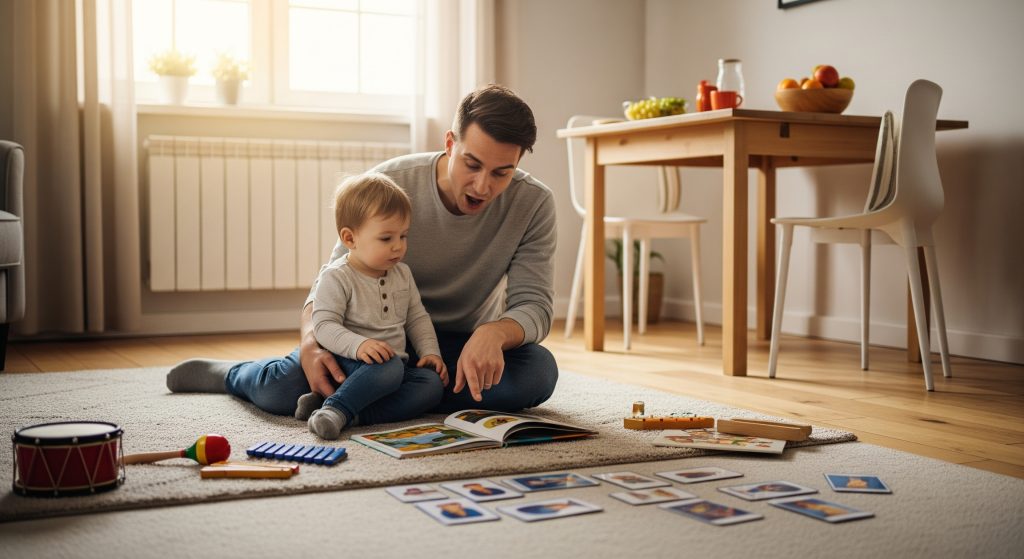
1. Interactive Reading Activities
I’m going to say something controversial: forget “reading” to your child in the traditional sense. Sitting passively while someone reads aloud doesn’t build language nearly as effectively as interactive reading.
Interactive reading means stopping constantly. Pointing at pictures. Asking questions. Making silly sounds for the animals. Letting your child “read” the familiar bits back to you. A ten-page board book should take fifteen minutes, not three. You’re not trying to get through the story. You’re trying to have a conversation about the story.
Specific techniques that work:
-
Pause and point: Pause mid-sentence and point at a picture, waiting for your child to fill in the word
-
Expand: When your child says “dog,” you say “Yes! A big brown dog running fast!”
-
Ask open questions: “What do you think happens next?” rather than “Is the ball red?”
-
Re-read favourites: Repetition builds vocabulary. The same book twenty times teaches more than twenty different books once each
2. Repetition and Modelling Exercises
When your child says something incorrectly, don’t correct them. Model the correct version instead. If they say “goggy,” you say “Yes, doggy! That’s a doggy.” This gentle correction preserves their confidence while providing the correct model.
Repetition is everything. Choose a few target words and find ways to use them dozens of times throughout the day. If you’re working on “ball,” don’t just say it once during playtime. “Where’s the ball? There’s the ball! Big ball. Red ball. Throw the ball. Catch the ball. Ball goes up. Ball comes down.”
Sounds tedious? It is, a bit. But it works.
3. Play-Based Learning Strategies
Here’s a revelation that took me embarrassingly long to grasp: children don’t learn language from drills. They learn it from play. Your job is to turn yourself into a running commentary during playtime.
Follow your child’s lead. Whatever they’re interested in, narrate it. Build on it. If they’re pushing a car, you push a car too. “Vroom vroom! My car goes fast. Your car goes… where does your car go? Up the hill! Down the hill! Crash!”
The magic happens when play is genuinely fun and language just happens to be embedded in it. A child stacking blocks doesn’t know they’re learning “up,” “down,” “on,” “more,” and “fall down.” They just know stacking is brilliant.
4. Visual Aids and Picture Cards
Some children are highly visual learners. For these kids, picture cards can accelerate speech development dramatically.
|
Type of Visual Aid |
Best Used For |
|---|---|
|
Simple flashcards (single images) |
Building initial vocabulary, naming practice |
|
Category cards (animals, foods, etc.) |
Teaching word relationships and organisation |
|
Action cards (running, eating, etc.) |
Introducing verbs and sentence building |
|
Sequence cards |
Understanding story structure, using past/future tense |
|
Communication boards |
Children who need AAC (augmentative and alternative communication) support |
You can buy these or make them yourself. Phone photos of familiar objects printed and laminated work brilliantly because they show your actual dog, your actual car, your actual grandma.
5. Music and Rhythm Activities
There’s something about music that bypasses normal language processing difficulties. I’ve seen children who couldn’t string two words together sing entire nursery rhymes perfectly. The rhythm, melody and repetition seem to create a different pathway into language.
Use this ruthlessly. Sing constantly. Make up songs about what you’re doing. “This is the way we brush our teeth, brush our teeth, brush our teeth.” Choose songs with actions and encourage your child to do the motions even if they’re not singing. The words often follow the actions.
Clapping games, rhythm instruments, and musical games all support speech development by building auditory processing skills and rhythm awareness. Both matter more than you’d think for clear speech.
6. Oral Motor Strengthening Exercises
If oral-motor weakness is part of the picture, specific exercises can help strengthen the muscles needed for speech. These work best when disguised as games:
-
Blowing bubbles: Strengthens lip muscles and breath control
-
Drinking thick smoothies through straws: Works the cheeks and tongue
-
Licking food off lips: Tongue mobility and strength (peanut butter or chocolate spread works wonders for motivation)
-
Making funny faces in the mirror: Stretches and strengthens facial muscles
-
Blowing cotton balls across a table: Breath control and sustained airflow
Don’t overdo these. Five minutes of oral-motor play scattered throughout the day is plenty. The goal is consistent practice, not marathon sessions.
7. Technology-Assisted Learning Tools
Wait. Didn’t I just say screens are a problem? They can be. But used intentionally and interactively, certain apps and tools can support speech development.
The key distinction is between passive screen time (watching videos alone) and active screen time (using apps with a parent, video calling grandparents, using speech-practice apps together). The second category can be valuable. The first is basically useless for language development.
Look for apps specifically designed for speech therapy practice. Many allow you to record and play back your child’s speech, which some children find incredibly motivating. Video calls with family members provide genuine back-and-forth conversation. Even well-designed educational programmes can help if you watch together and talk about what you’re seeing.
Creating an Effective Speech Development Environment at Home
Speech delay treatment isn’t just about specific exercises. It’s about creating an entire environment that supports language development. Think of it like trying to learn a foreign language. Immersion beats textbooks every time.
Daily Routine Integration Strategies
The most effective speech practice doesn’t feel like practice at all. It’s woven into daily routines so seamlessly that it becomes invisible.
Morning routine: Name every item of clothing as you dress them. Count buttons. Describe what you’re doing. “First socks. One sock, two socks. Now trousers. Pull up, up, up!”
Meals: Name foods. Describe textures and temperatures. Use words like “more,” “all done,” “yummy,” and “yuck” repeatedly. Let them make choices between two visible options.
Bath time: This is speech therapy gold. Water play, bubbles, toys, body part naming, action words (splash, pour, drip), temperature words. A bath offers more language opportunities in twenty minutes than most formal therapy sessions.
Bedtime: Recap the day. “Remember when we went to the park? You went on the swing! Wheee!” This builds memory, narrative skills, and past-tense verb use.
Language Development Milestones Tracking
You need to know where your child is to know if they’re making progress. Here’s a rough guide to typical language development milestones:
|
Age |
Typical Language Skills |
|---|---|
|
12 months |
1-3 words, responds to name, understands “no” |
|
18 months |
10-25 words, points to body parts, follows simple instructions |
|
2 years |
50+ words, two-word phrases, understood by parents most of the time |
|
3 years |
200+ words, three-word sentences, strangers understand most speech |
|
4 years |
Complex sentences, tells stories, understood by anyone |
Track progress informally. Keep a note on your phone of new words and when they appeared. This information is invaluable if you do end up seeing a speech therapist.
Family Communication Guidelines
Everyone in the household needs to be on the same page. This includes siblings, grandparents and anyone else who spends significant time with your child.
Key guidelines for the whole family:
-
Wait. Give the child time to respond before jumping in. Count to ten in your head.
-
Get down to their eye level when speaking
-
Don’t finish their sentences (unless they’re genuinely stuck and getting frustrated)
-
Model correct speech without explicitly correcting
-
Celebrate all communication attempts, not just clear words
-
Avoid the temptation to anticipate every need – let them ask
That last one is tough. When you know your child wants the blue cup, it’s quicker to just give them the blue cup. But every time you anticipate their need, you remove a reason to communicate. Let them work for it a bit.
Screen Time Management
What drives me mad is the all-or-nothing approach to screen time. “No screens ever!” is unrealistic for most families. “Unlimited screens!” is genuinely harmful for language development. The answer, annoyingly, is somewhere in the middle.
For children with speech delays, the guidance is stricter than for typically developing children. Aim for:
-
No solo screen time for children under 2 (video calls with family are fine)
-
Maximum 30 minutes of high-quality, interactive screen time for 2-3 year-olds
-
Maximum 1 hour for 3-5 year-olds
-
Always co-view when possible – talk about what you’re watching
-
Never use screens during meals or in the hour before bed
The issue isn’t that screens are inherently evil. It’s opportunity cost. Every hour spent watching a screen is an hour not spent in interactive play and conversation. For a child who’s already behind on language, those lost hours matter.
When to Seek Professional Help
Home-based speech therapy techniques are powerful. But they have limits. You should seek professional evaluation if:
-
Your child isn’t babbling by 12 months
-
No words by 18 months
-
No two-word phrases by 2 years
-
Speech is significantly less clear than peers by age 3
-
You notice regression – losing words they previously used
-
Your child shows frustration or behavioural problems related to communication difficulties
-
There are signs of hearing problems
-
You’re concerned (trust your instincts)
Getting a professional assessment doesn’t mean something is “wrong.” It means you’re being thorough. Many children assessed for speech delay turn out to be within normal variation. Others get early intervention that dramatically improves their trajectory. Either outcome is better than waiting and wondering.
Moving Forward with Speech Delay Treatment
Picture this: a three-year-old who barely spoke six months ago is now chatting away at the breakfast table, demanding a specific cereal, complaining about wearing socks, asking why the sky is blue. That transformation happens. I’ve seen it happen. And it happens through consistent, patient, daily practice far more than through any magic intervention.
The single most important thing? Talk to your child. All day. Every day. Even when they don’t respond. Even when you feel like an idiot narrating your trip to the supermarket. Even when you’re exhausted and don’t feel like explaining what you’re cooking for the fortieth time. The words are going in, even when they’re not coming out yet.
Speech delay treatment at home isn’t about perfection. It’s about creating an environment so rich in language, so full of communication opportunities, so encouraging of all attempts to connect, that speech becomes inevitable. You’re not teaching a skill. You’re creating conditions for development that’s already trying to happen.
And if professional help turns out to be necessary? You’ll have laid the groundwork that makes therapy more effective. Every minute of home practice amplifies the impact of clinical intervention. You’re not waiting for someone else to fix this. You’re part of the solution, starting now.
Frequently Asked Questions
At what age should I worry about speech delay?
Red flags appear at different ages. Be concerned if there’s no babbling by 12 months, no words by 18 months, or no two-word phrases by 24 months. That said, “concern” should mean “seek evaluation,” not “panic.” Many children who miss these milestones catch up with appropriate support.
Can speech delay be completely cured with home treatment?
Many mild delays resolve entirely with consistent home-based intervention. More significant delays often require professional therapy alongside home practice. The honest answer is: it depends on the cause. Home treatment is always beneficial, but it may not be sufficient by itself.
How long does speech therapy take to show results?
Most families see some improvement within 3-6 months of consistent intervention. However, this varies enormously depending on the underlying cause, severity of delay, age of the child, and consistency of practice. Some children make rapid progress; others need years of support.
Is speech delay always linked to autism?
Absolutely not. While speech delay is common in children with autism, most speech-delayed children are not autistic. Pure speech delay without social communication difficulties is far more common than speech delay related to autism spectrum disorder.
What foods help with speech development?
Foods that require chewing strengthen oral muscles. Think crunchy vegetables, chewy foods like dried fruit, and foods that encourage tongue movement (like licking ice cream). Avoid over-reliance on pouches and purées past infancy – the chewing practice matters for speech development.
Can excessive screen time cause speech delay?
Research shows a correlation between heavy screen use and language delays, particularly for children under 3. Whether screens directly cause delay or simply displace interactive activities that build language isn’t entirely clear. Either way, reducing screen time and increasing conversation is beneficial.
Should I use baby talk with a speech-delayed child?
It depends what you mean by baby talk. Simplified vocabulary and exaggerated intonation (parentese) actually help language development – this is the sing-song voice adults naturally use with babies. However, using incorrect words or pronunciation (“baba” for “bottle”) should be avoided. Use real words, but don’t be afraid to speak in a warm, exaggerated, engaging way.

