






 We do what's right for you...


What Bone Fracture Medication Works Best for Healing Fast?
Dr. Neetan Sachdeva
Quick fixes are often praised in fracture care. The promise of a single injection that makes bone mend overnight is tempting. It is also misleading. I focus on what actually accelerates repair. The right bone fracture medication helps, but it never replaces sound fixation, nutrition, and load management. Used well, it shortens the time to union and reduces complications. Used poorly, it delays healing and adds risk.
Top Bone Fracture Medications for Accelerated Healing
1. Teriparatide (Forteo) – Leading Anabolic Treatment
I consider teriparatide the reference anabolic for difficult fractures. It is a parathyroid hormone analogue that stimulates osteoblast activity. In practice, this bone fracture medication promotes callus formation and improves remodelling. The effect is most visible in delayed unions, atypical femoral fractures, and fragility fractures with high risk of non-union.
Two pragmatic advantages stand out. First, it acts on formation rather than only reducing resorption. Second, its onset is relatively quick for a bone drug. I have seen earlier radiographic bridging in complex tibial fractures under this therapy. That is a pattern repeated by many colleagues, though not without exceptions.
-
Use case: delayed union, non-union risk, osteoporotic fractures.
-
Administration: daily subcutaneous injection with structured monitoring.
-
Practical tip: start as early as the clinical picture justifies, after fixation stability is confirmed.
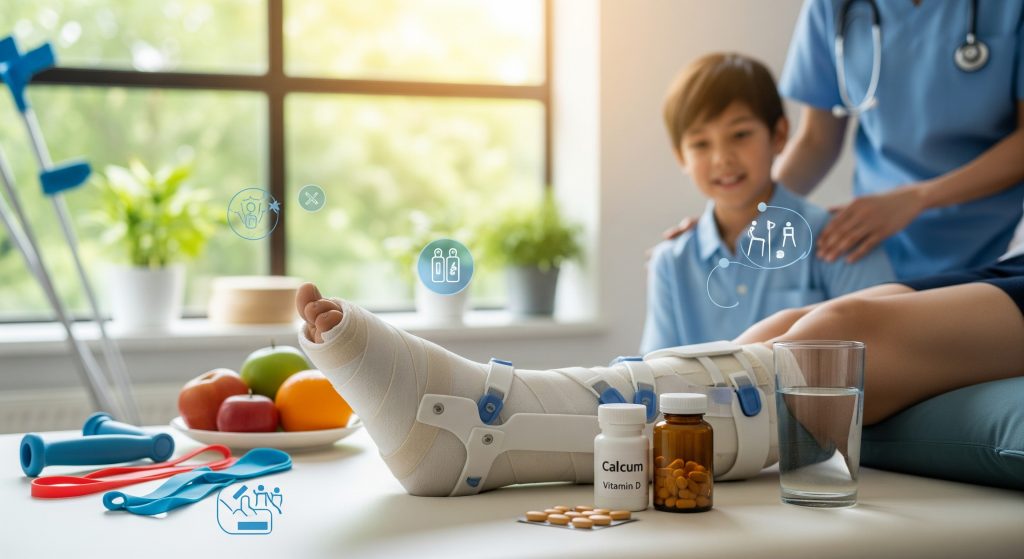
2. Calcium and Vitamin D Supplements – Essential Nutrients
These are not glamorous, yet they remain foundational. Calcium provides the raw material for mineralisation. Vitamin D supports calcium absorption and skeletal metabolism. I use them to support any bone fracture medication that targets formation or reduces resorption.
In practice, I confirm baseline vitamin D status where possible. I correct low levels promptly. This modest step reduces avoidable delays in mineralisation. It also protects against secondary hyperparathyroidism during immobilisation.
-
Indication: nearly universal in adult fracture patients unless contraindicated.
-
Role: adjunct to surgical care and any pharmacologic programme.
-
Red flag: do not overcorrect. Hypercalcaemia creates its own problems.
3. Novel Injectable Drugs Under Development
Several investigational agents aim to speed fracture repair. Mechanisms include Wnt pathway modulation, sclerostin inhibition, and targeted osteoanabolic signalling. Some of these are reformulations of osteoporosis agents with fracture specific protocols. Others are entirely new molecules.
My stance is careful optimism. The pipeline is active, and preclinical data are encouraging. Clinical utility will depend on safety, injection frequency, and cost. A future bone fracture medication will likely combine rapid onset with simple dosing and low adverse events.
4. Growth Factors and BMP-2 Therapies
Local delivery of bone morphogenetic protein 2 can aid challenging cases. It is not a casual choice. I reserve BMP-2 for recalcitrant non-unions or large segmental defects with poor biology. When fixation is rigid and infection is controlled, BMP-2 can push the biology forward.
Risks include soft tissue swelling and ectopic bone. Cost is significant. I weigh these factors against the potential to avoid multi stage reconstruction. When used thoughtfully, it complements rather than replaces systemic bone fracture medication.
5. Alternative Anabolic Medications
Abaloparatide is a PTHrP analogue with anabolic action. Romosozumab is a sclerostin inhibitor with dual effects on formation and resorption. Both have plausible roles in fracture scenarios, especially in severe osteoporosis. Evidence for dedicated fracture repair acceleration is growing but remains heterogeneous.
I do use them when osteoporosis treatment options narrow and fracture risk is extreme. Selection hinges on cardiovascular risk, injection logistics, and payer realities. The right choice supports the core goal: a stable union with preserved long term bone strength.
Bisphosphonates and Osteoporosis Treatment in Fracture Management
Understanding Bisphosphonate Effects on Healing
Bisphosphonates reduce osteoclastic bone resorption. That is the core pharmacology. A frequent concern is whether they slow callus remodelling and delay union. The clinical picture is more nuanced. With stable fixation and adequate biology, union proceeds in most cases. Callus may appear larger, and remodelling can be slower in the late phase.
I distinguish between acute healing and long term microarchitecture. Many patients benefit from bisphosphonates for bone health after an initial anabolic phase. This staged approach balances immediate healing with secondary fracture prevention. It also keeps the overall bone fracture medication plan coherent.
Optimal Timing for Bisphosphonate Initiation
Timing matters. I avoid initiating potent antiresorptives in the first weeks after a high risk repair. Where fracture stability is excellent and biology is robust, earlier starts are acceptable. However, a brief window for early callus formation is often prudent.
A practical approach is simple. Confirm clinical progress and initial radiographic bridging. Begin bisphosphonates for bone health once the union trajectory is clear. If an anabolic is used, transition to antiresorptive therapy after the anabolic course completes.
Managing Osteoporosis Treatment During Recovery
An acute fracture is an opportunity to reassess osteoporosis treatment options. I stratify by fracture risk, prior therapy, renal function, and adherence history. An anabolic first strategy suits severe disease or delayed healing risk. Antiresorptives follow to maintain gains.
For patients already on long term therapy, I review duration and response. A guarded pause may be reasonable with stable low risk. With high risk, I prefer continuity or a structured switch. The underlying principle remains clear. The fracture must heal, and future fractures must be prevented.
Balancing Bone Health with Healing Requirements
Tension between short term union and long term protection is real. It is not insoluble. I map a phased plan that sets expectations. Early phase prioritises biology and stability. Middle phase consolidates union. Late phase focuses on durability and secondary prevention.
-
Early 0 to 6 weeks: support callus with nutrition and, where indicated, an anabolic agent.
-
Consolidation: evaluate progression, adjust load, and consider antiresorptive initiation.
-
Maintenance: continue antiresorptive or sequential therapy and reinforce fall prevention.
Structured sequencing turns a complex choice into a manageable protocol. That is how a bone fracture medication programme earns its keep.
Evidence-Based Treatment Guidelines and Protocols
Clinical Dosing Recommendations for Teriparatide
My standard protocol uses daily subcutaneous dosing with calcium and vitamin D optimisation. I counsel on injection technique and rotate sites. I also document baseline pain, function, and risk factors. A clear start gives measurable progress later.
|
Parameter |
Recommendation |
|---|---|
|
Candidate profile |
Delayed union risk, severe osteoporosis, atypical fracture, or failed prior consolidation |
|
Adjuncts |
Calcium 1000 to 1200 mg daily and vitamin D repletion as indicated |
|
Monitoring |
Clinical pain and function every 4 to 6 weeks and imaging at key milestones |
|
Safety |
Assess calcium, renal profile, and rare adverse signals at regular intervals |
Teriparatide is most effective when fixation is stable, vitamin D is adequate, and loading is progressive but controlled.
This is basic, but it changes outcomes. Good mechanics and good biology multiply each other. Poor mechanics defeats any bone fracture medication.
Combination Therapy Approaches
Combination means sequence as much as overlap. I often use anabolic first and antiresorptive second. Overlap can be considered at the transition point to preserve gains. Calcium and vitamin D run throughout.
-
Sequential approach: teriparatide followed by a bisphosphonate or denosumab.
-
Local plus systemic: stable fixation, local BMP-2 in selected cases, systemic anabolic support.
-
Rehabilitation: progressive weight bearing aligned with biological stage.
The best combination respects the tissue timeline. It avoids metabolic confusion and keeps adherence realistic. That is the quiet art behind an effective bone fracture medication plan.
Duration of Treatment for Optimal Results
Duration depends on fracture site, patient risk, and response. Many complex cases benefit from several months of anabolic support. I taper only after sustained clinical and radiographic improvement. Longer courses are considered in stubborn unions, within safety limits.
Antiresorptives often continue for years in high risk osteoporosis. Drug holidays may be appropriate in selected patients. The decision is individual and, to an extent, depends on bone density and incident fracture history.
Monitoring Healing Progress and Adjustments
I track three signals. Symptoms, function, and imaging. Pain reduction is a crude but useful guide. Function improves as the callus matures. Imaging confirms bridging and remodelling trajectory. I adjust therapy when one signal diverges from the others.
Examples clarify the approach. A mid tibia delayed union with rising pain and flat radiographs prompts anabolic escalation. A stable wrist fracture with strong clinical recovery permits earlier antiresorptive transition. The bone fracture medication follows the biology, not the calendar.
Managing Side Effects and Treatment Considerations
Common Ibandronic Acid Side Effects
Oral and intravenous ibandronate help maintain bone mass. I discuss typical ibandronic acid side effects before starting therapy. Common reactions include transient flu like symptoms, musculoskeletal pain, and gastrointestinal upset. Rare complications include atypical femoral fracture and osteonecrosis of the jaw after prolonged use.
Good technique reduces risk. I advise dental review for high risk patients. I separate dosing from calcium supplements to protect absorption. Counselling increases adherence and reduces unnecessary concern.
Contraindications and Risk Factors
Absolute and relative contraindications require attention. For anabolics, prior skeletal radiation and certain malignancies are key considerations. For antiresorptives, severe renal impairment, hypocalcaemia, and high osteonecrosis risk matter. I screen systematically and document the baseline state.
Risk is not static. It changes with healing progress, comorbidities, and new medications. That is why I review therapy at every major milestone. A bone fracture medication should serve the current phase, not the last one.
Drug Interactions to Avoid
Interactions are common and often avoidable. Calcium and iron reduce oral bisphosphonate absorption. I separate doses by several hours. Proton pump inhibitors can influence calcium absorption and fracture risk over time. I reassess need and lowest effective dose.
Glucocorticoids complicate the picture by increasing resorption and impairing healing. If steroids are necessary, I favour an anabolic first approach. Anticoagulants affect surgical decisions but seldom interact with the bone fracture medication itself. Coordination across teams prevents surprises.
Special Populations and Precautions
Older adults, those with frailty, and patients with chronic kidney disease require tailored regimens. For advanced renal disease, I use caution with potent antiresorptives and adjust calcium strategies. For very elderly patients, adherence and fall risk overshadow stylish pharmacology. Success is safer homes, steadier gait, and a union that holds.
In athletes, return to play pressures are intense. I set objective milestones and avoid premature load. In pregnancy and lactation, I avoid most systemic agents and focus on mechanics and nutrition. The right bone fracture medication is sometimes no medication at all, just disciplined care.
Making Informed Decisions About Bone Fracture Medication
Decision quality improves when objectives are explicit. The first objective is union. The second is function. The third is durable bone strength. I align agents to sequence these goals. Anabolic to build. Antiresorptive to keep. Nutrition to support. Rehabilitation to translate gains into real movement.
Here is a simple frame I use at the bedside. It fits on one page and avoids decision paralysis.
-
Confirm fixation stability and infection control before pharmacologic escalation.
-
Screen for modifiable deficits: vitamin D, protein intake, and smoking status.
-
Consider teriparatide when healing is at risk or biology is compromised.
-
Transition to maintenance therapy for bisphosphonates for bone health when union is secure.
-
Reevaluate every 4 to 6 weeks and adjust based on progress, not habit.
A bone fracture medication is a tool, not a shortcut. Used judiciously, it shortens time to union and reduces reoperation. Used casually, it muddies the picture and wastes time. The difference is disciplined assessment and honest follow up.
Frequently Asked Questions
How long does teriparatide take to accelerate fracture healing?
Clinical improvement often appears within several weeks. Radiographic changes follow as bridging develops. I usually evaluate formal progress at 6 to 8 weeks. This window allows biology to respond and removes noise from week to week pain variation.
For complex non-unions, the meaningful change is function. I look for improved load tolerance and reduced night pain. If neither improves by two months, I reconsider the plan. The bone fracture medication must earn its place with observable gains.
Can bisphosphonates be safely started immediately after fracture?
They can be started early in selected cases with stable fixation and simple biology. My routine approach is more staged. I give a short period for initial callus formation before introducing potent antiresorptives. This avoids any risk of blunting early remodelling, at least in theory.
When anabolic therapy is used, initiation of antiresorptive treatment follows completion. That sequence preserves the anabolic gains while addressing future fracture risk. The result is a coherent path rather than competing signals.
What are the most serious side effects of bone fracture medications?
Serious but rare events include osteonecrosis of the jaw, atypical femoral fractures, and severe hypocalcaemia with some regimens. For anabolics, hypercalcaemia and transient hypotension can occur. I review dental status, calcium balance, and duration of prior therapy.
Discussing ibandronic acid side effects helps set expectations. Most reactions are mild and transient. Early reporting of jaw symptoms or thigh pain is essential. The benefits are real, but vigilance keeps risks low.
Is calcium and vitamin D supplementation alone sufficient for fracture healing?
Not for complex injuries. Supplements support mineralisation, but they do not drive callus formation by themselves. For higher risk cases, I add targeted pharmacology and structured rehabilitation. For straightforward fractures, calcium and vitamin D combined with good mechanics are often enough.
Choice depends on fracture pattern, patient risk, and trajectory of healing. A bone fracture medication adds value when biology lags behind mechanics. It is unnecessary when biology already outperforms expectations.
When should osteoporosis treatment be modified during fracture recovery?
Modify treatment when risk changes or the healing phase shifts. I reassess at fixation, early consolidation, and pre discharge from rehabilitation. Anabolic first is reasonable for delayed union risk. Maintenance antiresorptive therapy follows when union is secure.
This sequence respects timing and outcomes. It also integrates broader osteoporosis treatment options into a single plan. The aim is simple. Heal this fracture and prevent the next one.
Final note: If in doubt, tighten the fundamentals. Stable fixation, adequate nutrition, smoking cessation, and progressive load. Then add the right bone fracture medication, chosen for the patient in front of you.

