






 We do what's right for you...


What Are the Early Signs of Squamous Cell Carcinoma?
Dr. Payal Gupta
There’s a prevailing belief that skin cancer announces itself dramatically. It doesn’t. Squamous cell carcinoma symptoms often begin as something so unremarkable that most people dismiss them entirely. That rough patch that’s been there for months? The little sore that almost heals and then doesn’t? These quiet, persistent changes are precisely what demand attention.
I’ve spent years reviewing dermatological cases, and the single most frustrating part of this work is seeing patients who waited. Not because they didn’t care, but because they genuinely thought what they were looking at was nothing. A bit of dry skin. An irritation from shaving. Something that would sort itself out eventually. By the time they finally booked that appointment, what could have been a straightforward removal had become something far more complicated.
This piece breaks down exactly what to look for, where squamous cell carcinoma tends to appear, and the underlying causes that put certain people at higher risk. Think of it as a field guide for your own skin. The goal isn’t to make anyone anxious about every freckle. It’s to help distinguish between the mundane and the meaningful.
Early Warning Signs of Squamous Cell Carcinoma
Squamous cell carcinoma (SCC) develops in the squamous cells that make up the middle and outer layers of skin. Unlike some conditions that arrive with obvious fanfare, SCC tends to creep in. The early signs can mimic common skin irritations, which is precisely why they’re so easy to overlook.
Persistent Scaly Red Patches
One of the earliest squamous cell carcinoma symptoms is a rough, scaly patch that simply won’t clear up. These patches often have a reddish tinge and feel like sandpaper when touched. They might itch occasionally, but many people experience no discomfort at all.
Here’s the critical distinction: normal dry skin responds to moisturiser. These patches don’t. Apply all the cream you want. They persist. This stubbornness is the giveaway. If a scaly patch has been hanging around for more than a few weeks without improvement, that’s worth investigating.
Open Sores That Won’t Heal
This one catches people off guard more than almost anything else. We all get minor cuts and scrapes that heal within a week or two. But an open sore that bleeds and crusts over and then partially heals and then breaks down again? That’s a red flag.
According to Mayo Clinic, open sores that won’t heal are a significant symptom of SCC, particularly in sun-exposed areas. The key word there is “particularly.” These sores most commonly appear on skin that’s had years of cumulative sun exposure.
I think of these non-healing sores like a smoke alarm that won’t stop chirping. It’s annoying. It’s tempting to ignore. But ignoring it doesn’t make the underlying problem disappear.
Elevated Growths with Central Depression
Picture a small dome-shaped bump that, instead of being uniformly rounded, has a dip or crater in the centre. This is sometimes called a “volcano” lesion, and the visual metaphor is apt. These growths might be flesh-coloured, pink, or red, and they tend to feel firm to the touch.
As noted by Cleveland Clinic, these elevated growths with central depression may crust or bleed if left untreated. The central depression occurs because the tumour is essentially outgrowing its own blood supply in the middle, causing that characteristic indentation.
Wart-like Growths
This is where things get tricky. Some squamous cell carcinomas genuinely look like common warts. They’re rough, raised, and might even have that cauliflower-like texture associated with viral warts. The difference? They don’t respond to wart treatments and they keep growing.
Any wart-like growth that appears after age 40, particularly on sun-exposed skin, deserves professional evaluation.
Changes in Existing Moles or Spots
While changes in moles are more commonly associated with melanoma, SCC can also arise from pre-existing spots. Watch for:
-
A previously flat spot that becomes raised
-
Changes in texture from smooth to rough or scaly
-
New redness or inflammation around an existing mark
-
Sudden growth in size after years of stability
The rule of thumb is simple. Stable is good. Change is concerning.
Bleeding or Crusting Lesions
Any skin lesion that bleeds spontaneously or with minimal contact warrants attention. Same goes for lesions that repeatedly form crusts that fall off and then reform. This cycle of crusting and breaking down is the body’s attempt to heal something that keeps breaking through.
Location-Specific Symptoms of Squamous Cell Carcinoma
SCC doesn’t play favourites, but it does have preferred spots. Understanding where these cancers commonly develop helps focus attention where it’s most needed.
Squamous Cell Carcinoma on Scalp Signs
The scalp is one of the most overlooked sites for skin cancer, particularly in people with thinning hair or baldness. Squamous cell carcinoma on scalp areas often starts as a scaly patch that feels like a persistent flaky spot. It might be mistaken for dandruff or seborrhoeic dermatitis initially.
What sets SCC apart on the scalp:
-
Localised to one specific area (rather than diffuse scaling)
-
Doesn’t respond to anti-dandruff treatments
-
May bleed when combing or brushing hair
-
Progressively thickens over time
The scalp is particularly vulnerable because it receives intense sun exposure throughout life. Most people don’t think to apply sunscreen there, especially if they have a full head of hair in their younger years. By the time hair thins, decades of damage have accumulated.
Squamous Cell Carcinoma on Lip Symptoms
Squamous cell carcinoma on lip areas almost always affects the lower lip. This makes anatomical sense. The lower lip faces upward, receiving direct sun exposure, while the upper lip is somewhat shaded by the nose.
Early signs on the lip include:
-
A persistent rough or scaly patch on the lip border
-
A sore that repeatedly crusts and bleeds
-
Loss of the clear definition between the lip and surrounding skin
-
A firm lump that develops within the lip tissue
What drives me crazy is how often lip SCC gets dismissed as chronic chapping. Yes, lips chap. But chapped lips respond to lip balm and environmental changes. A precancerous or cancerous lesion doesn’t. If lip “chapping” persists in one specific spot for weeks on end, that’s not chapping. That’s something else.
Signs on Face and Ears
The face is prime territory for SCC. The nose, forehead, cheeks, and temples all receive significant cumulative sun exposure. Ears are particularly vulnerable because people often forget to protect them.
|
Location |
Common Presentation |
|
Nose |
Scaly patch or nodule, often on the bridge or sides |
|
Forehead |
Red, scaly areas that may be mistaken for eczema |
|
Ears |
Crusting lesions on the helix (outer rim) or behind the ear |
|
Temples |
Firm bumps or thickened skin patches |
|
Eyelids |
Persistent sores that may affect lash line |
Symptoms on Hands and Arms
The backs of hands and forearms are classic locations for SCC because they receive constant sun exposure in everyday life. Think about it. Every time you drive, walk outside, or sit by a window, your hands and forearms are catching rays.
Signs to watch for include:
-
Rough, scaly patches that feel like they’re embedded in the skin
-
Raised growths that may be tender to touch
-
Sores that appear where skin was previously damaged (old burns, scars)
-
Thickened areas that don’t smooth out with moisturising
Here’s something most people don’t realise. The skin on the backs of your hands tells the story of your entire life’s sun exposure. That’s why SCC on the hands often appears in people’s 60s, 70s, and 80s, decades after the exposure that caused it.
Risk Factors and Squamous Cell Carcinoma Causes
Understanding squamous cell carcinoma causes helps identify who needs to be most vigilant. Some risk factors are modifiable. Others aren’t. But knowing them all puts you in a better position to protect yourself.
UV Radiation Exposure
Let’s be direct about this. UV radiation is the single biggest cause of SCC. Nothing else comes close. Don’t even bother worrying about the other factors until you’ve addressed this one.
UV damage is cumulative. Every sunburn adds to the total. Every hour gardening without sunscreen adds to the total. Every holiday at the beach adds to the total. The skin has a memory, and it never forgets.
There are two types of problematic exposure:
-
Chronic exposure: Years of daily sun exposure (outdoor workers, gardeners, sailors)
-
Intermittent intense exposure: Periodic sunburns (the typical office worker who gets burned on holiday)
Both matter. Both cause damage. The difference is that chronic exposure tends to produce SCC on constantly exposed areas (face, hands), while intermittent intense exposure can cause problems anywhere.
Weakened Immune System
The immune system is constantly identifying and destroying abnormal cells before they become problematic. When that system is compromised, abnormal cells get a chance to multiply.
People at increased risk include:
-
Organ transplant recipients on immunosuppressive medications
-
Those undergoing chemotherapy
-
People living with HIV/AIDS
-
Those on long-term immunosuppressive therapy for autoimmune conditions
For transplant recipients specifically, the risk of SCC is dramatically elevated.
Previous Skin Injuries
This one often surprises people. SCC can develop in areas of previous skin trauma. Burns, chronic wounds, radiation treatment sites, and even old surgical scars can become sites where SCC develops, sometimes decades after the original injury.
There’s a specific term for this. It’s called a Marjolin’s ulcer. It basically refers to SCC arising in chronic wounds or scar tissue. The important point is that any long-standing wound that suddenly changes character, starts growing, or develops raised edges needs evaluation.
Chemical Exposure
Certain occupational exposures increase SCC risk. Arsenic exposure (historically in some agricultural workers), coal tar, and some industrial chemicals have all been linked to increased rates of squamous cell carcinoma.
HPV (human papillomavirus) infection also plays a role in some cases of SCC, particularly in the genital area and sometimes in other locations. Certain HPV strains are specifically associated with increased cancer risk.
Genetic Predisposition
Fair skin, light eyes, and red or blonde hair all correlate with higher SCC risk. This isn’t because these features are inherently problematic. It’s because they indicate lower levels of melanin, the pigment that provides some natural protection against UV damage.
Certain genetic conditions dramatically increase risk:
-
Xeroderma pigmentosum: A rare condition where the body cannot repair UV damage
-
Albinism: Absence of melanin production
-
Family history of skin cancer: Suggests shared genetic susceptibility
If you’re fair-skinned with a family history of skin cancer, you’re essentially playing on hard mode. Extra vigilance is non-negotiable.
When to Seek Medical Attention
There’s a balance here. Not every skin mark requires a medical appointment. But certain changes absolutely do.
Changes That Require Immediate Consultation
Book an appointment promptly if you notice:
-
Any sore that hasn’t healed within three weeks
-
A new growth that’s rapidly enlarging
-
Bleeding from a skin lesion without obvious trauma
-
A spot that’s causing pain, tingling, or numbness
-
Any lesion that looks distinctly different from others on your body
The last point is sometimes called the “ugly duckling” sign. Even if a spot doesn’t match classic descriptions of cancer, if it stands out as dramatically different from your other marks, that’s worth investigating.
Self-Examination Guidelines
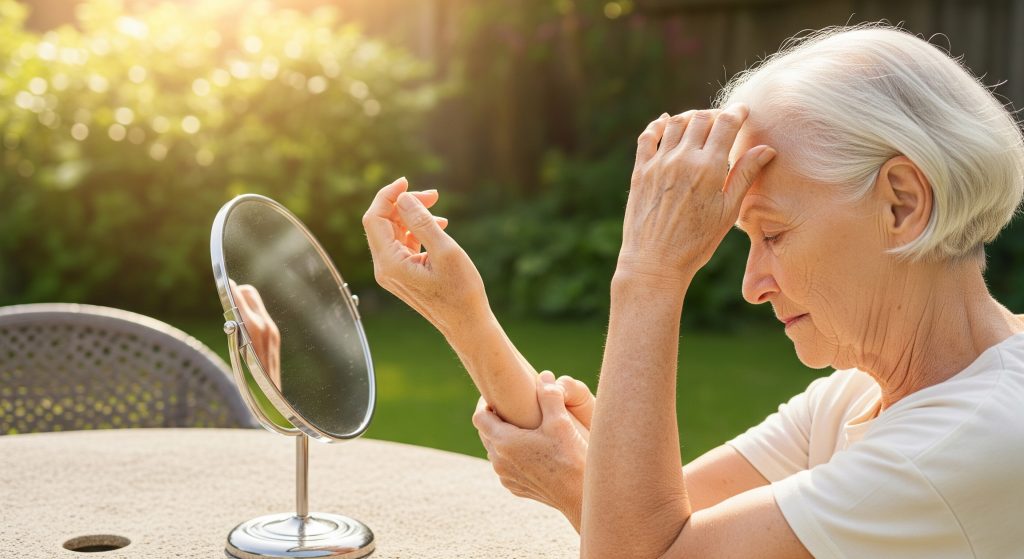
Regular self-examinations are the single most effective way to catch problems early. Here’s how to do it properly:
-
Perform a full skin check monthly
-
Use a well-lit room and a full-length mirror
-
Use a hand mirror for hard-to-see areas (scalp, back, buttocks)
-
Check between fingers and toes
-
Examine the soles of feet and palms
-
Don’t forget ears, hairline, and under nails
The goal isn’t to diagnose anything. It’s to notice change. Taking photos of concerning spots can help track whether something is growing or changing over time.
Diagnostic Tests and Procedures
If a doctor suspects SCC, the standard approach involves a skin biopsy. This is straightforward. A small sample of the suspicious tissue is removed and examined under a microscope. The biopsy provides definitive diagnosis and helps determine the specific type and aggressiveness of the cancer.
The procedure itself is quick, performed under local anaesthetic, and usually leaves minimal scarring. Waiting for results can feel interminable, but most biopsies are processed within one to two weeks.
Recognising Early Signs Saves Lives
Here’s the reality of squamous cell carcinoma. When caught early, treatment success rates are excellent. We’re talking cure rates above 95% for early-stage SCC. But the longer it’s left, the greater the chance it invades deeper structures or spreads to lymph nodes. At that point, treatment becomes more aggressive and outcomes less predictable.
If you’re in a higher-risk category (fair skin, history of sun exposure, immunosuppression, previous skin cancers), annual professional skin checks are worth the investment.
That rough patch that’s been there for two months? The little sore that won’t quite heal? The scaly spot on your ear that keeps crusting over? Don’t dismiss them. Don’t wait and see. Get them checked. It takes ten minutes with a GP or dermatologist to know whether something needs attention or whether you can stop worrying about it.
Early detection isn’t complicated. It just requires attention. And attention is something we can all manage.
Frequently Asked Questions
How quickly does squamous cell carcinoma spread?
SCC typically grows slowly, often over months or years. Most cases remain localised to the skin and don’t spread. But a small percentage (around 2-5%) can metastasise, particularly SCCs on the lip, ear, or in immunocompromised patients. Larger tumours and those that have been present for extended periods carry higher risk of spreading.
Can squamous cell carcinoma appear on covered skin?
Yes, though it’s less common. While sun-exposed areas account for the vast majority of cases, SCC can develop anywhere on the body. In non-sun-exposed areas, it’s often related to other factors such as chronic wounds, radiation exposure, or HPV infection. Any suspicious lesion warrants evaluation regardless of location.
What’s the difference between basal cell and squamous cell carcinoma symptoms?
Both are non-melanoma skin cancers, but they look slightly different. Basal cell carcinoma (BCC) typically appears as a pearly or waxy bump, often with visible blood vessels on the surface. SCC tends to look rougher and scalier, more like a thick, crusty patch or wart-like growth. BCC rarely spreads, while SCC has a slightly higher metastatic potential. Both need treatment, but the urgency is marginally higher with SCC.
Is squamous cell carcinoma painful in early stages?
Usually not. Most early SCCs cause no pain at all, which is part of why they’re often ignored. Some people report mild itching or tenderness, but significant pain typically only develops if the tumour grows large enough to involve deeper structures or nerves. Lack of pain shouldn’t be interpreted as lack of concern.
How often should I check my skin for suspicious changes?
For those at higher risk (fair skin, previous skin cancer, immunosuppression, extensive sun damage), monthly checks are essential, supplemented by professional skin examinations at least annually. The key is consistency. Spotting change requires knowing what normal looks like for your own skin.

