






 We do what's right for you...


What Are Cardiac Biomarkers? An Introduction to Heart Health Tests
Dr. Hriday Kumar Chopra
Heart tests are often sold as crystal balls. They are not. Biomarkers guide decisions, reduce guesswork, and reveal risk that an exam misses. I use the term cardiac biomarkers for blood measurements that reflect injury, stress, or inflammation in the heart. Used well, they shorten time to treatment and raise diagnostic confidence. Used poorly, they confuse the picture.
Common Types of Cardiac Biomarkers Used in Clinical Practice
Clinicians rely on a focused set of tests. The types of cardiac biomarkers below cover damage, stretch, and systemic inflammation. I group them by what they do in practice.
1. Troponin I and Troponin T
Troponins are the frontline test for myocardial injury. High or rising values indicate heart muscle damage, most commonly from acute coronary syndrome. Timing matters. Levels typically rise within hours and may remain elevated for days. High sensitivity assays detect small changes, so I always interpret them with symptoms and ECG findings.
2. B-Type Natriuretic Peptide (BNP) and NT-proBNP
BNP and NT-proBNP reflect ventricular wall stress. In practice, they support the diagnosis of heart failure and help monitor response to therapy. Results are influenced by age, renal function, and body mass. A normal value has a strong negative predictive value for acute heart failure. Clear enough to guide urgent care.
3. Creatine Kinase-MB (CK-MB)
CK-MB once dominated infarct diagnosis. Its role is now narrower, given troponin’s superior sensitivity and specificity. It can assist in certain re-infarction assessments due to its different kinetic profile. Still, I rarely request it when high sensitivity troponin is available.
4. Myoglobin
Myoglobin rises very early after muscle injury, including non-cardiac causes. That speed has appeal, but specificity is limited. I view it as an adjunct at best, and only when rapid rule-in needs an early signal with subsequent confirmation.
5. High-Sensitivity C-Reactive Protein (hs-CRP)
hs-CRP measures low-grade systemic inflammation. It assists with long-term cardiovascular risk stratification, not acute infarct diagnosis. Elevated results may suggest higher atherosclerotic risk. They do not pinpoint a culprit lesion. Use it to refine prevention strategy alongside lipids and blood pressure control.
6. Emerging Biomarkers: ST2 and Galectin-3
ST2 and Galectin-3 track fibrosis and cardiac remodelling. Their main use is in prognostication for heart failure. Evidence is promising, yet uptake varies across centres. In selected cases, they add texture to risk discussions and follow-up planning.
|
Biomarker |
Primary clinical signal |
|---|---|
|
Troponin I/T |
Myocardial injury detection |
|
BNP/NT-proBNP |
Ventricular stress and heart failure status |
|
CK-MB |
Historical MI marker and re-infarction support |
|
Myoglobin |
Very early, non-specific muscle injury |
|
hs-CRP |
Inflammation and long-term risk |
|
ST2, Galectin-3 |
Remodelling, prognosis in heart failure |
Clinical Applications and Diagnostic Procedures
I order cardiac biomarkers when a blood test can sharpen the clinical picture. The tests do not replace judgement. They support it.
When Doctors Order Cardiac Biomarker Tests
Typical triggers include chest pain, dyspnoea, palpitations, or syncope. Pre-operative assessments and oncology regimens may also prompt testing. I request repeat measurements when the baseline is non-diagnostic and the clinical suspicion remains high. This serial strategy tracks dynamic change, which often tells the real story.
-
Acute chest pain with ischaemic symptoms or ECG changes.
-
Suspected acute or chronic heart failure.
-
Cardiotoxic therapy monitoring in oncology.
-
Risk stratification in primary prevention clinics.
Sample Collection and Laboratory Analysis
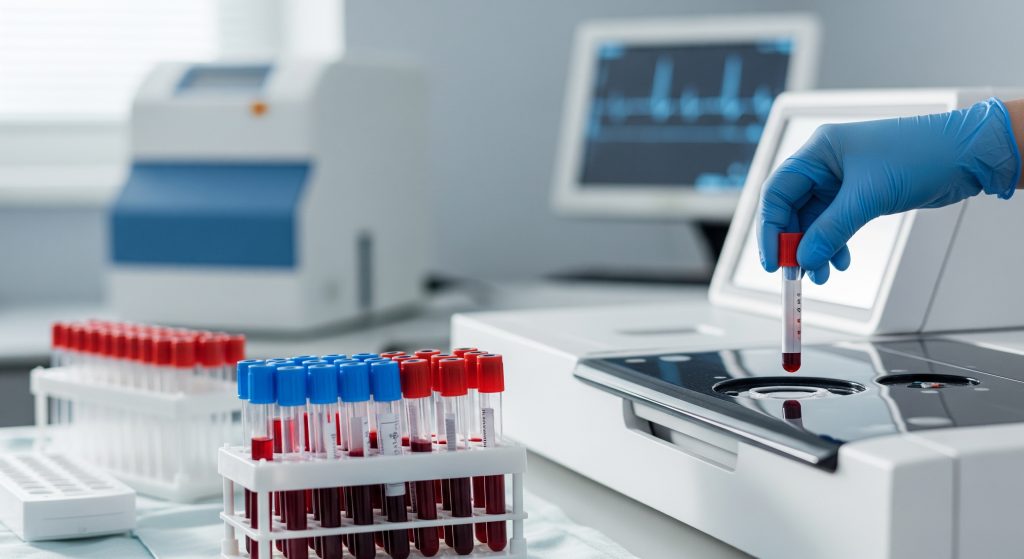
Venous blood is standard. Pre-analytic handling affects accuracy, so timely processing matters. High sensitivity assays detect very low troponin levels. That precision helps rule out myocardial infarction earlier. It also increases detection of small, clinically varied injuries, so I always correlate with context.
Interpreting Test Results and Reference Ranges
Reference ranges vary by assay and laboratory. I review the method, the upper reference limit, and whether sex-specific thresholds apply. A single normal value rarely ends the enquiry if symptoms persist. For cardiac biomarkers, the pattern across time is often the decisive piece. Rising or falling values carry different implications from a flat profile.
Combining Multiple Biomarkers for Accurate Diagnosis
No single marker answers every question. Pairing a troponin trajectory with BNP or NT-proBNP refines the differential between infarction and decompensated heart failure. Adding hs-CRP informs longer term risk management. This layered model reduces uncertainty, and it reduces unnecessary imaging.
Clinical reality is messy. An organised panel, interpreted with the history and ECG, brings it back into focus.
Conclusion
Cardiac biomarkers are decision tools, not verdicts. Used thoughtfully, they accelerate diagnosis, guide therapy, and improve follow up. I recommend a structured approach: choose the right test, collect at the right time, and read trends rather than snapshots. Focus on troponin for injury, BNP or NT-proBNP for pressure load, and hs-CRP for risk. The types of cardiac biomarkers will continue to expand, but the principle stands. Pair data with context, then act with clarity.
Frequently Asked Questions
What is the most accurate cardiac biomarker for detecting heart attack?
High sensitivity troponin is the preferred marker for myocardial infarction. It detects small injuries and supports earlier rule out when combined with clinical assessment and ECG.
How long do cardiac biomarkers remain elevated after a heart event?
Troponin can stay elevated for several days, sometimes longer. CK-MB falls sooner. BNP and NT-proBNP reflect haemodynamic stress, so they change with clinical improvement rather than a fixed clock.
Can cardiac biomarker tests detect heart problems before symptoms appear?
They can suggest risk or subclinical strain. hs-CRP may indicate higher cardiovascular risk, and NT-proBNP can reveal occult ventricular stress. These findings guide prevention rather than diagnose a silent infarct.
Do I need to fast before a cardiac biomarker test?
Fasting is generally not required. I still advise confirming lab instructions, especially if lipid testing is planned alongside the biomarker panel.
What factors can cause false positive results in cardiac biomarker tests?
Renal impairment, strenuous exercise, myocarditis, sepsis, and pulmonary embolism can elevate troponin. Age, renal function, and obesity influence natriuretic peptides. Analytical variation and timing also matter.

