






 We do what's right for you...


Understanding Knee Joint MRI Anatomy: A Simple Explainer
Dr. Neetan Sachdeva
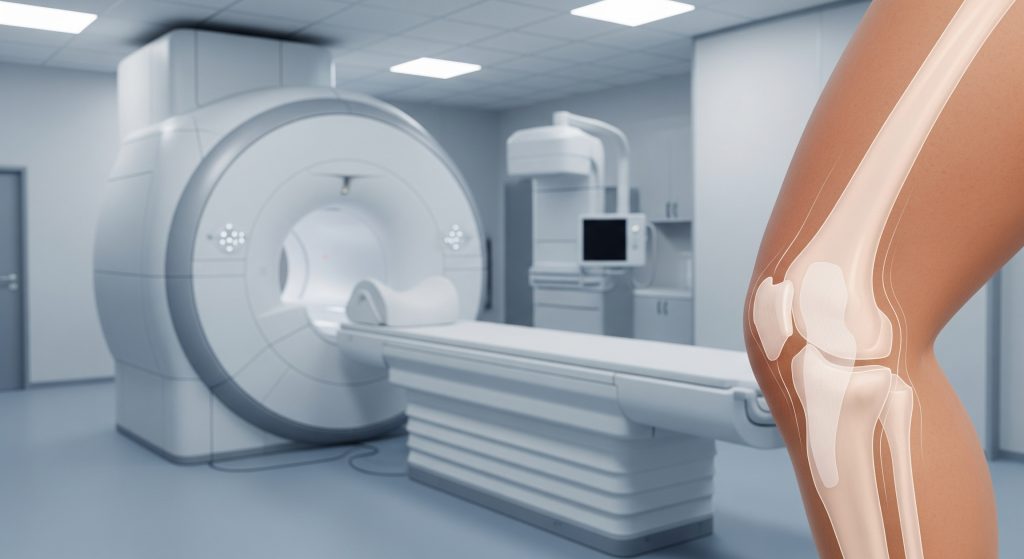
Common advice says to read every slice like a checklist. That slows decisions and misses context. I prefer to frame the entire study around knee joint MRI anatomy first, then let findings fall into place. This approach turns a knee MRI scan from a puzzle into a narrative. It is basically a tidy map of bones, cartilage, menisci, ligaments, and synovial recesses working as one system.
Key Structures Visible in Knee Joint MRI Anatomy
1. Bones and Bony Landmarks
On routine sequences, the femur, tibia, and patella set the framework for knee joint MRI anatomy. The tibiofemoral and patellofemoral articulations define how forces travel through stance and flexion. I look first for cortical integrity, trabecular signal, and the alignment of key ridges and grooves.
-
Trochlear groove depth and shape guide patellar tracking assessment.
-
Tibial spines and intercondylar notch orient cruciate positioning.
-
Subchondral plate uniformity hints at cartilage load and early stress response.
As MRI Knee Anatomy notes, these three bones form the patellofemoral and tibiofemoral joints. That simple fact anchors how I structure the rest of the review. In practice, small bony variants or osteophytes can echo bigger kinetic issues. Subtle, but telling.
This bony context is the scaffolding of knee joint anatomy and the practical entry point for knee joint MRI anatomy in daily reporting.
2. Articular Cartilage Layers
Cartilage appears as a smooth, low signal layer on most sequences. I assess thickness, surface contour, deep layer integrity, and subchondral marrow response. In knee joint MRI anatomy, defects tend to declare themselves twice: once at the surface and again in the bone beneath.
|
Layer |
What to check |
|---|---|
|
Superficial zone |
Surface fibrillation, focal thinning, flaps |
|
Middle zone |
Signal heterogeneity suggesting softening |
|
Deep zone |
Contour of the tidemark-adjacent region |
|
Subchondral plate |
Continuity, cysts, or marrow oedema pattern |
Ageing alters cartilage microarchitecture. As Sism Vol-10, Issue 04 by Azhar reports, the tidemark that separates uncalcified and calcified cartilage thickens with age in osteoarthritis. That boundary matters for grading degeneration and anticipating biomechanical consequences.
When I read a knee MRI scan, I correlate cartilage signal with the adjacent bone. Cartilage does not fail in isolation. It usually tells a load story that the marrow confirms.
3. Menisci Components
The menisci distribute load, stabilise the joint, and enable smooth motion. In knee joint MRI anatomy they present as triangular low signal structures with horns and a body. Each region is interrogated for shape, free edge integrity, and root attachment continuity.
-
Medial meniscus: typically C-shaped, more fixed, and more vulnerable to degenerative tears.
-
Lateral meniscus: usually more circular and mobile, with different tear patterns.
-
Roots and ramp regions: crucial for hoop stress and subtle instability.
This is not academic detail. It affects whether a patient can pivot without pain or locking. As Radiopaedia outlines, the medial meniscus is C-shaped and larger, while the lateral is more circular. That geometry underpins load transmission and shock absorption.
I look closely at the peripheral capsular attachments and the meniscotibial ligaments. The medial meniscus has firmer capsular links, which increases stability but also tear risk under varus load. This nuance in knee joint anatomy shapes what I expect to find in knee joint MRI anatomy for specific mechanisms of injury.
4. Ligament Structures
Cruciates and collaterals define directional stability. The ACL and PCL govern anterior-posterior control and rotational restraint. The MCL and LCL resist valgus-varus stress and guide coronal stability. Signal, fibre continuity, and orientation are the essentials.
Ligaments fail in patterns. Mid-substance disruption, femoral avulsion, tibial avulsion, and partial-thickness sprain each change rehabilitation timelines.
As Imaging of Athletic Injuries of Knee Ligaments and Menisci notes, MRI is the primary modality for assessing ligament and meniscal injuries in sport. That is because knee joint MRI anatomy captures both macroscopic fibre integrity and the oedema trail that reveals mechanism and acuity.
-
ACL: look for fibre buckling, discontinuity, and pivot-shift bone bruise pattern.
-
PCL: assess striated low signal cable and tibial attachment geometry.
-
MCL complex: superficial band, deep meniscofemoral component, and bursal plane oedema.
-
LCL complex: fibular collateral, popliteus tendon, arcuate complex, and their interplay.
This ligament overview sets expectations for the rest of knee joint MRI anatomy. It also clarifies when a knee MRI scan needs extended field-of-view to capture posterolateral corner structures.
5. Tendons and Muscle Attachments
Quadriceps and patellar tendons are the front anchors. I examine thickness, fibre alignment, and enthesial changes. The hamstring tendons and pes anserinus insertions shape medial dynamic stability, while the popliteus and ITB contribute laterally. Enthesophytes and reactive oedema mark overload.
In daily work, the tendon story often mirrors training errors. Power athletes show proximal quadriceps changes. Endurance athletes present with distal patellar signal. The functional theme matters for interpreting knee joint MRI anatomy accurately and advising referrers clearly.
-
Quadriceps tendon: multilaminar structure with distinct layers.
-
Patellar tendon: look for proximal tendinosis and infrapatellar fat pad oedema.
-
Semimembranosus: assess distal expansion near the posterior medial capsule.
6. Synovial Spaces and Bursae
The knee has several synovial recesses and bursae that enable low-friction movement. The suprapatellar pouch, medial and lateral recesses, and posterior compartments frequently display joint effusion first. Bursae can mimic pathology when distended, so location and shape matter.
-
Suprapatellar bursa: continuous with the joint space in most adults.
-
Prepatellar and infrapatellar bursae: anterior swelling patterns differ from intra-articular effusions.
-
Semimembranosus-gastrocnemius bursa: classic site for a Baker cyst.
As Knee Bursae | Radiology Reference Article – Radiopaedia explains, bursae reduce friction between moving structures and can inflame with overuse. In reporting knee joint MRI anatomy, I map fluid to its anatomical plane. That simple step avoids mislabelling bursitis as an intra-articular process.
MRI Sequences for Knee Joint Anatomy Visualisation
T1-Weighted Images
T1-weighted images define anatomy and marrow fat signal. They clarify cortical outline, subchondral plate, and post-surgical changes. In knee joint MRI anatomy, T1 is my baseline for bony landmarks and for detecting haemorrhagic products or fatty replacement.
-
Use for marrow composition and fracture line conspicuity.
-
Helpful for pre-op roadmapping of tunnels and hardware.
T2-Weighted Images
T2-weighted sequences highlight fluid. They expose oedema, cysts, synovitis, and effusions. This makes them vital for correlating symptoms with active inflammation or acute injury. In a knee MRI scan, T2 signal often determines clinical urgency.
A briefer note. T2 hyperintensity should be married to structure. Unmapped fluid leads to misinterpretation.
Proton Density Sequences
Proton density images with or without fat suppression offer crisp fibre detail at high signal-to-noise. They are the workhorse for knee joint MRI anatomy. I use PD fat-sat for menisci, ligaments, and peritendinous oedema, and PD without fat-sat for cartilage surfaces where dark-on-dark contrast helps.
-
PD fat-sat: sensitive to subtle fluid and small tears.
-
PD non-fat-sat: preserves anatomy and avoids over-suppression artefacts.
STIR and Fat Suppression Techniques
STIR and spectral fat saturation isolate oedema and subtle fluid tracking. This raises contrast around cartilage lesions, ligament sprain, and marrow stress. The goal is not just prettier images. It is better detection where knee joint MRI anatomy blurs into early pathology.
As Role of Magnetic Resonance Imaging in Evaluation notes, fat suppression helps separate oedema, cartilage injury, and marrow change. Implemented well, it improves diagnostic confidence, especially in multifocal trauma or post-operative cases.
In practice, I balance fat-sat strength with field homogeneity. Aggressive suppression can erase useful marrow detail. Moderation wins.
Anatomical Planes and Views in Knee MRI Scan
Sagittal Plane Anatomy
Sagittal imaging lays out cruciate ligaments, extensor mechanism, and osteochondral surfaces in sequence. It is my first pass for ACL integrity and for patellofemoral alignment. In knee joint MRI anatomy, sagittal is where time is either saved or wasted.
-
Trace ACL fibres from tibial insertion to posteromedial femoral footprint.
-
Assess patellar tendon, Hoffa fat pad, and trochlear morphology.
-
Review meniscal anterior and posterior horns and their roots.
One sharp rule. Verify the ACL on at least two contiguous slices before calling a tear.
Coronal Plane Anatomy
Coronal images characterise collateral ligaments, meniscal bodies, and compartmental cartilage symmetry. They show varus-valgus alignment impact better than any other plane. For knee joint anatomy, coronal views display the femorotibial relationship cleanly.
-
Check MCL superficial-deep layers and the adjacent bursal plane.
-
Inspect lateral compartment for ITB friction sequelae and LCL complex integrity.
-
Compare medial and lateral cartilage thickness in matched slices.
Coronal imaging also clarifies bone marrow oedema spread. That helps in staging stress response and osteochondral injury within knee joint MRI anatomy.
Axial Plane Anatomy
Axial images capture patellofemoral engagement, retinacula, and the posterolateral corner. They are indispensable for trochlear dysplasia grading and for tracking fluid through synovial recesses. In a knee MRI scan with instability, axial slices often hold the key.
I align the evaluation with biomechanics. Lateral patellar tilt, TT-TG distance surrogates, and retinacular signal map directly to symptoms. Precision here strengthens the overall read of knee joint MRI anatomy.
Common Anatomical Variations and Normal Findings
Age-Related Changes
Growth, load, and biology sculpt the joint across decades. As Age dependent morphological changes of the normal meniscus in children based on large scale MRI analysis documents, a cohort of 877 children showed progressive meniscal size increase up to about 15 years. That study provides age-specific reference ranges that sharpen paediatric interpretation.
Later in life, degenerative markers creep in. As Structural knee MRI findings are already frequent in a general population-based birth cohort at 33 years of age reports, mild structural changes are common at around 33 years, even without pain. Body mass index correlates with early cartilage defects and small osteophytes, which tracks with clinic observations.
These trends influence how I contextualise knee joint MRI anatomy. A small osteophyte in a 20-year-old is not the same story as the same finding in a 60-year-old.
Normal Signal Variations
Not every bright focus is pathology. Vascular channels, magic-angle effects near 55 degrees, and partial volume can mimic tears. I always test suspicious signal against geometry and sequence behaviour. This prevents overcalling in a knee MRI scan where context is king.
-
Magic-angle: tendons angled to the main field produce spurious high signal on short TE.
-
Vascular channels: linear foci that lack morphological disruption.
-
Meniscal flounce: transient wavy contour without structural tear.
Normal variants are part of knee joint MRI anatomy. Recognising them is a core skill, not a footnote.
Developmental Variants
Variants shape both appearance and biomechanics. A discoid lateral meniscus alters coverage and tear patterns. A high patella modifies engagement and tracking. Shallow trochlea changes lateral restraint. None of these are rare in practice.
I label a variant, then ask two questions. Does it explain the symptoms. And does it change management. That discipline keeps knee joint anatomy interpretation clinically useful.
Making Sense of Knee Joint MRI Anatomy
An efficient reading workflow is systematic and light. I move bones to cartilage to menisci to ligaments to synovium, then correlate with planes. This flow respects how knee joint MRI anatomy actually functions. It also shortens reports without losing nuance.
-
Start with alignment and cortical integrity.
-
Map cartilage and subchondral response by compartment.
-
Interrogate meniscal roots and peripheral attachments.
-
Confirm cruciates and collaterals on orthogonal slices.
-
Track fluid through synovial recesses and bursae.
-
Cross-check with mechanism and clinical question.
Here is why this matters. Findings are rarely isolated. A bone bruise pattern predicts the ligament tear. A meniscal root failure predicts extrusion and rapid cartilage wear. When read as a system, knee joint MRI anatomy becomes a decision tool, not just an image set.
One final point. Knee joint anatomy is simple on a diagram and complex in motion. But still, a disciplined checklist and a clear narrative will reconcile both in a single knee MRI scan.
Frequently Asked Questions
What anatomical structures appear brightest on knee MRI scans?
On fluid-sensitive sequences, free fluid and oedema appear brightest. Fat is bright on T1 and non-suppressed PD. Cortical bone remains dark. This pattern helps me separate active change from background anatomy within knee joint MRI anatomy.
How many ligaments are typically visible in a standard knee MRI?
A routine protocol shows the ACL, PCL, MCL complex, and LCL complex reliably. The posterolateral corner structures and the patellofemoral retinacula are also assessed. Together they frame functional stability in a knee MRI scan.
Which MRI sequence best shows cartilage damage in the knee joint?
Proton density fat-suppressed and T2-weighted images highlight oedema and fissuring. Non-fat-suppressed PD or T1 clarify surface contour and subchondral plate. I use both for a balanced read of knee joint MRI anatomy.
Can you identify all knee joint anatomy problems with a single MRI sequence?
No. Different structures require different contrast. PD fat-sat finds subtle fluid and small tears. T1 defines marrow fat and hardware. T2 displays effusion and synovitis. A single sequence cannot capture the full span of knee joint MRI anatomy.
What is the normal thickness of knee cartilage on MRI?
Thickness varies by compartment and location. There is no single universal value that fits all zones. I compare to adjacent regions and age context rather than citing a fixed number. This comparative method suits knee joint anatomy across diverse patients.
How do menisci appear differently from ligaments on knee MRI?
Menisci are triangular, low signal fibrocartilage with distinct horns and a body. Ligaments are linear low signal bands with defined fibre direction. That shape difference is consistent across planes and helps anchor knee joint MRI anatomy.
Key takeaways
-
Start with structure, not slices. Let knee joint MRI anatomy guide the read.
-
Match sequence to question. No single sequence answers everything.
-
Link findings. Bones, cartilage, menisci, ligaments, and synovium tell one story.
-
Respect variants and age context. Normal is a spectrum.

