






 We do what's right for you...


Understanding Capsule Endoscopy Cost and Procedure in India
Dr. Urvashi Gupta


Capsule endoscopy cost in India gets quoted wildly, sometimes by a factor of three or four, even within the same city. What’s frustrating? Most patients hear a single number from a hospital and assume that’s the standard rate. It’s not. The price depends on the capsule type, the hospital’s reputation, whether AI-assisted analysis is included and even the day of the week. I’ve seen quotes ranging from ₹20,000 at a modest diagnostic centre to ₹1,80,000 at a premium multi-specialty hospital for what is essentially the same procedure. Understanding what drives these differences isn’t just academic curiosity. It’s the difference between overpaying by lakhs and getting the exact same diagnostic insight.
This guide breaks down the capsule endoscopy procedure from preparation to results, explains the types available, covers the risks honestly and helps make sense of the price variations across Indian cities. Think of it as the conversation a well-informed gastroenterologist would have with a friend who needed the test.
Capsule Endoscopy Cost Breakdown in India
Minimum Cost Range of ₹20,000 to ₹25,000
The entry-level price point for capsule endoscopy sits between ₹20,000 and ₹25,000. This tier typically appears at smaller diagnostic centres, regional hospitals or during promotional periods at larger chains. According to Bookimed, the minimum cost hovers around ₹20,000 to ₹25,000 depending on clinic-specific factors.
What does this price point actually get you? Usually a standard small bowel capsule, basic image review by a radiologist or gastroenterologist and a written report within a week. The capsule itself is the major cost driver. It’s a single-use device that gets discarded after passing through. At this price level, expect minimal frills. No same-day reporting, no AI-assisted image analysis and potentially longer waiting times for the procedure slot.
Here’s what matters: the capsule quality at this tier is often identical to higher-priced options. The difference lies in service speed, facility comfort and the experience of the reviewing physician. For patients with straightforward diagnostic needs and flexible schedules, this tier delivers genuine value.
Average Cost Range of ₹25,000 to ₹80,000
Most patients end up paying somewhere in this middle band. The spread is enormous because it captures everything from efficient private hospitals to branded multi-specialty chains. What pushes prices up from ₹25,000 towards ₹80,000?
-
Hospital accreditation – NABH-accredited facilities charge a premium for standardised protocols
-
Physician expertise – Gastroenterologists with sub-specialty training in small bowel disorders command higher interpretation fees
-
Capsule technology – Newer generation capsules with higher resolution imaging or extended battery life cost more
-
Turnaround time – Same-day or next-day reporting adds to the bill
-
Bundled services – Some packages include pre-procedure consultations, patency capsule tests and follow-up appointments
The sweet spot for most patients? Around ₹40,000 to ₹70,000 at a reputable mid-tier hospital with experienced gastroenterologists. This gets quality imaging, reasonable turnaround and access to specialists who’ve reviewed thousands of capsule endoscopy images.
Premium Cost Range of ₹50,000 to ₹1,80,000
The premium tier exists for specific reasons, not just brand positioning. Bookimed reports that high-end services push costs towards $1,400 to $3,800, translating to approximately ₹1,20,000 to ₹1,80,000 at the upper extreme.
What justifies these prices? Three things primarily:
-
Colon capsule endoscopy – This requires a different, more expensive capsule with dual cameras and specific bowel preparation protocols. It’s genuinely costlier to administer.
-
AI-enhanced analysis – Cutting-edge centres use machine learning algorithms to assist image review, potentially improving detection rates for subtle lesions.
-
International patient services – Packages designed for medical tourists include coordination, translation, accommodation assistance and expedited reporting.
Is the premium tier worth it? Honestly, for most domestic patients with standard small bowel indications, probably not. The diagnostic yield from a ₹35,000 procedure at a good hospital is comparable to a ₹1,50,000 procedure at a luxury centre. Save the premium budget for cases requiring colon capsule endoscopy or genuinely complex diagnostic challenges.
City-Wise Cost Variations Across India
Geography matters more than most patients realise. The same procedure, same capsule brand, same experience level can vary by ₹30,000 or more depending on the city.
|
City |
Minimum Cost |
Maximum Cost |
Typical Range |
|---|---|---|---|
|
Delhi NCR |
₹30,000 |
₹1,10,000 |
₹40,000 – ₹70,000 |
|
Mumbai |
₹35,000 |
₹1,20,000 |
₹45,000 – ₹80,000 |
|
Bengaluru |
₹28,000 |
₹90,000 |
₹35,000 – ₹65,000 |
|
Chennai |
₹25,000 |
₹85,000 |
₹35,000 – ₹60,000 |
|
Hyderabad |
₹25,000 |
₹80,000 |
₹30,000 – ₹55,000 |
|
Kolkata |
₹22,000 |
₹70,000 |
₹28,000 – ₹50,000 |
ImpactGuru confirms that Mumbai tends to be the most expensive market, with Delhi following closely. Tier-2 cities like Jaipur, Pune, Ahmedabad and Lucknow often offer 20-30% savings compared to metro pricing for equivalent service quality.
The single most frustrating part of this? Price opacity. Hospitals rarely publish capsule endoscopy rates online. Getting quotes requires phone calls, sometimes multiple. And the first price quoted is often negotiable, especially for self-paying patients.
Comparison with International Pricing
India’s capsule endoscopy pricing represents exceptional value globally. A quick comparison puts this in perspective:
-
United States: $1,500 to $5,000 (₹1,25,000 to ₹4,20,000)
-
United Kingdom: £800 to £2,500 (₹85,000 to ₹2,65,000)
-
Singapore: $1,200 to $3,000 (₹1,00,000 to ₹2,50,000)
-
Thailand: $800 to $1,500 (₹67,000 to ₹1,25,000)
-
India: $300 to $2,200 (₹25,000 to ₹1,80,000)
This pricing advantage explains why India attracts medical tourists specifically for gastrointestinal diagnostics. The capsules used are identical global brands. The physicians often trained internationally. The only difference is the cost of delivery.
Complete Capsule Endoscopy Procedure Process
Pre-Procedure Preparation and Diet Requirements
Preparation begins 24 to 48 hours before swallowing the capsule. The goal? An empty, clean small bowel that allows the camera to capture clear images. Think of it like trying to photograph something through a dirty window versus a clean one. The cleaner the window, the better the picture.
Standard preparation protocol includes:
-
Day before procedure: Clear liquid diet only. This means water, clear broths, apple juice, black tea or coffee. Nothing with pulp, dairy or solid particles.
-
12 hours before: Complete fasting. No food, no liquids except small sips of water for medications.
-
Evening before: Some centres prescribe a mild laxative to clear residual material from the small bowel.
-
Morning of procedure: Arrive fasting. Wear comfortable, loose clothing without metal buttons or buckles near the abdomen.
Medications need discussion with the prescribing physician. Blood thinners, iron supplements and certain diabetes medications may require temporary adjustment. Never stop medications without explicit medical guidance.
Swallowing the Capsule and Recording Process
The capsule itself is about the size of a large vitamin tablet. It’s roughly 26mm long and 11mm in diameter. Smooth, oval-shaped, designed to pass easily through the oesophagus. Most patients swallow it without difficulty using a glass of water.
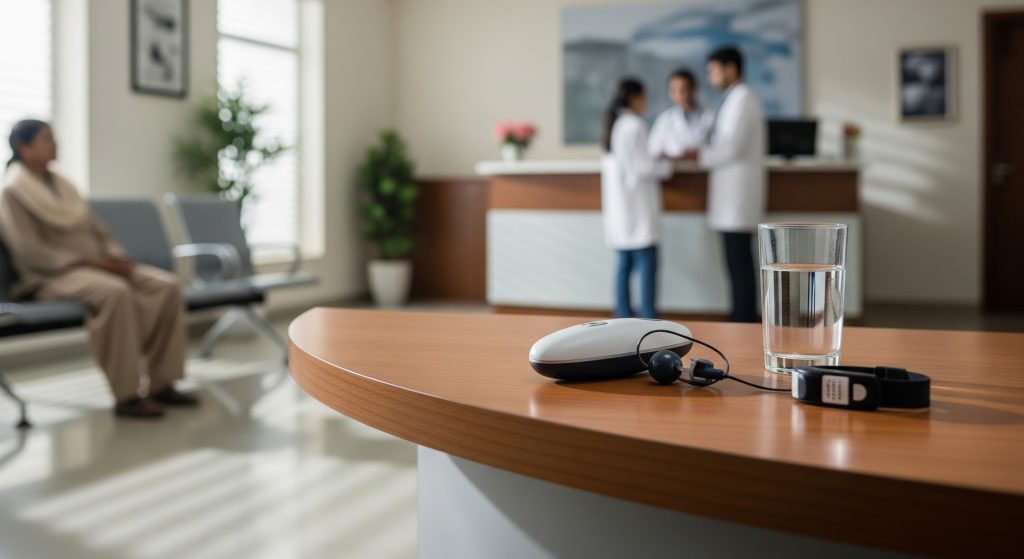
Before swallowing, technicians attach sensor pads to the abdomen. These adhesive electrodes connect to a small recording device worn on a belt. The sensors track the capsule’s position and receive transmitted images. It’s basically a receiving station for the tiny camera’s wireless signal.
The capsule activates automatically upon removal from its holder. It begins capturing two to six images per second immediately. No user intervention required. Once swallowed, it travels by natural peristalsis. It’s basically a passive passenger using the body’s own movements.
Duration and Monitoring During the Test
The complete examination takes 8 to 12 hours from swallowing to capsule passage. During this time, normal activities are largely permitted. Walking around actually helps. Movement encourages peristalsis and keeps the capsule moving.
What’s allowed during the procedure?
-
Walking, light activity, desk work
-
Clear liquids after 2 hours
-
Light meal after 4 hours
-
Normal diet after 8 hours or when directed
What’s restricted?
-
Strenuous exercise or heavy lifting
-
MRI scans until capsule passage is confirmed
-
Getting the recording device wet
-
Removing sensor pads prematurely
Patients return to the facility after the recording period to return the data recorder. Some centres provide overnight monitoring for patients with suspected motility issues.
Post-Procedure Recovery and Capsule Passage
There’s virtually no recovery period. The capsule passes naturally through the digestive tract, typically within 24 to 72 hours. Most patients don’t notice its passage. It exits with normal bowel movements and gets flushed away.
Confirmation of passage matters for two reasons. First, it rules out capsule retention. Second, it clears the patient for MRI scans if needed for other conditions. The capsule contains metal components and poses risks in magnetic fields until passed.
Some patients wonder what happens if they don’t see the capsule pass. It’s common. The capsule is small enough to pass unnoticed. If no symptoms develop within two weeks, the capsule has almost certainly passed. Abdominal X-rays can confirm passage if there’s any doubt.
Results Analysis and Follow-Up Timeline
Here’s where the real work happens. The data recorder captures between 50,000 and 100,000 images during a typical examination. A specialist reviews these images, looking for abnormalities, bleeding sources, polyps, ulcerations, tumours and inflammatory changes.
Results typically take 3 to 7 working days. This isn’t a procedure where instant results are possible. The image review is time-intensive, requiring trained eyes and systematic evaluation. Some centres offer preliminary verbal results within 48 hours with detailed written reports following.
Follow-up appointments depend on findings. Normal results may require no further action. Abnormal findings might lead to:
-
Conventional endoscopy for biopsy of suspicious lesions
-
Double-balloon enteroscopy for therapeutic intervention
-
Surgical consultation for identified masses or strictures
-
Medical management for inflammatory conditions
Types of Capsule Endoscopy Available
Small Bowel Capsule Endoscopy
This is the workhorse of capsule endoscopy. It’s what most patients receive and what most doctors mean when they recommend “capsule endoscopy” without further specification.
The small bowel represents a diagnostic blind spot for traditional endoscopy. Standard upper endoscopy reaches the duodenum. Colonoscopy reaches the terminal ileum. The six metres of jejunum and ileum between them remain largely inaccessible except through surgical exploration or capsule technology.
Mayo Clinic notes that capsule endoscopy captures images throughout the digestive tract, particularly excelling in small intestine visualisation. Research published by Pak J Med Sci reports a diagnostic yield of 70.9% for small bowel capsule endoscopy in cases of obscure gastrointestinal symptoms.
Common indications include:
-
Obscure gastrointestinal bleeding (bleeding with no source found on standard endoscopy)
-
Suspected or known Crohn’s disease affecting the small bowel
-
Celiac disease assessment and monitoring
-
Small bowel tumour surveillance
-
Unexplained iron deficiency anaemia
-
Polyposis syndrome surveillance
Colon Capsule Endoscopy
Colon capsule endoscopy uses a different device with cameras at both ends. It’s designed specifically for large bowel visualisation and represents a potential alternative to conventional colonoscopy for certain patients.
The colon capsule is larger, has a longer battery life and captures images from two directions simultaneously. It requires more intensive bowel preparation than small bowel capsules. Patients often need to take boosters during the examination to speed transit and ensure complete colonic visualisation.
But here’s the honest assessment: colon capsule endoscopy hasn’t replaced colonoscopy and probably won’t anytime soon. Why? Colonoscopy allows biopsy and polyp removal. Colon capsule endoscopy is purely diagnostic. If abnormalities are found, colonoscopy is still needed for intervention. This makes colon capsule endoscopy useful primarily for patients who cannot tolerate sedation, have anatomical abnormalities preventing colonoscopy or need colorectal screening but refuse conventional colonoscopy.
Esophageal Capsule Endoscopy
The oesophagus presents a unique challenge for capsule imaging. Transit time is brief. A swallowed capsule passes through in seconds, not hours. Oesophageal capsules compensate with extremely rapid image capture rates.
According to research in the Gastrointestinal Endoscopy Journal, oesophageal capsule endoscopy offers a viable non-invasive alternative for screening patients with GERD symptoms, comparing favourably to traditional endoscopy for detecting significant pathology.
Oesophageal capsule endoscopy serves best as a screening tool for Barrett’s oesophagus in patients with long-standing reflux, variceal surveillance in cirrhotic patients who cannot tolerate sedation and general oesophageal assessment when conventional endoscopy is contraindicated.
Advanced Technology Options and Features
Capsule endoscopy technology continues evolving rapidly. Recent developments represent genuine improvements, not just marketing exercises.
Research published in Nature Communications highlights emerging technologies including autonomous lesion detection and treatment capabilities, magnetic field active drive systems and AI-based lesion detection. These aren’t science fiction. They’re in clinical trials and early commercial deployment.
Current advanced features include:
-
Higher resolution imaging – Newer capsules capture finer detail, improving detection of subtle mucosal changes
-
Extended battery life – Important for patients with slow transit times
-
Real-time viewing – Some systems allow physicians to watch images as the capsule progresses
-
AI-assisted analysis – Machine learning algorithms flag suspicious frames for physician review
-
Magnetically controlled capsules – External magnets can steer the capsule to areas of interest
The integration of artificial intelligence is particularly promising. As noted by MDPI Bioengineering, AI is essential for improving diagnostic precision and clinical readiness of capsule technologies. It reduces image review time and potentially improves detection rates for easily missed lesions.
Capsule Endoscopy Risks and Safety Considerations
Capsule Retention and Management
Capsule retention represents the primary risk of capsule endoscopy. It occurs when the capsule fails to pass naturally and remains in the digestive tract beyond two weeks. The overall retention rate sits around 2%, though this varies dramatically based on patient selection.
Research from the Jordan Medical Journal confirms that capsule retention occurs in approximately 2% of patients, with early diagnosis being critical for management.
Risk factors for retention include:
-
Known Crohn’s disease with stricturing
-
Previous small bowel surgery
-
Previous abdominal radiation
-
Long-term NSAID use
-
Known or suspected small bowel tumours
-
History of bowel obstruction
Management depends on symptoms and location. Asymptomatic retention may resolve with watchful waiting. Symptomatic retention. That’s different. It requires intervention. Options include medical therapy to promote passage, endoscopic retrieval using double-balloon enteroscopy and surgical removal when other approaches fail.
Preventive strategies make a difference. ATM Journal recommends patency capsule testing before capsule endoscopy in high-risk patients. A patency capsule is a dissolvable dummy capsule. It tests whether the real capsule will pass before committing to the actual procedure.
Contraindications and Patient Restrictions
Not everyone can undergo capsule endoscopy safely. Absolute contraindications exist, though they’re relatively few.
Absolute contraindications:
-
Known or suspected gastrointestinal obstruction
-
Significant strictures without prior patency testing
-
Active high-grade bowel obstruction symptoms
-
Inability to swallow the capsule
Relative contraindications requiring careful consideration:
-
Cardiac pacemakers and implanted defibrillators (though newer devices are often compatible)
-
Pregnancy (limited safety data available)
-
Severe gastroparesis or motility disorders
-
Swallowing disorders
What drives me crazy is when patients with obvious contraindications still get scheduled for capsule endoscopy because someone didn’t take a proper history. Pacemaker compatibility needs verification with the device manufacturer. Previous abdominal surgeries need documentation. Known Crohn’s disease needs assessment of stricture status. These aren’t optional checks.
Technical Complications and Solutions
Beyond retention, technical issues occasionally complicate capsule endoscopy. The technology is robust but not perfect.
Common technical problems:
-
Incomplete small bowel examination – The capsule battery dies before completing transit. Happens in roughly 15-20% of studies, particularly in patients with slow motility.
-
Poor image quality – Inadequate preparation leaves debris obscuring the view.
-
Gastric retention – The capsule sits in the stomach rather than progressing. May require endoscopic deployment into the duodenum.
-
Signal loss – Transmission gaps can leave blind spots in the examination.
Solutions exist for most technical challenges. Prokinetic medications can speed transit. Real-time viewing allows early identification of gastric retention. Extended recording times compensate for slow transit in some cases. Better preparation protocols improve image quality.
The fundamental limitation remains: capsule endoscopy cannot perform biopsies or therapeutic procedures. If something abnormal is found, conventional endoscopy or surgery is still needed. This isn’t a flaw as much as a design reality. Capsule endoscopy is diagnostic. It tells you what’s there. Getting it out requires different tools.
Success Rates and Diagnostic Accuracy
How reliable is capsule endoscopy? Pretty reliable, actually. It’s far from perfect. But for small bowel evaluation, nothing else comes close for non-invasive visualization.
Diagnostic yield (the percentage of studies finding relevant abnormalities) varies by indication:
-
Obscure gastrointestinal bleeding: 60-70%
-
Suspected Crohn’s disease: 50-70%
-
Established Crohn’s disease assessment: 70-80%
-
Iron deficiency anaemia: 45-55%
-
Polyposis surveillance: 75-85%
Complete small bowel examination rates range from 80-85% with standard protocols. This means 15-20% of studies have incomplete visualization, usually due to battery life limitations or slow transit.
Sensitivity for detecting significant lesions exceeds 90% in most studies. Specificity is somewhat lower. The capsule sometimes flags false positives that prove benign on further investigation. This is preferable to missing something important.
Making an Informed Decision About Capsule Endoscopy
Choosing capsule endoscopy involves weighing multiple factors against individual circumstances. The decision framework differs for someone with obscure bleeding versus someone screening for Crohn’s disease.
Questions to ask before proceeding:
-
Is capsule endoscopy the right diagnostic choice for my specific indication?
-
Have alternative less expensive tests been considered and ruled out?
-
Do I have any risk factors for capsule retention?
-
What happens if the capsule finds something abnormal?
-
What’s included in the quoted price and what’s extra?
-
Who will review the images and what’s their experience level?
Red flags when selecting a facility:
-
Unwillingness to discuss total costs upfront
-
No clear protocol for managing retention
-
Limited experience with capsule endoscopy interpretation
-
Pressure to proceed without proper preparation
-
No access to interventional endoscopy if findings require follow-up
The ideal facility has performed hundreds of capsule endoscopy procedures, has clear pricing, can manage complications if they arise and has seamless pathways to therapeutic intervention when needed.
Price matters. But it shouldn’t be the only factor. A ₹25,000 procedure interpreted by someone who sees ten cases per year may deliver less value than a ₹45,000 procedure at a high-volume centre with expert interpreters. The diagnostic accuracy. The completeness of examination. The management pathway. These all contribute to ultimate value, not just the headline price.
Frequently Asked Questions
Is capsule endoscopy covered by health insurance in India?
Coverage varies significantly between insurers and policies. Most comprehensive health insurance policies cover capsule endoscopy when medically indicated and recommended by a specialist. Pre-authorization is typically required. Some policies have sub-limits on diagnostic procedures that may not fully cover premium capsule endoscopy costs. Always verify with the insurer before scheduling. Get written confirmation of coverage amount and any co-payment requirements.
How long does the entire capsule endoscopy procedure take?
The active examination takes 8 to 12 hours from swallowing the capsule to returning the recording device. The appointment itself involves roughly 30 minutes for preparation, sensor placement and capsule swallowing. Patients then leave and return later. Total elapsed time from arrival to final departure is typically 9 to 13 hours, though normal activities are permitted during most of this period.
Can children undergo capsule endoscopy safely?
Yes, capsule endoscopy is approved for children, though with some modifications. Children aged 2-10 often require endoscopic placement of the capsule rather than swallowing, as the device may be too large for comfortable oral intake. Children over 10 can usually swallow the capsule normally. Paediatric-specific capsules exist with smaller dimensions. Safety profiles in children are comparable to adults, with capsule retention remaining the primary concern.
What happens if the capsule gets stuck?
Most retained capsules cause no symptoms and eventually pass spontaneously. Symptomatic retention (causing pain, nausea, vomiting, or obstruction symptoms) requires intervention. Initial management typically involves observation and medical therapy. If this fails, endoscopic retrieval using double-balloon enteroscopy is attempted. Surgical removal is reserved for cases where endoscopic retrieval isn’t possible or if complete bowel obstruction develops. The retained capsule itself rarely causes direct harm if asymptomatic.
How does capsule endoscopy compare to traditional endoscopy?
They serve different purposes and aren’t directly interchangeable. Traditional endoscopy examines accessible areas (stomach, duodenum, colon, terminal ileum) and allows biopsy and therapeutic intervention. Capsule endoscopy visualises the entire small bowel non-invasively but cannot perform biopsies or treatment. Capsule endoscopy requires no sedation and carries lower complication risks. Traditional endoscopy provides definitive tissue diagnosis. For small bowel evaluation specifically, capsule endoscopy is superior to traditional methods. For stomach, duodenum and colon, traditional endoscopy remains the gold standard.

