






 We do what's right for you...


Understanding ACL Tear Symptoms and Knee Instability
Dr. Rajeev K Sharma
Most advice about knee injuries tells you to rest and wait. That approach often misses the early clues that decide outcomes. Identifying ACL Tear Symptoms promptly lets you choose the right pathway and avoid months of avoidable frustration. This guide explains what to notice, how diagnosis works, and how recovery progresses, so you can act with confidence and speed.
Common ACL Tear Symptoms and Signs
1. Popping Sound or Sensation During Injury
A distinct pop at the time of injury should raise suspicion immediately. As StatPearls notes, roughly 70% of patients report a popping sound or sensation followed by pain and swelling. You may also feel instant instability, especially if the knee was pivoting or landing from a jump. Treat that pop as a meaningful signal, not background noise during sport.
2. Rapid Knee Swelling Within Hours
Rapid swelling within a few hours strongly suggests bleeding into the joint. As Mayo Clinic indicates, this timing pattern aligns with acute ligament injury rather than delayed irritation. Effusion often limits motion and makes weight bearing painful. Ice and elevation help, but early assessment matters more.
3. Severe Pain and Inability to Continue Activity
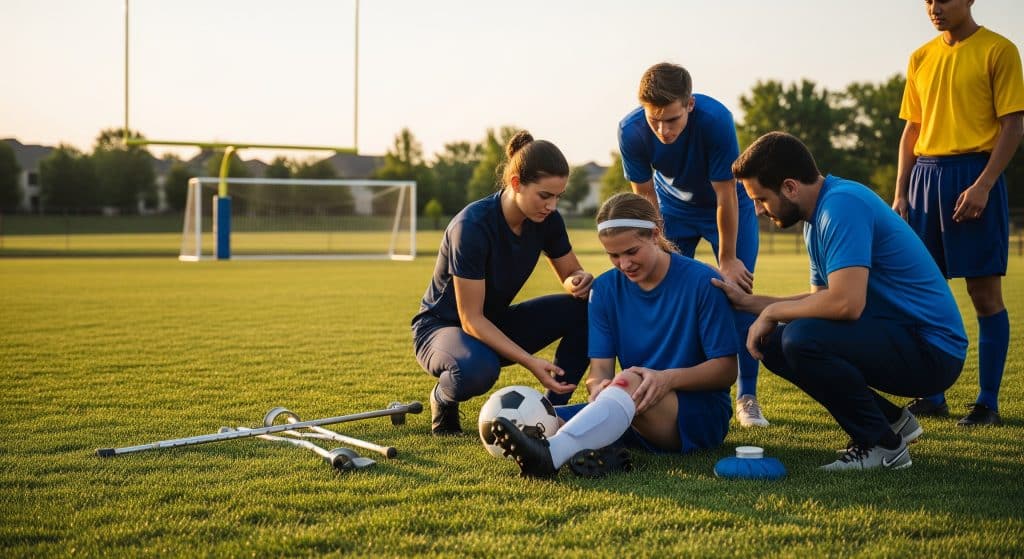
Severe pain that stops you instantly is common after an anterior cruciate ligament tear. As StatPearls records, pain often coexists with instability and early swelling. Many people stop play, reach for support, and cannot resume. That abrupt halt is useful diagnostic context for clinicians.
4. Loss of Range of Motion
Loss of flexion and especially extension appears early due to pain and effusion. As StatPearls explains, the volume within the joint and protective muscle guarding restrict movement. Early extension recovery becomes a key rehabilitation priority. It sets the tone for later gait and strength milestones.
5. Feeling of Knee Giving Way or Instability
A recurrent sense that the knee might buckle is a signature instability symptom. As StatPearls notes, this often appears with pivots, cuts, and awkward landings. Everyday situations can provoke it too, like stepping off a kerb. Repeated giving-way episodes raise risk for additional damage.
6. Difficulty Bearing Weight on Affected Leg
Early weight bearing is often limited by pain and the unstable feel of the joint. As PMC reports, clinicians may recommend crutches briefly to unload the knee while swelling settles. Use support until a clinician clears a progression. Forcing weight often worsens your gait pattern.
7. Tenderness Along the Joint Line
Joint line tenderness can accompany ACL injuries. As PhysioPedia highlights, this sign also correlates with meniscal involvement. Tenderness does not diagnose the ligament alone, but it sharpens clinical suspicion. It also influences the imaging and treatment plan.
Anterior Cruciate Ligament Tear Diagnosis and Assessment
Physical Examination Tests for ACL Tears
Clinical tests remain highly informative when performed by skilled examiners. As PubMed notes, combining Lachman, anterior drawer, and pivot shift increases diagnostic accuracy substantially. Sensitivities and specificities vary with timing and chronicity. In practice, a test cluster plus your injury history provides strong predictive value.
Lachman Test and Anterior Drawer Test
The Lachman test is the preferred single test in acute settings. As PubMed summarises, pooled sensitivity is about 85% and specificity near 94%, though estimates vary by study method. The anterior drawer test helps more in chronic instability. Technique and patient relaxation matter as much as the test itself.
MRI Imaging for Confirming ACL Damage
MRI offers excellent soft tissue visualisation and clarifies partial versus complete tears. As PubMed reports, MRI sensitivity for ACL tears can exceed 95% with high diagnostic accuracy. It also reveals associated injuries like bone bruising or meniscal tears. Imaging guides both non-operative and surgical decisions.
Arthroscopy as Diagnostic Tool
Arthroscopy remains the reference standard when diagnosis is uncertain or surgery is planned. As PubMed discusses, thorough clinical evaluation and MRI often suffice for decision making. Arthroscopy is then both diagnostic and therapeutic. Use it when findings are inconclusive or when treatment is already indicated.
Grading ACL Injuries from Partial to Complete Tears
Grading distinguishes partial fibre disruption from complete ligament rupture. As PMC outlines, partial tears are common and require careful assessment of residual stability. Classification draws on history, exam, and MRI. Management depends on function, not the label alone.
ACL Tear Recovery Time and Treatment Pathways
Non-Surgical Recovery Timeline for Partial Tears
Stable partial tears may recover with structured rehabilitation. As Elite Orthopaedic notes, targeted strengthening and neuromuscular training can restore control. You might use a brace for demanding activities. Periodic re-evaluation ensures the plan remains appropriate.
-
Typical aims: full extension, reduced effusion, and progressive strength within 6 to 12 weeks.
-
Criteria to advance: no giving way, symmetrical gait, and improving hop balance tests.
-
Escalation triggers: recurrent instability or sport demands exceeding knee control.
Surgical Reconstruction Recovery Phases
Reconstruction changes the timeline and the milestones. As PubMed emphasises, early-stage rehabilitation quality sets the trajectory for everything that follows. Early mobilisation reduces complications and accelerates function. Criteria-based progress beats rigid dates.
1. Acute Phase Recovery (Weeks 0-2)
Your first objectives are simple and vital: calm the knee and regain extension. As PMC notes, the targets include full passive extension and approximately 0 to 90 degrees of flexion. You will prioritise swelling control, patellar mobility, and quadriceps activation. Small wins add up quickly.
-
Pain and swelling control: ice, elevation, compression, and guided medication.
-
Mobility: heel slides, towel stretches, and gentle patellar glides.
-
Activation: straight leg raises, quad sets, and early weight bearing as tolerated.
2. Early Rehabilitation Phase (Weeks 2-12)
This phase builds motion, strength, and basic function. As World Journal of Orthopedics explains, structured protocols guide safe progress, but individual response dictates pace. Physical therapy is often front-loaded in these weeks. Adherence correlates with better mid-stage outcomes.
-
Goals: full range of motion, normalised gait, and foundational strength.
-
Methods: progressive loading, proprioception drills, and bike or pool work.
-
Monitoring: watch for effusion spikes, pain flare-ups, or gait compensation.
3. Strengthening Phase (Months 3-6)
Now you layer strength, control, and movement quality. As PMC suggests, personalised progressions outperform rigid calendars. Expect closed-chain strength work, balance training, and controlled plyometrics. Movement quality comes before intensity.
-
Objective measures: quadriceps index, single-leg squat control, and hop symmetry.
-
Workload design: progressive resistance, tempo control, and landing mechanics.
-
Risks: ramping intensity before symmetry often prolongs recovery.
4. Return to Activity Phase (Months 6-12)
Return to sport depends on meeting criteria, not a calendar date. As PMC indicates, physical and psychological readiness both matter. Early returns before nine months carry higher re-injury risk (at least from available cohort data). Patience here protects your future seasons.
-
Criteria: hop tests above 90% symmetry and robust movement quality under fatigue.
-
Program: sport-specific drills, deceleration control, and decision-making under pressure.
-
Support: address confidence and fear of re-injury with graded exposure.
Factors Affecting Recovery Duration
ACL tear recovery time varies with biology, surgery, and adherence. As PubMed notes, early mechanical loading within safe bounds improves graft integration. Age, activity level, and graft choice influence healing speed. Quality of rehabilitation remains the common denominator.
|
Factor |
Influence on Timeline |
|---|---|
|
Graft type |
Hamstring vs patellar tendon affects early strength and anterior knee comfort. |
|
Meniscal treatment |
Concurrent repair often limits early loading and delays impact work. |
|
Neuromuscular control |
Better control shortens progression between phases with fewer setbacks. |
|
Psychological readiness |
Confidence and risk appraisal shape return-to-sport decisions. |
|
Workload management |
Over-ambitious loading tends to trigger effusion and regression. |
Physiotherapy Protocols and Milestones
High-quality physiotherapy uses phase goals, objective tests, and feedback loops. As PMC advises, rehabilitation is first-line care and may precede surgery if the knee is stable. The best protocols blend strength, proprioception, and graded exposure. They also respect your individual context.
-
Milestones: full extension early, then strength symmetry, then hop and agility criteria.
-
Visit pattern: many visits cluster in the first 6 to 10 weeks to set foundations.
-
Outcome focus: function under fatigue, not just isolated strength numbers.
ACL Tear vs Meniscus Tear Key Differences
Location and Function of Each Structure
The ACL restrains anterior tibial translation and contributes to rotational stability. As StatPearls notes, its two bundles provide stability across ranges of motion. The menisci distribute load and assist in stability as secondary restraints. Both structures work together during cutting and landing.
Mechanism of Injury Comparison
ACL injuries often occur during non-contact pivoting with deceleration and internal rotation. As Curr Rev Musculoskelet Med explains, faulty biomechanics and valgus collapse increase risk. Meniscus tears can result from twisting under load or gradual degeneration. Context clarifies the likely structure.
Symptom Differences Between ACL and Meniscus Tears
ACL Tear Symptoms include a pop, rapid swelling, and immediate instability. As StatPearls notes, meniscal tears more often produce locking, catching, or joint line pain. You may notice clicking with turns or squats in meniscal cases. The timing and feel differ meaningfully.
Swelling Patterns and Timing
Swelling within hours points towards an ACL injury. As Mayo Clinic confirms, hemarthrosis develops rapidly after a ligament rupture. Meniscal swelling can be slower and activity dependent. The clock matters for triage.
Stability Issues and Movement Limitations
ACL rupture leads to instability on pivots, cuts, and decelerations. As StatPearls notes, chronic instability risks further joint damage. Meniscal tears limit deep flexion, cause locking, or provoke pain with loaded rotation. Both can co-exist and compound symptoms.
Treatment Approaches for Each Injury Type
Rehabilitation is central for both injuries, but surgical decisions diverge. As StatPearls outlines, an anterior cruciate ligament tear often needs reconstruction in unstable knees. Meniscal tears favour repair when vascular zones permit. Timing can influence repair options.
|
Feature |
ACL |
Meniscus |
|---|---|---|
|
Typical onset |
Acute pivot, pop, rapid swelling |
Twist under load or gradual wear |
|
Primary complaint |
Instability and giving way |
Locking, catching, joint line pain |
|
Imaging focus |
Ligament integrity, bone bruise |
Tear pattern, vascular zone |
|
Treatment bias |
Reconstruction if unstable |
Repair preferred when viable |
Combined ACL and Meniscus Injuries
Combined injuries are common and alter strategy. As PMC reports, around 44% of ACL injuries include a meniscal tear. Meniscal treatment can modify weight-bearing and loading progressions. Plan your rehabilitation with both structures in mind.
Conclusion
Spot the signals early. A pop, fast swelling, and instability cluster strongly towards ACL Tear Symptoms. The right next step is a skilled assessment, an MRI when indicated, and an evidence-led plan. Your recovery hinges on extension early, strength symmetry, controlled return to impact, and psychological readiness. Timelines help, but criteria decide. Maybe that is the real lesson. Strong knees are built by strong decisions.
Frequently Asked Questions
Can you walk with a torn ACL?
Yes, some individuals can walk on level ground after an anterior cruciate ligament tear once swelling settles. The challenge appears with pivots, turns, and deceleration. That is when instability surfaces. Walking tolerance is therefore not proof of ligament integrity.
How long does ACL surgery recovery take?
Rehabilitation typically spans 9 to 12 months, though criteria matter more than clocks. Expect earlier goals around extension and swelling control, mid-stage strength progress, and late-stage sport-readiness testing. Aim for symmetry, movement quality, and confidence before return.
What happens if an ACL tear goes untreated?
Untreated instability can cause recurrent giving-way episodes and secondary damage, including meniscal tears. Over time, joint health may decline with higher osteoarthritis risk. Some stable partial tears cope well with rehabilitation. Instability, however, changes the calculus.
Can an ACL tear heal without surgery?
The ligament does not typically heal back to normal integrity. But a partial and functionally stable tear may do well without surgery. Comprehensive rehabilitation can offset instability to an extent. Persistent giving way usually necessitates reconstruction.
What activities increase risk of ACL tears?
Cutting, pivoting, and landing sports carry higher risk, particularly with fatigue or poor mechanics. Football, basketball, netball, and skiing are frequent contexts. Neuromuscular training and load management reduce risk meaningfully when applied consistently.
How painful is an ACL tear compared to other knee injuries?
Initial pain is often severe and immediate with an ACL rupture, frequently accompanied by a pop and swelling. Meniscal tears can be sharply painful with twists or deep flexion. Pain profiles overlap, so use timing and instability patterns to differentiate.

