






 We do what's right for you...


Transvaginal Ultrasound for Pelvic Pain: How TVS Can Help
Dr. Manju Hotchandani
Pelvic pain advice often focuses on blood tests and waiting lists. That delay costs clarity. For many symptoms, a precise imaging study answers the key question fast: what is causing the pain. TVS Ultrasound provides high-resolution views of pelvic organs from close range, so subtle abnormalities are easier to see and interpret. You gain an earlier signal, a clearer plan, and fewer false turns. The method is safe, widely available, and practical for busy clinics. Used well, it shortens the path from uncertainty to treatment.
Conditions TVS Ultrasound Diagnoses for Pelvic Pain
Endometriosis Detection Through Transvaginal Ultrasound
Deep endometriosis can be difficult to spot. TVS Ultrasound brings the probe within centimetres of the ovaries, uterus, and rectovaginal septum, improving visualisation of endometriomas and deep nodules. You may not see microscopic implants, but you can often identify indirect signs. Examples include endometriomas with ground glass echoes and reduced ovarian mobility on gentle probe pressure.
In practice, targeted scanning of the uterosacral ligaments, bladder base, and pouch of Douglas yields the most value. A structured protocol helps you or your clinician map site, size, and likely adhesions. That mapping informs theatre planning and pain management. It also frames realistic expectations for recovery.
Ovarian Cysts and Masses
Characterising a cyst accurately matters more than simply finding one. TVS Ultrasound differentiates functional cysts, haemorrhagic cysts, endometriomas, and suspicious masses with high confidence. Close proximity allows assessment of wall thickness, septations, papillary projections, and vascularity using colour Doppler.
A concise approach works well: document size, internal pattern, and flow. Then apply a standard risk system such as IOTA simple rules. If the pattern is benign, surveillance may be enough. If features are indeterminate, a senior review or MRI may follow. Precision reduces unnecessary surgery and helps prioritise urgent cases.
Uterine Fibroids
Fibroids are common and heterogenous. TVS Ultrasound identifies number, location, and type: submucosal, intramural, or subserosal. This classification predicts bleeding risk and guides therapy, from medical management to hysteroscopic resection.
Two details are decisive: cavity distortion and size near the endometrium. A small submucosal fibroid can cause disproportionate bleeding and cramping. Conversely, a larger subserosal fibroid may be asymptomatic. You obtain the nuance needed to choose observation, uterine artery embolisation, or surgery with confidence.
Pelvic Inflammatory Disease
Pelvic Inflammatory Disease can escalate quickly. TVS Ultrasound supports diagnosis by showing thickened, hyperaemic fallopian tubes, free pelvic fluid, or a tubo-ovarian abscess. Distinguishing early infection from advanced abscess formation changes management timelines.
Scan findings are paired with clinical features and swab results. If a complex collection is present, inpatient therapy is often necessary. If there is only mild tubal thickening, antibiotics and close follow-up may suffice. This is where clear, structured reporting has a direct impact on outcomes.
Ectopic Pregnancy
Ectopic pregnancy is time sensitive. TVS Ultrasound provides the best chance to localise a gestational sac early, including adnexal and cervical sites. The ability to visualise a yolk sac, a ring of fire vascular pattern, and peritoneal free fluid allows rapid triage.
Serial beta hCG trends support the scan findings. When the scan suggests ectopic pregnancy, urgent review is indicated. This is one of the clearest examples where immediate access to TVS Ultrasound prevents morbidity and, to an extent, mortality.
Adenomyosis Identification
Adenomyosis mimics other causes of heavy, painful periods. TVS Ultrasound can show asymmetrical uterine walls, myometrial cysts, and a thickened junctional zone appearance. The pattern of fan shaped shadowing and globular uterus often completes the picture.
Accurate identification matters for treatment selection. Symptoms often respond to hormonal therapy or a levonorgestrel IUS. When fertility is a priority, conservative management is preferred. Detailed imaging reduces trial and error. Less guesswork. More targeted care.
Polycystic Ovary Syndrome
PCOS is a clinical diagnosis, but ovary morphology helps. TVS Ultrasound measures ovarian volume and counts antral follicles with better fidelity than abdominal scanning. High follicle counts and increased volume support the diagnosis when combined with cycle history and biochemical markers.
You should treat the scan as one part of a structured assessment. Documenting ovarian appearance is useful for baseline and follow up. It also aids discussions about ovulation induction and metabolic risk. A picture is often more persuasive than a paragraph in a lab report.
The TVS Ultrasound Procedure
Pre-Procedure Preparation
Preparation is simple. You normally empty your bladder to improve proximity and comfort. Consent is taken, and a chaperone is offered. A trained sonographer or clinician explains each step and confirms any specific concerns.
-
Wear comfortable clothing that allows easy access.
-
Bring a summary of symptoms and medication list.
-
If there is a chance of pregnancy, mention it before scanning.
TVS Ultrasound does not require fasting. There are few contraindications, though you should defer scanning in certain post operative situations. When in doubt, ask in advance.
Step-by-Step Process
-
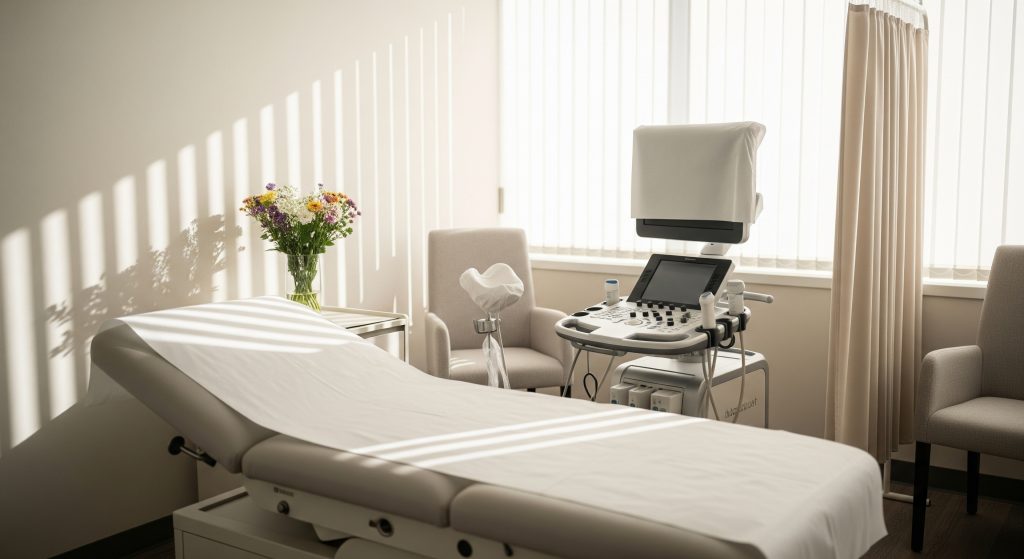
You lie on the couch in a semi reclined position with a drape for privacy.
-
The probe is covered with a sterile sheath and gel.
-
Gentle insertion follows, usually less than a tampon depth.
-
The operator surveys the uterus, endometrium, ovaries, and adnexa.
-
Targeted views are captured, and Doppler is added if needed.
The key is clear communication. You can request a pause at any point. TVS Ultrasound should feel tolerable, not painful. If discomfort occurs, repositioning usually helps.
Duration and Comfort Levels
Most studies take 10 to 20 minutes. Complex cases may take longer, especially when mapping deep endometriosis. Breathing steadily and relaxing pelvic muscles improves comfort.
Topical anaesthetic is rarely needed. A support person can attend if that is your preference. TVS Ultrasound balances thoroughness with efficiency, which suits busy diagnostic pathways.
Immediate Results Interpretation
Preliminary impressions are often shared immediately. Still, the final report is issued after image review and structured measurement checks. That prevents errors and ensures consistency.
|
Finding |
Typical Next Step |
|---|---|
|
Simple ovarian cyst |
Short interval follow up or discharge if small |
|
Suspected endometrioma |
Gynaecology referral and medical therapy discussion |
|
Fibroid distorting cavity |
Consider hysteroscopic resection pathway |
|
PID features with abscess |
Urgent antibiotics and possible drainage |
|
Ectopic pregnancy |
Immediate senior review and active management |
The goal is clarity on the day. TVS Ultrasound supports a decision there and then, or with minimal delay.
Benefits of TVS Over Other Pelvic Ultrasound Methods
Superior Image Quality
Transvaginal positioning places the transducer close to the target organs. Resolution improves, and artefacts decrease. Small lesions and subtle tissue differences become visible.
Compared with transabdominal pelvic ultrasound, the near field advantages are decisive in many scenarios. Ovarian and endometrial details are simply clearer. TVS Ultrasound turns borderline images into actionable findings.
Early Detection Capabilities
Early signs often hide in the details. TVS Ultrasound detects endometriomas, small fibroids, and early ectopics at smaller sizes. That enables prompt intervention and reduces emergency presentations.
Roughly speaking, earlier detection lowers treatment intensity and recovery time. You move sooner from symptoms to plan. The relief is not only clinical. It is psychological as well.
Cost-Effectiveness
Ultrasound is relatively affordable and widely available. TVS Ultrasound can preclude unnecessary MRI or invasive diagnostic procedures. Shorter diagnostic pathways reduce time off work and repeat appointments.
From a service angle, this is high value care. Good triage, faster answers, and rational escalation. And yet, escalation remains available whenever features are indeterminate.
Minimal Preparation Requirements
No fasting is needed. There is no ionising radiation. You empty the bladder and proceed. TVS Ultrasound therefore fits same day pathways and short notice slots.
That convenience matters in real clinics with tight schedules and unpredictable demand. Fewer barriers mean more completed studies and fewer cancellations.
Real-Time Visualisation Advantages
Real time scanning allows dynamic assessment: probe pressure, mobility tests, and pain correlation. You can identify organ sliding and tethering suggestive of adhesions.
Interactive scanning helps target the history. TVS Ultrasound links symptom location with visible pathology. That tight link often strengthens patient understanding and adherence.
Making Informed Decisions About TVS Ultrasound
Decision quality depends on symptoms, timing, and access. If pain is persistent or escalating, early imaging is prudent. If pregnancy is possible, act promptly. TVS Ultrasound is the first line test for many pelvic pain scenarios because it balances resolution, safety, and speed.
Consider the decision drivers:
-
Symptom profile and duration.
-
Fertility considerations now or soon.
-
Red flags: fever, heavy bleeding, or syncope.
-
Likelihood of endometriosis or PID based on history.
Discuss your preferences openly. Some patients prioritise rapid answers. Others prefer to sequence tests. TVS Ultrasound supports both approaches, as it integrates well with gynecological ultrasound pathways and, when needed, MRI. Choose the path that yields clarity and preserves options.
Frequently Asked Questions
Is TVS ultrasound painful?
Most people describe pressure rather than pain. Discomfort can occur with active inflammation, but it is usually manageable. Communication helps: ask for adjustments in angle or depth. TVS Ultrasound should remain tolerable, brief, and respectful of your comfort.
When should I schedule a transvaginal ultrasound for pelvic pain?
Schedule promptly if pain is persistent, severe, or associated with bleeding or fever. For cycle related symptoms, days 5 to 10 are often optimal. TVS Ultrasound is useful at other times too, especially for urgent concerns such as suspected ectopic pregnancy.
Can TVS ultrasound be performed during menstruation?
Yes, it can. Scanning during menstruation is acceptable when symptoms are acute or significant. Some patients prefer to wait for lighter flow. TVS Ultrasound remains feasible with appropriate preparation and clear consent.
How accurate is gynecological ultrasound for diagnosing endometriosis?
Accuracy is high for endometriomas and deep infiltrating disease at specific sites. Superficial peritoneal implants may not be seen. TVS Ultrasound performs strongly when conducted with a structured protocol, though laparoscopy is sometimes required for confirmation.
What’s the difference between transabdominal and transvaginal pelvic ultrasound?
Transabdominal scanning uses a probe on the abdomen and a full bladder. It offers a wider field but lower resolution. Transvaginal ultrasound places the probe closer to pelvic organs for higher detail. TVS Ultrasound is preferred for near field structures and early detection.
How long do TVS ultrasound results take?
Preliminary impressions are often shared immediately. Final reports typically follow within 24 to 72 hours, depending on service flow. If urgent findings arise, escalation occurs on the day. TVS Ultrasound therefore supports timely decision making.
Quick reference (for clarity): TVS Ultrasound is a form of transvaginal ultrasound that provides superior near field resolution. It complements pelvic ultrasound and gynecological ultrasound pathways, especially when pelvic pain is unexplained or evolving.

