






 We do what's right for you...


The Lumbar Laminectomy Procedure: Meaning, Process, and Results
Dr. Vishal Nigam
Conventional wisdom says every back problem needs a scan, a pill, and weeks of rest. That advice helps some, not all. When nerves remain pinched, function suffers and pain persists. This is where I consider lumbar decompression surgery. It is not a shortcut. It is a structured way to free compressed nerves and restore capacity. In this guide, I explain the options, the exact steps, the likely results, and the trade-offs. I also outline who benefits, who should wait, and how I set recovery expectations. The goal is simple. Make the decision feel reasoned, not rushed.
Types of Lumbar Decompression Surgery Available
Traditional Open Lumbar Laminectomy
Open laminectomy remains a reliable option when stenosis spans multiple levels. I use a midline incision to expose the lamina and central canal. The aim is to create generous space for the nerve roots. In selected patients, this open approach allows direct visual control and broad decompression. I consider open surgery when previous operations, severe deformity, or diffuse narrowing exist. In such contexts, lumbar decompression surgery must be thorough and safe. A measured open technique supports that objective.
-
Best suited for multilevel stenosis and complex anatomy.
-
Allows extensive decompression under direct vision.
-
Typically involves a longer incision and more muscle dissection.
Minimally Invasive Laminectomy
Minimally invasive techniques reduce muscle trauma through tubular retractors. I operate through smaller incisions and rely on magnification. Blood loss is often lower, and discharge can be earlier. The core goal remains the same. Free the nerve with precise removal of compressive bone and ligament. For focal stenosis, this route fits well. It is still lumbar decompression surgery, just with a different corridor and a restrained footprint.
-
Smaller incision and reduced soft tissue disruption.
-
Comparable decompression when used for focal disease.
-
Demands exact planning and careful imaging review.
Hemilaminectomy and Partial Laminectomy
Hemilaminectomy involves removing the lamina on one side only. I reserve it for unilateral symptoms and imaging that confirm asymmetric compression. Partial laminectomy trims only the necessary segment of lamina. Both approaches spare midline structures when possible. This can preserve stability and shorten recovery. The procedure still qualifies as lumbar decompression surgery. The difference is the tailored scope and the tissue preserved.
Laminotomy vs Full Laminectomy
Laminotomy means creating a keyhole opening rather than removing the full lamina. I use it to target a discrete narrowing, often at the lateral recess. A full laminectomy removes more bone to enlarge the central canal. Choice depends on the site and pattern of compression. I aim to remove compression while leaving supportive structures intact. That balance defines good lumbar decompression surgery in daily practice.
|
Term |
Definition |
|---|---|
|
Laminotomy |
Keyhole window in the lamina to address focused stenosis. |
|
Full laminectomy |
Removal of most or all lamina to enlarge the canal widely. |
Combined Procedures with Spinal Fusion
Decompression can destabilise a spine that is already borderline. In such cases, I add fusion to maintain alignment and reduce motion at the treated level. This is not routine. It is decided when slip, deformity, or significant facet removal exists. The decompression frees the nerve. The fusion preserves stability so benefits last. Some patients fear fusion. I understand that. The right fusion prevents repeat compression and protects the result of lumbar decompression surgery.
-
Consider fusion for spondylolisthesis with instability.
-
Consider fusion when extensive facet resection is required.
-
Preserve motion segments when safe to do so.
The Lumbar Laminectomy Procedure Step-by-Step
Pre-Operative Preparation and Tests
I begin with a focused history and neurological examination. Imaging includes MRI for soft tissues and sometimes CT for bone detail. I review red flags and discuss conservative therapy completed so far. Blood tests, anaesthetic review, and risk stratification follow. Expectations are aligned in writing. It sounds procedural. It is. Careful planning is a hallmark of safe lumbar decompression surgery.
-
Confirm radiology correlates with symptoms.
-
Optimise diabetes, blood pressure, and smoking status.
-
Plan levels, side, and extent of decompression in advance.
Anaesthesia and Patient Positioning
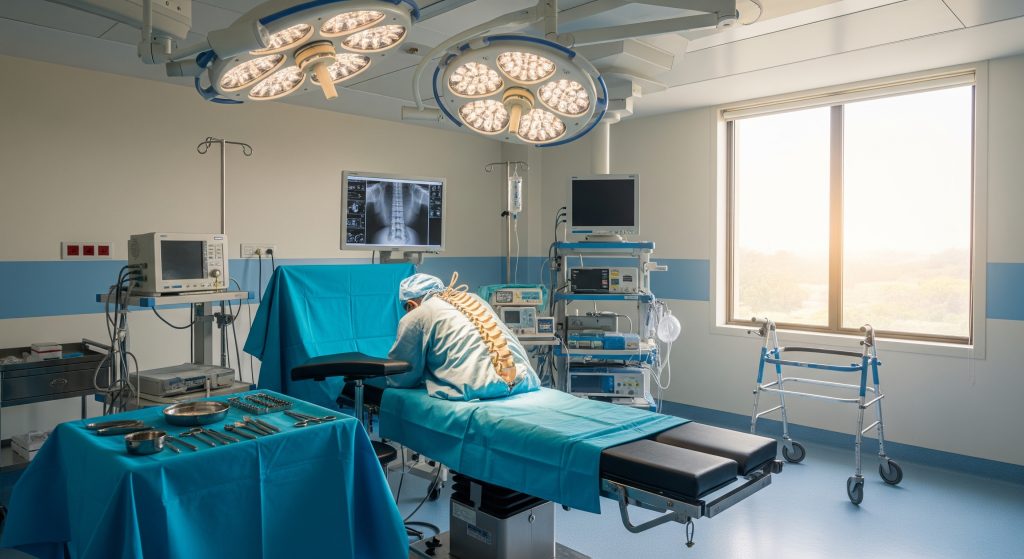
I use general anaesthesia for comfort and control. Patients are positioned prone with padding to protect pressure points. Fluoroscopy confirms the exact level before incision. The team runs a final safety pause. Clear communication supports a calm operating field. Accuracy at this stage sets up efficient lumbar decompression surgery.
Surgical Incision and Muscle Retraction
I make a midline or paramedian incision based on the chosen approach. Muscle fibres are split or elevated in a controlled manner. Minimising bleeding preserves visibility. Retractors are placed to maintain a stable corridor. I protect soft tissue as a priority. Soft tissue kindness speeds recovery after lumbar decompression surgery.
Lamina Removal Process
I identify the lamina and the interlaminar window. Using burrs and rongeurs, I remove the planned bone while preserving stability. The ligamentum flavum is then thinned or resected. The dura and nerve roots are visualised fully. This step is measured and slow. The aim is effective space creation with no undue traction. This is the structural core of any lumbar decompression surgery.
Precise bone work matters. Millimetres gained around the nerve often translate to meaningful relief.
Nerve Decompression Techniques
I decompress the central canal, lateral recess, and foramina as needed. Osteophytes and thickened ligament are removed under magnification. Disc fragments may be extracted if present and compressive. I confirm the nerve floats freely without tethering points. Excessive manipulation is avoided. Gentle technique protects the outcome of lumbar decompression surgery.
-
Central canal: remove lamina and hypertrophic ligament.
-
Lateral recess: undercut superior facet if needed.
-
Foraminal zone: shave osteophytes and clear disc edges.
Closure and Immediate Post-Op Care
Haemostasis is secured before closure. I close fascia and skin in layers and consider a drain for oozing. In recovery, I monitor neurological status and pain control. Early mobilisation begins the same day or the next morning. A short course of analgesia and a walking plan are provided. Clear instructions support a smooth exit after lumbar decompression surgery.
Recovery Timeline and Expected Results
Hospital Stay Duration
Most patients stay one to two days after a straightforward laminectomy. Some minimally invasive cases go home the same day. Complex multilevel cases may need longer. I decide based on mobility, pain control, and safety at home. A sensible stay often protects the gains of lumbar decompression surgery.
First Week Recovery Milestones
In the first week, walking is the main therapy. Short, frequent walks reduce stiffness and clot risk. Wound care is simple and brief. Leg pain often improves early. Back ache near the incision is common and fades. I ask patients to log their activity. This reinforces steady progress after lumbar decompression surgery.
-
Walk 5 to 10 minutes, 4 to 6 times daily.
-
Avoid bending, lifting, and twisting in combination.
-
Keep the wound dry as advised.
Physical Therapy Programme
Formal physiotherapy usually begins in weeks two to four. I focus on core endurance, hip mobility, and gait mechanics. Flexion bias or neutral bias exercises are tailored to symptoms. Education matters. Patients learn safe movement patterns that protect the decompression. A focused programme sustains the effect of lumbar decompression surgery.
Return to Daily Activities Schedule
Desk work often resumes in two to three weeks. Light manual tasks may need four to six weeks. Sports that stress the spine return in phases. Driving returns when pain is controlled and reaction time is normal. I prefer function-based decisions. Recovery should respect tissues healing after lumbar decompression surgery.
|
Desk work |
2 to 3 weeks if pain and mobility allow. |
|
Light lifting |
4 to 6 weeks with proper technique. |
|
High-impact sport |
12 weeks or more, progression dependent. |
Long-term Outcome Statistics
Long-term outcomes vary by diagnosis and baseline health. Roughly speaking, most patients report meaningful leg pain relief and functional gains. Some residual back discomfort can persist, particularly with degenerative changes. Outcomes improve when strength and weight are managed. Good habits convert a technical success into a life improvement after lumbar decompression surgery.
Pain Relief Success Rates
In practice, relief of sciatica symptoms is strong when compression is the driver. Numbness can recover slowly. Weakness recovers variably and depends on duration of pressure. I set realistic expectations in advance. Clear goals prevent disappointment after lumbar decompression surgery.
Risks, Complications, and Candidacy Criteria
Common Surgical Risks
Any operation carries risk. The main risks are bleeding, infection, blood clots, and anaesthetic issues. Nerve irritation can cause transient leg symptoms. Dural tears can occur and are usually repairable. I discuss each risk and how we mitigate it. Transparency supports informed consent for lumbar decompression surgery.
Specific Complications of Spinal Decompression
Specific to decompression are instability, recurrent stenosis, and adjacent level symptoms. Scar tissue may form and occasionally irritate nerves. Over-resection of facets can loosen the segment. I avoid that with conservative bone removal. Stability matters as much as space in lumbar decompression surgery.
Pros
-
Direct nerve relief and improved walking tolerance.
-
Reduced leg pain and neurogenic claudication.
Cons
-
Potential instability if resection is extensive.
-
Risk of recurrence with ongoing degeneration.
Ideal Candidates for Lumbar Decompression Surgery
I consider candidates who have neurogenic claudication or radicular pain with matching imaging. Symptoms should impair function despite targeted conservative care. Red flags or progressive deficits warrant faster action. Patients who engage with rehab fare best. Motivated candidates maximise the benefits of lumbar decompression surgery.
Conditions Treated by Laminectomy
Common indications include lumbar spinal stenosis, facet hypertrophy, ligamentum flavum thickening, and bony overgrowth. A central herniated disc with canal compromise may be included. Laminectomy tackles structural narrowing. It is a core element of spinal decompression surgery when the canal is tight.
Alternative Treatment Options
Alternatives include focused physiotherapy, analgesics, epidural injections, and activity modification. Weight management reduces load on joints. A guided trial of conservative care helps clarify likely benefit. If symptoms persist, I revisit surgery. The aim is the right care at the right time. Sometimes that is lumbar decompression surgery. Sometimes not.
Making an Informed Decision About Lumbar Decompression Surgery
Decision quality matters. I align the diagnosis, symptoms, and imaging into a simple narrative. Then I map options, benefits, risks, and timelines. A short comparative view helps.
|
Option |
When it fits |
Key trade-off |
|---|---|---|
|
Conservative care |
Mild symptoms and no deficit. |
Slower relief, avoids surgical risk. |
|
Minimally invasive laminectomy |
Focal stenosis with clear correlation. |
Precision required, limited visual field. |
|
Open multilevel laminectomy |
Diffuse stenosis or complex revision. |
More soft tissue disruption. |
|
Decompression with fusion |
Instability or planned facet resection. |
Longer recovery, enhanced stability. |
Here is my decision rule of thumb. If symptoms are severe and match imaging, and conservative treatment has failed, proceed. If function is acceptable, continue structured non-operative care. A clear threshold protects patients from premature lumbar decompression surgery and from avoidable delay.
Frequently Asked Questions
How long does a lumbar laminectomy procedure typically take?
Most operations take 60 to 120 minutes for a single level. Multilevel cases take longer. Time reflects anatomy, previous surgery, and findings. I value precision over speed. Effective lumbar decompression surgery is never rushed.
What is the difference between laminectomy and discectomy?
Laminectomy removes bone and ligament to widen the canal. Discectomy removes herniated disc material to free a nerve root. They address different structures. In some cases, both are performed together. The combined result is targeted spinal decompression surgery.
Can spinal stenosis return after lumbar decompression surgery?
Stenosis can recur due to ongoing degeneration or at adjacent levels. Good technique and rehab reduce risk, not eliminate it. Weight control and conditioning help maintain space. Early symptom review allows timely action if problems return.
Is lumbar laminectomy covered by health insurance in India?
Coverage depends on the policy and insurer network. Pre-authorisation is often required with documentation of indications. I advise patients to obtain a written estimate and approval. Clear communication avoids surprises around the lumbar laminectomy procedure.
What percentage of patients experience complete pain relief after the procedure?
Many achieve major relief of leg pain when compression is the driver. Complete relief varies by duration and nerve status. I frame success as better walking, better function, less leg pain. That is the honest goal in lumbar decompression surgery.
How soon can I drive after lumbar decompression surgery?
Driving resumes when pain is controlled and reflexes are normal. This often occurs within two to three weeks. No driving while on sedating analgesics. A short supervised drive in a safe setting is a prudent first step.
Will I need spinal fusion along with my laminectomy?
Fusion is needed when instability exists or will result from decompression. I assess slip, facet integrity, and alignment. If the segment is stable, I preserve it. If not, adding fusion protects the gains of lumbar decompression surgery.
Final note: Decisions improve with clarity. Define the problem, set the threshold for action, and choose the least invasive option that works. That is the discipline behind good lumbar decompression surgery and the basis for durable results.

