






 We do what's right for you...


Skin Cancer Treatment: Causes, Types, and Diagnosis Simplified
Dr. Payal Gupta
Early action beats complicated care. Standard advice often focuses on the disease after it spreads. That is backwards. I start with the practical decisions that determine outcomes, then explain the science that sits behind them. This is a concise, formal guide to skin cancer treatment, the main skin cancer types, the typical skin cancer causes, and how diagnosis works in practice.
Treatment Options for Skin Cancer
Choosing a modality is not only about the tumour type. It is about depth, anatomic site, comorbidity, and personal priorities. Below, I outline where each skin cancer treatment usually fits, and where caution is warranted.
1. Surgical Treatments
Surgery remains the default for localised disease. We prioritise complete excision with histologically clear margins. That gives durable control and preserves options.
-
Wide local excision: standard for melanoma and many non-melanoma lesions.
-
Curettage and electrodessication: suitable for superficial basal cell lesions in low-risk sites.
-
Excisional biopsy with narrow margins: diagnostic and often curative for small lesions.
Pros are immediate removal and definitive pathology. Cons include scarring and, occasionally, functional impact near critical structures. Precision matters most.
2. Mohs Surgery
Mohs micrographic surgery allows layer-by-layer excision with real-time margin assessment. Use it for high-risk facial basal and squamous carcinomas, recurrent disease, and tumours with ill-defined edges.
-
Tissue-sparing technique that maximises clearance in cosmetically sensitive areas.
-
Excellent cure rates for selected non-melanoma cancers.
It is resource intensive. But for complex facial tumours, it is often the right call.
3. Radiation Therapy
Radiotherapy is effective for patients who are not surgical candidates or for adjuvant control when margins are close. It is also useful for perineural invasion and selected nodal disease.
-
External beam radiation: standard fractionation for local control.
-
Brachytherapy: targeted dosing for small or curved sites.
Expect gradual cosmetic change in the treated field. Balance is the aim.
4. Chemotherapy Options
Systemic cytotoxic therapy is now less common, yet it still holds value in specific settings. As Skin Cancer Treatment (PDQ) – NCBI – NIH reports, topical 5-fluorouracil can reduce superficial basal cell carcinoma and actinic keratoses with tumour reduction up to 75%.
-
Topicals: 5-FU for field change and superficial disease, often in cycles.
-
Intralesional chemotherapy: for small basal or squamous lesions when surgery is less suitable.
-
Systemic agents: dacarbazine or temozolomide for advanced melanoma when other lines fail.
Temozolomide offers oral convenience and central nervous system penetration, which assists when brain metastases complicate melanoma. Side effects are manageable with proactive supportive care. I set expectations early and review frequently.
5. Immunotherapy
Checkpoint inhibitors have reshaped outcomes for advanced disease. In line with recent clinical overviews, as Mayo Clinic highlights, PD-1 and CTLA-4 antibodies have increased survival in advanced melanoma.
-
PD-1 inhibitors (pembrolizumab, nivolumab): restore T cell activity against tumour.
-
CTLA-4 blockade (ipilimumab): deepens immune activation, often combined with PD-1 agents.
-
Expanding use in advanced cutaneous squamous carcinoma as first line in many centres.
Immune toxicities can affect skin, gut, lungs, or endocrine organs. Early reporting and prompt steroids are crucial. I brief patients thoroughly and coordinate rapid response pathways.
6. Targeted Drug Therapy
Targeted therapy strikes at known mutations. In melanoma, BRAF mutations are common, and we pair a BRAF inhibitor with a MEK inhibitor to suppress signalling escape.
-
BRAF inhibitor plus MEK inhibitor: rapid responses in BRAF V600 tumours.
-
c-KIT or NRAS strategies: trial eligibility or off-protocol use in select cases.
I explain the acronyms upfront. PD-1 is a receptor that dampens T cells. BRAF is a kinase driving growth signals. Clarity improves adherence.
7. Photodynamic Therapy
Photodynamic therapy combines a topical photosensitiser with controlled light exposure. Doctors consider it for actinic keratoses and superficial non-melanoma lesions on the scalp and face.
-
Field therapy treats visible and subclinical lesions together.
-
Downtime is limited, though photosensitivity precautions are essential for 48 to 72 hours.
Results are reliable for field change, though multiple sessions may be required. It can sit alongside other skin cancer treatment approaches.
8. Cryotherapy
Liquid nitrogen remains a practical option for actinic keratoses and small superficial lesions. Freeze-thaw cycles disrupt tumour cells with minimal equipment.
-
Fast clinic procedure with immediate return to activity.
-
Risk of hypopigmentation or scarring in darker skin types.
Treatment fit at a glance
Types of Skin Cancer
Understanding the main categories helps match risk to action. I keep this section direct and clinically useful.
1. Basal Cell Carcinoma
Basal cell carcinoma is the most common and usually slow growing. It rarely metastasises, but local damage can be substantial if neglected.
-
Typical signs include pearly nodules, telangiectasia, and occasional ulceration.
-
Primary treatment is surgical removal or Mohs for critical sites.
Early, tidy excision is often curative. That is the quiet advantage of prompt care.
2. Squamous Cell Carcinoma
Cutaneous squamous cell carcinoma carries a higher metastatic risk than basal cell. It often arises on sun-exposed areas or chronic wounds.
-
Keratinising nodules, scaly plaques, or non-healing ulcers are typical.
-
Surgery is first line, with adjuvant radiation for high-risk features.
Advanced cases respond well to modern PD-1 immunotherapy. Surgical vigilance still matters.
3. Melanoma
Melanoma is aggressive and potentially lethal when late. As Mayo Clinic reports, it is the deadliest form, though early detection allows cure in many cases.
-
Look for changing moles or new, atypical pigmented lesions.
-
Sentinel node biopsy and staging guide adjuvant therapy decisions.
When BRAF mutated, targeted combinations produce rapid shrinkage. When not, I prioritise immunotherapy. Different paths, same objective.
4. Merkel Cell Carcinoma
Merkel cell carcinoma is rare and highly aggressive. It presents as a painless, rapidly growing nodule on sun-exposed skin in older adults.
-
Management integrates surgery, radiation, and immunotherapy.
-
Close surveillance is non-negotiable due to recurrence risk.
Speed of coordination is critical here. Delays reduce options.
5. Sebaceous Gland Carcinoma
Sebaceous carcinoma often arises on the eyelid. It can mimic benign conditions like chalazion.
-
Diagnosis requires biopsy, often with map biopsies for periocular disease.
-
Treatment focuses on meticulous excision and ophthalmic follow-up.
Under-calling these lesions causes harm. I keep a low threshold for biopsy.
Causes and Risk Factors
Risk is cumulative and multifactorial. I encourage patients to consider additive effects, not single causes. That framing is more useful than lists.
UV Radiation Exposure
Ultraviolet exposure drives the majority of cases. Intermittent intense sun during childhood and regular adult exposure both increase risk.
-
Use broad-spectrum SPF 30 or higher and reapply during outdoor activity.
-
Protective clothing and shade reduce cumulative dose.
Tanning beds remain a clear hazard. The benefit is zero. The risk accumulates silently.
Genetic Factors
Family history and specific mutations elevate risk. CDKN2A and BRAF pathways feature in melanoma biology, though not every mutation is destiny.
-
Hereditary syndromes warrant earlier and more frequent screening.
-
Genetic counselling can guide testing and monitoring.
I tailor screening intensity to pedigree and phenotype. Precision reduces anxiety and waste.
Skin Type and Complexion
Fair skin, red or blonde hair, and light eyes correlate with higher risk. Darker skin is not immune, and acral and mucosal melanomas still occur.
-
Adjust screening to phenotype and history, not only to ethnicity.
-
Educate on non-sun-exposed sites in darker skin types.
Equity here is about awareness and access. Both are required.
Age and Gender Factors
Risk rises with age due to cumulative damage. Men show higher incidence for many non-melanoma cancers, likely reflecting occupational exposure and screening patterns.
-
Older adults benefit from routine full-body checks.
-
Younger adults with strong sun histories need earlier education.
Patterns are not destiny. Behaviour change shifts risk curves.
Environmental Triggers
Chronic arsenic exposure, ionising radiation, and immunosuppression add measurable risk. Occupational exposures deserve direct questioning.
-
Transplant recipients require structured dermatology follow-up.
-
Industrial exposure histories guide surveillance intensity.
Record the history once. Reference it at every review.
Pre-existing Skin Conditions
Actinic keratoses can progress to squamous carcinoma. Large congenital naevi carry higher melanoma risk and warrant careful longitudinal assessment.
-
Field therapies reduce the burden of actinic damage.
-
Photographs assist in monitoring complex naevi over time.
Small habits like monthly checks pay off. Consistency beats intensity.
Diagnosis and Detection Methods
Diagnosis is a sequence, not a single act. I combine pattern recognition, magnification, and tissue proof, then stage intelligently.
Visual Skin Examination
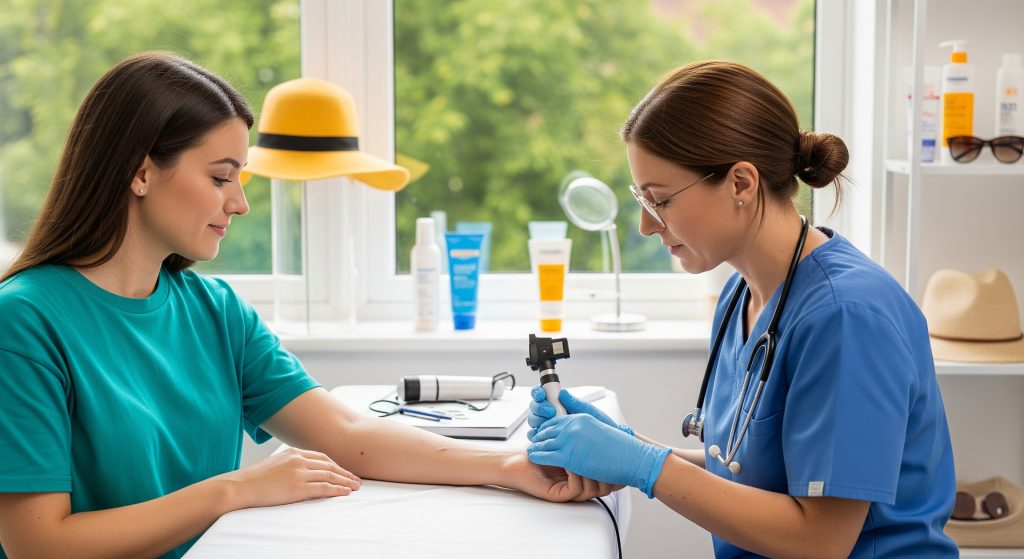
I start with a full-body review, including scalp, nails, and mucosa. A structured head-to-toe approach reduces misses.
-
ABCDE for pigmented lesions: asymmetry, border, colour, diameter, evolution.
-
Non-pigmented cues: persistent ulcers, pearly nodules, crusting plaques.
Atypical lesions move quickly to biopsy. Decisiveness prevents drift.
Dermoscopy
Dermoscopy adds magnification and polarised light to reveal subsurface structures. It increases diagnostic accuracy for both pigmented and non-pigmented lesions.
-
Patterns such as pigment network, dots, streaks, and vascular morphology inform risk.
-
Training matters. Pattern libraries accelerate learning.
It is basically a second set of eyes. And a disciplined one.
Biopsy Types
Histology is the final word. I choose the biopsy method that secures architecture and depth while minimising delay.
|
Biopsy |
Best use |
|
Excisional |
Small lesions where melanoma is suspected |
|
Punch |
Sampling thicker plaques or nodules for depth |
|
Shave |
Raised lesions suspicious for basal or squamous carcinoma |
|
Incisional |
Large or complex lesions where full excision is impractical initially |
Clear lab communication speeds accurate reporting. Simple, explicit notes help pathologists deliver precise margins and subtype detail.
Imaging Tests
Imaging aligns with staging needs. We order ultrasound for nodal basins, CT or PET-CT for advanced tumours, and MRI for brain assessment in high-risk melanoma.
-
Use imaging when results will change management.
-
Avoid routine scans for low-risk localised lesions.
Less is sometimes more. Good staging avoids noise.
Early Warning Signs
Early recognition is the simplest way to improve outcomes. At a minimum, I teach the ABCDE rule and the ugly duckling sign.
-
New, changing, or non-healing lesions warrant prompt assessment.
-
Symptoms such as itching, bleeding, or pain in a mole raise suspicion.
These are practical skin cancer symptoms to watch for. Action beats reassurance when doubt persists.
Taking Control of Skin Cancer
Control starts with what is chosen daily. Sun protection, routine checks, and timely appointments make a measurable difference. I keep plans simple so they actually happen.
-
Adopt a lifelong protection routine: sunscreen, clothing, and shade habits.
-
Set quarterly self-checks and annual professional examinations.
-
Document lesions with photos and dates to track change.
-
Seek assessment for any evolving lesion within two weeks.
-
Discuss eligibility for immunotherapy or targeted agents when stage warrants.
For clarity, I summarise how each skin cancer treatment fits into the bigger picture of risk, biology, and personal goals. This is where informed consent becomes informed choice.
If a single line must be remembered, it is this. Early diagnosis simplifies everything.
Frequently Asked Questions
What are the first signs of skin cancer?
Common early signs include a new lesion, a changing mole, or a non-healing sore. For pigmented lesions, use ABCDE. For non-pigmented lesions, look for persistent crusting, bleeding, or a pearly edge. These changes are classic skin cancer symptoms and should prompt review.
Can skin cancer be completely cured?
Yes, many cases are cured, especially when localised and treated promptly. Surgical excision or Mohs surgery offers high control rates. Early-stage melanoma is often curable with surgery alone. Advanced disease may respond well to immunotherapy or targeted skin cancer treatment, though not without exceptions.
How long does skin cancer treatment take?
Timeframes vary. A standard excision is usually completed in one session with brief recovery. Mohs can take several hours due to on-site histology. Immunotherapy or targeted regimens run for months with scheduled infusions or tablets. I align duration with disease stage and response.
Is skin cancer treatment painful?
Most procedures use local anaesthesia and cause limited discomfort. Post-procedure soreness is common but manageable. Systemic therapies have side effects that I address proactively. Clear pain plans and early communication reduce distress significantly.
What is the survival rate for skin cancer?
Survival varies by type and stage. Early-stage basal and squamous cancers have excellent outcomes after local therapy. Early melanoma has high survival with prompt excision, while advanced melanoma outcomes have improved with immunotherapy as Mayo Clinic notes. Figures differ by registry and methodology.
Can skin cancer return after treatment?
Yes, recurrence can occur locally or systemically. Risk depends on type, margins, depth, and biology. I schedule follow-up at defined intervals and educate on self-monitoring. Relapse caught early remains highly treatable in many scenarios.
In practice, prevention costs little and pays back for decades. That is the quiet win most miss. It is basically the simplest form of skin cancer treatment there is.
Note: This article summarises current practice as far as available guidance suggests. Individual care plans should be agreed with a qualified clinician.

