






 We do what's right for you...


Prostatectomy Explained: Surgery, Recovery and Side Effects
Dr. Mohammed Tabish Rayee
Conventional wisdom says the operation is the difficult part. In prostate care, the decision before surgery and the recovery after it define outcomes just as much. In this explainer, I set out the Prostatectomy Procedure in practical terms, from surgical options to day-by-day recovery and long-term function. I also address common concerns about prostate cancer surgery, with clear steps to manage risk and improve quality of life.
Types of Prostatectomy Procedures
1. Robotic-Assisted Laparoscopic Prostatectomy
In routine practice, a robotic platform enables precise dissection through small ports. I favour it for a Prostatectomy Procedure when cancer is confined to the gland and pelvic nodes. The camera magnification helps with nerve-sparing around the neurovascular bundles, which may preserve continence and erections. Port placement typically uses a periumbilical camera site with three or four working ports across the lower abdomen. The pneumoperitoneum creates working space, while fine wristed instruments refine suturing and haemostasis. The result is controlled resection and tidy reconstruction of the urethrovesical anastomosis.
Benefits include reduced blood loss, shorter inpatient stays, and often faster convalescence. The caveat is that outcomes still depend on surgeon experience and case selection. Robotics is a tool. Technique and judgement drive results.
-
Best suited for localised disease and nerve-sparing intent.
-
Small incisions and usually modest postoperative pain.
-
Access to pelvic lymph nodes for staging when indicated.
2. Open Radical Prostatectomy
An open Prostatectomy Procedure remains appropriate in selected cases, especially with complex anatomy or extensive disease. The retropubic approach uses a lower midline incision, allowing direct access to the prostate and pelvic lymph nodes. Visibility is broad, and tactile feedback is immediate. This method can be optimal when prior pelvic surgery or scarring limits laparoscopic planes. Recovery is typically longer than minimally invasive methods, and blood loss can be higher. Even so, open surgery delivers excellent oncological control in the right hands.
Patients often ask whether an open operation means inferior function. Not necessarily. Continence and erectile outcomes relate to nerve-sparing feasibility, fibrosis, and baseline function. Technique again matters.
3. Simple Prostatectomy
Simple prostatectomy is not a cancer operation. I consider it when the goal is to relieve severe urinary obstruction from benign prostatic hyperplasia. The adenoma is removed, not the entire gland. It can be performed open, laparoscopic, or robot-assisted. For cancer, a simple approach is inadequate. For massive benign enlargement with recurrent retention, it can transform urinary flow and quality of life.
-
Indication: benign enlargement with significant obstruction or retention.
-
Outcome: improved flow and symptom relief.
-
Not appropriate for malignancy management.
4. Perineal Prostatectomy
Perineal prostatectomy reaches the gland through an incision between the scrotum and the anus. I consider this Prostatectomy Procedure when abdominal access is problematic or prior surgery complicates the retropubic route. It can reduce intra-abdominal manipulation and may suit higher body mass index or complex abdominal histories. Lymph node dissection is less straightforward through this route, so staging plans must be clear. In experienced centres, functional outcomes can be comparable with other techniques.
Surgical Approaches and Incision Sites
Approach selection shapes incision sites and working planes. For a robotic Prostatectomy Procedure, ports are placed across the lower abdomen to allow triangulation and stable camera work. As Translational Andrology and Urology notes, robotic radical prostatectomy has become standard for localised disease, with 3D visualisation and refined instrumentation improving precision.
Open retropubic surgery uses a suprapubic midline incision for wide exposure and direct control of the dorsal venous complex. The perineal approach uses a midline perineal incision for a short route to the apex and prostatic fossa. All three routes aim for clear margins, careful nerve handling, and a watertight bladder neck to urethra join. The incision is the surface cue. The underlying goal is identical: oncological clearance and functional preservation.
|
Approach |
Typical Incision or Ports |
Highlights |
|---|---|---|
|
Robotic-assisted |
Periumbilical camera + 3 to 4 lower abdominal ports |
3D view, small scars, consistent suturing control |
|
Open retropubic |
Lower midline suprapubic incision |
Direct access, tactile feedback, straightforward node dissection |
|
Perineal |
Midline perineal incision |
Short route to apex, avoids abdomen, node access limited |
Choosing the Right Procedure
Choice is not about fashion. It is about pathology, anatomy, and goals. For localised prostate cancer surgery with nerve preservation, I often recommend a robotic Prostatectomy Procedure when feasible. For very large glands, prior abdominal surgery, or adhesions, an open or perineal route may be safer. Patient factors such as baseline continence, erectile function, and comorbidities guide the plan.
-
Oncological priority: margin status and appropriate node assessment.
-
Functional priority: continence and erectile function, where nerve-sparing is viable.
-
Recovery priority: pain control, early mobilisation, clear wound care, and realistic timelines.
There is a counterpoint. Some argue that the robot guarantees faster recovery. It often does, but not always. Surgeon skill and preoperative preparation still decide most outcomes.
Prostatectomy Recovery Timeline
Hospital Stay Duration
Most patients now experience shorter hospital stays after a Prostatectomy Procedure. In robotic cases, one overnight stay is common. As Mount Sinai Health reports, many men spend a single night on the ward before discharge.
Open procedures may require an extra day, particularly with higher pain scores or when drains are used. Clinical stability drives discharge: safe mobilisation, controlled pain, and catheter education. I prefer to discharge when patients can walk comfortably, manage oral intake, and understand postoperative signs to watch.
First Week at Home
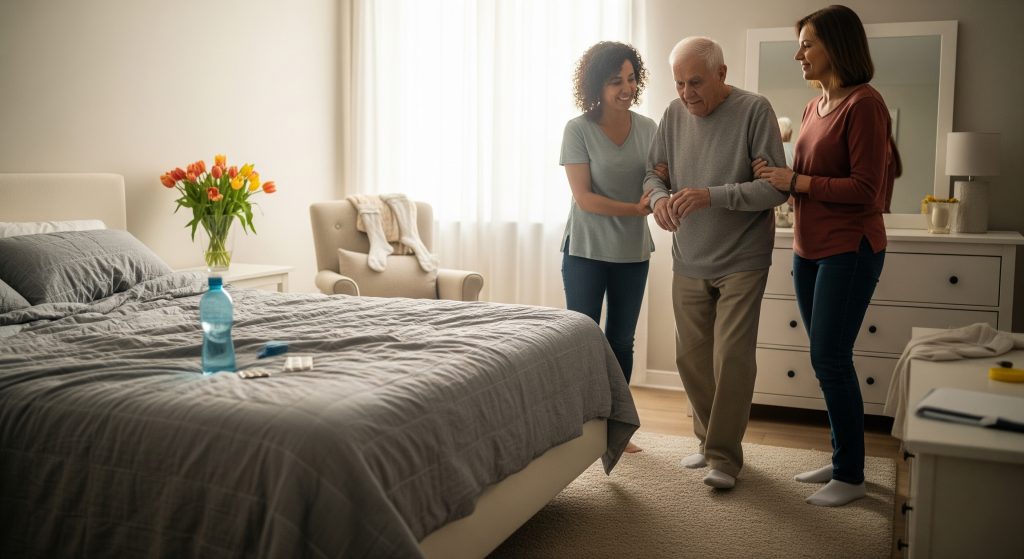
The first week is about rest with movement. I advise short indoor walks every hour while awake to aid circulation and reduce clot risk. A Prostatectomy Procedure leaves tissue planes healing under the skin, so lifting and straining should be avoided. Keep the catheter secure and the bag below bladder level. Maintain hydration and a simple diet that avoids constipation. A gentle stool softener can help.
-
Walk frequently, then rest with legs elevated.
-
Take prescribed analgesia on schedule, not just when pain escalates.
-
Record temperature and watch for fevers or worsening pain.
For many, energy is variable. That is normal. Healing is not linear. It improves, and then it plateaus, and then it improves again.
Catheter Management and Removal
A Foley catheter is standard after a Prostatectomy Procedure to protect the anastomosis. The dwell time is usually about one to two weeks. As the Mayo Clinic notes, many patients manage a catheter for up to two weeks, with routine cleaning and infection checks throughout.
At home, simple steps help. Keep the drainage bag below bladder level, clean the meatus daily, and switch to a leg bag during the day if instructed. After removal, transient leakage is common as the pelvic floor re-engages. I suggest starting pelvic floor exercises preoperatively and continuing daily after removal. Minor blood staining in urine can occur for a short time as activity increases. Any severe pain, heavy bleeding, or inability to pass urine requires urgent review.
Weeks 2 to 4 Recovery Milestones
The second to fourth week sets the tone for function. After a Prostatectomy Procedure, continence usually improves in steps. Pads reduce from several per day to one, then to occasional use. Pelvic floor exercise technique matters. Focus on the lift-and-hold of the sphincter, not on gluteal or abdominal bracing. Short walks become longer, while fatigue gradually eases. Many men can return to desk work in this window if duties are light.
-
Typical goals: extended walking tolerance and less pad usage.
-
Light household tasks only, no heavy lifting or core strain.
-
Continue analgesia taper and maintain regular hydration.
Return to Normal Activities
For a desk role, two to four weeks is a realistic target after a straightforward Prostatectomy Procedure. For manual work, six to eight weeks is safer. Gym routines should restart with caution, beginning with light resistance and slow progression. Cycling seats can irritate the perineum, so I delay saddle time until continence stabilises and tenderness resolves. Sexual activity can resume when comfortable, mindful of erectile dysfunction risk and the potential for a dry orgasm after the prostate and seminal vesicles are removed.
One practical example helps. A manager returned at week three for half days, avoided long meetings in the first week back, and used scheduled walks. Recovery held steady because the plan respected fatigue and continence training.
Long-Term Recovery Expectations
By three months, most men feel largely recovered from a Prostatectomy Procedure. Continence often stabilises by six months, with further small gains up to a year. Erectile function recovery varies widely and depends on nerve-sparing, baseline function, vascular health, and adherence to penile rehabilitation. To an extent, age and comorbidity shape the ceiling. Patience and structured follow-up make a difference.
-
Oncological follow-up: PSA checks at defined intervals.
-
Functional follow-up: continence review, ED assessment, and therapy adjustments.
-
Lifestyle: weight control, cardiovascular fitness, and sleep quality to support recovery.
Progress is rarely a straight line. It is basically a set of gradual steps that consolidate over months. Keep expectations firm and flexible at once.
Managing Prostatectomy Side Effects
Urinary Incontinence Treatment
Leakage after a Prostatectomy Procedure is common early on. Most men improve with time and targeted training. I use a structured pelvic floor programme with biofeedback when available. Daily Kegels, timed voiding, and avoidance of bladder irritants help. For persistent stress incontinence after nine to twelve months, options include male sling or an artificial urinary sphincter. Each option has distinct indications, success rates, and trade-offs.
-
Start pelvic floor training preoperatively if possible.
-
Use pads strategically while function improves.
-
Escalate to devices or surgery for refractory cases.
Erectile Dysfunction Solutions
Erectile dysfunction (ED) follows a proportion of cases, even with nerve-sparing. A Prostatectomy Procedure can shock the neurovascular tissue, leading to neuropraxia that takes months to settle. Penile rehabilitation is practical and evidence-guided. I prescribe PDE5 inhibitors, vacuum erection devices, and, when needed, intracavernosal injections. These interventions maintain tissue oxygenation and structure, reducing long-term fibrosis. For those with persistent ED, a penile prosthesis offers reliable function.
There is scepticism about rehabilitation protocols. The data are mixed, but early, regular stimulation likely helps preserve tissue health. Low risk, potential gain. Reasonable trade.
Pain Management Strategies
Pain after a Prostatectomy Procedure is usually moderate and short-lived. I use multimodal analgesia: paracetamol, an NSAID if appropriate, and a short course of opioids only when required. Ice packs help perineal tenderness in perineal operations. Good pain control supports deep breathing, mobility, and sleep, which together accelerate recovery.
-
Scheduled simple analgesics for the first few days.
-
Opioid minimisation to avoid constipation and sedation.
-
Address constipation proactively with fibre and softeners.
Preventing Blood Clots
Venous thromboembolism risk rises after pelvic surgery. I stratify risk and use compression stockings, early mobilisation, and pharmacological prophylaxis as indicated. Walking soon after a Prostatectomy Procedure is a simple, powerful preventive step. Hydration supports blood volume and reduces viscosity. For high-risk profiles, extended prophylaxis may be warranted.
-
Move every hour while awake in the first week.
-
Use stockings until activity levels normalise.
-
Escalate anticoagulation for high-risk histories.
Wound Care Guidelines
Incisions must stay clean and dry. After a Prostatectomy Procedure, showering is usually permitted after 24 to 48 hours, with careful pat-drying. Avoid soaking until the wounds fully seal. Look for spreading redness, discharge, or fever. Laparoscopic port sites are small and usually heal quickly. Open or perineal incisions may require more frequent inspection and support with simple dressings.
-
Keep adhesives intact unless instructed to change them.
-
Avoid friction, tight waistbands, and heavy lifting.
-
Report odour, discharge, or increasing pain promptly.
When to Contact Your Doctor
Contact the team without delay for any of the following after a Prostatectomy Procedure:
-
Fever above 38.0 C or rigors.
-
Severe or escalating abdominal, pelvic, or perineal pain.
-
Heavy bleeding, inability to pass urine after catheter removal, or clots.
-
Spreading redness around wounds or purulent discharge.
-
Shortness of breath, chest pain, or calf swelling.
Better to call early and be reassured than to wait and risk progression.
Living Well After Prostatectomy
Life after a Prostatectomy Procedure is more than continence pads and clinic visits. It is a return to confidence and routine. I recommend a phased plan that supports cardiovascular health, pelvic floor strength, and sexual rehabilitation. Nutrition should emphasise lean protein, vegetables, fibre, and adequate hydration. Weight control helps continence and erectile function. Sleep and stress management matter as much as any pill.
-
Exercise: brisk walking, light resistance training, and gradual progression.
-
Pelvic floor: daily sets with correct technique and consistency.
-
Sexual health: discuss ED early, try therapies systematically, and involve partners.
-
Psychological support: counselling or peer groups when needed.
Follow-up is non-negotiable. PSA monitoring tracks oncological control. Discussion of prostatectomy side effects keeps small issues from becoming bigger ones. The aim is a steady state of health that feels sustainable and personal. Not perfect. Sustainable.
Frequently Asked Questions
How long does a prostatectomy procedure typically take?
Duration varies by approach and complexity. A robotic Prostatectomy Procedure usually takes two to three hours in straightforward cases. Open surgery can be similar, though complex anatomy or lymph node dissection adds time. Theatre time also reflects the need for meticulous nerve-sparing and a secure anastomosis. Safe and methodical beats quick, every time.
When can I return to work after prostate surgery?
For office roles, two to four weeks is common after an uncomplicated Prostatectomy Procedure. Many resume part time first. Manual or safety-critical roles may require six to eight weeks. Recovery plans must consider continence stability, energy, and pain control. Err on the side of caution, then build up hours.
What percentage of men experience permanent side effects?
Permanent issues are less common but not negligible. After a nerve-sparing Prostatectomy Procedure, most men regain continence, typically within months. A smaller proportion have ongoing stress leakage that may require further treatment. Erectile function recovery is variable and age dependent. Some men need long-term ED support or a prosthesis. The best predictor is preoperative function and the feasibility of nerve-sparing.
Can prostate cancer return after prostatectomy?
Recurrence can occur, though many remain cancer free after prostate cancer surgery. A Prostatectomy Procedure removes the gland and aims for clear margins. PSA monitoring detects biochemical recurrence early. If PSA rises, options include salvage radiotherapy, systemic therapy, or combined approaches. Early detection of recurrence expands the menu of effective treatments.
What lifestyle changes are recommended after prostate removal?
I advise three pillars after a Prostatectomy Procedure: cardiovascular fitness, pelvic floor strength, and sexual rehabilitation. Add a supportive diet, weight control, and regular sleep. Reduce alcohol that worsens leakage. Address anxiety with structured strategies, not stoicism. Small, consistent actions compound into meaningful recovery.

