






 We do what's right for you...


Postmenopausal Endometrial Thickness: What’s Normal After 50?
Dr. Manju Hotchandani
Conventional advice says any postmenopausal lining above a single number is a problem. The data are more nuanced. Your risk depends on symptoms, thresholds, hormones, and age. This guide sets out what clinicians look for, how Normal Endometrial Thickness is judged in practice, and when you should escalate care. It is designed so you can discuss findings and next steps with confidence.
Normal Endometrial Thickness Ranges for Postmenopausal Women
Standard Thickness Measurements for Women Without Bleeding
In the absence of bleeding, Normal Endometrial Thickness is typically thin. A practical threshold helps decide when to investigate. As How thick is too thick? When endometrial thickness should… notes, an endometrium above 11 mm in an asymptomatic postmenopausal woman warrants biopsy consideration, with a cancer risk near 6.7%. Values at or below 11 mm carry a very low risk in this group.
Risk is not static. It rises with age and with greater thickness. The same analysis reported a roughly 4.1% risk at age 50 for the 11 mm threshold, increasing to about 9.3% by age 79. Your clinician interprets Normal Endometrial Thickness in that context, rather than on a number alone.
Some newer studies propose a lower cut point for asymptomatic screening. Others advise caution given false positives. The clinical point remains steady. Without bleeding, the pretest probability is low, and management should reflect that. Normal Endometrial Thickness guidance therefore privileges symptoms over a single scan.
-
No bleeding and thickness 4 to 11 mm: usually observe and individualise.
-
No bleeding and thickness above 11 mm: discuss biopsy or repeat scan.
-
Incidental cystic or irregular lining: consider closer review despite size.
What this means: one scan rarely tells the whole story. Pattern and context matter more than a lone number on the screen.
Thickness Guidelines for Women With Postmenopausal Bleeding
Any bleeding after 12 months of no periods changes the calculus. Normal Endometrial Thickness thresholds tighten because the symptom raises baseline risk. As Closer Look at Postmenopausal Bleeding and Endometrial Cancer reports, roughly 90% of women diagnosed with endometrial cancer experienced postmenopausal bleeding. Evaluation should be timely.
In practice, a cut-off near 4 mm is often used to reassure or to trigger further tests. A thin, uniform lining at or below 4 mm, with bleeding that settles, typically supports a conservative approach. A thicker or irregular lining prompts sampling. Normal Endometrial Thickness in the setting of bleeding is therefore a narrower target than in asymptomatic women.
Ultrasound remains the first-line test. Texture, vascularity, and focal lesions can sway management. A thickness of 5 mm with bleeding may still be significant, especially with a heterogeneous appearance. Your clinician integrates the image with your presentation. It is not just the number.
|
Finding |
Typical next step |
|---|---|
|
Bleeding + endometrium ≤ 4 mm, smooth |
Reassure, watchful waiting, consider repeat scan |
|
Bleeding + endometrium 5 to 8 mm |
Consider biopsy or hysteroscopy based on risk factors |
|
Bleeding + endometrium > 8 mm or irregular |
Endometrial sampling and targeted evaluation |
Differences Between Hormone Therapy Users and Non-Users
Hormones alter what counts as Normal Endometrial Thickness. Unopposed oestrogen stimulates the lining. Progestogen counterbalances this effect. As Hormone therapy in postmenopausal women and risk of endometrial hyperplasia summarises, unopposed oestrogen increases the risk of endometrial hyperplasia, while combined therapy mitigates it.
Tamoxifen is a special case. It can thicken the lining and create cystic changes. That does not always imply malignancy. It does complicate interpretation. For users of sequential HRT, timing of your scan against the progestogen phase helps. It reduces misleading readings.
-
On combined HRT: a slightly higher but often benign thickness can occur.
-
On unopposed oestrogen: lower threshold for sampling if thickening persists.
-
On tamoxifen: consider hysteroscopy if ultrasound is equivocal.
Your care team will define Normal Endometrial Thickness for you based on the regimen. Context trumps a one-size value.
Age-Related Variations in Normal Thickness Values
Years since menopause also influence acceptable values. As Measurement precision and normal range of endometrial thickness in a postmenopausal population by transvaginal ultrasound details, mean endometrial thickness sits near 2.3 mm in the first five years after menopause. It decreases by about 0.03 mm per year and stabilises around 1.8 mm, before a slight rise later.
This is a small shift, but it explains why Normal Endometrial Thickness may be marginally different at 52 compared with 72. It also explains why asymptomatic values cluster low. Age, body mass index, and fibroids can subtly push values upward, though not always in a clinically meaningful way.
In practice, your report should describe pattern, homogeneity, and focality. Those features matter more than tiny age-related drifts. Normal Endometrial Thickness is a range anchored by clinical common sense.
Understanding Risk Factors and Warning Signs
Major Risk Factors for Abnormal Endometrial Thickness
Risk is driven by biology and by exposure. As Endometrial Cancer – StatPearls – NCBI Bookshelf outlines, key risk factors include obesity, diabetes, and prolonged oestrogen exposure, including unopposed oestrogen therapy. Each can contribute to abnormal endometrial thickening.
Metabolic syndrome exerts a compounding effect. Insulin resistance and chronic inflammation both influence the endometrium. Family history and certain inherited syndromes also matter, though these apply to fewer people. Normal Endometrial Thickness becomes less reassuring when risk concentrates.
-
Higher BMI and central adiposity increase oestrogen from peripheral conversion.
-
Polycystic ovary syndrome history may extend the exposure window.
-
Late menopause and nulliparity often reflect higher lifetime oestrogen exposure.
Your clinician considers risk in sum and not in isolation. One factor seldom decides the plan.
Critical Warning Symptoms Requiring Medical Attention
Bleeding after menopause deserves assessment. As Mayo Clinic explains, any vaginal bleeding after 12 months without periods is abnormal. Even light spotting warrants evaluation.
Other symptoms include watery or blood-streaked discharge, pelvic pain, or new urinary changes. Fever or chills suggest infection, which also requires prompt care. Normal Endometrial Thickness on a scan does not override persistent symptoms.
-
Seek urgent advice for heavy bleeding, clots, or dizziness.
-
Document timing, triggers, and duration to support clinical review.
-
Bring a list of medications, including HRT or tamoxifen.
Small signals add up. Early evaluation avoids bigger problems.
When Thickened Endometrium Indicates Cancer Risk
Without bleeding, the cancer risk remains low up to a higher threshold. With bleeding, a lower threshold applies. As How thick is too thick? When endometrial thickness should prompt biopsy in postmenopausal women without vaginal bleeding shows, asymptomatic thickness above 11 mm justifies biopsy due to a measurable malignancy risk.
There is no perfect cut-off. Instead, odds change gradually. If you carry several risk factors and have a thickened lining, sampling is often prudent. If risk is low and ultrasound features are benign, short-interval follow-up may suffice. Normal Endometrial Thickness thresholds guide, but they do not replace judgement.
Endometrial thickness is a risk signal, not a diagnosis. Biopsy decides.
Benign Causes of Endometrial Thickening
Not all thickening is malignant or even pre-malignant. Polyps, submucosal fibroids, and retained intrauterine tissue can increase apparent thickness. Hormone therapy can as well. Infection or endometritis occasionally causes swelling and fluid that mimic a thicker lining.
Cystic changes with tamoxifen are common and can look dramatic. Hysteroscopy clarifies ambiguous scans by visualising the cavity. Normal Endometrial Thickness therefore overlaps with benign variants, especially when the cavity contains a focal lesion rather than a diffuse process.
-
Focal polyp: consider polypectomy and histology.
-
Submucosal fibroid: resection if symptomatic or if distorting the cavity.
-
Cystic change on tamoxifen: targeted sampling if irregular or persistent.
Diagnostic Methods and Management Options
Transvaginal Ultrasound Measurement Techniques
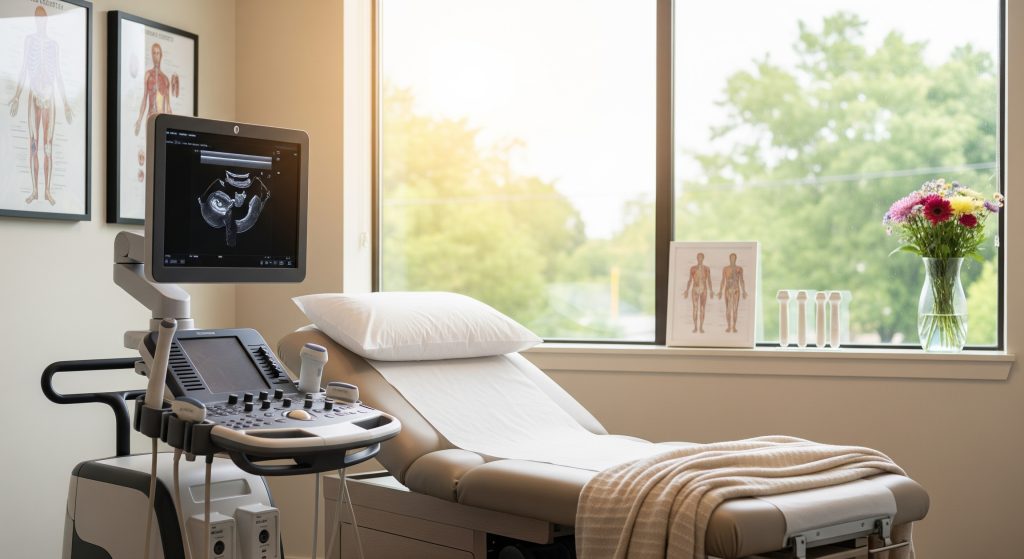
Reliable endometrium measurement starts with good technique. As Sonography Transvaginal Assessment, Protocols and Interpretation advises, proper probe positioning, optimal bladder status, and a true mid-sagittal view are essential. A thickened sidewall or oblique slice can inflate the value.
Measure the double-layer thickness, excluding intracavitary fluid. Capture the maximum anteroposterior dimension in the exact plane. If the endometrium is not clearly seen, document limitations. Normal Endometrial Thickness depends on an accurate plane and a clean margin.
-
Ensure a midline view with the endometrial echo continuous from fundus to cervix.
-
Avoid measuring through focal polyps or fibroids; use hysterosonography if required.
-
Repeat measures and average if margins are indistinct.
For reporting, include endometrium measurement, homogeneity, vascularity, and focal lesions. The term endometrium measurement in your report should match the image saved. Its basically your audit trail.
When to Proceed with Endometrial Biopsy
Biopsy is the definitive test for pathology. As Endometrial Cancer – StatPearls – NCBI Bookshelf notes, it is a first-line investigation for abnormal uterine bleeding in postmenopausal women. It confirms or excludes hyperplasia and carcinoma.
Typical indications include postmenopausal bleeding with endometrium thicker than 4 mm, or persistent bleeding despite a thin lining. Asymptomatic thickness above 11 mm also merits sampling. Normal Endometrial Thickness does not require biopsy unless other red flags exist.
-
Assess symptoms and risk factors.
-
Perform transvaginal ultrasound with clear documentation.
-
Proceed to biopsy if thresholds or features suggest risk.
-
Consider hysteroscopy for focal lesions or nondiagnostic samples.
A negative biopsy with ongoing bleeding usually triggers hysteroscopy. Sampling error happens, and visual inspection closes the gap.
Treatment Approaches for Endometrial Hyperplasia
Management depends on histology. As Management of Endometrial Intraepithelial Neoplasia or Atypical Endometrial Hyperplasia sets out, atypical hyperplasia carries a significant risk of concurrent or future cancer. Total hysterectomy is the standard for those not seeking fertility.
For hyperplasia without atypia, progestin therapy is often effective. Options include oral progestins or a levonorgestrel intrauterine system. Surveillance every 3 to 6 months with repeat sampling checks for regression. Normal Endometrial Thickness on follow-up supports de-escalation when histology also normalises.
-
Hyperplasia without atypia: progestin therapy and surveillance.
-
Atypical hyperplasia or EIN: hysterectomy if surgical candidate.
-
Fertility-sparing or surgical contraindication: high-dose progestins with strict follow-up.
Think in phases. Stabilise bleeding, treat the pathology, and then prove remission on tissue. That sequence reduces relapse.
Follow-up Monitoring Guidelines and Recommendations
Surveillance must be purposeful. As Guideline No. 451: Asymptomatic Endometrial Thickening in Postmenopausal Women advises, asymptomatic thickening requires structured evaluation to exclude malignancy and to avoid unnecessary procedures. Serial assessment is often better than a single intervention.
For hyperplasia, repeat biopsy at 3 to 6 months is standard. Extend the interval after regression. For incidental thickening without symptoms and low risk, a repeat scan in 3 to 6 months may suffice. Normal Endometrial Thickness on repeat imaging, plus stable symptoms, usually closes the episode.
|
Situation |
Typical follow-up |
|---|---|
|
Asymptomatic thickness 5 to 10 mm, low risk |
Repeat TVS in 3 to 6 months |
|
Hyperplasia without atypia on progestin |
Biopsy every 3 to 6 months until regression |
|
Atypical hyperplasia, non-surgical pathway |
Frequent sampling and early escalation for non-response |
The aim is clarity. Either demonstrate a sustained return to Normal Endometrial Thickness with benign histology, or intervene sooner.
Conclusion
A single number never carries the whole truth. Postmenopausal care weighs symptoms, risk, imaging features, and tissue. Use ultrasound to frame probability. Use biopsy to decide. Then use follow-up to confirm the response. Normal Endometrial Thickness is a helpful anchor, not a verdict.
If you have bleeding, seek timely assessment. If you have incidental thickening, ask about risk and options. And if you are on hormones or tamoxifen, request tailored thresholds and timing for scanning. Good decisions follow good context.
Frequently Asked Questions
What endometrial thickness requires immediate medical evaluation after menopause?
Any postmenopausal bleeding deserves prompt review. With bleeding, many services use 4 mm as a reassurance threshold. Above this, or with irregular features, sampling is often advised. Even with a thin lining, persistent bleeding requires assessment. Normal Endometrial Thickness does not overrule symptoms.
Can endometrial thickness return to normal without treatment?
Yes, in selected situations. Transient hormone effects, polyps that pass, or measurement artefacts can settle on repeat imaging. If risk is low and you have no symptoms, clinicians may re-scan in weeks to months. A documented return to Normal Endometrial Thickness supports conservative care.
How often should postmenopausal women monitor endometrial thickness?
Routine screening is not recommended for asymptomatic women. Monitoring is targeted to findings and risk. After treating hyperplasia, repeat biopsy every 3 to 6 months is common until regression. For incidental thickening without symptoms, a single repeat scan may be enough if it normalises.
Does hormone replacement therapy affect normal endometrial thickness values?
Yes. Combined oestrogen-progestogen therapy can slightly increase acceptable values. Unopposed oestrogen raises risk and lowers the threshold for action. Tamoxifen can create cystic thickening that needs careful interpretation. Normal Endometrial Thickness varies by regimen and timing in the cycle of HRT.
What lifestyle changes help maintain healthy endometrial thickness?
Focus on weight management, balanced nutrition, and physical activity. These reduce peripheral oestrogen conversion and improve insulin sensitivity. Manage diabetes and blood pressure. Discuss HRT choices to balance benefits and endometrial effects. Normal Endometrial Thickness aligns with broad metabolic health.
Is endometrial thickening always a sign of cancer?
No. Many causes are benign, including polyps, fibroids, and treatment effects. That said, thickening with bleeding warrants evaluation to rule out malignancy or hyperplasia. Ultrasound and biopsy resolve uncertainty. Normal Endometrial Thickness is reassuring, but tissue is decisive when risk is non-trivial.

