






 We do what's right for you...


MRI Scan Cost for Knees Explained: Price, Procedure, and Results
Dr. Beenish Khan


Price lists alone rarely answer the real question: what should someone actually pay, and what matters about image quality and reporting. I explain the practical factors that move the needle on an MRI scan cost for knees, set clear expectations for the knee MRI scan procedure, and outline how to read results without second guessing every line. The goal is straightforward. Make a confident choice and avoid avoidable spend.
Current Knee MRI Costs Across Major Indian Cities
Mumbai to Delhi Price Comparison for 2025-26
I start with benchmarks because price anchors help set expectations. For Delhi, the mri scan cost for knees in 2026 shows a wide range. As LabsAdvisor notes, the lowest listed fee is ₹2700 with higher-tier centres reaching about ₹8075. That variance reflects machine strength, protocol quality, and reporting expertise.
In large metros like Mumbai, Bengaluru, and Chennai, I typically see mid-market pricing zones. The mri scan cost for knees clusters around a competitive core with premium outliers. Prices move when a provider offers 3T magnets, sub-specialist reporting, extended sequences, or same-day reporting. I consider those as value drivers rather than add-ons.
For a practical example, a sportsperson with suspected meniscal damage does not need exotic add-ons. A high-quality 1.5T study with solid sequences and a clear report is sufficient. That helps keep the mri scan cost for knees sensible without compromising diagnostic yield.
Government Hospital vs Private Centre Rates
Government facilities generally list the mri scan cost for knees at subsidised levels. Private centres price higher due to equipment, staffing, and faster turnaround. The gap can be meaningful. Subsidised tariffs help households manage spend, while private units offer speed and scheduling flexibility.
Access is improving in public systems with planned expansions of MRI services. The result will likely compress the average cost of knee mri in select districts, especially where private centres were the only option. In practice, I advise choosing based on urgency, need for a sub-specialist read, and travel time.
-
Public units: lower fees, longer queues, limited appointment windows.
-
Private centres: higher fees, faster slots, more protocol flexibility.
If timing is critical after an acute injury, private centres can justify the higher mri scan cost for knees. If the case is non-urgent, public units can be very cost effective.
Standard vs Contrast-Enhanced MRI Pricing
Most knee studies are non-contrast. Contrast is reserved for specific indications such as suspected tumours, infection, or post-surgical complications. When contrast is justified, the mri scan cost for knees increases by the agent and monitoring overhead. As ImpactGuru explains, contrast agents typically add about ₹1,000 to ₹5,000 to the bill.
Clinical rule of thumb: if the clinical question is ligamentous or meniscal, non-contrast is standard. If there is a suspicion of synovial pathology or complex postoperative change, contrast may add value. This approach keeps the average cost of knee mri aligned with clinical need.
-
Standard knee MRI: routine for ligament, meniscus, cartilage, bone marrow oedema.
-
Contrast knee MRI: specific scenarios guided by the orthopaedician or radiologist.
I discourage contrast unless the indication is clear. It controls the mri scan cost for knees and avoids unnecessary exposure.
Bilateral Knee MRI Cost Structure
Bilateral studies price differently. Some centres quote a 1.5x multiplier over unilateral pricing. Others bill near 2x due to time and reporting complexity. If bilateral symptoms are asymmetric, a staged approach can be sensible. Scan the symptomatic knee first and proceed with the other only if clinically needed. That strategy can reduce the mri scan cost for knees without compromising care.
Where a bilateral scan is indicated upfront, confirm whether the centre uses mirrored protocols or a condensed sequence set. Efficient protocols shorten machine time and often lower the average cost of knee mri for two joints.
Regional Cost Variations by State
State-level pricing varies with cost of operations, machine availability, and competition. In high-density urban belts, prices cluster due to competition and high scan volumes. In smaller cities, reduced competition can push tariffs up or down depending on capacity utilisation. The mri scan cost for knees therefore reflects local dynamics as much as national trends.
For patients considering travel, factor in time, transport, and the value of prompt treatment. Saving a modest amount while delaying diagnosis rarely pays off. Timely clarity often reduces overall spend on repeat consults and imaging. That is an underappreciated driver of the total mri scan cost for knees across an episode of care.
Complete Step-by-Step MRI Scan Procedure
Pre-Scan Preparation Requirements
Knee MRI preparation is simple for most patients. Eating is usually allowed, though contrast studies may involve fasting. As Ace Imaging sets out, contrast-enhanced scans often require fasting for about 4 to 6 hours to reduce nausea risk. I advise a light meal if permitted, and good hydration unless instructed otherwise.
Complete the screening form carefully. Disclose implants, prior surgeries, and possible pregnancy. The form is not a formality. It guides safety decisions, including any modification to the knee mri scan procedure.
-
Avoid metal-infused clothing and heavy cosmetics with metallic particles.
-
Carry previous reports for comparison if available.
-
Notify the team about claustrophobia or anxiety in advance.
This preparation keeps the mri scan for knee pain efficient and reduces the chance of rescheduling. It also protects image quality, which reduces the chance of repeat scans and extra cost.
Metal Removal and Safety Protocols
Safety is absolute in MRI. Screening for metallic bodies and implants is thorough for good reason. As NCBI notes, ferromagnetic items can become projectiles and certain implants pose risks. A careful review prevents rare but serious incidents.
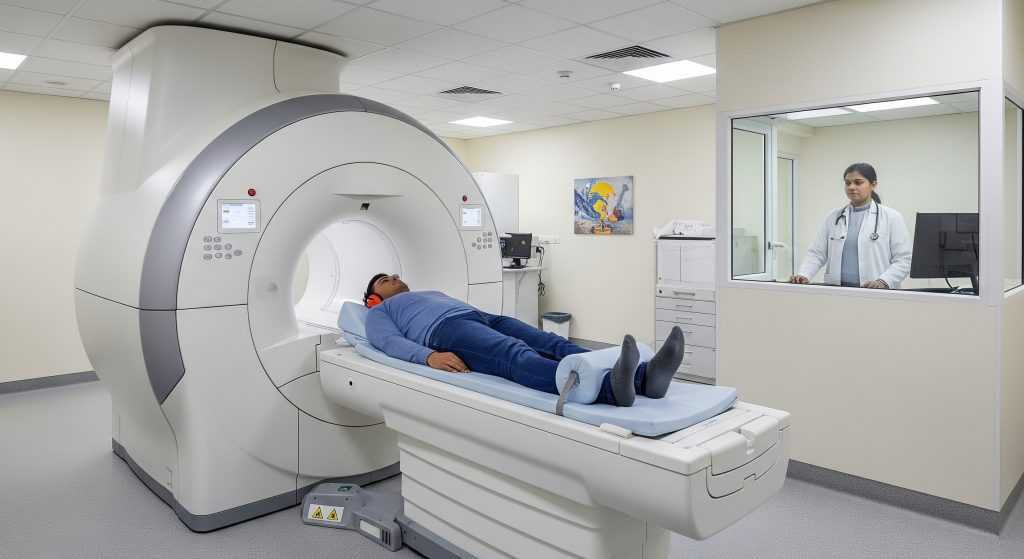
Before the knee mri scan procedure begins, I ensure the removal of all jewellery, watches, cards, and accessories. Staff check compatibility for pacemakers, cochlear implants, and other devices. If a device is conditional, the team may adapt settings, timing, or supervision protocols.
Communication during scanning is standard. A call button and talkback keep the patient connected with the technologist. That reassurance matters for anxious patients, and it protects scan quality.
Patient Positioning and Machine Entry
Positioning determines diagnostic value. For knees, alignment with the dedicated coil and stabilisation to prevent motion are critical. If the patient is uncomfortable, the images suffer. Small pads and cushions usually fix this. Anxiety management helps too, especially at machine entry.
I ask patients to focus on stillness. The technologist confirms alignment and starts a brief scout scan. If anything needs correction, this is where it gets fixed. Good positioning early helps ensure a single, clean scan and a controlled mri scan cost for knees overall.
-
Coil centred at the joint line or region of interest.
-
Leg stabilised with straps or pads to reduce drift.
-
Breathing kept calm to limit incidental movement.
Duration and Noise Management During Scan
Most knee MRIs take 15 to 30 minutes. Complex or bilateral studies take longer. The machine is loud. Ear protection is standard. Timing varies by magnet strength, sequence count, and need for repeat images if motion occurs.
Noise is routine and harmless. I brief patients to expect rhythmic tapping and buzzing. A short mental checklist, a relaxation cue, or counting patterns can help. Keeping still is the single biggest factor. It avoids repeat sequences and helps keep the mri scan cost for knees stable.
Post-Procedure Recovery Guidelines
Recovery is minimal. Most patients walk out and resume daily routines. If a sedative was used for anxiety, a companion is advisable and driving should be avoided for the day. If contrast was administered, drink water and report unusual symptoms. Serious reactions are rare, but vigilance is prudent.
Collect the films or digital images as advised. Confirm the expected report time before leaving. That avoids extra calls and delays. It also keeps the episode of care organised, which indirectly reduces the average cost of knee mri over time.
Understanding Your MRI Results and Reports
ACL Tear Detection and Grading
ACL evaluation on MRI focuses on fibre continuity, oedema, ligament contour, and secondary signs such as bone bruising. Studies report high sensitivity for complete tears and variable performance for partial tears. As PMC summarises, sensitivity near 95% has been documented for ACL injuries in selected settings.
Grading follows clinical tradition. Grade I indicates sprain, Grade II partial tear, and Grade III complete tear. The report should align imaging signs with clinical findings. If the exam suggests instability and MRI shows ambiguous partial disruption, the orthopaedician integrates both. That is why a well-executed scan matters more than headline numbers.
For cost planning, a clear and concise report prevents redundant follow-ups. It protects the mri scan cost for knees from creeping upward through avoidable repeat imaging.
PCL and Meniscus Injury Assessment
PCL injuries are less common, but MRI evaluates them well. Posterior drawer mechanics and associated bone bruises often appear. For menisci, I look for clear tear morphology, displaced fragments, and root involvement. Root tears matter in surgical planning. A missed root tear delays appropriate care.
In practice, meniscal tears drive many referrals for an mri scan for knee pain. On the report, I expect plain language on tear type and stability. That plain language helps patients and surgeons decide next steps quickly.
-
Meniscal tear patterns: horizontal, vertical, radial, flap, root.
-
Stability markers: displacement, extrusion, associated cysts.
-
PCL integrity: fibre continuity, oedema, avulsion signs.
Cartilage Damage and Bone Abnormalities
Cartilage loss and subchondral changes are central to knee morbidity. MRI identifies early cartilage softening, fissuring, and full thickness defects. As MayoClinic notes, MRI is highly sensitive for joint soft tissues and subchondral bone changes. This matters in osteoarthritis, sport injuries, and post traumatic cases.
Bone marrow oedema patterns correlate with pain and mechanical stress. In acute trauma, MRI clarifies occult fractures missed on radiographs. Early detection informs load management and rehabilitation. It shortens the path to appropriate care and avoids unnecessary interventions that add to the mri scan cost for knees.
When cartilage defects are focal and mechanical, targeted physiotherapy or arthroscopy may be appropriate. When degeneration is diffuse, conservative care and alignment strategies lead.
Report Timeline and Accuracy Rates
Report timelines vary. Non-urgent studies may be ready within a day or two. Urgent reads are faster. As MayoClinic notes, finalised reports typically arrive within 24 hours to several days depending on complexity and workload.
Accuracy correlates with protocol quality and radiologist experience. Variability exists, though strong centres maintain consistent standards. If the report appears equivocal on a critical decision point, I recommend a second read rather than a fresh scan. A second read costs less than repeating the study, which keeps the mri scan cost for knees contained.
-
Ask for expected report time at booking.
-
Share clinical notes and prior imaging to improve context.
-
Request key images or a summary sheet for the treating surgeon.
Making an Informed Decision About Your Knee MRI
A sound decision balances clinical need, timing, and value. I use a simple checklist to align the mri scan cost for knees with quality.
-
Confirm the clinical question. Ligament, meniscus, cartilage, or bone marrow focus.
-
Choose contrast only when indicated. This prevents unnecessary spend.
-
Match magnet strength to need. A well run 1.5T is adequate for most knees.
-
Ask who reports the study. Sub-specialist reads add interpretive clarity.
-
Check the turnaround time. Delayed reports can delay care.
If cost is the primary constraint, ask for a base protocol without extended sequences. Ensure the team still captures the essentials. This approach keeps the average cost of knee mri reasonable while safeguarding diagnostic intent.
I will add one operational note. Pricing is not only the printed tariff. It is scheduling, reporting speed, and the chance of avoiding repeat imaging. Good execution saves time and money. The right scan once is cheaper than the wrong scan twice.
Frequently Asked Questions
Does health insurance cover knee MRI costs in India?
Many policies cover diagnostic imaging when ordered by a registered clinician. Coverage depends on plan type and whether the condition qualifies as medically necessary. Cashless options may require network centres and pre authorisation. I advise calling the insurer for written confirmation. That prevents surprises and protects the mri scan cost for knees from out-of-pocket shocks.
How long does a knee MRI scan typically take?
Most studies finish in 15 to 30 minutes. Complex protocols or bilateral scans can extend beyond 40 minutes. The queue, not just the scanner time, affects the total visit. Shorter slots sometimes cost more, but the trade-off is speed. This can matter after acute injury.
Can I get a knee MRI without a doctor’s prescription?
Some centres accept self-referrals. However, I recommend a clinician order. A clear question directs the protocol and interpretation. It reduces ambiguity and prevents unnecessary sequences. That precision helps contain the mri scan cost for knees and improves the quality of the report.
What is the difference between 1.5T and 3T MRI machines for knee scanning?
3T magnets offer higher signal to noise ratios and can improve resolution. They can also accelerate certain sequences. A modern 1.5T with optimised protocols remains excellent for most knee indications. Choose 3T when very fine structures or postoperative detail is critical. Avoid paying a premium if the clinical question does not require it.
Are there any side effects or risks associated with knee MRI scans?
MRI has no ionising radiation. Risks relate to metal safety, contrast reactions, and claustrophobia. Contrast reactions are uncommon and usually mild. Safety screening prevents metal related incidents. For claustrophobia, sedation or open MRI options exist. Discuss these before booking to avoid rescheduling and extra cost.

