






 We do what's right for you...


Melanoma Stages Explained: What Each Stage Means
Dr. Payal Gupta
The conventional wisdom about melanoma staging suggests it follows a neat, linear progression – catch it early and everything will be fine, miss it and prepare for the worst. That oversimplification costs lives. Understanding melanoma stages requires grasping not just the numbered categories but the biological behaviour, the treatment implications, and crucially, when to push for aggressive intervention versus watchful waiting.
Five Stages of Melanoma
Stage 0: Melanoma In Situ
Stage 0 represents melanoma at its most treatable – malignant cells confined entirely to the epidermis, the skin’s outermost layer. The numbers here are genuinely reassuring. The five-year relative survival rate for melanoma in situ sits at 97%, as reported by NCBI Bookshelf. With optimal surgical excision achieving near-complete removal, patients can expect melanoma-specific survival approaching 100%.
Wide local excision remains the gold standard. The surgeon removes the entire melanoma along with a margin of surrounding healthy tissue – essentially ensuring no stray cells are left behind. It’s straightforward. It works. The catch? Most people don’t know they have it.
Regular follow-ups after diagnosis are non-negotiable. Even at this earliest stage, monitoring for new or recurring lesions maintains those impressive survival rates. Miss a recurrence and the situation changes dramatically.
Stage I: Early-Stage Melanoma
Stage I melanoma has breached the basement membrane – that boundary between epidermis and dermis – but remains localised. The tumour measures up to 2mm in thickness, and there’s no evidence of spread to lymph nodes or distant sites. Still early. Still highly treatable.
The prognosis? Excellent. Five-year survival rates exceed 90% for localised disease, making early detection genuinely life-saving. Histologically, these tumours often present as superficial spreading or nodular forms, each with distinct characteristics that guide surgical planning.
Treatment typically involves surgical excision. For thicker tumours or those with certain high-risk features, sentinel lymph node biopsy enters the conversation. This procedure identifies whether cancer cells have reached the nearest lymph nodes – critical information for staging and treatment decisions.
The follow-up protocol matters enormously. Annual dermatological evaluations become routine. Patients learn to monitor their own skin, watching for changes that might signal recurrence. It’s a partnership between patient and physician that can last years.
Stage II: Intermediate Thickness Melanoma
Stage II represents a middle ground – tumours thicker than 1mm but without evidence of lymph node involvement. The cancer has grown more substantial, penetrating deeper into the dermis, sometimes exceeding 4mm in thickness. Ulceration may or may not be present.
Here’s where things get more complex. Surgical excision remains the primary treatment, but sentinel lymph node biopsy becomes standard practice for most Stage II cases, particularly when tumours exceed 2mm. The goal? Determine whether microscopic spread has occurred, even when imaging shows nothing obvious.
Adjuvant therapy enters the picture for high-risk patients. PD-1 inhibitors – a type of immunotherapy that essentially takes the brakes off the immune system’s cancer-fighting ability – can significantly improve recurrence-free survival. These aren’t treatments reserved for advanced disease anymore. For Stage IIB and IIC melanomas, they’re increasingly standard.
But what does this stage actually mean for daily life? More frequent monitoring. More scans. More appointments. The risk of recurrence is real, and catching it early – should it happen – makes a genuine difference to outcomes.
Stage III: Regional Spread
Stage III marks a significant shift. The melanoma has spread beyond its original site to nearby lymph nodes, lymph vessels, or satellite lesions in the surrounding skin. It hasn’t travelled to distant organs yet. But it’s moving.
The staging subdivisions matter here. Stage IIIA through IIID classifications depend on factors like the number of affected lymph nodes, presence of ulceration, and extent of regional disease. Fewer affected nodes generally correlates with better outcomes, but the picture is nuanced.
Symptoms might include palpable lumps in lymph node areas – groin, armpit, neck – or changes in existing moles. Sometimes new lesions appear near the original site. These aren’t subtle signs, which is why regular self-examination remains crucial.
Treatment becomes multidisciplinary. Surgical removal of affected lymph nodes. Immunotherapy. Targeted therapy for tumours with specific genetic mutations. The latest guidelines recommend both neoadjuvant therapy (before surgery) and adjuvant therapy (after surgery) based on individual tumour characteristics.
Monitoring intensifies considerably. The goal shifts from cure to surveillance and rapid response. Early detection of recurrence can mean the difference between manageable disease and something far more serious.
Stage IV: Distant Metastasis
Stage IV melanoma has spread to distant organs – lungs, liver, brain, bone. This is advanced disease. The survival statistics are sobering: approximately 22.5% five-year survival rate, according to CURE Melanoma.
And yet. The treatment landscape has transformed in the past decade.
Targeted therapies and immunotherapies have dramatically improved outcomes for many patients with metastatic melanoma. TIL immunotherapy – tumour-infiltrating lymphocyte therapy – represents one of the newest approaches, harvesting immune cells from a patient’s own tumour, multiplying them in the laboratory, and reinfusing them to attack cancer throughout the body.
Treatment decisions at this stage involve careful assessment of where metastases have occurred, the patient’s overall health, and the tumour’s genetic profile. Some patients respond remarkably well to immunotherapy. Others may benefit more from targeted agents. Combination approaches are increasingly common.
Palliative care becomes part of the conversation – not as giving up, but as ensuring quality of life alongside active treatment. Managing symptoms, maintaining function, supporting patients and families through a difficult journey.
Recognising Melanoma Symptoms at Each Stage
ABCDE Warning Signs
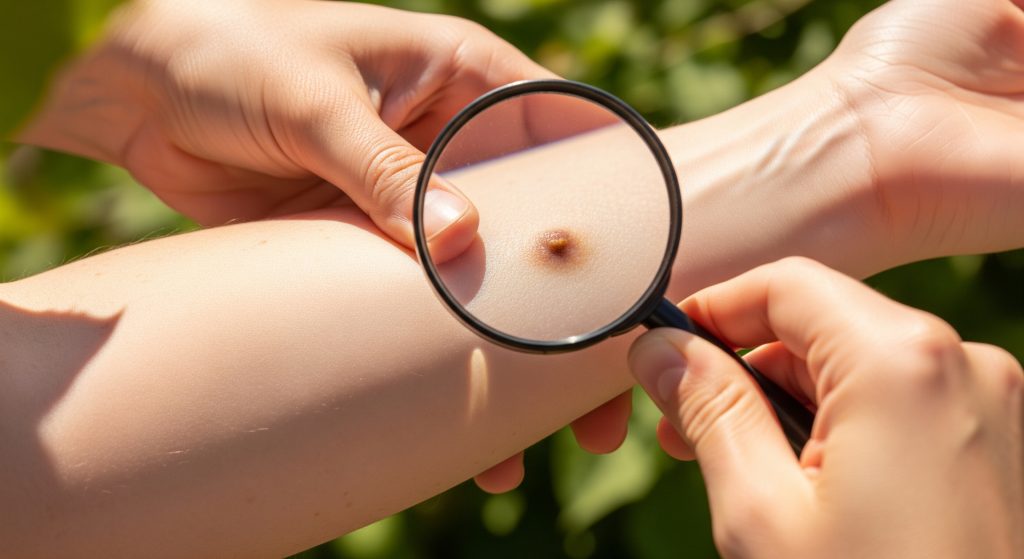
The ABCDE criteria remain the cornerstone of melanoma self-detection. They’re taught in medical schools and printed on dermatology office posters for good reason – they work.
-
Asymmetry – one half of the mole doesn’t match the other
-
Border – edges are irregular, ragged, notched, or blurred
-
Colour – uneven colour distribution with shades of brown, black, sometimes patches of pink, red, white, or blue
-
Diameter – larger than 6mm (about the size of a pencil eraser), though melanomas can be smaller
-
Evolving – any change in size, shape, colour, elevation, or new symptoms like bleeding, itching, or crusting
The E for evolving is probably the most important. That mole that’s been stable for twenty years and suddenly starts changing? That’s the one demanding attention.
Early-Stage Physical Changes
In Stage 0 and Stage I, changes are often subtle. A new pigmented lesion that didn’t exist before. A flat or slightly raised patch with irregular colouration. The surface might be smooth or slightly scaly.
These early melanomas don’t hurt. They don’t bleed spontaneously. They don’t announce themselves dramatically. They simply appear. Different. The challenge is noticing something different among dozens of existing moles and freckles – which is why regular skin checks, both self-examinations and professional assessments, matter so much.
Fair-skinned individuals might notice melanomas developing on sun-exposed areas – face, arms, legs. But melanoma can appear anywhere, including areas that rarely see sunlight. Soles of feet. Between toes. Under fingernails. The scalp.
Advanced Stage Symptoms
Stage III and IV symptoms extend beyond skin changes. Regional spread might manifest as:
-
Hard or swollen lymph nodes
-
Satellite lesions – small tumours appearing near the original site
-
In-transit metastases – nodules appearing between the primary site and regional lymph nodes
Distant metastases produce symptoms depending on location. Lung involvement might cause persistent cough or shortness of breath. Liver metastases can cause abdominal pain, jaundice, or unexplained weight loss. Brain metastases may present with headaches, seizures, or neurological changes.
The single most frustrating thing about advanced melanoma symptoms is how easily they’re attributed to other causes. Fatigue gets blamed on stress. Weight loss seems like a welcome accident. Headaches are just headaches – until they’re not.
When to Seek Medical Attention
Any skin change fitting the ABCDE criteria warrants evaluation. Full stop. But certain features demand urgent attention:
-
Lesions that bleed without trauma
-
Rapidly growing or changing moles
-
New pigmented lesions in adults over 40
-
Any lesion that appears distinctly different from others – the “ugly duckling” sign
Men and women with pronounced melanoma risk factors – fair skin, history of sunburns, multiple moles – should pursue regular dermatological checks regardless of symptoms, as recommended by specialists at Mayo Clinic.
Self-examination should become routine. Monthly skin checks using mirrors and good lighting can detect changes early – when treatment is most effective. It takes ten minutes. Those ten minutes could save a life.
Risk Factors and High-Risk Groups
Genetic and Family History Factors
Genetics loads the gun. Family history of melanoma – particularly in first-degree relatives – substantially increases personal risk. Certain genetic syndromes, like familial atypical multiple mole melanoma syndrome (FAMMM), confer dramatically elevated lifetime risk.
CDKN2A mutations represent the best-characterised genetic risk factor. Families carrying these mutations may have lifetime melanoma risks exceeding 70%. Genetic counselling and testing can identify high-risk individuals who benefit from intensified surveillance.
But here’s what catches people off guard: most melanomas occur in individuals without strong family histories. A negative family history doesn’t confer protection. It simply means other risk factors – environmental, phenotypic – require attention.
Environmental and Lifestyle Risks
UV exposure dominates environmental risk. Intermittent intense sun exposure – think blistering sunburns during holiday trips – carries higher risk than chronic moderate exposure. Sunbed use, particularly before age 35, dramatically increases melanoma risk.
The pattern matters as much as total exposure. Indoor workers who get intense weekend sun exposure may face higher risks than outdoor workers with consistent, moderate exposure. Counterintuitive, perhaps, but the biology makes sense – intermittent UV damages DNA repair mechanisms more severely.
Geographic location plays a role. Living closer to the equator increases UV exposure. Australia and New Zealand have among the world’s highest melanoma rates. But northern latitudes aren’t safe – reflection from snow and ice can deliver significant UV doses.
Age and Gender Considerations
Melanoma risk increases with age, peaking after 50. But it’s also one of the most common cancers in young adults, particularly young women – possibly related to sunbed use.
Gender patterns show interesting variation. Before age 50, melanoma incidence is higher in women. After 65, men face higher rates and worse outcomes. Body site distribution differs between genders. Men develop melanoma more commonly on the trunk. Women more commonly on the legs. These patterns likely reflect different clothing choices and sun exposure habits across genders.
Preventive Measures for High-Risk Individuals
Honestly, the only preventive measures that really matter are sun protection and surveillance. Everything else is secondary.
Sun protection means:
-
Broad-spectrum SPF 30+ sunscreen, reapplied every two hours and after swimming or sweating
-
Protective clothing – long sleeves, wide-brimmed hats, UV-blocking sunglasses
-
Seeking shade during peak UV hours (typically 10am-4pm)
-
Complete avoidance of sunbeds – there’s no such thing as a “safe tan” from artificial UV
Surveillance for high-risk individuals typically involves dermatological examinations every three to twelve months, depending on individual risk profile. Full-body photography establishes a baseline for detecting new or changing lesions. Some centres offer dermoscopy – magnified examination of skin lesions – and total body mapping.
Self-examination fills the gaps between professional visits. Monthly skin checks become as routine as brushing teeth.
Treatment Options by Stage
Surgical Treatments for Early Stages
Surgery remains the foundation of early-stage melanoma treatment. The principle is straightforward: remove the tumour with clear margins. The execution requires precision.
Sentinel lymph node biopsy identifies whether melanoma cells have spread to the nearest lymph nodes. A radioactive tracer and blue dye identify the sentinel node – the first lymph node receiving drainage from the tumour site. If this node is clear, more extensive lymph node dissection is typically unnecessary.l.
Immunotherapy and Targeted Therapy
Immunotherapy has revolutionised melanoma treatment. PD-1 inhibitors – pembrolizumab and nivolumab – block a molecular brake that tumours use to evade immune detection. The result? The immune system recognises and attacks melanoma cells.
For Stage IIB-IIID melanomas, adjuvant immunotherapy significantly reduces recurrence risk. The treatment course typically spans a year, delivered as intravenous infusions every few weeks. Side effects can include fatigue, skin reactions, and occasionally more serious autoimmune complications requiring careful monitoring.
Targeted therapy addresses melanomas with specific genetic mutations. About half of melanomas carry BRAF mutations – alterations in a gene controlling cell growth. BRAF inhibitors combined with MEK inhibitors can produce dramatic responses in these tumours. The catch? Only effective for tumours actually carrying the mutation. Genetic testing of tumour tissue is essential.
The week after starting targeted therapy, the visible tumour often begins shrinking. Sometimes dramatically. It’s genuinely remarkable to witness. But responses can be temporary, which is why combination approaches and sequencing with immunotherapy are actively being studied.
Melanoma Radiation Therapy Applications
Melanoma radiation therapy plays a supporting role rather than a leading one. Melanoma was historically considered radiation-resistant, but this understanding has evolved.
Adjuvant radiation to lymph node basins can reduce local recurrence risk after surgery, particularly for extensive nodal disease. Brain metastases often respond to stereotactic radiosurgery – precisely targeted radiation delivered in few fractions – sometimes as an alternative to surgical removal.
Palliative radiation controls symptoms from metastases – bone pain, bleeding, or neurological complications. It’s not curative in advanced disease but can significantly improve quality of life.
The decision to use melanoma radiation therapy involves weighing potential benefits against side effects. Short-term effects include skin irritation and fatigue. Long-term risks depend on the treatment site. These conversations require careful consideration of individual circumstances.
Combination Treatment Approaches
Modern melanoma treatment increasingly combines modalities. Neoadjuvant immunotherapy – treatment before surgery – can shrink tumours and improve surgical outcomes while providing insight into tumour responsiveness.
The triplet combination of BRAF inhibitors, MEK inhibitors, and immunotherapy is under investigation for BRAF-mutant melanomas. Early results are promising. The complexity is considerable.
Clinical trials offer access to emerging combinations. For patients with advanced melanoma, trial participation isn’t just about contributing to science – it’s often the pathway to the most innovative treatments available.
Palliative Care for Advanced Stages
Palliative care isn’t about giving up. It’s about living well while treating cancer.
Symptom management addresses pain, nausea, fatigue, and other treatment-related or disease-related symptoms. Psychological support helps patients and families cope with the emotional burden of advanced disease. Advance care planning ensures treatment decisions align with patient values and wishes.
Early integration of palliative care alongside active treatment improves quality of life and, paradoxically, sometimes even survival. It’s not either/or. It’s both.
Understanding Your Melanoma Diagnosis
A melanoma diagnosis arrives with overwhelming information. Breslow thickness. Clark levels. AJCC staging. TNM classification. Making sense of it all requires patience and, ideally, a treatment team willing to explain things clearly.
Key questions to ask your oncologist:
-
What is the precise stage, and what does that mean for my prognosis?
-
What are ALL my treatment options, not just the recommended one?
-
What are the risks and benefits of each approach?
-
Are there clinical trials I should consider?
-
What surveillance schedule is appropriate for my situation?
Second opinions are entirely appropriate, particularly for complex cases. Melanoma expertise varies significantly between centres. Specialised melanoma centres – often attached to major academic hospitals – offer multidisciplinary teams with experience in the latest treatment approaches.
Early-stage diagnosis typically means excellent outcomes with straightforward treatment. Advanced disease means more complex decisions but increasingly effective options. Knowledge is power. Understanding your specific situation enables informed participation in treatment planning.
Frequently Asked Questions
Can melanoma skip stages during progression?
Yes. Melanoma doesn’t necessarily progress sequentially through stages. A thin primary melanoma can occasionally present with distant metastases, effectively “skipping” to Stage IV. This is uncommon but possible, which is why staging workups sometimes include imaging even for apparently early-stage disease when certain high-risk features are present.
How quickly does melanoma advance from one stage to another?
Highly variable. Some melanomas remain indolent for years. Others progress rapidly within months. Growth rate depends on tumour biology, genetics, and immune factors. There’s no reliable way to predict individual tumour behaviour, which is why prompt treatment and regular surveillance matter regardless of stage.
Can Stage IV melanoma go into remission?
Absolutely. With modern immunotherapy, durable complete responses – lasting years – occur in a meaningful proportion of patients with metastatic melanoma. Some researchers cautiously use the word “cure” for patients maintaining complete responses beyond five years. This was essentially unheard of before the immunotherapy era.
How often should high-risk individuals get skin checks?
Professional examinations every three to twelve months, depending on individual risk level. Those with prior melanoma, multiple atypical moles, or strong family history warrant more frequent surveillance. Monthly self-examinations should be standard practice for everyone with elevated risk.
Does melanoma always start as a mole?
No. While melanoma can arise from pre-existing moles, approximately 70-80% develop on previously normal-appearing skin. New pigmented lesions in adults deserve attention, particularly if they look different from existing moles or show ABCDE warning features. The “ugly duckling” – a lesion that simply looks different from everything else – warrants evaluation regardless of whether it arose from a mole.

