






 We do what's right for you...


Knee Replacement Recovery Time: What to Expect at Every Stage
Dr. Neetan Sachdeva
Conventional wisdom says knee replacement recovery time is about six weeks, maybe three months at the outside. That timeline is repeated in waiting rooms and by well-meaning relatives so often it almost feels like fact. It’s not. Six weeks is when the wound heals and the crutches might go away. Actual recovery – the kind where a knee bends properly, stairs feel normal, and sleep isn’t interrupted by throbbing – takes most people closer to a year. Accepting this longer timeline from the start isn’t pessimism. It’s the single most useful thing anyone can do to prepare for what lies ahead.
Complete Timeline of Knee Replacement Recovery Stages
Week 1-2: Hospital Discharge and Initial Mobility
The first two weeks are about survival, not progress. I don’t mean that dramatically – it’s simply that the body is dealing with significant trauma and the primary goal is managing pain while preventing blood clots and infection. Most patients leave hospital within one to three days post-surgery, which sounds quick until you realise the real work begins at home.
During this phase, mobility means shuffling to the bathroom with a walker and little else. The knee will be swollen, warm to the touch, and about as cooperative as a rusted hinge. That’s expected. Physiotherapy starts immediately – often within hours of surgery – but the exercises are gentle: ankle pumps, quad sets, and small knee bends while lying down. The point isn’t to gain range of motion yet. It’s to keep blood flowing.
Pain management dominates daily life. Ice, elevation, and prescribed medications work together, and skipping any of these three makes the other two less effective. Sleep comes in fragments. But here’s the honest truth: these two weeks feel endless while you’re in them and then blur into nothing when you look back six months later.
Week 3-4: Early Home Recovery Phase
Something shifts around week three. The surgical pain starts distinguishing itself from the rehabilitation discomfort – a meaningful difference because one is fading while the other is intentional. By now, most patients have graduated from a walker to a cane, at least for short distances indoors.
This is when knee replacement recovery exercises become serious. A physiotherapist will typically introduce heel slides, assisted knee bends, and light standing exercises. The target is usually reaching 90 degrees of flexion by the end of week four. For context, that’s roughly enough bend to sit comfortably in a standard chair. Not glamorous, but essential.
Swelling remains the persistent companion. It peaks and troughs throughout the day, worse in the evenings and after activity. Cold therapy and elevation continue to matter. The single most frustrating part of this phase is that progress feels invisible – each day looks much like the one before. Trust the process anyway.
Week 5-8: Intermediate Recovery Milestones
The intermediate phase is where rehabilitation becomes almost a part-time job. Sessions increase in intensity. Resistance bands appear. Stationary cycling becomes possible for some. The knee might feel weaker than before surgery on certain days, which is disconcerting but normal – muscles that have been protecting a damaged joint for years are now being asked to work differently.
Walking distance increases significantly. A trip around the block that would have been unthinkable at week two becomes the daily routine. Staircases remain challenging, typically requiring a step-to pattern (good leg leads going up, surgical leg leads going down) rather than alternating feet.
By week eight, many people notice a genuine turning point. The moment I remember most clearly from my own observation of patients at this stage is when someone realises they’ve been standing at the kitchen counter for ten minutes without thinking about the knee at all. That absence of constant awareness is the first real victory.
Month 3-6: Advanced Recovery Progress
Months three through six are when confidence rebuilds. The surgical site has healed completely. Scar tissue is forming (and being worked on in physio to prevent stiffness). Most importantly, the brain is starting to trust the new joint.
This is the window where patients often return to driving, typically somewhere between weeks six and twelve depending on which leg was operated on and local regulations. Right knee surgery means a longer wait for automatic vehicle drivers. Walking without any assistive device becomes standard for the majority.
Knee replacement recovery time for elderly patients may extend through this period, and that’s perfectly acceptable. The implant doesn’t know the patient’s age – it functions the same regardless. What differs is the surrounding muscle strength, balance, and overall stamina, all of which simply take longer to rebuild in older bodies.
Advanced exercises now include leg presses, step-ups, and balance work. Some surgeons clear patients for swimming and low-impact gym activities. Golf returns for enthusiasts. Life starts resembling something normal.
Month 6-12: Return to Normal Activities
The six to twelve month window is often called “full recovery” but that label oversimplifies things. The joint has settled. The major strength gains from physiotherapy have been achieved. Most people have returned to work, hobbies, and daily routines without significant modification.
But does the knee feel identical to the original healthy joint? Rarely. Most patients describe it as functional and pain-free but different. There’s often awareness of the implant during certain movements. Some residual swelling after extended activity remains common even at month nine or ten. Kneeling is uncomfortable for many and remains so permanently.
This is also when the risk of “overdoing it” increases. Feeling good leads to pushing harder, which can cause setbacks. The boring truth is that knee replacement recovery tips for this phase are mostly about moderation. Keep exercising. Keep stretching. Don’t suddenly decide to train for a marathon.
Beyond 12 Months: Long-term Expectations
After the first year, attention shifts from recovery to maintenance. The prosthetic knee should function well for fifteen to twenty years or longer, depending on the implant type and how it’s treated. What determines longevity? Activity level matters, as does body weight, and avoiding high-impact movements that stress the artificial components.
Annual check-ups become routine. X-rays track the implant’s position. Any new pain, clicking, or instability deserves investigation. Most people at this stage forget about their knee replacement for months at a time – which is exactly the goal.
It’s worth noting that the second year often brings continued improvement. Strength and flexibility gains can continue subtly for up to twenty-four months post-surgery. The knee at month eighteen is frequently better than the knee at month twelve, even if formal rehabilitation ended long ago.
Essential Knee Replacement Recovery Exercises by Phase
Immediate Post-Surgery Exercises
Exercises in the first days are deceptively simple. Ankle pumps – flexing the foot up and down repeatedly – prevent blood clots and maintain circulation. Quad sets involve pressing the back of the knee down into the mattress, holding for five seconds, and releasing. These can be done hourly while awake.
Short arc quads come next. With a rolled towel under the knee for support, the lower leg lifts and straightens, working the quadricep without demanding full range of motion. Straight leg raises, where the entire leg lifts off the bed with the knee locked, strengthen the hip flexors and quads together.
The key here isn’t intensity. It’s frequency. Ten repetitions six times daily beats thirty repetitions twice daily. The muscle needs reminding that it still has work to do.
Week 2-4 Strengthening Exercises
Heel slides become the primary focus during this window. Lying on a bed, the heel drags towards the buttock, bending the knee as far as tolerable, then slides back out. This improves flexion gradually and is often done with a strap or towel around the foot for assistance.
Standing exercises enter the routine:
-
Supported knee bends: Holding a counter or chair, gentle squatting motions to thirty degrees
-
Standing hip abduction: Lifting the surgical leg out to the side while balancing on the other
-
Standing hip extension: Moving the surgical leg straight back behind the body
-
Mini lunges: Small forward steps with controlled lowering
Resistance is minimal – bodyweight only. The muscles are still relearning their roles. Pushing too hard creates inflammation that slows progress rather than speeding it.
Month 2-3 Range of Motion Exercises
By month two, the goal is typically 110 to 115 degrees of flexion. This allows for comfortable cycling, most stair use, and normal walking gait. Exercises become more dynamic:
Stationary cycling begins, initially with the seat raised high enough that the knee barely bends past ninety degrees. Gradually the seat lowers. Swimming pools become useful for walking and gentle range of motion work – the water supports body weight while allowing free movement.
Wall slides – standing with the back against a wall and sliding into a shallow squat – build functional strength. Step-ups onto a low platform (around four inches initially) train the muscles for real-world tasks. Prone knee bends, lying face down and bending the knee towards the ceiling, stretch the quadricep while working flexion from a different angle.
This phase feels like proper exercise rather than just rehabilitation. That’s motivating.
Advanced Exercises for Months 4-6
Here’s where things get interesting. Gym equipment enters the picture. Leg presses (with controlled range and moderate weight), leg curls, and leg extensions all have roles. Balance training intensifies – single leg stands, wobble boards, and tandem walking challenge the proprioceptive system.
But honestly, the only exercise that really matters at this stage is walking. Long walks, varied terrain, gentle hills. Walking consolidates all the strength and flexibility gains into functional movement. Everything else supports walking.
Don’t bother with heavy weights or extreme ranges of motion until walking feels effortless. The knee doesn’t need to be impressive in a gym. It needs to work in life.
Maintaining Strength After Full Recovery
Long-term maintenance looks different from rehabilitation. The frequency drops but consistency becomes permanent. A sustainable routine might include:
|
Activity |
Frequency |
Purpose |
|---|---|---|
|
Walking |
Daily, 20-30 minutes |
Cardiovascular health and joint mobility |
|
Cycling or swimming |
2-3 times weekly |
Low-impact cardio and strength |
|
Resistance training |
2 times weekly |
Muscle maintenance around the joint |
|
Flexibility work |
Daily, 5-10 minutes |
Preventing stiffness |
The biggest mistake people make after recovery is stopping completely. Muscles atrophy. Flexibility decreases. And three years post-surgery they wonder why the knee feels stiffer than it did at month twelve.
Critical Recovery Tips for Faster Healing
Pain Management Strategies
Pain after knee replacement falls into two categories: surgical pain (which fades) and rehabilitation pain (which is productive). Learning to distinguish them matters because they require different responses.
Surgical pain responds to medication, ice, and rest. Rehabilitation pain – the ache after physio, the stiffness after pushing range of motion – responds better to continued gentle movement. Taking strong painkillers before physiotherapy helps some patients participate more fully. Others prefer to feel feedback from the joint during exercises.
Ice remains useful for months, not just weeks. Twenty minutes on, twenty minutes off, several times daily, particularly after activity. Compression sleeves provide some relief for swelling. Elevation works better than most people think – but the foot needs to be above heart level for it to be effective, not just propped on a footstool.
Wound Care and Infection Prevention
Infection is the nightmare scenario. A prosthetic joint infection can mean revision surgery, prolonged antibiotics, and months of additional recovery. Prevention is everything.
Keep the incision clean and dry until it’s fully closed – typically ten to fourteen days. No baths, no swimming pools, no hot tubs during this period. Watch for warning signs: increasing redness spreading from the wound, new or worsening discharge, fever, or escalating pain after the first week. These need immediate medical attention.
Long-term infection prevention means being cautious about dental work, cuts, or any procedure that introduces bacteria into the bloodstream. Most surgeons recommend prophylactic antibiotics before dental cleanings for the first two years, sometimes longer.
Nutrition for Optimal Healing
The body is building new tissue and needs raw materials. Protein requirements increase significantly – most sources suggest at least 80 to 100 grams daily during active recovery. Iron supports blood cell production after surgical blood loss. Vitamin C contributes to collagen synthesis. Vitamin D and calcium maintain bone health around the implant.
But what drives me crazy is the amount of misinformation about supplements supposedly speeding recovery. The truth is simpler: eat enough protein, stay hydrated, take a standard multivitamin if your diet is limited, and don’t smoke. Smoking impairs wound healing more than any supplement can compensate for.
Sleep Positioning and Rest
Sleep becomes precious and frustrating during recovery. The surgical knee doesn’t want to lie flat (uncomfortable). It doesn’t want to bend too much (also uncomfortable). Side-sleeping requires a pillow between the knees to prevent crossing the legs.
Back sleeping with a pillow under the knee seems logical but keeps the joint in constant flexion, which can promote stiffness. Better to lie flat with no pillow under the knee itself, perhaps with a thin pillow under the calf only for comfort.
The strangest thing nobody mentions? Sleep often doesn’t fully normalise until month three or four. Night-time discomfort persists long after daytime function improves. Accepting this makes it less alarming.
When to Contact Your Doctor
Call immediately for:
-
Fever above 38°C (100.4°F)
-
Wound drainage that is cloudy, green, or foul-smelling
-
Calf pain with swelling, warmth, or redness (possible blood clot)
-
Chest pain or sudden shortness of breath (possible pulmonary embolism)
-
Sudden increase in pain unrelieved by medication
-
Knee that gives way or feels unstable
Seek advice (not emergency) for: progress stalling despite consistent exercise, persistent swelling after three months, new clicking or grinding sensations, or any concern that something doesn’t feel right. Better to ask and be reassured than to wait and discover a problem that’s grown.
Home Modifications for Safety
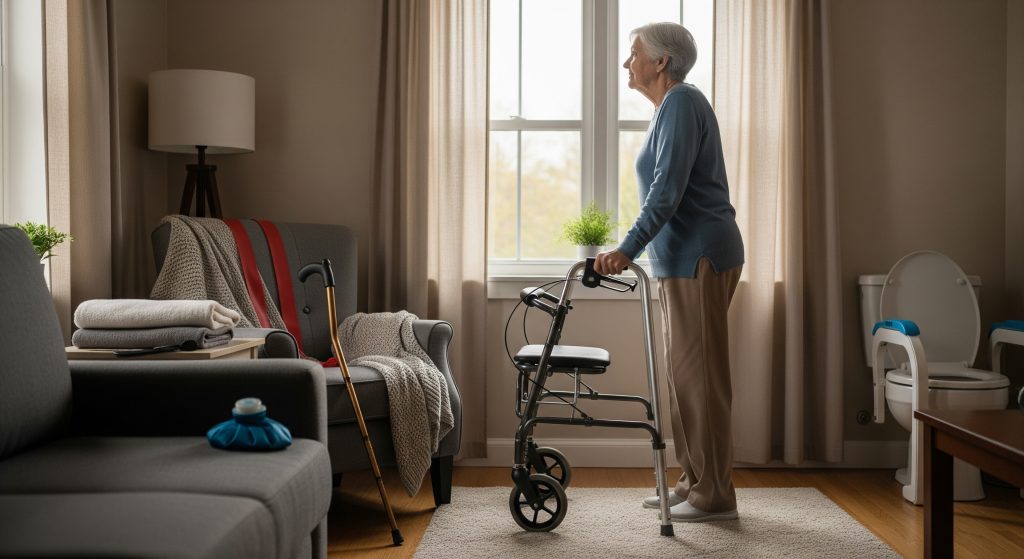
Falls during recovery can be catastrophic. Preparing the home before surgery prevents avoidable disasters:
-
Remove loose rugs and electrical cords from walkways
-
Install grab bars in the shower and near the toilet
-
Arrange furniture to create clear paths wide enough for a walker
-
Place frequently used items at waist height (no reaching up or bending down)
-
Consider a shower chair and handheld shower head
-
Ensure adequate lighting, especially in hallways and bathrooms
A raised toilet seat sounds unglamorous but makes early weeks dramatically easier. Same with a reacher tool for picking items off the floor. Pride has no place in the first month of recovery.
Special Considerations for Elderly Patients
Modified Recovery Timeline for Seniors
Knee replacement recovery time for elderly patients extends at every stage. Where a younger patient might ditch the walker at week three, an older adult may use it for six weeks or more. Where full recovery might mean nine months for someone in their fifties, it could mean fifteen months or longer for someone in their seventies.
This isn’t failure. It’s physiology. Older muscles take longer to respond to exercise stimulus. Older bodies produce less collagen for tissue repair. Cardiovascular reserves are typically lower, meaning fatigue sets in faster during rehabilitation sessions.
What stays the same? The exercises themselves. The principles of progressive loading. The importance of consistency. Age modifies the timeline but not the roadmap.
Additional Support Requirements
Most elderly patients cannot manage the first two weeks alone. Having someone present – a family member, home carer, or friend – isn’t optional. They assist with medication management, meal preparation, help with showering, and most importantly, provide supervision during mobility practice when fall risk is highest.
Post-acute rehabilitation facilities (sometimes called step-down units) bridge the gap between hospital and home for patients who need more support than family can provide but don’t require hospital-level care. Insurance coverage varies, but the option is worth discussing with the surgical team.
Physiotherapy may need to be conducted at home initially if travelling to a clinic is impractical. Many services offer home visits for the first weeks post-surgery, transitioning to outpatient sessions once mobility improves.
Common Complications in Older Adults
Certain complications appear more frequently in elderly patients:
|
Complication |
Why It’s More Common |
Prevention Strategy |
|---|---|---|
|
Blood clots (DVT/PE) |
Reduced mobility, vascular changes with age |
Blood thinners, compression stockings, early mobilisation |
|
Delirium |
Anaesthesia sensitivity, disrupted routines |
Familiar faces, minimising sedatives, maintaining sleep-wake cycles |
|
Urinary retention |
Prostate issues in men, medication effects |
Monitoring output, catheter if necessary initially |
|
Prolonged stiffness |
Pre-existing arthritis, slower tissue healing |
Aggressive physiotherapy, patience |
None of these are inevitable. Awareness allows preparation. Older patients who know these risks can work with their medical team proactively.
Adapting Exercises for Limited Mobility
Standard knee replacement recovery exercises assume a baseline level of fitness that not all elderly patients possess. Adaptations maintain the principles while accommodating limitations:
Chair-based exercises replace standing work when balance is poor. Assisted standing transfers use armrests rather than requiring independent rising. Range of motion work happens lying down before progressing to seated positions. Exercise bands provide resistance without requiring heavy weights or gym equipment.
The guiding principle is: something beats nothing. An older patient who can only manage five heel slides per session is still progressing. Small consistent efforts compound over months. Recovery isn’t a sprint for anyone, and it’s certainly not a sprint for seniors. But they get there.
Conclusion
Knee replacement recovery time defies the neat timelines people want. It’s not six weeks. It’s not even six months for many. It’s a longer journey that rewards patience, consistency, and realistic expectations far more than aggressive pushing or wishful thinking.
The stages are predictable even if the exact timing varies. Early weeks focus on basic mobility and wound healing. Intermediate months build strength and confidence. Later months return function and normalcy. Throughout it all, knee replacement recovery exercises remain the engine of progress, and knee replacement recovery tips around pain management, nutrition, and safety prevent unnecessary setbacks.
For elderly patients, the timeline stretches but the destination remains the same: a functioning knee that removes the pain and limitation that made surgery necessary in the first place. That outcome is achievable. It simply requires understanding what “recovery” actually means – and accepting that the twelve-month mark is often just the beginning of enjoying the new joint fully.
Frequently Asked Questions
How long before I can walk without assistance after knee replacement?
Most patients transition from a walker to a cane around week three to four and walk independently by week six to eight. However, knee replacement recovery time for elderly patients may extend this timeline to ten or twelve weeks. The key factor is quad strength – once the muscle can reliably support the joint, aids become unnecessary.
When can I drive after knee replacement surgery?
For left knee surgery with an automatic vehicle, driving often returns by week four to six. Right knee surgery requires longer – typically six to eight weeks minimum – because the right leg operates the brake and accelerator. Reaction time must be tested (and cleared by your surgeon) before resuming driving.
What activities should I permanently avoid after knee replacement?
High-impact activities accelerate implant wear. Avoid running, jumping sports, and activities with sudden pivoting or direction changes. Contact sports are permanently off the table. Kneeling becomes uncomfortable for many patients and is best avoided. Golf, cycling, swimming, walking, and most gym work remain perfectly acceptable lifelong.
Is recovery different for partial versus total knee replacement?
Yes, generally partial replacement recovery is faster. Because less bone is removed and fewer ligaments are affected, early mobility improves more quickly and hospital stays are often shorter. However, long-term recovery timelines are similar – both procedures require dedicated rehabilitation and patience before full function returns.
How do I know if my recovery is progressing normally?
Track flexion range (your physio should measure this regularly), pain levels (which should trend downward over weeks), and functional milestones (walking distance, stair ability, independence in daily tasks). If any of these stall for more than two weeks despite consistent exercise, discuss with your surgical team. Some plateaus are normal; prolonged ones need investigation.
Can I speed up my knee replacement recovery time?
Within limits. Consistent, daily physiotherapy attendance accelerates progress. Optimal nutrition supports tissue healing. Adequate sleep allows recovery between sessions. Avoiding setbacks (falls, infections, overexertion) keeps momentum going. But there’s a ceiling – biology can’t be rushed past a certain point. The best predictor of good recovery is consistent effort rather than heroic intensity.

